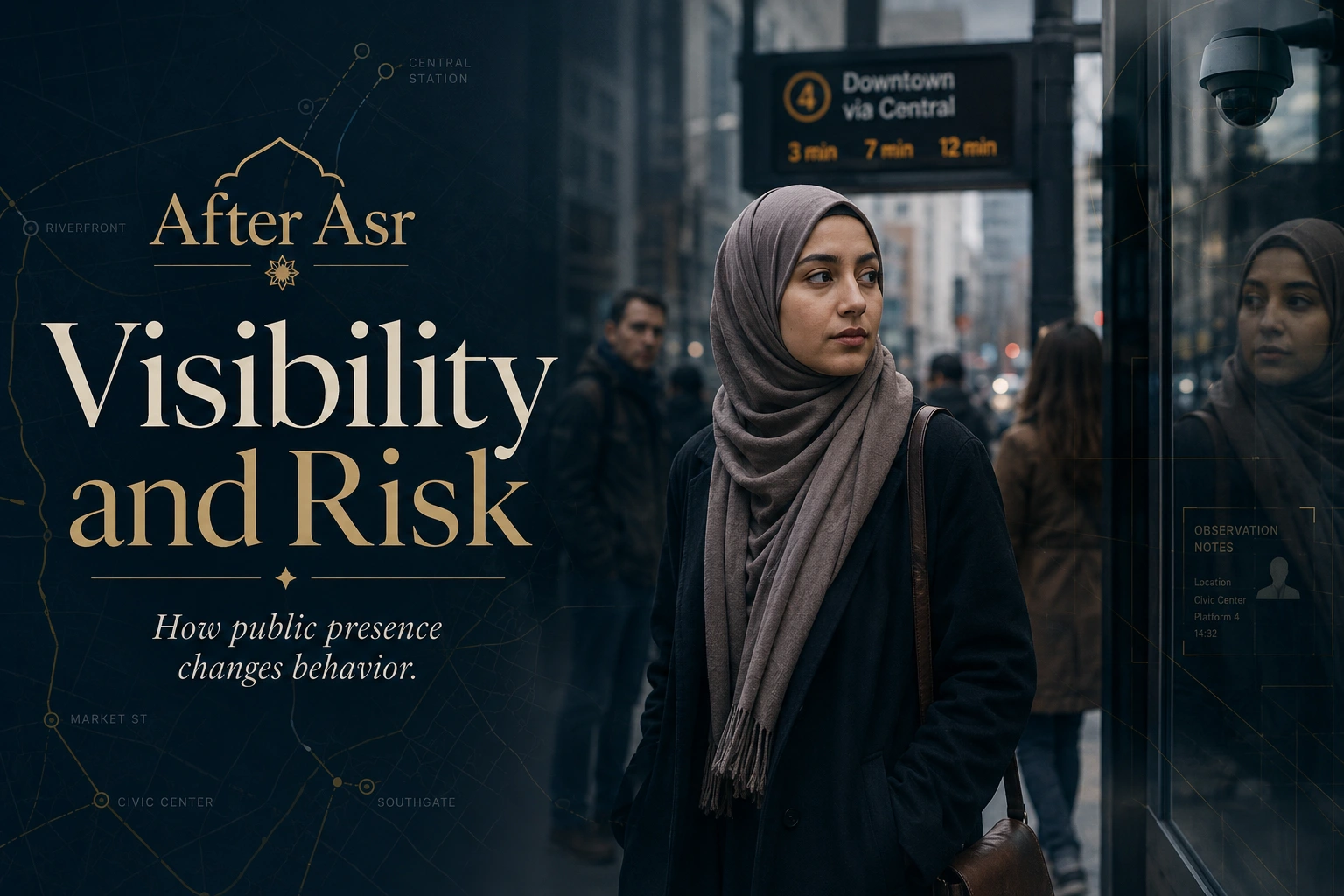
How public presence changes behavior.
Visibility is not always freedom.
Sometimes, it is exposure.
To be visible is to be seen, recognized, and able to participate openly in public life. For many Muslims, visibility can carry pride. A hijab, a kufi, a beard kept for religious reasons, an abaya, a thobe, a prayer mat in a quiet corner, a Muslim name spoken without alteration, a mosque dome rising over a neighborhood, these can all express belonging rather than apology.
But visibility can also change the way a person moves through the world.
It can make someone more alert in a parking lot, more cautious on public transit, more selective about where they stop for gas, more measured in a workplace conversation, more aware of the room after a breaking-news alert. It can produce a quiet calculation that others may never have to perform:
How Muslim do I appear here, and what might that cost me?
That calculation is not imaginary. Research continues to find that visible Muslim identity can be associated with greater experiences of discrimination, and recent work on hijab-wearing Muslim women describes the “invisible work” of adjusting behavior, appearance, and movement in public spaces to manage safety and perception.
The Difference Between Being Present and Being Read
Every person in public is visible in some sense. But not everyone is interpreted in the same way.
A person walking into a store may be seen as a customer. A Muslim woman in hijab may be seen as a customer, but also as a religious symbol, a cultural question, a political assumption, or a target for someone else’s resentment. A Muslim man with a beard and traditional clothing may enter the same space carrying no intention other than buying coffee, yet still find himself read through a national-security imagination he did not create.
This is what makes Muslim visibility complicated. It is not merely being noticed. It is being read.
Visible Muslim identity can become a shortcut for other people’s fears, stereotypes, or political frustrations. The individual is still physically present, but public perception adds a second presence beside them: an imagined Muslim, assembled from headlines, arguments, suspicions, and inherited narratives.
The person must then move through both realities at once.
Visibility Creates a Second Awareness
Many Muslims learn to watch themselves being watched.
They notice who is staring. They register changes in tone. They assess whether a joke is about to become uncomfortable. They hear the news in the morning and wonder whether public interactions will feel different by afternoon. They become alert not only to what they are doing, but to how what they are doing may be interpreted.
A 2026 study of hijab-wearing Muslim women in East London describes this as a form of identity management: women reported adapting their behavior in public spaces to appear especially polite, nonthreatening, and socially reassuring in environments where they felt they might otherwise be read with suspicion. Nineteen of the twenty-two interviewees discussed changing their public behavior in this way.
That kind of adjustment is easy to miss from the outside. No rule requires it. No one may directly demand it. Yet it becomes part of the mental routine of public life.
Smile a little sooner.
Avoid looking irritated.
Do not respond too sharply.
Keep the phone away on the train.
Choose the busier sidewalk.
Notice who is behind you.
Think twice before speaking Arabic loudly.
Think twice before discussing politics at work.
This is not paranoia. It is learned social caution.
When Clothing Becomes Risk Assessment
For many Muslims, visibility is tied to dress. That makes clothing more than personal presentation. It can become part of a safety calculation.
A woman who wears hijab may decide whether to travel alone at night, whether to take a particular train, whether to visit an unfamiliar town, whether to enter a tense public setting, or whether to remove or alter visible markers of Muslim identity in moments of heightened public hostility. This does not mean every hijab-wearing woman experiences public life the same way. Experiences differ by race, class, geography, age, confidence, community, and personal history. But the pressure itself is well documented.
A 2024 national study of American Muslim women found that those who wore hijab more frequently were more likely to report religious discrimination in the prior year. A separate study of British Muslim students found that those with more visible signs of Muslim faith reported greater discrimination, with perceived discrimination also positively associated with psychological distress.
This creates a painful tension. A visible religious practice may be spiritually grounding, personally meaningful, and freely chosen. Yet the public response to that visibility can impose a cost the person did not choose.
The question is not whether Muslims should retreat from visibility. The question is why visible Muslimness is made to feel risky in the first place.
Public Presence Can Become Strategic
When a community learns that visibility changes how it is treated, public presence may become strategic.
Some people respond by minimizing visibility. They avoid religious clothing in certain settings. They shorten names on job applications or in customer-facing roles. They avoid political speech that might be perceived as confirming a stereotype. They hesitate to attend protests, speak at public meetings, or ask for accommodations because they do not want to appear “difficult” or attract scrutiny.
Others respond in the opposite direction. They become more visibly Muslim, not less. They choose bold hijabs, unapologetic names, public prayer, community organizing, open advocacy, and civic presence as acts of dignity. Visibility becomes refusal. It says: I will not disappear to make others comfortable.
Researchers have described Muslim visibility as both a source of vulnerability and a site of recognition, negotiation, and resistance. Studies of Muslim organizations and public discourse show that communities often work to reclaim visibility rather than accept its framing as a social problem.
These responses are not contradictory. They are different answers to the same pressure.
One person seeks safety through quietness.
Another seeks dignity through openness.
Both are responding to a society that has made visibility consequential.
The Risk of Being Mistaken for a Statement
Visible Muslims are often treated as if their presence itself is communicative.
A woman in hijab is not simply wearing what she wears. She is assumed to be making a statement about feminism, integration, politics, or modernity. A man praying in an airport is not simply fulfilling a religious obligation. He may become a spectacle. A mosque expansion is not simply a local zoning matter. It can become a referendum on national identity.
In this environment, Muslim visibility is burdened with symbolism.
Ordinary presence is elevated into public meaning, often without consent. The Muslim person becomes legible not as a whole individual, but as a symbol onto which others project questions they are already debating.
This is one of the central harms of hypervisibility. It does not only make people more noticeable. It makes them less free to be ordinary.
Scholars writing on Muslim visibility describe how public discourse in Western societies has often treated visibly Muslim identity as excessive, politically charged, or socially disruptive, particularly in the post-9/11 period.
Visibility After Public Crisis
The risks of public presence can intensify during periods of geopolitical conflict, terrorist violence, or highly charged national debate.
After major events involving Muslims or Muslim-majority regions, ordinary Muslims may experience a sudden change in atmosphere. People who were indifferent the day before become curious, suspicious, accusatory, or overly attentive. Public spaces feel less neutral. The Muslim body carries the news cycle into the grocery store, the classroom, the workplace, the airport, and the sidewalk.
This pattern has been reported across countries. In Australia, for example, a 2025 investigation described Muslim women changing commuting habits and public behavior amid a sharp rise in reported anti-Muslim incidents after October 7, 2023. The Islamophobia Register Australia reported a 530 percent increase in incidents during that period, with women comprising roughly three-quarters of reports.
The specific national context differs, but the mechanism is familiar: distant events produce local consequences for visibly Muslim people who had no role in causing them.
The public gaze tightens.
Risk Changes Speech Too
Visibility is not only visual. It can also shape what people feel safe saying.
A Muslim employee may avoid discussing Palestine, foreign policy, civil liberties, or religious discrimination out of concern that their words will be received differently than a colleague’s. A student may hesitate before joining a campus organization. A parent may choose not to challenge a school decision because they fear being labeled confrontational. A community member may self-censor not because they lack conviction, but because public expression feels costly.
Research and survey work on Islamophobia has documented Muslim self-censorship and the ways surveillance, suspicion, and discrimination can shape civic and social engagement.
That matters because public participation is not truly equal when some people must constantly weigh whether visibility will be punished.
A society may formally guarantee speech while informally making some communities think twice before using it.
The Emotional Cost of Constant Calculation
The practical adjustments of visible Muslim life can be easy to describe. The emotional cost is harder.
It is tiring to move through ordinary spaces with an extra layer of situational awareness. It is tiring to scan for danger. It is tiring to wonder whether a stare is meaningless or meaningful. It is tiring to decide, repeatedly, whether a place feels safe enough, whether a conversation is worth having, whether one’s clothing will attract trouble, whether one’s irritation will be misread.
This burden does not always present as fear in the dramatic sense. Sometimes it appears as fatigue.
The Muslim person still goes to work, attends school, shops, travels, advocates, worships, and builds a life. From the outside, nothing may seem restricted. But inside those activities, there may be hundreds of micro-decisions shaped by the knowledge that visibility changes risk.
The body learns routes.
The mind learns atmospheres.
The self learns caution.
That is a cost.
Not All Visibility Is Vulnerability
It is important not to write about Muslim visibility only as harm.
Visible Muslim life is also beautiful, communal, and powerful. A crowded Eid prayer in a public park. A mother and daughter in matching hijabs. A Muslim student association tabling openly on campus. A restaurant owner advertising halal food without explanation. A masjid’s calligraphy visible from the street. A convert wearing a kufi for the first time with quiet joy.
Visibility can deepen belonging. It can help younger Muslims see a place for themselves. It can normalize what prejudice tries to mark as foreign. It can turn isolated individuals into a visible community.
The issue is not Muslim visibility itself.
The issue is the social condition that makes visibility feel like a gamble.
A healthy society does not ask minorities to disappear for safety. It ensures that they can appear fully without undue risk.
The Unequal Freedom to Be Unremarkable
One of the privileges of belonging is the freedom to be unremarkable.
To walk into a room without representing a religion.
To dress without becoming a public debate.
To speak without one’s tone being interpreted through stereotype.
To travel without one’s body seeming politically relevant.
To be annoyed, distracted, joyful, or quiet without any of those states being read as evidence of something larger.
Visible Muslims are often denied that ease.
They may be fully present in public life, yet not fully released from public interpretation. Their ordinary actions remain overread. Their appearance remains legible in ways others’ appearances do not.
The question is not whether Muslims can handle being seen. They have been seen, and they continue to show up.
The question is why being seen should require so much management.
What Solidarity Looks Like in Public Space
Reducing the risk attached to Muslim visibility requires more than telling Muslims to be brave.
It requires other people to change how they behave when visible Muslimness enters a space.
Do not stare as though a headscarf is a disruption.
Do not let a joke pass because addressing it feels awkward.
Do not ask a visibly Muslim stranger to satisfy personal curiosity on demand.
Do not interpret religious dress as a statement about your own values.
Do not make Muslims perform reassurance before receiving ordinary trust.
Institutions matter too. Schools, employers, transportation systems, universities, and public agencies need to understand that safety is not merely the absence of assault. It also includes whether people can move, speak, and appear in public without constant anticipatory self-protection. Recent research on public space argues precisely for broader definitions of safety that take minority experiences seriously rather than reducing security to physical design alone.
Solidarity begins by refusing to make someone else’s visibility heavier than it already is.
Conclusion
Visibility and risk should not belong together.
Yet for many Muslims, especially those whose faith is easily read in public, they often do. Public presence can change behavior: where people go, what they wear, how they speak, how alert they remain, and how much of themselves they feel free to reveal.
This is not simply a matter of individual confidence. It is a social condition. When a society repeatedly treats Muslim visibility as suspicious, symbolic, or politically charged, Muslims learn to navigate the world accordingly.
Some retreat.
Some resist.
Many do both at different times.
But none should have to calculate their safety simply because their faith can be seen.
A public life worthy of the name must make room not only for Muslim existence, but for Muslim ease.