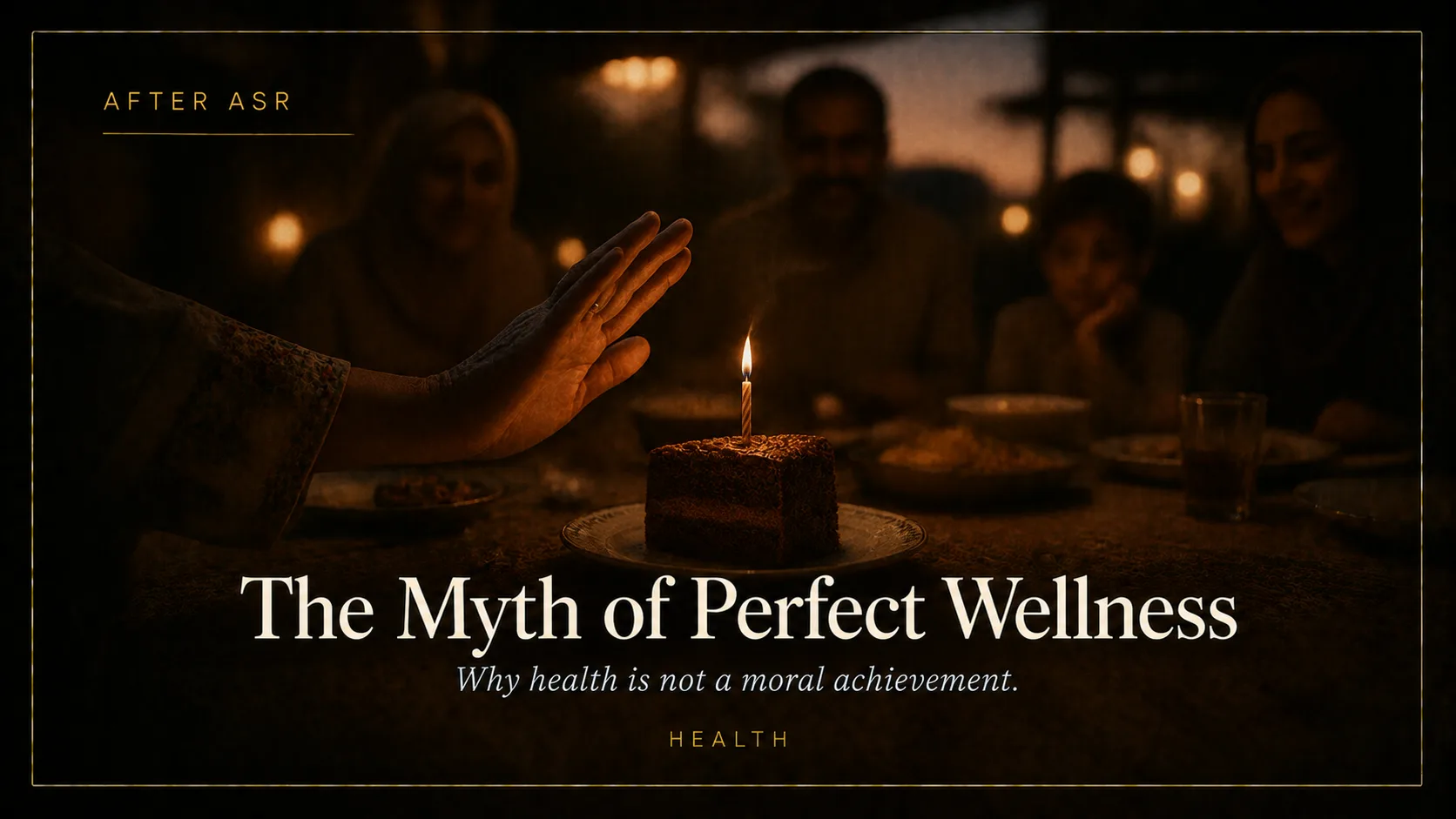
At a birthday table last spring, a friend waved the cake away. “I have been so bad this week,” she said, and the whole table laughed and nodded, because we all knew the liturgy by heart.
Bad. As if a slice of cake were a small sin. As if her worth could be weighed out in sugar and found wanting.
I have been thinking about that one word ever since.
We Turned Health Into a Religion
Somewhere in the last few decades, health stopped being a condition and became a creed. It grew commandments, saints, and sins. It grew a priesthood of influencers and a confessional built out of food diaries. We do not simply try to feel well anymore. We try to be good at being well, and we measure our goodness by it.
This is a quiet spiritual mistake, and it wears the clothing of virtue, which is what makes it so hard to see. When wellness becomes a religion, the healthy become the righteous, and the sick become the fallen. And that arrangement is not only false. It is unkind, and it wounds the very people already carrying the most.
The New Language of Purity
Listen to how we talk about food now. We eat clean, as if other food were dirty. We cleanse and we detox, words borrowed straight from the vocabulary of sin and repentance. We call sugar poison and call kale a virtue. We speak of guilty pleasures, as though pleasure required a defense in court.
This is purity language, and purity language always sorts people into the clean and the unclean. It was doing quiet harm long before it reached our kitchens. When a plate becomes a test of purity, every meal becomes a small trial, and the person eating becomes either righteous or ruined by lunch.
Wellness Was Never Free
The gleaming version of health we are sold has a price tag, though the advertisement hides it. Organic produce costs more. Trainers and clean kitchens and quiet mornings for yoga cost more, in money and in time. The unbroken sleep costs a job that does not run through the night.
So when we treat wellness as a moral achievement, we are often, without meaning to, praising people for their advantages. We are handing halos to the well-rested and the well-resourced. The single mother on two shifts is not less virtuous than the man with the standing desk and the meal plan. She simply has less of what the myth demands, and the myth never once asks why.
Health is not distributed evenly, and it never has been. Some neighborhoods have no grocery store within a bus ride, only the corner shop and its bright rows of the cheapest calories. Some jobs break the body slowly and pay too little to repair it. To then moralize the outcome, to praise the thriving and pity the struggling, is to mistake a map of privilege for a map of virtue. The two have never been the same map, though the powerful have always found it convenient to pretend they were.
What the Body Did Not Choose
So much of health was decided before we had any say in it. The genes we carry. The air of the neighborhood we were born into. The illnesses that run quiet in a family, waiting. The body that came with a strong back or a fragile one, a steady heart or an anxious one.
None of this was earned, and none of it was chosen. To praise a person for health they were largely handed is like praising them for their height. And to blame a person for illness they did not invite is a cruelty dressed up as concern. The body arrives with a history already written into it, and grace means reading that history without judgment.
I have sat with women who did everything right and got sick anyway, and with men who abused every rule and stayed stubbornly well into old age. The body does not keep the tidy moral accounts we wish it would. It follows its own logic, much of it invisible, much of it decided long before we could weigh in. Once you have watched this closely enough, the whole architecture of blame begins to look not only unkind but foolish, a child’s theory of justice imposed on a mystery far larger than the child.
The Halo Around the Healthy
We have decided, without quite saying it, that the fit body signals a disciplined soul. The lean figure reads as proof of willpower, restraint, and moral seriousness. We look at a healthy person and quietly assume they have their whole life in order.
But the body is not a transcript of the soul. Plenty of disciplined, generous, God-fearing people live in bodies that will never photograph well. Plenty of selfish people are lean. The halo we hang above the healthy is a trick of the light. It confuses a physical state with a spiritual one, and in doing so it flatters some people who have not earned it and shames others who deserve none of it.
The Suspicion We Cast on the Sick
The cruelest edge of this myth falls on the ill. If health is a moral achievement, then sickness must be a moral failure. And so the unwell are quietly interrogated. What did you eat. Did you try harder. Did you bring this on yourself somehow.
I have watched people with serious illness perform wellness for their visitors, exhausting what little they had left to seem like good patients. They apologize for their own bodies. They manage the comfort of the healthy in the room. No one should have to defend their diagnosis in a courtroom that never should have convened. Sickness is not a sentence handed down for a crime.
You Cannot Shame a Body Into Health
Underneath the whole myth lies a stubborn and mistaken belief: that shame is a medicine. That if we judge the body harshly enough, it will finally straighten up and behave. That contempt is a form of motivation, and cruelty is a form of care.
It has never once worked that way. Shame does not produce health. It produces hiding. The shamed body eats in secret, skips the appointment it dreads, and avoids the mirror and the doctor alike. Fear is a poor physician. I have watched people improve, slowly and truly, only after someone finally spoke to them with kindness instead of judgment. The body, it turns out, heals better in warmth than in cold. It always did. We simply preferred the satisfying feeling of judgment to the slow patience of mercy.
Virtue Is Not a Blood Panel
Goodness does not show up in bloodwork. There is no test that measures patience, no scan that reveals mercy, no number on a chart for the quiet kindness a person shows when no one is watching. The things that actually make a life good are invisible to every instrument in the clinic.
Yet we have let the clinic’s numbers stand in for our worth. We read our own value off a scale in the morning and let it set the weather of the day. I want to say this plainly, because someone needs to hear it today: your character is not in your cholesterol. Your soul is not on the panel.
The Table Turned Into a Confessional
Watch what happens at a shared meal now. Someone eats the bread and feels they must explain. Someone declines the dessert and is congratulated, as if for an act of moral courage. The table, which is meant to be a place of welcome and ease, has become a confessional booth where we account for our appetites.
My grandmother would not have understood this. At her table, to refuse food was closer to an insult than a virtue. Eating what was offered was how you honored the hands that cooked it. A table is a place of hospitality and mercy. It was never meant to be the room where we stand trial for being hungry.
The Guilt That Passes From Mother to Child
Food-shame is inherited, handed down at the family table like a recipe no one meant to keep. A mother who learned to fear her own body teaches that fear to a daughter without a single lesson, simply by living it in front of her. The child learns to read a plate as a moral document before she can spell.
I think often about what our children absorb while we narrate our diets aloud. They hear that some foods are bad, and they are not far behind in deciding that some bodies are bad, and that theirs might be one of them. We can break this quietly. We can eat without apology in front of them. We can call food good because it is warm and shared, not because it is virtuous. We can let a child grow up believing her body is a home and not a project she was born already behind on.
When Discipline Quietly Becomes Vanity
There is real good in caring for the body, and I do not want to dismiss the discipline it takes. But discipline has a shadow, and the shadow is vanity. The line is crossed the moment my care for my body becomes a way to feel superior to yours.
You can tell the difference by how it feels inside. Care is warm and quiet and asks nothing of anyone else. Vanity is anxious and comparative and always keeping score. When a healthy habit starts to make you look down on other people, it has stopped serving your body and started feeding your ego, and the ego is a far hungrier thing than the stomach ever was.
The Moderate Middle
My faith warns, again and again, against extremes, even extremes in worship. The Prophet, peace be upon him, gently corrected those who would fast every day and never sleep and abandon their families for devotion. He pointed them back toward the middle, toward balance, toward a life that included rest and food and people and joy.
If the tradition guards us against extremes even in prayer, how much more in kale and cardio. The pursuit of perfect wellness is often just extremity wearing a health halo. The moderate middle is not a failure of ambition. In the wisdom I was raised on, it is the path itself, the straight and walkable road.
Real Piety Is Quieter Than a Smoothie
The most genuinely healthy people I have known did not announce it. They were not documenting their meals or narrating their runs. They ate well and moved often and slept enough, and then they went on to the actual business of their lives, which was other people.
Real care for the body is quiet. It does not need a witness. The moment wellness becomes a performance, a thing to be seen and admired and posted, it has left the territory of health and entered the territory of pride. And pride, my tradition teaches, is the one sickness that always insists it is a form of health.
Health Is Partly a Gift, Not a Grade
Every morning I can rise and move without pain is a gift I did not manufacture. I can steward it, and I should. But I did not earn my working knees the way I earn a wage. They were given, and they can be taken, and no amount of virtue guarantees I keep them.
This is the truest reframe I know. Health is not a grade you are awarded for good behavior. It is closer to a gift you are handed for a time and asked to hold with gratitude. Gifts are received with thanks, not with pride. And the right response to a gift is never to look down on those who were given less.
When I remember this, my whole relationship to my body softens. I stop standing over it like a supervisor with a clipboard, and I start walking beside it like someone grateful for the company. The gratitude does not make me careless. It makes me tender. And tenderness, I have found, is a far more durable reason to care for a body than fear or vanity ever were. Fear burns out. Vanity curdles. Gratitude simply keeps going, quiet and warm, for as long as the gift is here.
Compassion for the Unwell, Beginning at Home
If we could lay down the myth, we would treat the sick more gently. We would stop the quiet interrogations. We would bring the meal and turn the pillow and sit in the room without needing the ill to reassure us. We would let them simply be unwell, without moral commentary, without the burden of explaining.
And that mercy has to begin with the body you are living in right now. Speak to your own tired self the way you would speak to a sick friend. Not with contempt for what it cannot do, but with tenderness for what it carries. The compassion you extend outward is only ever as deep as the compassion you have first shown yourself.
Mercy Is the Missing Ingredient
For all its recipes and regimens, wellness culture leaves out the one ingredient the body needs most. Mercy. It offers discipline, tracking, restriction, and optimization, and it forgets entirely to offer gentleness. It is a kitchen full of tools and empty of warmth.
Yet mercy is not decoration on the side of real health. It is closer to the main dish. A body carried through life with kindness ages more gently than a body harangued. The nervous system settles under compassion and clenches under judgment, and it has been clenching for years in most of us. When I imagine a healthier way to live, I do not picture a stricter one. I picture a kinder one, where the body is spoken to like a beloved and not a defendant, and where mercy is finally allowed back into the room it was exiled from.
Well Enough Is Not a Lesser Virtue
I no longer aim for perfect wellness, and I have stopped apologizing for that. I aim for well enough, cared for, tended in the life I actually live. This is not settling. It is sanity, and I think it is closer to faith than the frantic pursuit ever was.
Well enough leaves room for cake at a birthday. It leaves room for a body that ages, tires, and sometimes simply fails, without reading any of it as a moral collapse. Well enough refuses to keep score. And a life that has stopped keeping score of its own goodness is, quietly, a far freer and more grateful life than the one that is always counting.
Lay Down the Scorecard
So the next time you wave away the cake, notice the word you reach for.
You were not bad. You are not good for skipping it.
You are a person, in a body, doing your best in the life you were given.
That was always enough.
Sit down. Eat if you are hungry.
Let the table be a place of mercy again.