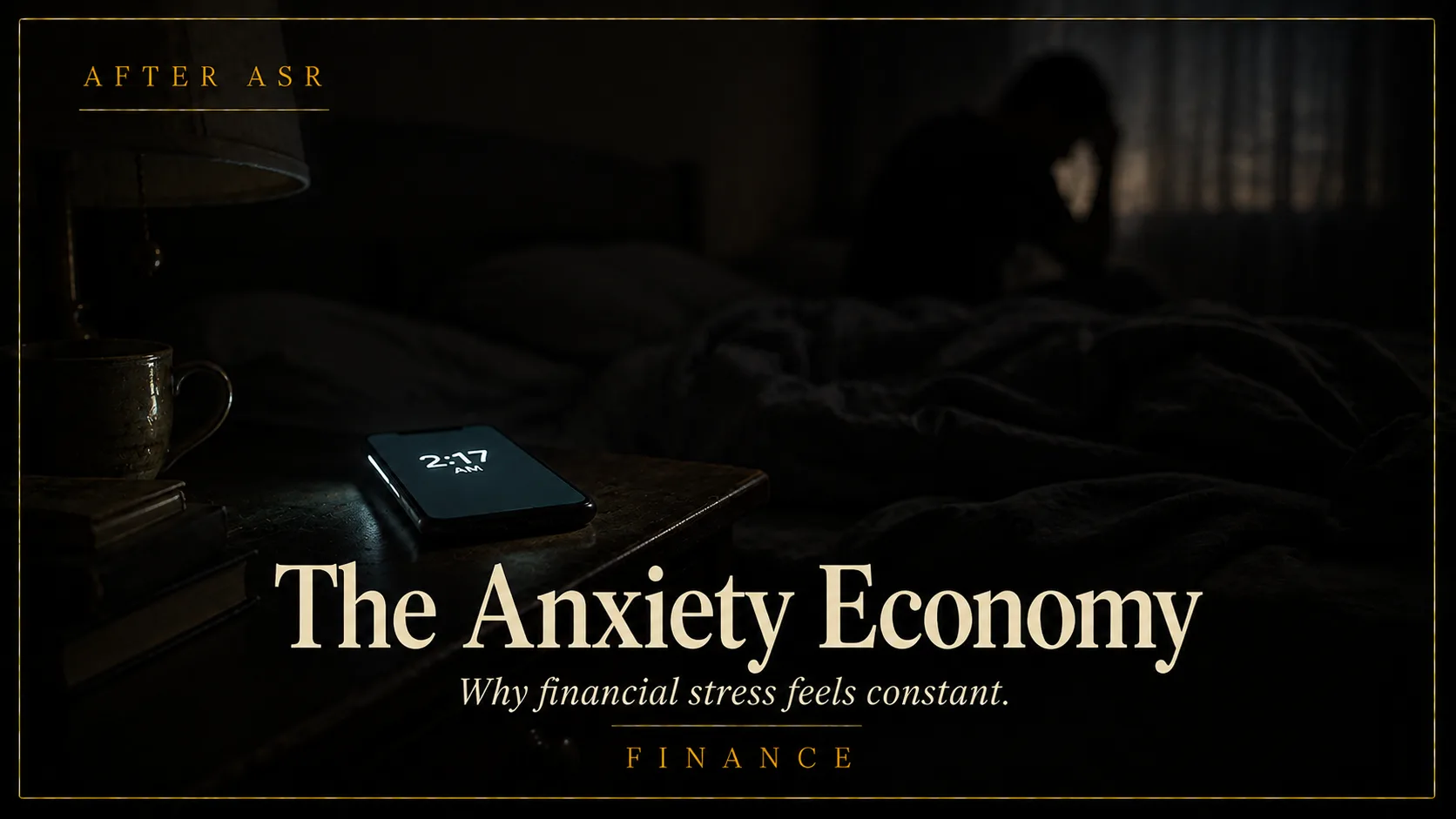
It is two in the morning and a man is refreshing a number that cannot change until nine thirty.
The markets are closed. He knows they are closed. The glow of the phone lights a face that has done this every night for a week, pulling downward on a screen like a man pulling a lever.
Nothing is wrong, exactly. Nothing has to be.
Financial anxiety no longer waits for financial events. It runs continuously now, a background hum under ordinary lives, and the hum has gotten louder every year of my adult life. This essay is about why. Not why money worries exist, which is obvious, but why they never seem to turn off, which is not.
Alarm Without a Storm
Distinguish two experiences that wear the same clothes.
The first is fear with an address: a layoff notice, a transmission failure, a bill that outweighs the account. Painful, but shaped. It arrives, it is dealt with or endured, and it ends.
The second has no address. It is a permanent low-grade alert, a sense of financial endangerment that persists through raises, through savings milestones, through good news of every kind. People describe reaching goals they had chased for a decade and feeling the dread simply re-aim itself, undiminished.
The first experience is as old as harvests. The second is newer, and its constancy is the clue worth following. A signal that never varies with circumstances is not reporting on your circumstances. Something else is generating it, and that something has suppliers.
I have sat with men who carried both kinds in one chest: a real bill, and a bottomless dread. Solving the bill barely dented the dread. That gap between the problem and the feeling is where this essay lives.
Somebody Profits From Your Pulse
Here is the uncomfortable center of the matter: your financial unease is a revenue stream, and not accidentally.
Media companies learned long ago that a calm reader closes the app, while a worried one keeps scrolling. Advertisers pay for the scrolling. Entire categories of content exist to keep the economic sky perpetually falling, because falling skies hold attention through the commercial break.
The wellness industry monetizes the same nerve from the other side, selling courses, subscriptions, and systems to cure the worry its neighbors manufacture. One industry rings the alarm. Another sells earplugs. Both invoice you.
I do not say this to breed conspiracy thinking. Nobody in particular designed the machine. It assembled itself out of incentives, the way most machines do now. But once you see that your pulse is a product, you can stop volunteering it quite so freely.
Follow the incentives the way you would follow money in any deal. Ask of each alarming thing that reaches you: who benefits if I stay worried. The question does not cure anxiety. It reassigns its credibility.
The News Treats Every Day as an Emergency
Watch financial media with the sound off sometime, and just read the faces and the fonts.
Markets plunge, futures tumble, red arrows everywhere by ten, a modest recovery by two that no one covers with equal urgency. The words are weather words, catastrophe words, applied to fluctuations that a chart of twenty years renders invisible.
Here is a steward’s secret: on most days, markets simply breathe. In and out. The breathing is renamed drama because drama retains viewers, and a viewer who understood how ordinary today was would go do something better with his afternoon.
Notice, too, what never makes the segment: the index quietly doubling across a decade, the household that finished its last debt on a Thursday. Calm compounding is the most consequential story in finance, and it has never once been breaking news.
The old investors used to say that the market is a device for transferring money from the impatient to the patient. The coverage exists to manufacture impatience. Treat it accordingly, the way you treat a carnival barker: politely, briefly, and from a distance.
Your Apps Have Opinions About Your Mood
The instruments we carry are not neutral either, and it helps to say so plainly.
The retirement account you will not touch for thirty years displays a daily profit and loss, in red and green, as if you were a trader at a desk. The budgeting app pushes a notification because you bought groceries. The banking app badges its icon like a message from a friend, except the friend only ever brings unease.
None of this is information you needed. A thirty-year instrument measured in single days is a lie told with true numbers.
Professional traders need real-time data because trading is their trade. You are, statistically, not them. Dressing a household in a trading desk’s instruments is installing cockpit alarms in a family sedan.
The settings menu is a place of worship in this respect. Turn off what serves the app’s engagement rather than your stewardship. You are not obligated to attend every alarm your software wishes to hold.
Real Precarity Deserves Real Respect
Now a necessary honesty, before this essay floats off into breathing exercises.
Some financial anxiety is accurate. Wages in this country have chased costs for decades and lost repeatedly. Households run thinner margins than their parents did on similar work. Gig income wobbles by design, rent resets annually, and one billing code can reorganize a family’s entire year.
If that is your situation, your nervous system is not malfunctioning. It is reporting. The remedy for accurate alarm is not serenity content. It is margin, and the slow boring work of building it, which earlier essays in this column have walked through.
The anxiety economy’s cruelest trick is blending the two signals, selling manufactured dread to the comfortable while selling mindfulness to the drowning. Both customers needed something else entirely. Sorting your signal honestly is the first competent act.
Communities should hear this as assignment, not description. Anxiety that margin would cure is a zakat conversation waiting for a treasurer brave enough to start it.
Scarcity Thinking Shrinks the Mind
Researchers who study scarcity keep arriving at a humbling conclusion: worry about money consumes the very faculties needed to fix money.
A mind preoccupied with shortage loses a startling share of its capacity, they find, as if running a second job in the background. Planning suffers first. The horizon pulls in close, until only this week exists, and decisions that need a year’s view get made with a Tuesday’s vision.
This produces the tragic loop the payday industry feeds on. Stress narrows thinking, narrowed thinking chooses expensive relief, and the expense deepens the stress. None of the people in the loop are stupid. They are taxed.
The tradition anticipated the mercy in this finding. No soul is burdened beyond its capacity, scripture says, and capacity is precisely what shortage attacks. Be slower, then, to judge the frayed decisions of the stretched, including your own in the lean years.
Knowing this changes self-talk. The fog you feel when the numbers are bad is not a character reading. It is arithmetic doing damage, and every dollar of margin you build is cognition purchased back.
Urgency Is Almost Always a Salesman
Somewhere in your pocket right now, something is insisting that you act immediately. A rate that expires, a dip that must be bought, a coin that is leaving the station without you.
Apply the steward’s rule: urgency is a sales tactic until proven otherwise. Legitimate financial decisions almost never require an answer within the hour. The compounding that actually builds households works in decades and does not care which Tuesday you started.
Every mania of the past decade ran on the same fuel: the terror of watching neighbors get rich without you. The tradition has a phrase for wealth that arrives in a frenzy, and it is not a compliment. Haste, the Prophet observed, is from the devil, and deliberation from God.
The people selling speed need your adrenaline in the transaction. The moment you slow down, read the terms, and sleep on it, most of these offers die quietly of exposure. That is not a coincidence. It is a confession.
The Hustle Sermon Is Part of the Machine
The anxiety economy also runs a motivational wing, and it preaches daily.
Its doctrine is familiar by now. Sleep is for the unambitious. Every hobby should invoice someone. The man with one income stream is a cautionary tale, and rest is a character flaw confessed in public.
Hear how this lands on someone already worried about money: not as inspiration, but as indictment. The hustle sermon converts every quiet evening into evidence of failure. It is the same alarm as the news ticker, wearing a gym shirt.
The tradition apportions time differently. Surah An-Naba describes the night as covering and rest, and the day as the time for livelihood. Both halves are design, neither is weakness. The Prophet, peace be upon him, worked, rested, and kept nights for worship and sleep, and no generation ever accomplished more per lifetime.
Diligence is a virtue. A second job in a hard season is honorable. But grind as identity, worn like a badge, is the anxiety economy recruiting you as its own overseer. You were hired to steward a life, not to strip-mine one.
Tie the Camel, Then Stop Pulling the Rope
The tradition’s word for the missing posture is tawakkul, reliance upon God, and it is widely misfiled as passivity.
A man asked the Prophet, peace be upon him, whether he should tie his camel or trust in God. Tie it, came the reply, and trust. Effort first, then reliance, in that order, with no third stage in which you stand at the window all night watching the camel.
Modern financial anxiety is mostly third stage. The camel is tied. The budget exists, the fund grows, the insurance is paid. And the owner keeps checking the knot, hourly, because vigilance has become confused with virtue.
Tawakkul is the discipline of ending your shift. Do the assigned work, competently and honestly. Then hand the outcome back to the One who owns outcomes, and go to sleep. The knot does not improve from being watched.
The Prophet, peace be upon him, also taught morning and evening remembrances that seek refuge from anxiety and grief by name. The tradition expected these weathers. It packed for them.
What the Heart Was Promised
Surah Ar-Ra’d carries one of the most quoted promises in the Quran: in the remembrance of God, hearts find rest.
Notice what the verse claims and what it does not. It does not promise that circumstances calm down. It locates rest in a practice, available in any circumstance, portable across every tax bracket.
The five daily prayers, seen through a steward’s eyes, are scheduled interruptions of the anxiety economy. Five times a day, the phone goes down, the ticker disappears, and a person stands before the Owner of all provision and says: You are in charge, not the market, and not me.
The Quran also names the oldest sales pitch on record. Satan, Surah Al-Baqarah says, threatens you with poverty and commands what is shameful, while God promises forgiveness and abundance. Fear of poverty as a manipulation tool did not begin with cable news. It merely hired better graphics.
I will not pretend prayer is a financial plan. It is something prior to a plan: a recalibration of who carries what. The believer plans as seriously as anyone. He simply declines to carry the outcomes, because that weight was never assigned to him.
The Body Pays the Interest
Chronic financial stress is not an emotion. It is a physiology, and it bills the body on a schedule.
Sleep goes first, replaced by the two a.m. arithmetic that never once, in recorded history, improved a balance. Then the jaw, the stomach, the blood pressure. Physicians can track a bad economy through their waiting rooms without reading a single headline.
There is a bitter irony here. Health is the one asset that compounds in both directions and can never be repurchased at any price. Trading it for vigilance over money is selling the estate to guard the fence.
Our tradition counts the body among the trusts. It will testify, we are taught, about how it was used. Grinding it down over numbers that watching cannot change is not diligence. It is a slow embezzlement of the first wealth you were ever given.
An Emergency Fund Is Anxiety Medicine
If the anxiety economy sells alarm, the steward’s counterpurchase is margin, and it works better than anything in the app store.
A few months of expenses in a boring account performs a quiet miracle: it converts emergencies into inconveniences. The transmission still fails. The failure no longer reaches the nervous system, because the household absorbs it the way a mattress absorbs a dropped cup.
The behavioral evidence agrees with the grandmothers here. A cushion changes the mind before it changes anything else.
Build it slowly if slowly is what the season allows. The first few hundred dollars do disproportionate work, the way the first wall of a house changes the wind.
Notice that the medicine is unglamorous and one-time. Margin does not need optimizing, rebalancing, or daily review. It sits there, being sufficient, which is precisely the quality the anxiety economy cannot sell you, because sufficiency ends the subscription.
Decide on a Schedule, Not on a Feeling
Anxiety loves an open decision, so the steward’s move is to close them on a calendar.
Pick a monthly hour for the household money: bills reviewed, progress marked, adjustments made. Pick a quarterly hour for the long instruments. Outside those hours, the ledger is closed, the way a shopkeeper closes a shop, without apology and without checking the till from bed.
Automate whatever recurs. The transfer that happens by rule cannot be second-guessed at midnight, and every automated virtue is a worry retired.
Put the appointment where witnesses exist: a spouse at the table, a notebook that keeps minutes. Decisions witnessed in daylight have a way of staying decided after dark.
This cadence is not neglect. It is governance. Corporations review results quarterly precisely because more frequent steering produces worse driving. Your household deserves the same dignity: decisions made at the table, in daylight, by appointment, rather than in the glow at two in the morning.
Fast From the Feed
We fast from food one month a year and from information never, and the imbalance shows.
Run a modest experiment. Two weeks without financial media, market apps deleted from the phone, newsletters paused. Keep the monthly money hour; drop everything ambient. People who try this report the same sequence: agitation for three days, then a silence they had forgotten was available.
Nothing in the portfolio will notice your absence. That is the humbling discovery. The watching was never holding anything up.
Return afterward on your own terms, if you return at all. A steward needs information the way a farmer needs weather reports: a serious daily glance, not a livestream of every cloud. The clouds were never yours to steer. The field is.
The Household Thermostat
One more reason to take this seriously: financial anxiety is contagious, and children are the most efficient receivers in the house.
They cannot read a balance sheet, but they read faces fluently. They notice the tone that enters the kitchen when mail is opened, the argument conducted in pressurized whispers, the way a request for field trip money changes the air. Households teach money feelings years before they teach money facts.
Spouses set each other’s weather as well. One partner’s midnight refresh habit becomes the other’s insomnia by osmosis. De-escalation is a gift you give the entire floor plan.
This is not an argument for performing fake serenity. Children detect that too, and it unsettles them worse.
It is an argument for doing the real work, margin, cadence, tawakkul, because the temperature you actually reach is the one they will inherit. A parent at peace with enough is a curriculum no school offers.
Constant Was Never the Assignment
Return, at the end, to the man refreshing his phone in the dark.
The tradition he belongs to told him that provision was apportioned before he was born, that worry adds not one dirham to it, and that his Lord does not sleep and therefore he may.
The economy around him profits when he forgets all three.
He tied the camel. The camel is fine.
The number will still be there at nine thirty.
His heart was promised rest, and the promise still stands.
Vigilance was never the price of provision. It was only ever the price of forgetting who provides.