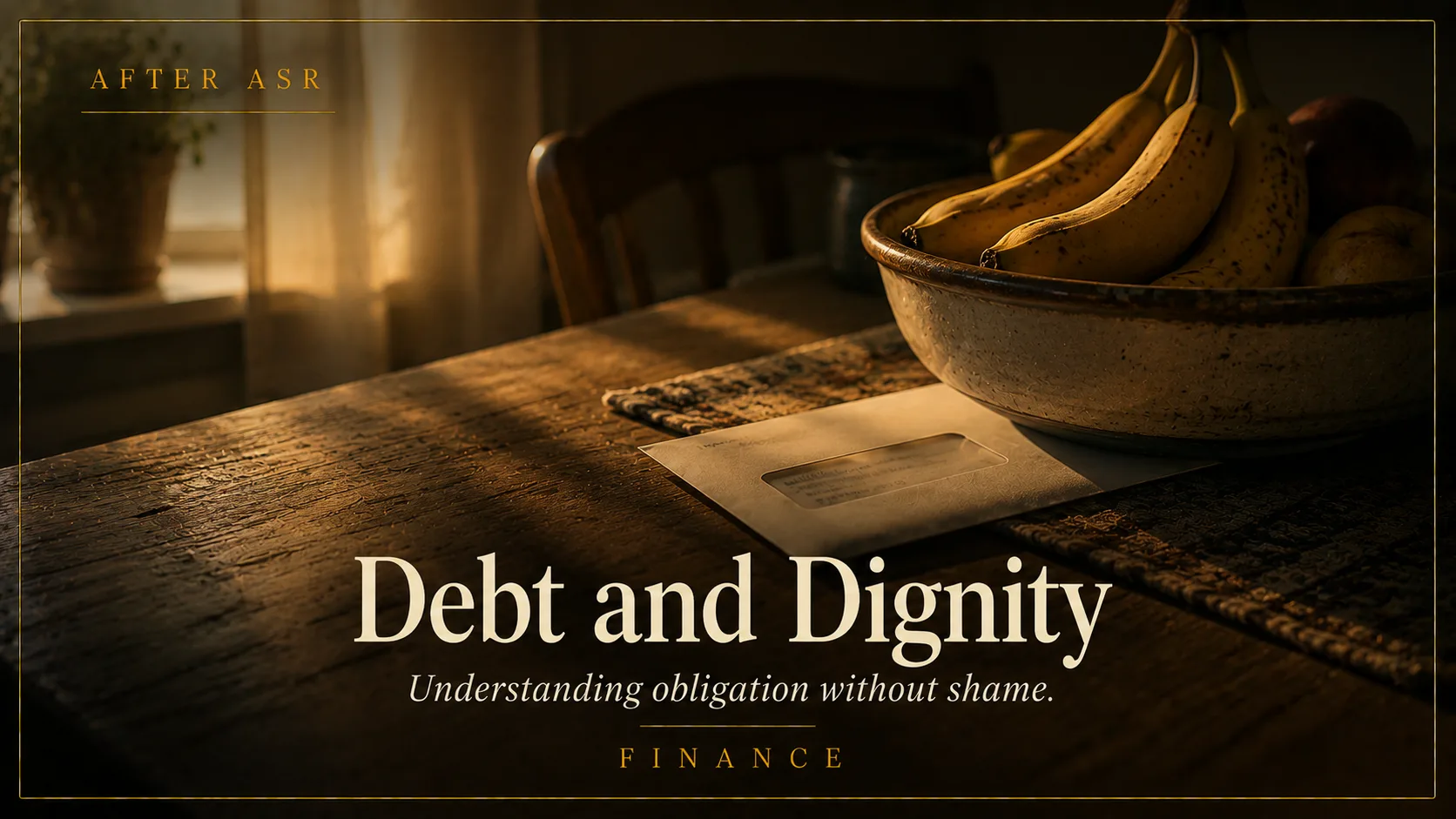
There is an envelope under the fruit bowl that has been there for eleven days.
The man who put it there is not lazy, and he is not a fool. He is a person who ran out of ways to make the numbers work, and the envelope knows it. So it waits under the bananas, radiating quietly, while he walks past it several times a day pretending not to feel the heat.
Millions of households have that envelope somewhere.
This essay is about debt: what our tradition actually says about it, which is more serious and more merciful than most of us have heard. The seriousness gets preached. The mercy mostly does not, and a community that teaches half a teaching should not be surprised when its people hide.
Debt Is Heavy on Purpose
Let us start where the tradition starts, with weight.
The Prophet, peace be upon him, sought refuge from debt in his prayers, regularly, by name. When asked why, he observed that a person in debt speaks and lies, promises and breaks. Debt bends conduct. He knew it the way a physician knows a disease.
There were moments when he declined to lead the funeral prayer for a man who died owing money that his estate could not cover, until someone stood and guaranteed the balance. Imagine the scene, and the lesson it fixed in everyone present. Obligations do not dissolve at death. Someone must still carry them.
Even martyrdom, the tradition warns, does not erase unpaid debt. The rights of people survive everything, because God may pardon His own claims while holding ours in escrow for us.
None of this was designed to humiliate borrowers. It was designed to keep borrowing serious in a community where lending needed to stay safe. A society that shrugs at repayment soon has no one willing to lend, and the poor lose first.
Weight Is Not a Verdict
Now the half that gets skipped: the same tradition that weights debt heavily treats the indebted person gently.
The weight belongs to the obligation, not to the person’s worth. Nowhere does the tradition rank the borrower as a lesser Muslim. The Prophet himself, peace be upon him, borrowed at times, and died while his armor was held by a lender as security for a debt. Borrowing, honestly undertaken and honestly carried, sat inside the best life ever lived.
Scripture normalized borrowing by regulating it in careful detail, with witnesses and written terms. Traditions do not draft procedure for acts decent people are never expected to perform.
This distinction rescues everything. A weight is something you carry, plan around, and set down at the end. A verdict is something you are. Households that hear debt as verdict stop opening envelopes, because every envelope reads as a sentence about their souls.
Hear it as weight instead. Weight responds to strategy. Weight can be shifted, shared, and scheduled. Nobody strategizes a verdict.
How Americans Actually Fall Into Debt
The sermon version of debt involves a man who wanted a boat. The data version looks different, and Muslims live in the data version.
The largest debts in American life arrive through doors nobody chose: the hospital visit coded into five figures, the degree the job market demanded and then declined to fully pay for, the layoff that outlasted the savings by four months. Rent rising faster than the wage beneath it does the rest.
Consumption debt exists, and essay after essay in this column argues against it. But precision matters, because shame aimed at the wrong target does not reform anyone. It just teaches the injured to hide their injuries.
Run an honest census in any congregation and the pattern holds. The man beside you at Jumu’ah is far likelier to be carrying a hospital bill than a jet ski. Preach accordingly.
If your debt came through one of those unchosen doors, hear this clearly. You did not fail a test of character. You were billed for being alive in an expensive country, and the tradition has carried people like you before.
The Shame Spiral Is the Real Emergency
Watch what shame does to a debt, mechanically.
The ashamed borrower stops looking. Statements pile unopened, calls go unanswered, and the balance grows in the dark, because balances love the dark. Penalties stack on penalties. Options that existed at month two are gone by month eight.
Shame also isolates. The borrower tells no one, so no one helps. He sits in gatherings feeling like a fraud, smiling over a secret, and the secret compounds along with the interest.
Here is the reframe that changes outcomes: the debt is a problem, but the hiding is the emergency. Nearly every path out begins with the same unglamorous act. Open everything. Write every number on one page. The page will be ugly, and the ugliness is information. You cannot negotiate with a monster you refuse to measure.
If the page frightens you, recruit one witness: a spouse, a level-headed friend, someone who can sit beside arithmetic without flinching. Fear divides poorly. It loses half its size at the first sharing.
What the Quran Asks of Lenders
Before asking anything of borrowers, listen to what scripture demands from the other side of the table.
Surah Al-Baqarah instructs that if a debtor is in hardship, then postponement until ease. And to remit the debt as charity, the verse continues, is better still, if you only knew. That is scripture speaking to creditors, and it is not mumbling.
The Prophet, peace be upon him, told of a man who attained forgiveness for no reason except that he was easy on those who owed him, instructing his agents to overlook and give time. Heaven, in that account, was entered through leniency in collections.
Our tradition never romanticized lending as a favor beyond ethics. The lender holds power, and the tradition polices power wherever it finds it. If you are owed money by someone drowning, your conduct is also being recorded.
American Muslims mostly meet this teaching from the borrower’s chair, facing institutions rather than uncles. But many of us are owed as well: deposits, family loans, unpaid invoices. The verse does not check which chair you happen to prefer.
What the Tradition Asks of Borrowers
The borrower’s duties are equally specific, and none of them require shame.
First, intention. The Prophet, peace be upon him, said that whoever takes people’s wealth intending to repay it, God will repay on his behalf, and whoever takes it intending to waste it, God will destroy him. The moral hinge of a loan is set before the money moves.
Second, communication. The debtor who vanishes converts a financial problem into a betrayal. The debtor who calls first, names the shortfall, and proposes a schedule keeps the matter in the realm of commerce, where it belongs.
Third, repayment with grace. The Prophet repaid loans generously and said the best of people are the best in settling their debts. Paying back late and grudgingly is a double injury. Paying back promptly, with thanks, turns the whole episode into a record both sides can stand on.
Write It Down, Even With Family
The most quietly destroyed relationships in our communities are not destroyed by enemies. They are destroyed by undocumented loans between people who loved each other.
The Quran’s longest verse commands the writing down of debts, with terms and witnesses. Believers sometimes treat this as advice for strangers, then lend a brother-in-law five thousand dollars on a handshake. Three years later, two households remember two different agreements, and both remember them with total sincerity.
Memory is not a ledger. It is an advocate, and it works for its owner.
Write the amount, the schedule, and what happens if things go wrong, even when the borrower shares your last name. Especially then. The paper is not an insult to the relationship. The paper is armor around it, and scripture prescribed the armor first.
The Debts Nobody Calls Debts
While the page of numbers is out, add the obligations that never generate statements, because they are debts all the same.
The mahr promised at the nikah and then deferred into folklore is a debt. The couple hundred dollars a friend handed you in a bad month is another, even though both of you have politely stopped mentioning it. Add the zakat year that slipped past uncalculated, and the borrowed tool that quietly changed owners.
No collector will ever call about these, which is exactly why they are dangerous. Institutional debt harasses you into remembering. Personal and sacred debt relies entirely on your honor, and honor keeps no automatic reminders.
The old scholars would settle accounts before travel and before Ramadan, on the theory that meetings with God go better without outstanding balances. The practice survives anywhere somebody revives it. A list, an hour, a few uncomfortable messages. Cheap, compared to carrying it.
Debt Inside a Marriage
A special word about the debts spouses hide from each other, because there are more of them than any imam can count.
One partner carries a balance the other has never seen. A card opened quietly, a loan taken to cover a gap, a number that started small and grew teeth. The concealment always begins as protection. Why worry her. Why disappoint him.
But a marriage is a partnership of ledgers, and a hidden liability makes every shared decision a decision made on false information. The vacation, the house, the school: all priced against a balance sheet one partner knows is fiction.
The disclosure conversation is awful for one evening. The concealment is awful for years, and it converts discovery into betrayal. Choose the one evening. Most spouses, hearing the true number spoken at last, respond better than the hider ever predicted. It was the hiding they would not have forgiven.
Then set a standing rule for the future: no solo liabilities above an agreed number. The rule is not surveillance. It is two people agreeing that the balance sheet is a shared country with shared borders.
Talking to the People You Owe
Here is a practical truth the ashamed never learn: the entities you owe are mostly bored institutions, not wolves.
Hospitals negotiate. Utilities defer. Servicers hold entire departments for hardship cases, staffed by people who process them all day without gasping. The borrower who calls and says plainly, I cannot pay this as billed, what are my options, is not an embarrassment. He is a Tuesday.
Silence, by contrast, is expensive. Institutions escalate on schedules, and the schedule only pauses when someone speaks.
Make the calls with your one ugly page in front of you. Take names, write down every agreement, and confirm it in writing. This is not groveling. It is stewardship of a bad season, conducted with a straight back, and it routinely removes numbers that shame had assumed were carved in stone.
For the tangled cases, nonprofit credit counseling exists, and using it is no more shameful than hiring an accountant. Expertise is not a luxury of the rich. It is a tool of the serious.
A Way Out Has a Shape
Climbing out of debt is slow, but it is not mysterious. The shape is old and boring, and boring is a compliment in finance.
Stop the bleeding first: no new borrowing, however clever the offer. Then the page of numbers, every balance and its rate, in daylight. Then a sequence. Some minds need the smallest debt gone first for the morale of a closed account. Others go at the costliest rate first because arithmetic says so. Both work. The one that works is the one you continue.
Automate the payments so that virtue does not depend on mood. Sell what deserves selling. Add income where sleep allows.
Guard the exits too. The month a debt dies is the month the lifestyle lobby returns with suggestions. Retire the old payment into savings before it learns new habits.
Expect the middle to be dull. There is a long stretch where nothing visible changes, and households quit in that stretch daily. Mark progress somewhere you can see it, and let the line on the paper be the celebration.
The Long Debts Ask for a Different Posture
Some obligations are measured in decades, and they require a marathoner’s psychology rather than a sprinter’s.
A person can white-knuckle a credit card for eighteen months. Nobody white-knuckles anything for twenty-five years. The long debts, the degree and the roof, have to be carried the way farmers carry seasons: steadily, without drama, with the load built into the architecture of the household rather than its mood.
Two disciplines matter here. First, never let the long debt recruit short friends; a household straining under a mortgage has no spare shoulders for financed furniture. Second, revisit the terms every few years, because refinements exist and inertia is expensive.
And keep the end date somewhere visible. A debt with a known final morning is a project. Only a debt without one is a condition, and your job is to make sure none of yours goes without one.
What the Community Owes the Indebted
Islam did not leave debtors alone with their creditors. It built institutions around them, and we have mostly forgotten both.
Zakat law names eight categories of recipients, and the burdened debtor stands among them by name. Relief of crushing debt is not an act of pity our scholars invented. It is a designated destination for the community’s obligatory wealth. A zakat committee that never asks about debt is reading the list with one eye closed.
The tradition also honors the qard hasan, the benevolent loan given without increase, purely to carry a brother across a gap. Communities once ran funds for exactly this. Some are reviving them, quietly, and they deserve to be famous.
If your mosque has nothing of the kind, the gap is an invitation. The infrastructure of mercy does not descend. It gets built, by treasurers.
Asking for Help Is a Skill, Not a Fall
Somewhere we absorbed the idea that a Muslim in financial trouble should be invisible until cured. The tradition disagrees.
Asking is disliked when it is a lifestyle of the able. It is entirely permitted for genuine need, and the books of fiqh say so without blushing. A man crushed by obligation who approaches the zakat committee is not begging. He is presenting himself at a counter the Owner of the money established.
Ask early, while options remain. Ask precisely, with the real numbers, because vagueness forces helpers to guess and guessers underestimate. Ask the right offices: the committee, the nonprofit credit counselor, the scholar who knows the law of your situation.
The precedent here is beautiful. When Jabir ibn Abdullah inherited his father’s heavy date debt, the Prophet, peace be upon him, came to the orchard himself, arranged the piles, and blessed the harvest until every creditor was satisfied. The mercy was practical. It walked the rows and did the math.
And when the season turns, become the one who funds the counter. The line between asker and giver is thinner than either side believes, and most people cross it twice in a lifetime.
If You Are the One Lending
A closing word to the friend or relative considering a personal loan, because dignity runs in both directions.
Lend only what your household can survive never seeing again. Decide, before the money moves, how you will feel if it does not return, because some percentage of kindness does not. If that loss would poison the relationship, give a smaller amount as a gift instead, or decline with warmth. An honest no preserves more brotherhood than a resentful yes.
Never lend for leverage. Money given to gain a quiet superiority over a struggling man is not generosity. It is acquisition, and the tradition can smell it.
The tradition sweetens this chair as well. Some narrations suggest the benevolent loan outranks even charity in reward, precisely because it reaches the person too dignified to ask for alms. The lender serves a need the giver of handouts never sees.
And if you are owed and the debtor is drowning, reread the verse about postponement until ease. It was revealed for exactly this moment, and it already knows the balance.
A Season, Not a Name
Everything in this essay folds into one distinction, so let it be said once, plainly.
Debt is a situation. It is not an identity. The obligation deserves your seriousness, your planning, and your straight back. It never deserves your name.
The tradition holds both truths without strain. Repay as if honor depends on it, because some of it does. Regard yourself, meanwhile, as a servant moving through a difficult season, watched by a Lord who tests and does not sneer.
The envelope under the fruit bowl is just paper.
Open it. Write the number down.
Numbers respond to daylight.
Shame never does.