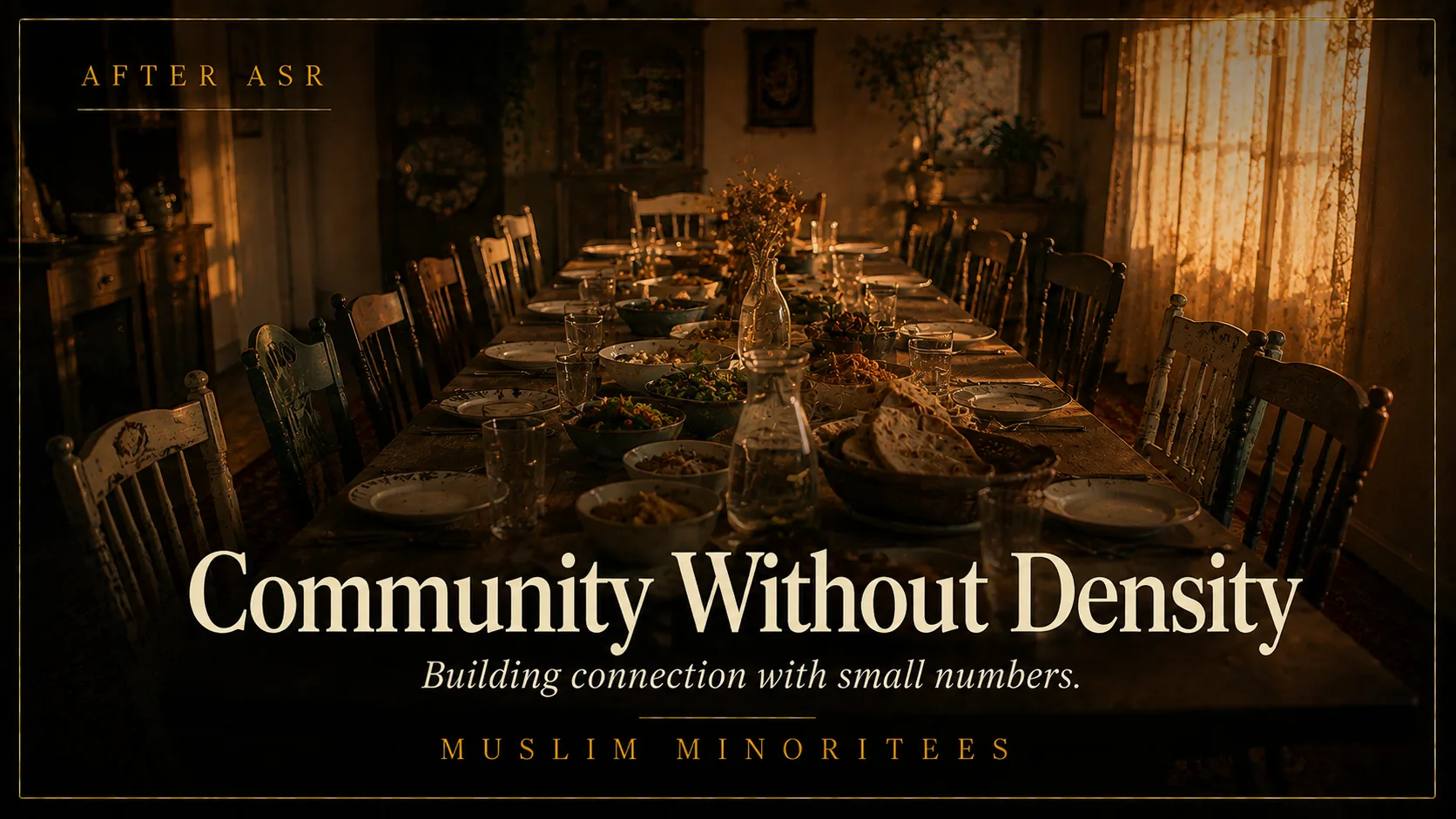
The entire Muslim community of the county fits around two pushed-together tables.
Eleven adults, nine children, one dining room in a farmhouse outside a small Vermont town. Someone drove ninety minutes. Someone brought a rice dish that required three phone calls to source the saffron. The four-year-olds are already under the table, which is where four-year-olds hold their own meetings.
Sociologists would call this a statistically insignificant population. The people at the table call it the community, and they are right.
Community Is a Practice, Not a Population Count
The common assumption runs quietly beneath every conversation about Muslim minorities. Real community requires numbers. Below some threshold of families, the thinking goes, you have only individuals, enduring.
The assumption deserves to be retired, because the evidence against it keeps eating dinner together. Across the thin geographies of the Muslim world’s edges, in the Scottish islands and the Uruguayan interior and the Dakotas, communities of a dozen people function, persist, and even flourish.
What they lack in density they replace with intention. Nobody drifts into a gathering that requires a two-hour drive. Nobody attends out of habit when attendance takes planning, packing, and a thermos. Every appearance is a decision, and everyone present knows it.
Density builds community the way rain fills a reservoir, passively and in volume. Scarcity builds it the way a well is dug, by hand, on purpose, and the water tastes different for the labor. Neither is counterfeit. But only one is routinely underestimated.
This essay is about the well diggers. Their methods deserve recording, partly in tribute, partly because the crowded places may need these skills sooner than they think.
The Potluck Is the Parliament
In cities, Muslim institutional life distributes across buildings. Out here it concentrates into a single recurring event, and that event is almost always a shared meal.
The monthly potluck is worship schedule, school board, welfare office, matrimonial bureau, and news service, all seated around folding tables. Before the food, the congregational prayer, with a teenager sometimes given the call to practice her voice. After the food, the quiet business. Who is traveling, who is struggling, whose mother abroad is ill, whose lease is ending.
The food itself does diplomatic work. The Somali family’s rice next to the Bosnian pastries next to the convert’s experimental casserole, each dish a flag planted in shared ground.
Watch the hosts rotate through the year and you see the deeper structure. Every household takes a turn holding the community in its living room. By December, everyone has been both guest and shelter.
And note who makes it run. The aunty who arrives an hour early with trays and stays an hour late with dish gloves has no title. Remove her, and the parliament dissolves. Every scattered community has one, and the smart ones have started training her replacement.
Grand institutions should study this efficiency. One table, properly attended, can carry an entire civilization’s social ministry for a county.
Distance Is the Membership Fee
Every scattered community has its odometer legends. The family that drives two hours each way, monthly, for a decade. The nurse who arranges her entire shift rotation around the second Saturday. The student with the failing transmission who never misses.
Distance functions here the way dues function elsewhere, except distance cannot be waived and cannot be faked. The drive is visible proof of valuation. When you watch a tired father load three sleeping children into a car at ten at night for the long road home, you are watching a man pay for community in the only currency that never inflates.
The economics sound punishing, and sometimes they are. Winter cancels gatherings. Fuel prices are a community budget line. A new baby can take a family off the roads for a season, and everyone understands.
But the fee purchases something cities rarely stock. Certainty about one another. Nobody at that table is there casually, and after a few years this shared knowledge becomes the community’s actual foundation, poured one round trip at a time.
The Web Between Gatherings Is Made of Messages
The community meets monthly, but it lives daily, and its daily address is a group chat.
Morning greetings move through it. Prayer time changes, a photo of the first fast broken, a question about whether a certain candy is gelatin free, answered within minutes by whoever is standing in a supermarket aisle. A job posting. A du’a request, quietly urgent, at two in the morning.
Older members who once managed phone trees recognize the technology as the same instrument with better reach. When the substance of it is checked on, the substance is ancient. Are you well. Do you need anything. You are not alone out there.
The chat also holds the community’s institutional memory. Scroll back far enough and there are the Eid photos from years past, the congratulations on graduations, the funeral announcements with their long threads of condolence.
A historian of minority Islam in this century will need access to these archives. The minutes of the scattered communities were kept in messages, complete with recipe photos.
The chat has etiquette, enforced gently by the elders who joined late and mastered it anyway. No politics from back home. No forwarded outrage. Announcements before opinions, and every newcomer welcomed within the hour, by name.
Three Families Can Hold Up a Whole Tradition
Count what a tiny community actually carries and the arithmetic turns astonishing.
Three families, properly organized, can sustain congregational prayer, two Eids with decorations and gifts, a rotating Quran class, a funeral fund, a new-arrival welcome protocol, and a supply chain for halal meat. Each adult carries three or four roles. The engineer is also the treasurer and the man who owns the folding chairs. The teacher is also the youth mentor and the keeper of the contact list.
They came to these roles with no training, no stipend, no title, and no expectation of relief, and they have held them, in some towns, for twenty years.
The load is real and should be named. Burnout stalks small communities precisely because no role has an understudy. When the woman who organizes everything gets sick, everything wobbles.
Which is why the healthiest tiny communities practice a discipline larger ones forget. They thank each other constantly, specifically, by name. Gratitude is their maintenance schedule.
At one autumn gathering, somewhere every year, a treasurer stands up to give a two-minute report and receives applause that startles him. Eleven adults clapping in a farmhouse dining room. It sounds small. He will run the books for another decade on it.
Differences That Divide Cities Must Coexist Here
In a metropolis, Muslims can sort themselves into congenial rooms. A mosque for each school of thought, each language, sometimes each village of origin. Scarcity permits no such sorting.
The county’s one gathering must hold the Pakistani cardiologist and the Bosnian mechanic, the strictly observant and the tentatively returning, the convert who found Islam through books and the elder who inherited it through lullabies. There is no second option to storm off to.
So the small community develops, of necessity, the skill the whole ummah preaches and rarely practices. It agrees on essentials, negotiates the rest, and lets differences stand unresolved in the same room, decade after decade.
Prayer follows whoever leads it that month, in whichever style he learned as a boy. The moon-sighting debate is conducted annually, cheerfully, and settled by a coin flip’s worth of deference to whoever organized the hall.
Visitors from big-city mosques sometimes find this doctrinally untidy. The small community finds it survivable, which is the higher orthodoxy of scattered places.
Something else happens over the years of this forced togetherness. The differences stop being tolerated and start being enjoyed. The children grow up assuming Islam naturally comes in several accents, several rice dishes, several ways of holding the hands in prayer. They are, in this one respect, better traveled than most of the ummah.
The Children Need the Gathering Most
For the adults, the monthly meeting is nourishment. For the children, it is oxygen.
Each of them spends the other twenty-nine days as the only Muslim in a classroom, fielding questions, explaining lunches, being singular. At the gathering, for one afternoon, they are simply children among children who require no explanation at all.
Watch them find each other. The two twelve-year-olds who see each other twelve times a year and call each other best friends, correctly. The teenagers comparing notes on how to handle the homecoming dance question, counsel no parent could provide.
Wise communities protect this fiercely. They schedule around exam seasons, build in unstructured hours, and resist the urge to program every minute with instruction. The instruction, the elders have noticed, is the least of what transfers.
What transfers is the deep lesson beneath the afternoon. You are not strange. You are not alone. There is a table where your name is known and your lunch requires no defense.
A child who receives that lesson monthly can carry the other twenty-nine days.
Elders Anchor What Buildings Cannot
Scattered communities own no minarets, so they navigate by people instead. Usually the landmark is an elder.
She is the one who has hosted since before the group chat existed, whose freezer holds emergency trays for funerals and births alike, who remembers every family that ever passed through the county and where they went. New arrivals are brought to her kitchen the way ships are brought to harbor.
Her authority holds no office and needs none. It rests on decades of showing up, the only credential scattered places honor without question.
When she speaks at the gathering, disagreement quiets, not from fear but from arithmetic. She has attended more of this community’s weddings, funerals, and hard winters than anyone else. Her memory is the community’s archive, and everyone knows the archive must be honored while it can still tell its stories.
The communities that thrive plan for succession with unsentimental love. Someone younger starts hosting alongside her. The freezer protocol gets written down. The archive trains its successor.
And when she is finally gone, the gathering nearest her passing fills beyond any Eid. People drive in from three states. The community she stitched shows up, whole, one last time, to say so.
Borrowed Rooms and Genuine Neighbors
Without buildings of their own, small communities become connoisseurs of borrowed space, and the borrowing builds unexpected bridges.
The Lutheran fellowship hall that hosts the Eid prayer every year, its pastor arriving early to unlock and staying to admire the rows. The public library meeting room booked under the reading club protocols. The Rotary hall, the grange, the university classroom on winter Fridays.
Each borrowed room requires a relationship, and the relationships compound. The church that lends its hall gets invited to the feast that follows. Members meet. Casseroles cross doctrinal lines. Years later, when a zoning question or an ugly incident arises, the community discovers it has allies who speak up unprompted, because friendship was accumulating interest the whole time.
There is a quiet lesson here that dense communities, sufficient unto themselves, can miss. Needing neighbors turns out to be a form of wealth. The smallest Muslim communities are often the best-woven into their towns, precisely because they could not afford walls.
Hospitality Does the Work of Institutions
What the scattered community cannot build in brick, it builds in welcome.
A new Muslim family arriving in the region triggers a protocol older than any bylaw. Within the week, a visit, a meal, the contact list, the map of essentials. Which supermarket stocks halal, which teacher understands Ramadan, which back road floods in spring thaw.
Travelers get the same treatment. The salesman passing through who searched online and found a phone number ends up at a dinner table, slightly bewildered by the warmth. Students at the small college find themselves adopted by families who feed them monthly and attend their graduations.
None of this is charity in the institutional sense. It is infrastructure in its original human form, the kind that predates every building the faith ever raised.
The tradition began, after all, with migrants received into private homes in a small oasis town. The scattered communities are not far from their roots when they practice this. They are standing directly on them.
The Distant City Mosque Is a Sister Ship
Almost every tiny community keeps one long-distance relationship, with the nearest real mosque, a hundred or three hundred kilometers away.
The relationship has seasons. In Ramadan, a few families make the pilgrimage for a weekend of taraweeh in actual congregation, returning like sailors from shore leave with dates, books, and news. When death comes, the city sends an imam up the highway, or talks a nervous volunteer through the prayer by phone.
The city mosque supplies certifications, scholarly answers, marriage paperwork, and the occasional visiting speaker who is startled by the drive and then startled again by the attendance.
The traffic runs both ways, though the city rarely notices. Scattered families donate to the building fund of a mosque they visit four times a year, faithfully, for decades. Their children eventually study in the city and arrive already trained to volunteer.
Fleet is the right image. The great city congregations are carriers, the county communities small fast vessels, and the faith moves as a formation, not as a single ship.
Conflict Here Is a Family Quarrel, and Must End Like One
Small communities fight. Anyone who reports otherwise has not stayed for the committee meeting.
They fight about the things all congregations fight about, money and method and whose turn it was, and the fights hurt more here because everyone is essential and no one is replaceable. In a city, factions solve conflict by separation. In a county with eleven Muslim adults, separation means the end of everything.
So the scattered learn repair, the least glamorous of the religious arts. The apology delivered with a plate of food. The mediating elder who drives to both houses in the same afternoon. The agreement to disagree, renewed annually like an insurance policy.
The tradition’s teachings on reconciliation, on not abandoning a brother beyond three days, stop being abstract virtue out here. They become operating requirements, as practical as antifreeze.
Ask members of long-running tiny communities their secret and the answers converge. We could not afford our grudges. So, eventually, we put them down.
When One Family Leaves, the Map Redraws
Fragility is the tax on all this depth, and it should be stated plainly.
One job transfer can remove a quarter of the congregation. The family that hosted the eastern half of the region moves, and suddenly the drive is too far for three others, and attendance thins, and the thinning discourages, and the spiral is quick.
Small communities live with this exposure the way coastal towns live with weather. They have watched gatherings of twenty become gatherings of six, and some have watched the six become silence for a few years until new arrivals restart the list.
The wise ones build for continuity on purpose. Contact lists kept current and shared. Relationships with the nearest city mosque, a hundred kilometers off, as a lifeline institution. The habit of writing things down, so the next founders inherit a map instead of a blank.
And they practice a certain theology of impermanence without despair. The community was never the roster, they will tell you. It was the practice of gathering, and practices can outlive any particular set of names.
Small Numbers Purchase Deep Knowing
Here is what the dense city cannot easily buy, at any price.
In a community of eleven adults, you are known entirely. Your absences are noticed the same day. Your struggles are tracked with casseroles. When your father dies overseas, everyone knows by nightfall, and the drive to your house begins in three kitchens at once.
Anonymity, the great luxury and great loneliness of the metropolis, simply does not exist. Nobody slips in late, prays at the edge, and leaves unnamed. There is no edge. The room is too small for edges.
People shaped by such communities carry recognizable traits into the wider world. They greet strangers at big-city mosques because the concept of an unwelcomed newcomer offends them. They notice the person eating alone. They keep lists.
The scattered places, it turns out, run an accidental finishing school in the very virtues crowded places preach. Not because their people are better, but because their scale makes indifference impossible. Everyone is load-bearing. Everyone gets carried.
Being fully known has its price, of course. Privacy thins. Mistakes are remembered. But ask the people who have lived both ways which loneliness is worse, and few choose the crowded kind twice.
The Measure Was Never the Headcount
Go back to the farmhouse in Vermont, where the dishes are being washed by committee and the four-year-olds have surfaced for dessert.
By every metric an agency would apply, this community barely registers.
By the measures that outlast metrics, it is complete.
It prays together. It feeds its guests. It teaches its children. It buries its dead with washed hands and does not let its quarrels see a fourth day.
Two tables, pushed together, holding everything essential.
Community was never a number.
It was always a decision, renewed monthly, mile by mile.