On the same Friday, at the same hour of the sun, three Muslims get ready for prayer.
One walks past a four-hundred-year-old wooden mosque in eastern Poland that her ancestors built. One takes an elevator to a rented floor above a phone repair shop in Guatemala City. One drives ninety minutes across the Scottish Highlands with his sons and a thermos.
We use one phrase for all three. The phrase is doing too much work.
One Word, a Thousand Situations
Say Muslim minority and a single image tends to load. Usually it is an immigrant neighborhood in a Western city, a generation or two deep, negotiating hyphens.
That image is real. It is also one tile in a mosaic that covers most of the earth. The majority of the world’s countries hold Muslim populations too small to set the culture, and the lives inside those numbers barely resemble one another.
A Tatar grandmother in Lithuania, a Ghanaian trader in São Paulo, a Japanese convert in Nagano, a fourth-generation imam in Trinidad: each is a Muslim minority. Each would find the others’ daily questions half familiar and half exotic.
Writers, preachers, and policy makers keep reaching for the singular. The singular is tidy. But tidiness costs accuracy, and accuracy is a form of respect. The only honest way to talk about minority Muslim life is to walk through its geography, its history, and its law, and watch the one word split into many.
Minority Does Not Even Mean Small
Start with the arithmetic error hiding inside the word itself.
India holds one of the largest Muslim populations on earth, and that population is a minority. Russia’s Muslims number in the tens of millions, with republics, muftiates, and centuries of institutional life, and they are a minority. Ethiopia’s Muslims fill whole regions and ancient trading cities, and they are a minority.
A minority of two hundred million people and a minority of two hundred people share a census category and almost nothing else. The first has universities, political parties, film industries, and internal debates too vast for any outsider to follow. The second has a group chat and a rented room.
Yet the word covers both, and coverage of both borrows the same vocabulary. It should not. The Hyderabadi Muslim navigating majority politics from inside a metropolis of his own people lives one story. The Muslim family in rural Bolivia lives another entirely.
Numbers are not destiny. But they are context, and context is the first thing the single phrase erases.
Begin with the Map, Because the Map Decides What Is Hard
Geography is the first divider, and it works with a blunt instrument. Distance.
In greater Toronto, a Muslim can choose among dozens of congregations and complain about parking. Four hours north, a family drives to another town for Eid and packs like it is a camping trip. Same country, same law, same passport. Different religion of the odometer.
Density writes the schedule. Where Muslims cluster, there are weekend schools, halal groceries, marriage networks, funeral committees. Where they scatter, one family carries all of those functions alone, in miniature, out of a kitchen.
Climate joins in. Fasting through a subarctic summer in Tromso, where daylight barely ends, is a different bodily covenant than fasting through a mild equatorial day in Nairobi. The scholars offer accommodations for the far north, and the households there weigh them around actual tables.
None of this is exotic trivia. It is the terrain that decides which acts of faith cost effort and which come free. The map is quietly theological.
Two families with identical devotion, placed on different points of it, will build different lives. Neither should be graded by the other’s coordinates.
Some Minorities Are Older Than Their Countries
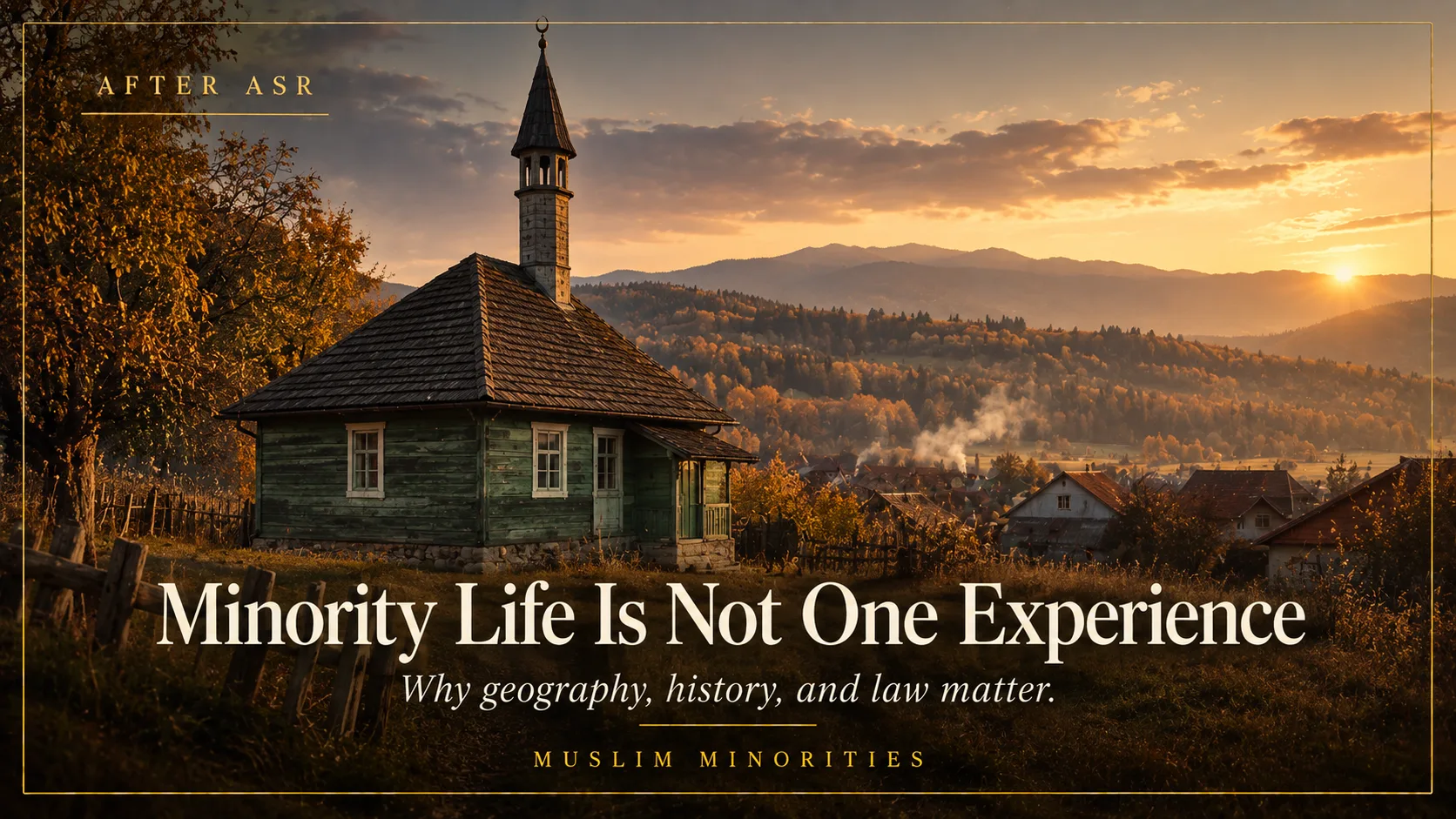
In the villages of eastern Poland stand small wooden mosques, green and modest, older than most European constitutions. The Tatar families who pray in them have been Polish and Lithuanian Muslims for six centuries. They fought in national armies. Their cemeteries hold soldiers and farmers and poets.
Nobody in those villages is a newcomer negotiating arrival. Their questions run differently. How does a tiny ancient community keep its young people? What happens when the last elder who remembers the old prayers passes?
China’s Hui Muslims have been Chinese for over a thousand years. Muslims in the Balkans predate the modern states drawn around them. In parts of western India, Muslim communities trace their coastlines back to the first century of Islam, arriving with monsoon traders.
For all of these, minority status is not an immigration story. It is an inheritance with deep local roots and its own antique furniture. When commentators describe Muslim minorities as guests still proving themselves, these communities raise an eyebrow older than the commentary.
Their persistence is its own library. Six hundred years of keeping a faith at the edge of its world, through empires, wars, and borders that moved while the villages stayed, is expertise no seminar can teach.
Some Communities Began on Ships They Did Not Choose
The Muslim presence in the Americas did not begin at an airport.
Among the millions of West Africans enslaved and carried across the Atlantic were many Muslims, literate in Arabic, carrying the faith in memory when everything else was taken. Their traces survive in fragments, in manuscripts, in family stories along the coasts of Brazil and the Carolinas.
Later, in the 1800s, indentured laborers from India brought Islam to Trinidad, Guyana, and Suriname. They cut cane, kept the fast, and built some of the hemisphere’s oldest functioning mosques. Their descendants are now five and six generations deep, Caribbean to the bone, Muslim by unbroken transmission.
A faith that arrived through bondage and indenture carries a different memory than one that arrived with a student visa. The Trinidadian Muslim whose great-great-grandfather prayed in a cane field does not experience minority life as a recent negotiation. He experiences it as a long citizenship, with receipts.
History is not background here. It is standing in the room.
And Some Communities Began with a Single Person Saying Yes
Then there are the communities with no ancestral chapter at all.
In much of Latin America, East Asia, and the Pacific, congregations trace back a few decades to a handful of converts and a couple of migrant families. The founding generation is often still alive, still leading, still photocopying.
A convert community improvises everything. There is no inherited recipe for Eid breakfast, so the Mexican congregation serves tamales and dates together and calls it tradition, which by the third year it is. The khutbah is in Spanish or Korean or Tagalog from day one, because there is no other tongue to be nostalgic for.
These young communities lack the deep cushions of the old ones. No ancestral cemeteries, no muscle memory, no grandmother who knows the funeral rites. Every crisis is a first crisis.
But they hold one advantage the ancient communities sometimes envy. Nothing about their faith is habit. Every single member chose the tradition on purpose, recently, against the current. A room like that has its own voltage.
Visitors from old Muslim lands often leave these congregations quietly moved. They came expecting to teach. They spent the evening taking notes.
Law Draws the Walls of the Prayer Room
Two Muslims can share a border and live under different weather, because the law differs on each side.
Austria has recognized Islam in its law since the early twentieth century, which shapes chaplaincy, education, and official standing. Elsewhere in Europe, communities operate as private associations, renting and registering like chess clubs. In some countries, religious slaughter faces legal restriction, and the halal supply chain must cross borders to stay lawful.
The differences reach the ground fast. Whether a mosque can have a minaret. Whether a school lunchroom must offer an alternative. Whether a scarf may be worn in a public classroom, a courtroom, a police uniform. Whether Eid can be taken as a legal holiday or must be bought with a vacation day.
Muslims living under generous frameworks sometimes cannot fathom the constraints an hour’s flight away, and the reverse. The faith is the same. The legal architecture around it changes what practicing costs, and the cost changes the culture.
The communities that navigate this best keep a lawyer on the volunteer rota next to the cook. Both feed the congregation, in their fashion.
Even the Graveyard Is a Legal Question
Nothing exposes the machinery of law like a funeral.
Muslim burial asks for simple things. The body washed, wrapped, buried without delay, facing the qibla, in earth. In Muslim-majority countries this happens almost automatically, the way water finds a drain.
In Japan, where cremation is the overwhelming norm, Muslim families have spent years working with municipalities to secure the few burial grounds that exist, sometimes driving the deceased across prefectures. In parts of Europe, communities negotiate for sections of municipal cemeteries and for the right to bury within the tradition’s timeline. In small-town America, the nearest Muslim section may be three states away.
The volunteer who manages the funeral fund knows all of this cold. She keeps the phone numbers of the sympathetic funeral director, the cemetery clerk, the imam two cities over. Grief in a minority community arrives with paperwork attached.
The paperwork gets done, quietly, by people who never mention it again. Ask an old funeral committee volunteer how many burials she has arranged, and she will change the subject to the family, every time.
To die as a Muslim minority is, one last time, to depend on what geography, history, and law have arranged around you.
Money Rewrites the Same Story Again
Inside a single city, class splits the minority experience as sharply as any border.
The surgeon’s family experiences minority life as a scheduling puzzle, solved with flexibility and goodwill from colleagues. The meatpacking worker on a night line experiences it as a physics problem, because prayer breaks and production quotas occupy the same minutes.
Wealthy congregations build. They buy the former church, hire the youth director, endow the school. Poor congregations rent, share, defer, and depend on the electrician who donates his weekends. Both are faithful. Their institutional lives barely overlap.
Migration channels sort communities this way from the start. A minority built by graduate students and physicians grows one kind of infrastructure. A minority built by refugees resettled with nothing grows another. A minority built by traders builds a third, usually near the port.
When we speak of the Muslim minority experience without asking who cleans the buildings and who owns them, we flatten the very people the phrase claims to honor.
The night-shift worker and the surgeon may pray in the same row on Friday, which is the tradition’s glory. On Monday they return to different minorities.
Language Decides Who Feels at Home on Friday
Step into Friday prayers around the minority world and listen.
In one hall the sermon runs in Urdu, and the teenagers check out politely at minute four. In another it runs in careful English or Spanish or Japanese, and the elders miss the cadences of home. In a third the imam alternates, sentence by sentence, a bilingual tightrope walked weekly for thirty years.
Language is belonging’s front door. Old diaspora communities agonize over when to switch tongues, because the switch admits the migration is permanent. Convert communities never face the question, and ancient communities like the Tatars answered it centuries ago, folding the faith into Polish and Lithuanian until the languages themselves learned to pray.
There is no correct answer, only correct attention. The congregations that thrive tend to be the ones that noticed the question early, argued about it kindly, and chose on purpose.
The ones that drifted lost the young to the back parking lot, one Friday at a time.
It is worth naming the man who carries this weight most Fridays. The bilingual imam, underpaid and overconsulted, translating not just words but generations, is one of the unsung load-bearing figures of the entire minority world.
Public Opinion Is a Local Climate, Not a Global One
The same scarf draws different weather in different cities.
In one town it draws warmth, curiosity, an invitation to address the Rotary Club. In another, silence on the bus. In a third, hostility sharp enough to change a walking route. The woman wearing it did nothing differently. The climate around her changed at the border, sometimes at the county line.
National politics, local memory, a single incident years ago, the presence or absence of one beloved Muslim doctor: all of it composes the atmosphere a minority breathes. Communities a hundred kilometers apart can live in different centuries of acceptance.
This is why testimonies about minority life seem to contradict each other. One writer describes ease, another describes siege, and readers assume someone is exaggerating. Usually both are reporting accurately from different weather stations.
Believing both at once is the beginning of understanding. The map of dignity has microclimates.
And climates change. The town that was cold in one decade warms in the next, usually because particular people did particular patient work. Weather, unlike geology, responds to effort.
Time Redraws Every One of These Maps
Hold a single community still and watch it across forty years. The minority experience changes under its feet without anyone moving.
The founding generation rents the room and writes the bylaws. Their children grow up translating at parent-teacher conferences and half in love with the majority culture, half responsible for the mosque accounts. Their grandchildren speak only the local language and rediscover the faith on their own terms, sometimes more devout than the founders, sometimes gone.
Around them, the town changes too. A factory closes and the community shrinks. A university opens and it doubles. A national election shifts the climate. The corner that once stared now waves.
So even the reporter’s questions must be dated. The Muslim experience of one city in the 1980s and the experience of the same city today are different countries. Elders and youth in the same congregation are, in a real sense, minorities of different eras, praying side by side.
Any map of this life needs a timestamp in the corner.
What They Still Recognize in Each Other
After all this dividing, walk back through the door of any of these communities and watch what repeats.
The Tatar villager, the Trinidadian imam, the Tokyo convert, and the Highland father would all recognize the folding chairs. The rota for cleaning the prayer space. The one aunty whose food trays anchor every gathering. The debate about moon sighting. The child asleep on a coat at the back during the late-night prayers.
They came from cane fields, steppes, port cities, universities, and living rooms, and they all end up printing prayer timetables, teaching small children the opening chapter, and arguing gently about parking.
The five prayers travel intact. The fast travels intact. The instinct to feed strangers travels intact.
Difference runs deep in minority Muslim life, but it runs over bedrock. What varies is the terrain. What repeats is the water finding its way through.
Speak of Minorities in the Plural, and Watch Understanding Improve
There is a practical payoff to all this, and it lands closest to Muslims themselves.
Majority-country Muslims sometimes issue advice to minority communities as if all of them were Birmingham or New Jersey. Aid flows toward the visible diasporas while the Guyanese village mosque and the Lithuanian village mosque repair their own roofs unnoticed. Conference panels seat one minority Muslim and ask her to speak for a category that includes several hundred distinct situations.
She cannot. Nobody can. The kindest thing to do with an impossible mandate is retire it.
Ask instead the reporter’s questions, the small ones. Which country, which town, which decade did the community begin, which language on Friday, which law on the books, how far to the cemetery. Ten minutes of such questions teaches more than a shelf of generalization.
Editors can do their part by printing the answers. A story about the Muslims of one fishing town, told at its own scale, serves readers better than another panorama. The panoramas blur. The fishing town stays with you.
Precision is not pedantry here. It is how you love a scattered people properly, one address at a time.
A Wider Map Makes a Gentler Judgment
Once the plural sinks in, certain judgments soften on their own.
The community that seems insular may be six centuries deep in survival lessons. The one that seems chaotic may be twenty years old and running entirely on volunteers.
The family that keeps its head down may live under laws you have never had to read.
The family that speaks loudly may finally live somewhere it is safe to.
Geography dealt them different hands. History dealt them different memories. Law deals them different mornings, still.
One faith, a thousand situations, each deserving to be seen at its own address.
Visit the address before forming the opinion.
That much, at least, every minority shares.