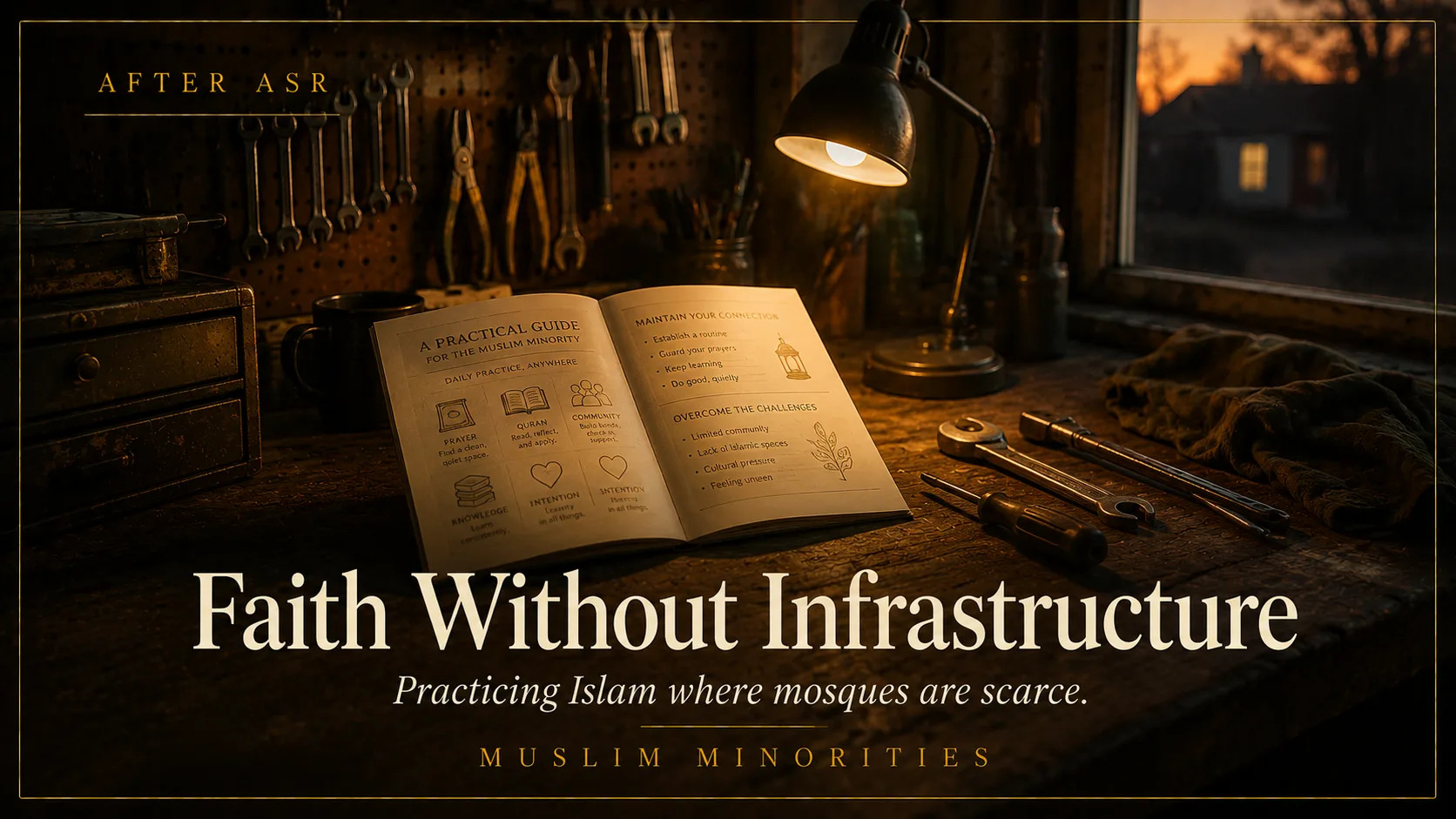
The printed guide sat on the workbench for a week before he could open it.
A man in a small New Zealand town, the only Muslim for many kilometers, was teaching himself how to wash a body for burial. His friend was dying two towns over. There was no one else to learn.
He practiced the movements in his garage, alone, on an evening after work. This is what faith looks like when the infrastructure never arrived.
What Infrastructure Quietly Does for a Soul
In a Muslim-majority city, religion runs on rails you never see. The adhan finds you five times a day without being asked. The mosque on the corner holds a teacher for your children and a scholar for your doubts. The butcher is halal because everything is.
A working religious infrastructure is a thousand small servants. It remembers the calendar for you. It supplies the funeral washer, the marriage officiant, the Quran teacher, the arbitration uncle, the reliable fatwa, the wedding hall, the grave.
Nobody thanks the rails. That is the nature of rails. You discover what they carried only when you step off them, into a town where none of it exists and all of it is suddenly your job.
Millions of Muslims live in exactly that town. Scattered across northern Scandinavia, rural Japan, the small cities of Latin America, the American mountain west, they practice a faith designed for company with almost none of the company. What they have built instead deserves closer attention than it gets.
Take an Honest Inventory of the Missing
Begin with a plain accounting, because vagueness helps no one.
No mosque within driving distance, or one so far it is a monthly event. No imam, so no Friday sermon, no counselor with religious training, no one to lead the Eid prayer. No weekend school, so the children’s entire religious education happens at home or nowhere.
No halal butcher, so the kitchen runs on fish, vegetables, and long drives. No Muslim cemetery, so death means improvisation at the worst possible hour. No religious court or council, so marriages, disputes, and conversions get assembled from goodwill and downloaded documents.
Missing most of all is the ambient reinforcement, the hundred daily signals that a whole society sends when it shares your rhythm. Nobody at work knows it is Ramadan. No shop window changes for Eid. The year passes without a single external echo of your inner calendar.
The inventory sounds bleak read aloud. The people living inside it rarely sound bleak at all, which is the first clue that something else is going on.
This is the actual terrain. Now watch what people do with it.
The Phone Took Over the Minaret’s Job First
The first replacement was the easiest, and it fits in a pocket.
Prayer time apps now do for scattered Muslims what muezzins do for gathered ones. The compass feature settles the qibla in hotel rooms, hospital wards, and highway rest stops. The lunar calendar that once required a committee now glows on a lock screen.
It is easy to be sentimental against the phone, and wrong. For the rancher’s wife in eastern Montana, the notification at dawn is not a gadget. It is the only voice in five hundred kilometers that calls her to prayer, and she is grateful for it.
Something is still lost, and honesty should say so. An alarm cannot bless a neighborhood. A notification synchronizes one person, not a street. The technology solves the information problem completely and the loneliness problem not at all.
But information was never nothing. Ask the generations of isolated Muslims who kept the fast by almanac and guesswork. They would have wept with relief at the lock screen.
The wise households treat the phone as a servant with one skill. It keeps time faithfully. Everything else, the meaning, the company, the sweetness, still has to be supplied by human beings on purpose.
The Kitchen Table Becomes the School
Where there is no weekend madrasa, the mother becomes one.
She prints worksheets after her shift. She learns the rules of recitation one lesson ahead of her daughter, the way pioneer teachers stayed one chapter ahead of the class. The kitchen table hosts long division at four and the short chapters of the Quran at seven.
Fathers take the commute shift, running memorization drills in the car. Grandparents on video calls handle the stories, the supplications, the family chain of who taught whom. The curriculum is patched together from library books, YouTube reciters, and a workbook ordered from another country.
Educators would call this unsystematic. It is. It is also astonishingly durable, because a child taught at the kitchen table learns something no institution teaches. She learns that this matters enough for her exhausted parents to do it themselves.
Many of the most grounded Muslim adults in scattered places tell the same origin story. There was no school. There was a table, a parent, and a lamp. It was enough. It had to be, and then it simply was.
The Scholar Is Online Now, for Better and Worse
Serious religious questions used to require a serious journey. Now they require a search bar, and this changes everything twice.
For the isolated Muslim, online scholarship is rescue. Whole libraries, translated and searchable. Lectures from every tradition and temperament. The widow in a Chilean port city can study her inheritance rights at midnight. The teenager in rural Finland can hear the Quran recited beautifully, daily, though no one within a hundred kilometers can read it.
The risk arrives in the same envelope. A search bar has no wisdom about which voice suits which soul. The angriest teachers are often the best marketers, and a lonely young Muslim with no local elders is precisely the audience they hunt.
Scattered families learn to curate as fiercely as any librarian. They pass names of trustworthy teachers hand to hand, like directions through a marsh.
The old system had gatekeepers and gates. The new one has neither, and the scattered household must become its own quiet gate.
A good rule circulates among such families. Choose teachers who make you gentler with your children and more honest at work. The screen cannot verify a chain of transmission, but the dinner table can verify fruit.
A Single Bookshelf Can Hold the Essentials
Visit these far-flung households and you find the same modest institution in most of them. One shelf.
A translation of the Quran, its margins soft with use. A prayer manual. A biography of the Prophet. A children’s book of stories, a supplication collection, perhaps a well-chosen volume of law for daily questions. Rarely more than twenty spines.
In majority lands, private libraries can be vast because public knowledge is vaster. Out here the shelf is the public knowledge. It gets consulted the way villages consult a well.
Families in these places choose books the way sailors choose cargo, by weight and necessity. What earns its place gets read to pieces. More than one scattered Muslim has described finishing the Quran for the first time precisely because there was nothing else, no lecture, no gathering, no distraction dressed as devotion.
Scarcity is a poor teacher of many things. Reading deeply is not one of them.
Small Engineering Solves the Daily Frictions
Then come the humbler puzzles, the ones no one writes theology about.
Where to make ablution when the only water is a public restroom sink, managed with a water bottle and practiced discretion. How to pray in a workplace with no spare room, timed to the empty stairwell. Which corner of the airport, which minute of the lunch break, which patch of clean grass behind the warehouse.
Scattered Muslims develop an engineer’s eye for the day. They map the city by its quiet corners, carry a folded mat in the car, keep dates in the glovebox each Ramadan, learn which supermarket chain labels its gelatin honestly.
Each solution is tiny. Together they form a competence that deserves a better name than coping. It is the practical intelligence of a faith that refuses to lapse simply because the environment forgot to accommodate it.
They trade these solutions generously when they find each other. The mat that folds to paperback size, the app that flags animal enzymes, the thermos trick for winter ablutions on a job site, the polite sentence that ends the lunchroom interrogation kindly.
The infrastructure of the scattered Muslim is mostly this. A hundred small solved problems, invisible to everyone but God and the solver.
Ramadan Alone Is a Different Instrument
The month built for crowds arrives, and there is no crowd.
No lights in the streets, no communal tables at sunset, no packed night prayers. The fast begins alone in a dark kitchen and breaks alone at a desk, with a date and a glass of water and the hum of a refrigerator.
It would be false to call this equal to Ramadan among millions. The communal month carries people; the solitary month must be carried. Every scattered Muslim knows the specific ache of hearing about iftars elsewhere.
And yet those who have fasted both ways report something unexpected. Alone, the month grows strangely pure. No feasts to over-plan, no social calendar wearing devotion’s clothes. Just hunger, prayer, and the book, in their original proportions.
Some drive hours on the weekends to break fast with the nearest families, and those evenings taste like holidays inside the holiday. The rest of the month belongs to the quiet original arithmetic. One soul, one fast, one Lord watching.
Employers and coworkers, told plainly, often rise to the occasion in small moving ways. The foreman who quietly moved the crew lunch an hour later each spring never made a speech about it. He just did it, for years.
Generosity Finds Routes Without a Collection Box
Islam assumes an economy of giving, and infrastructure usually organizes it. The mosque collects, the committee distributes, the community knows its poor.
Remove all that and the obligation remains, so the scattered Muslim builds her own routes. The annual alms travel by bank transfer to a vetted charity, or to family abroad, or to the one struggling household she knows three towns over. The calculation happens at the kitchen table with a calculator and a conscience.
Something interesting occurs in this privacy. Giving without a community watching is giving with only One watching, and people rise to it. The couple in a small Norwegian city who quietly fund winter coats through the local church’s drive, because it is the only charity in town, have thought carefully about what their alms are for.
Local generosity also becomes the community’s first advertisement. In places with a single Muslim family, that family’s giving is the entire public record of Islam. Most of them know it, and give accordingly.
Ask the food bank coordinators of a hundred small towns who never misses a month. A surprising number will describe the quiet family from the house with the unfamiliar name.
Weddings and Welcomes Without an Officiant
Life keeps happening, infrastructure or not. People marry. People convert. Babies arrive and need names and blessings.
Each of these normally calls for an imam, and there is no imam. So the community of three families discovers what the tradition has always technically held. The rites are simpler than the ceremonies grown around them. A marriage needs consent, witnesses, a gift, a public word. A conversion needs a sincere testimony, which a kitchen can host as validly as a dome.
The retired engineer who has read the most ends up officiating weddings, nervous in a pressed suit, checking his notes. The new convert is welcomed by potluck, her testimony witnessed by seven adults and a sleeping toddler.
There is loss in this, and no one should romanticize it. Questions arise that a scholar should answer, and mistakes happen. But there is also a stripping down to essentials that feels, on the good days, like touching the early history of the faith with bare hands.
The couples married this way tend to remember every word of their small ceremonies. Grandeur is forgettable. Seven witnesses in a living room, each one essential, is not.
The Funeral Remains the Hardest Examination
Everything scattered Muslims manage daily, death tests in a single night.
The body must be washed, and someone must know how. The shroud must be found in a town that has never sold one. The prayer must be led, the grave negotiated with a cemetery that has never dug one facing the qibla, all within the tradition’s urgent timeline, all while grieving.
This is why the man in the New Zealand garage practiced alone on a weeknight. He understood that love, out here, means becoming infrastructure yourself before it is needed.
Scattered communities quietly produce such people. The nurse who learned the washing for her father and now serves every family in the region. The farmer who donated the corner plot and mowed it for years so it would look kept when the inspector came.
No plaque names them. The tradition has a phrase for duties that someone must carry so the rest are excused, and these people are its living grammar.
They are also, usually, the calmest people in the room. Preparation does that.
Be Honest About What the Bare Ground Costs
An honest essay must sit with the losses, because they are real and they compound.
Without infrastructure, attrition runs quiet and steady. The family that drifts, not through decision but through friction, until Ramadan is a phone call from grandma and nothing else. The teenager who never met a Muslim peer and walked into adulthood unaccompanied. The convert who lasted two years alone and then folded back into the surrounding silence.
Knowledge thins. Mistakes replicate. Questions that needed a scholar got a guess instead, and the guess became family doctrine.
The people who remain often carry an invisible fatigue, the specific tiredness of being one’s own mosque for decades. They rarely complain, which makes it easy to miss.
Any honest accounting of scattered faith holds both truths at once. Remarkable things grow in bare ground. And bare ground takes casualties the fertile valleys never see. Both are true. The second is why the first matters so much.
What Grows Here Grows Deep Rooted
Now the other column of the ledger, which is not small.
Faith practiced without scaffolding becomes personally owned in a way inherited convenience rarely achieves. The woman who has calculated her own alms, taught her own children, defended her own fasts in a hundred lunchrooms, holds her religion the way a farmer holds land she cleared herself.
Practice becomes intentional down to the smallest gesture. Nothing is done because the neighborhood does it, since the neighborhood does none of it. Every prayer is a decision. Decades of such decisions forge a particular kind of Muslim, unhurried, unshowy, hard to impress and hard to shake.
These scattered households also become the tradition’s quality control. They discover which practices were essential and which were merely ambient, because the ambient ones fell away and the essential ones held.
What held, everywhere, was prayer, fasting, giving, and the book. The load-bearing walls turn out to be exactly where the tradition always said they were. It is one thing to be told. It is another to have tested it.
Every Mosque Began as a List of Names
And bare ground does not always stay bare. Watch how infrastructure is actually born.
It begins with a list. Someone hears there is another Muslim family across town and writes down a phone number. The list becomes a group chat, the chat becomes a monthly potluck, the potluck becomes a rented hall on the two Eids.
Then one year there is a bank account, because the hall wanted a deposit. Then a weekend class, because four families make a classroom. Then, sometimes a decade in, a mortgage on a small building that will need a new roof, and get one, from volunteers.
Every substantial Muslim institution on the minority map grew along this exact path, and the first step was never money. It was a name written down, an intention to not be scattered anymore.
The people on those early lists rarely stay to see the building. They transfer for work, retire south, pass on. What they leave is the habit of gathering, which turns out to be the only unlosable asset a community has.
Somewhere tonight a list like that is two names long. Its keeper has no idea she is a founder. They never do, at the time.
A Faith Built for Company, Carried Alone for Now
Islam was revealed into a community and built for one. The rows of prayer, the shared fast, the pilgrimage of millions: company is in its bones.
So there is something quietly heroic about the ones who carry it solo, faithfully, for years, in places the infrastructure never reached.
They are not the exception to the tradition. They are its advance parties.
The garage where a man practices the funeral rites is a sacred building. It just has not been renamed yet.
The kitchen table is a school. The phone is a minaret. The list of names is a mosque, waiting.
Infrastructure, it turns out, was never the buildings.
It was always the people who decided to be reliable.