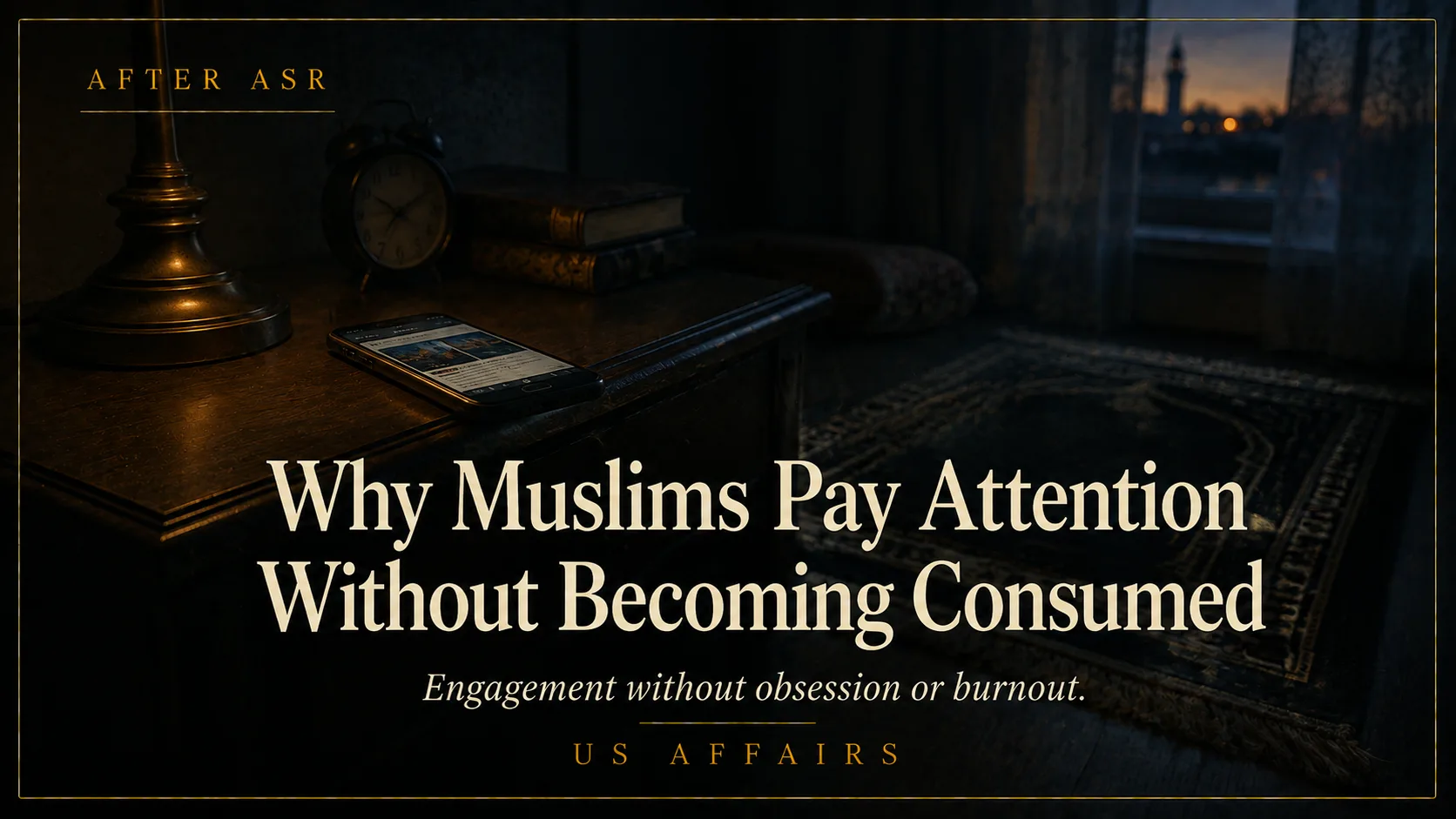
The phone lights up before the sun does. A notification arrives with a headline built to feel like an emergency.
You have not yet prayed, and already the day has an opinion about how you should feel.
Paying attention to the world is a responsibility. Being ruled by it is not the same thing, and the difference is worth defending.
Attention Is a Duty; Being Consumed Is Not Devotion
A believer is not asked to look away from the world. We are asked to witness it honestly and to act within our means.
Attention to injustice is part of faith, not a distraction from it. To ignore the suffering of others is a spiritual failure, not a form of peace.
But there is a version of attention that helps no one, including the one paying it. Consumption feels like caring, and it produces nothing but exhaustion.
Being consumed is not a deeper form of devotion. It is often devotion that has lost its shape and forgotten its purpose.
A heart that breaks a hundred times a day cannot mend fast enough to be of use. Care that destroys the one who carries it will not last long enough to help.
The goal is not to feel the most. The goal is to see clearly and to remain able to act.
Concern Is Not the Same as Anxiety
Concern is directed outward, toward a person or a wrong that needs addressing. Anxiety turns inward and circles, feeding on itself without end.
The two can feel identical in the body, and they are not the same in the soul. One moves you toward action, and the other pins you in place.
You can test which one you are holding by a simple question. Concern asks what can be done; anxiety only asks how bad it is.
When attention stops producing any next step, it has usually crossed from concern into something else. That crossing is worth noticing before it becomes a habit.
Anxiety mistakes intensity for seriousness, as if suffering more meant caring more. It does not, and the confusion wears good people down in the name of virtue.
Faith does not forbid worry, but it does offer it a destination. A concern carried to God is lighter than one carried alone in the dark.
The Feed Is Designed to Never End
The old newspaper ended. You reached the last page, and then you were done for the day.
The feed has no last page, and that is not an accident. It is engineered to keep you scrolling, because your attention is the product being sold.
A tool built to never end will never tell you that you have done enough. It has no interest in your rest, only in your return.
Understanding the machine is not cynicism; it is simple literacy about the thing in your hand. You cannot use a tool wisely if you mistake its purpose for your own.
Every hour you give it can be followed by another, without limit and without thanks. A resource with no floor will take as much as you are willing to lose.
The endlessness is not a sign that the world’s need is infinite. It is a sign that the design has no stopping point, and that you must supply one.
Being Informed Is Not the Same as Being Saturated
There is a level of knowledge that helps you act well in the world. Past that level, more information does not make you wiser, only heavier.
Being informed means understanding the shape of a matter and what it asks of you. Being saturated means having consumed far more than you could ever use or bear.
The saturated mind is not better prepared; it is merely more tired. It confuses the volume of what it has taken in with the depth of what it understands.
A few reliable sources, read with attention, will teach you more than a hundred skimmed. Breadth without depth leaves you knowing a little about everything and nothing you can stand on.
More is not the same as better once you have crossed the line into excess. The line moves with the season, and part of maturity is learning where yours sits.
Knowing when you have had enough is a skill the feed will never teach you. You have to decide the threshold yourself, because nothing else will decide it for you.
You Can Witness Without Absorbing
To witness is to see clearly and to hold what you have seen with honesty. To absorb is to let it soak into you until you cannot tell it from yourself.
A doctor witnesses suffering all day and would be useless if she absorbed it all. Her steadiness is not coldness; it is what lets her keep helping.
The believer is called to be a witness, which is a role with dignity and distance. Witness carries responsibility without demanding self-destruction.
You can look directly at a hard thing and still return to your family whole. That return is not a betrayal of the thing you saw.
Absorbing everything is not a way of honoring the wronged. It only adds one more exhausted person to a world that needs steady ones.
Witness keeps its footing, and absorption loses it. The difference between them is whether you can still act the next morning.
Urgency Is Not the Same as Importance
The news presents everything as urgent, because urgency is what captures attention. But most of what is urgent is not important, and much of what is important is not urgent.
The truly important things in a life move slowly and rarely trend. Your prayer, your children, your character, and your neighbors do not send notifications.
An urgent story demands your feeling right now and forgets you by tomorrow. An important duty waits patiently and asks for your steady return.
Confusing the two means spending your best attention on what matters least. The loud thing crowds out the quiet thing, and the quiet thing was the point.
Everything urgent competes for the same hour, and the hour is not large. What you place in it is a choice, whether or not you notice making it.
Sorting urgency from importance is one of the oldest disciplines of a serious life. The feed will not sort them for you, and it profits when you cannot.
The News Sells Emotion, Not Proportion
A news outlet is a business, and its product is your continued attention. It succeeds by making you feel, not by helping you see the world in proportion.
This is why a rare horror can feel more present than a common danger. What is vivid is not the same as what is likely, though the feed treats them alike.
Fear is easy to sell, and proportion is hard, so fear tends to win the front page. The result is an audience more frightened than the facts alone would justify.
None of this requires anyone to lie outright. Selecting what to show, and how loudly, is enough to bend the picture.
A steady reader asks not only whether a thing is true, but how common and how near. Those two questions restore the proportion that the headline quietly removed.
Reading with this in mind is not distrust of every report. It is only the awareness that emotion and proportion are different products.
A Fixed Time to Read Is a Form of Freedom
Limits sound like a loss, and they are usually the opposite. A fixed time to read the news frees the rest of your day from it.
When you know you will catch up at a set hour, you can let the rest of the day go. The constant checking is what exhausts, more than the news itself.
A container gives a thing its shape, and attention without a container spills everywhere. An hour chosen on purpose is worth more than a day given by default.
This is not withdrawal from the world; it is a way of staying in it without drowning. The world will still be there at the hour you have chosen.
The one who reads at a set time is not less informed than the one who reads all day. He is usually calmer, often clearer, and still knows what he needs to know.
Freedom is not the absence of limits. It is often the presence of the right ones, kept on purpose.
Knowledge Without Action Curdles
Knowledge is meant to lead somewhere, and when it cannot, it turns heavy. To know of a wrong and do nothing about it, week after week, corrodes the heart.
The feed offers endless knowledge of things you cannot personally fix. Held without any outlet, that knowledge becomes guilt, and guilt hardens into numbness.
The way out is not to know less but to pair knowing with doing. Even a small act restores the balance between what you see and what you give.
A dollar given, a call made, a prayer offered, a neighbor helped: these keep knowledge from souring. Action is the drain that keeps the basin from overflowing.
Awareness that never becomes action is not a virtue, whatever it feels like. It is often just a slow way of teaching yourself that nothing can be done.
You are not required to solve what you cannot reach. You are required not to let awareness become an excuse for despair.
Outrage Is Not the Same as Care
Outrage is loud, fast, and satisfying, and it fades almost as quickly as it flares. Care is quiet, slow, and durable, and it shows up again the next day.
The two are easily confused, because outrage feels like the proof of caring. But a person can be perpetually outraged and never once actually helpful.
Outrage spends itself in the feeling and asks nothing further of you. Care spends itself in the doing and asks for your patience.
The platforms reward outrage because it spreads, not because it heals. What is good for engagement is rarely the same as what is good for the wronged.
Anger has its place, and it can start a good work. But anger that never becomes work is not care; it is only heat.
A community known for its steady care will outlast one known for its loud anger. The first builds something, and the second only burns.
Distance Is Not the Same as Indifference
To step back from the constant flood is not to stop caring about the world. Distance can be the very thing that lets care survive.
The one who never looks away burns out and disappears within a year. The one who paces himself is still standing when he is finally needed.
Indifference does not care and does not act; distance cares and chooses when to act. They can look similar from outside and are opposite within.
Choosing not to consume every crisis is not abandoning the people caught in them. It is refusing to add your own collapse to their difficulties.
You are allowed to protect your capacity to care so that it lasts. Guarding the well is not the same as refusing to draw from it.
A sustainable concern helps more, over a life, than a brief and total one. The marathon is not run at the pace of the sprint.
Attention Is Finite, and Spending It Has a Cost
Attention is not unlimited, however much the feed pretends otherwise. Every hour of it spent on one thing is an hour not available for another.
The attention you give to a distant argument is taken from someone near you. The child, the spouse, the parent, and the neighbor draw from the same account.
This is not a reason to ignore the wider world. It is a reason to spend deliberately rather than to let the feed spend for you.
A budget for money is ordinary wisdom, and a budget for attention is the same wisdom applied. What you would not do with your savings, do not do with your focus.
Spending is not the same as wasting, and the difference is intention. Attention placed on purpose builds a life; attention taken by default erodes one.
The most valuable thing you hold is not your time alone but your attention within it. Guard it the way you would guard anything scarce and easily stolen.
Faith Sets a Rhythm the Feed Cannot
Five times a day, the believer is called to stop and turn away from everything. Prayer is an interruption built into the structure of the day itself.
This rhythm predates the feed by many centuries and answers a need the feed exploits. It returns you, again and again, to something steadier than the news.
A day divided by prayer cannot be wholly captured by any headline. The call to prayer is a boundary that no notification can cross.
The one who keeps the prayer keeps a floor beneath the day’s turbulence. Whatever the news, the ground of the appointed times does not move.
The feed offers no such pause and profits from your having none. Faith offers the pause for free, five times over, and asks only that you take it.
This is a mercy that the anxious modern reader often overlooks. The remedy for a day that never stops is a rhythm that makes it stop.
Choose Your Few, and Go Deep
You cannot follow everything, and trying to is the surest path to knowing nothing well. It is better to choose a few matters and understand them properly.
Depth in a few areas is more useful than a thin awareness of all. The person who understands one issue well can actually help with it.
This means letting many things go, which the anxious mind resists. But attention spread across everything is attention that lands nowhere.
Choose the matters closest to your life, your skills, and your reach. There you can move from knowing to doing, which is where knowledge is meant to arrive.
Narrow attention is not the same as a narrow heart. A heart can be wide while its hands work on the few things within their reach.
The rest of the world’s troubles are not yours to carry alone. They belong to a wide ummah, and to God, who is not overwhelmed by any of them.
The World’s Need Is Vast; Your Reach Is Bounded
The suffering of the world is larger than any one person can hold. This is a fact, not a failure, and accepting it is the beginning of usefulness.
You are one person, with one life, a limited reach, and a real set of duties. Pretending otherwise does not expand your reach; it only breaks you.
The believer is asked to do what is within capacity, and no more than that. The revelation does not burden a soul beyond what it can bear, and neither should you.
Accepting your limits is not surrender to injustice. It is the honesty that lets you act where you actually can.
A small part done faithfully is not the same as doing nothing. It is, in fact, most of what any good life amounts to.
The vastness belongs to God, who is never overwhelmed and never asleep. Your part is small, and doing it well is enough.
What a Muslim Reader Can Carry
Pay attention, because looking away is not peace. But do not confuse being consumed with being faithful.
Read at a set time, from a few good sources, and then close the screen. Turn what you learn into something small and real.
Keep the prayer. Keep the people near you.
Care will last longer than outrage. Distance is not the same as indifference.
You were made to witness the world, not to be crushed by it.
Carry what is yours to carry. Set the rest down, gently, and pray.