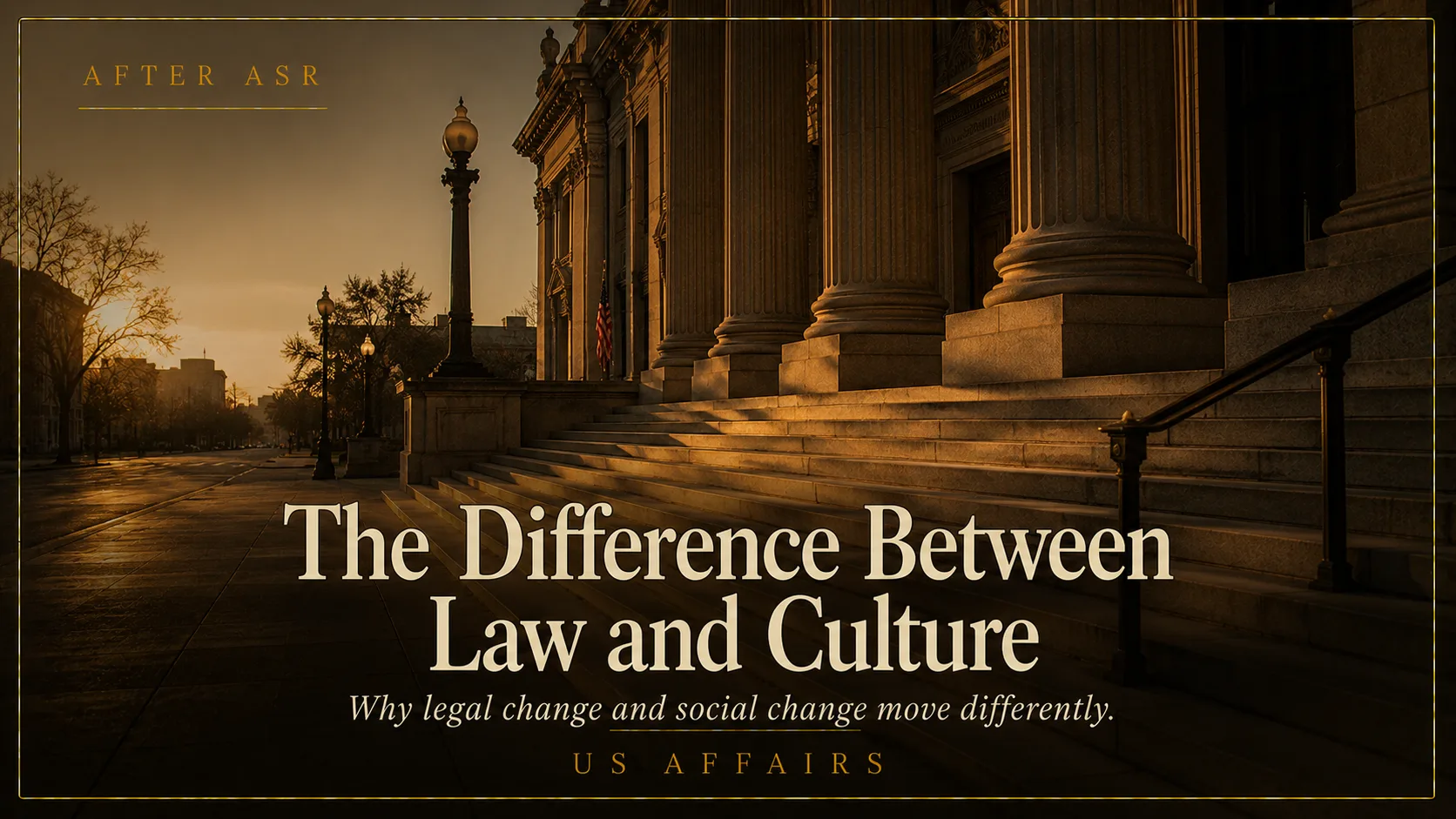
A court issues its ruling at ten in the morning, and by noon the law of the land has changed. A door that was closed is now open, by order, in writing.
Outside the courthouse, the street looks exactly as it did the day before. The same neighbors hold the same opinions they held an hour ago.
The law has moved, and the culture has not. Understanding the gap between them is one of the most useful things a citizen can learn.
Law Is Written; Culture Is Not
Law is a written thing. It exists in statutes, codes, and rulings that a person can point to and read aloud.
Culture is unwritten. It lives in habits, assumptions, and the thousand small reactions people never think to record.
Because law is written, it can be changed by changing the words. Because culture is unwritten, no one can amend it with a signature.
This single difference explains most of what confuses people about social change. They expect the two to move together, and the two are made of different material.
A statute is a decision, and a culture is an inheritance. You can repeal a decision, and you cannot repeal an inheritance by decree.
Knowing which one you are facing tells you which tool will actually work. Aiming a lawsuit at a culture, or a conversation at a statute, wastes both.
A Law Changes on a Date; a Culture Changes Across Generations
A law has a birthday. It takes effect at a specific hour, named in the text, and before that hour it did not exist.
A culture has no birthday. It shifts so slowly that no one can point to the day it changed.
This is why legal victories feel sudden and cultural change feels invisible. One arrives all at once, and the other arrives too gradually to see.
A generation can wake up to a new law and the same old neighbors. The words on the books have changed faster than the people who live beside them.
Patience is required precisely because the two clocks run at different speeds. Expecting the slow clock to keep pace with the fast one guarantees disappointment.
The mismatch is not a sign that nothing is working. It is the ordinary shape of how a society actually changes.
Legal Equality Is Not the Same as Social Acceptance
A law can declare two people equal, and it can do so overnight. It cannot make their neighbors treat them as equals by the same stroke.
Legal equality is a floor set by the state and enforced by its courts. Social acceptance is a warmth given freely by people who cannot be ordered to give it.
The two are related, and they are not the same, and confusing them causes real pain. A community can hold every legal right and still feel unwelcome at the school gate.
This is not a reason to dismiss the legal right as worthless. The floor matters enormously, especially to the one standing on it.
But a person who expected the law to deliver belonging will feel betrayed. The law never promised belonging; it promised protection, which is a different gift.
Knowing the difference spares you both false comfort and false despair. You can be legally secure and socially unsettled at the same time, and many are.
The Floor Is Not the Ceiling
Law sets a floor beneath which a society agrees not to sink. It says what may not be done to you, and it stops there.
Culture builds everything above that floor. The warmth of a welcome, the ease of belonging, the small daily dignities: none of these are legislated.
People who confuse the floor with the ceiling are disappointed twice over. They expect the law to deliver what only culture can, and it never does.
A law against discrimination does not produce friendship. It only removes one obstacle from a road you must still walk yourself.
The floor is worth defending fiercely, because falling below it is a catastrophe. But standing on it is not the same as arriving anywhere.
The distance from the floor to a full life is covered by culture, not by statute. That distance is walked in relationships, not won in courts.
A Right on Paper Is Not a Right in Practice
A right that exists in the code may still be hard to use in the world. Between the text and the reality stands a long chain of human beings.
A clerk who slows the paperwork, an officer who looks away, a landlord who finds another reason: each can dull a right without ever denying it.
The paper right is real, and it is not self-executing. Someone must claim it, and someone must honor it, and both steps can fail.
This is why communities that know their rights are safer than those that do not. A right unclaimed is nearly indistinguishable from a right you never had.
Learning to use a right is a separate skill from possessing one. The law gives you the key, and using the key is a different act.
The gap between the paper and the practice is where much of civic life actually happens. Closing that gap is ordinary, unglamorous, necessary work.
Enforcement Is Where Law Meets Culture
A law is only as strong as the people willing to enforce it. Enforcement is the hinge where the written meets the unwritten.
A hostile culture can quietly starve a law of enforcement without ever repealing it. The words remain on the books, unread and unused, like a tool left to rust.
A supportive culture can make even a modest law powerful. When people expect a rule to be honored, it usually is, with no lawsuit required.
This is why culture and law are not rivals but partners of unequal speed. The law provides the rule, and the culture decides how seriously it is taken.
A wise community works on both, knowing each protects the other. A right defended only in court is more fragile than one also defended by custom.
The enforcement of a law is itself a cultural act. It reflects what a people are willing to insist upon, and what they will quietly let slide.
Culture Can Protect What Law Ignores
Some of the most important protections in a life are never written down. A neighborhood that watches out for its children protects them beyond any statute.
Culture can guard what law never reaches. Hospitality, mercy, the benefit of the doubt: these are cultural gifts, not legal ones.
A Muslim family can be legally secure and still depend daily on the kindness of neighbors. That kindness is a cultural inheritance, not a right they can enforce.
This is why building good relationships is not a distraction from securing rights. It is a second, softer layer of protection that law cannot supply.
Where the law is silent, culture often speaks. And where culture is generous, many disputes never reach a court at all.
A community rich in trust needs the law less often. Not because its rights matter less, but because its neighbors honor them without being compelled.
Law Can Protect What Culture Rejects
The reverse is equally true and equally important. When a culture turns hostile, law can protect what the culture would deny.
A mosque has the right to exist whether or not the neighborhood welcomes it. That right does not depend on the goodwill of anyone nearby.
This is the mercy of a written law: it holds even when sentiment turns against you. A right in the code does not evaporate because a crowd disapproves.
Minorities have always depended on this feature more than majorities do. The majority can rely on culture, and the minority often relies on the law.
A hostile culture is a serious burden, and it is not the same as a lost right. The two feel similar and are not, and the difference can be everything.
When the neighbors are cold, the law is the floor you still stand on. It was written precisely for the seasons when culture offers no warmth.
The Lag Between the Ruling and the Reality
There is always a lag between a legal change and its lived result. The ruling comes first, and the reality follows years or decades later.
This lag frustrates everyone, and it is not evidence of failure. It is the time a culture needs to catch up to a decision made in an afternoon.
People who win a legal victory often expect the world to change by morning. When it does not, they conclude the victory was hollow, and they are wrong.
The victory was real; it simply operates on a slower schedule than they hoped. The seed is planted, and the tree does not appear the same week.
Understanding the lag protects you from a particular kind of despair. You stop mistaking the delay for a defeat, and you keep working through it.
Many changes we now take for granted were, in their first years, widely resisted. The lag closed quietly, while an impatient generation assumed nothing had moved.
Culture Moves by Story; Law Moves by Rule
Law changes conduct by rule, and culture changes it by story. The two speak different languages to different parts of a person.
A rule tells you what you must do, and it does not ask you to feel anything. A story shows you a life, and it changes what you feel without issuing a command.
This is why a single film or friendship can shift a culture more than a hundred statutes. Feeling moves ahead of obligation, and story reaches feeling directly.
A community that wants to change a culture must learn to tell its own story. If it leaves the telling to others, others will tell it badly.
The Muslim who is simply known, as a neighbor and a coworker, is a story. That quiet presence teaches what no argument could.
Rules and stories are different instruments, and a serious effort needs both. One secures the right, and the other slowly wins the room.
Law Usually Follows Culture, Not the Reverse
We like to imagine that law leads and culture follows. More often, the culture shifts first and the law is written to match.
By the time a law changes, the ground beneath it has usually already moved. The statute ratifies a change that the people had mostly made already.
This means cultural work is not secondary to legal work; it is often prior to it. The vote at the end tends to confirm a consensus built long before.
A community that wants a law changed is wise to change the conversation first. The most durable legal victories rest on cultural ground already prepared.
This is slow and patient labor, and it rarely makes the news. It is also where the deepest and most lasting changes begin.
The dramatic ruling is the visible peak of a hill that culture spent years raising. We remember the peak and forget the long work of the slope.
Yet Law Also Teaches
The influence does not run only one way. A law, once passed, slowly teaches the culture what to expect.
What is required for long enough begins to feel normal, and what feels normal becomes belief. The rule leads at first, and the sentiment eventually catches up.
A generation raised under a law often cannot imagine the world before it. The statute that once felt imposed becomes the common sense of their childhood.
So law and culture teach each other, on different timelines, in turn. Neither is purely the leader, and neither is purely the follower.
This mutual teaching is why patient civic work is never wasted. Every rule kept and every story told adds to a slow, two-way conversation.
The law is a teacher with a long lesson and a longer patience. It corrects the culture gently, over generations, and asks for time.
Two Tools for Two Different Problems
Law and culture are two tools, and each is suited to a different problem. The trouble begins when a person reaches for the wrong one.
If your right is being denied, the tool is the law, and you should use it without apology. A conversation will not restore a right that a court can.
If you are legally secure but socially alone, the tool is culture, and no lawsuit will help. You cannot sue your way into being welcomed.
Diagnosing the problem correctly is half of solving it. Ask first whether you face a broken rule or a cold room, because the answer names the tool.
Much wasted effort comes from applying the right tool to the wrong problem. The remedy is not more force but better aim.
A mature community keeps both tools sharp and knows when to pick up each. It does not expect the hammer to do the work of the hand.
Mistaking One for the Other Wastes Both
When people expect the law to deliver warmth, they grow bitter at the law. When they expect kindness to secure a right, they are left defenseless.
Each tool fails when it is asked to do the other’s job. The failure is not in the tool but in the choice of it.
A community that understands the difference spends its energy wisely. It litigates what must be litigated and befriends what must be befriended.
The one who confuses the two burns out fighting the wrong battles. He sues for belonging and pleads for rights, and loses at both.
Clarity here is not a luxury; it is the difference between progress and exhaustion. Naming the problem correctly conserves the strength you will need.
Both tools are precious, and neither is a substitute for the other. Respecting each for what it does is the beginning of getting anywhere.
What This Asks of a Community
A community that grasps this distinction works on two fronts at once. It defends its rights in the arenas built for rights.
And it builds its belonging in the slower arena of daily life. It knows the mosque needs both a lawyer and a good neighbor.
It does not despair when a legal win fails to warm the culture overnight. It does not mistake a friendly neighbor for a secured right.
It teaches its young people which tool answers which trouble. That teaching is itself a form of protection handed down.
Above all, it keeps the two clocks in mind and refuses to be ruled by either. The fast clock does not make it reckless, and the slow clock does not make it despair.
Such a community is hard to discourage, because it expects the right things. It knows what each tool can do, and it asks no more of either.
What a Muslim Reader Can Carry
Law and culture are not the same, and it is worth knowing that clearly. One is written and fast, and the other is unwritten and slow.
When a right is at stake, reach for the law and do not apologize. When belonging is at stake, reach for people and give it time.
Defend the floor. Build above it.
Do not ask the law for warmth, or ask kindness for protection.
The two clocks will never quite agree, and you can hold them both.
One change you may win this year. The other you must simply keep watering.