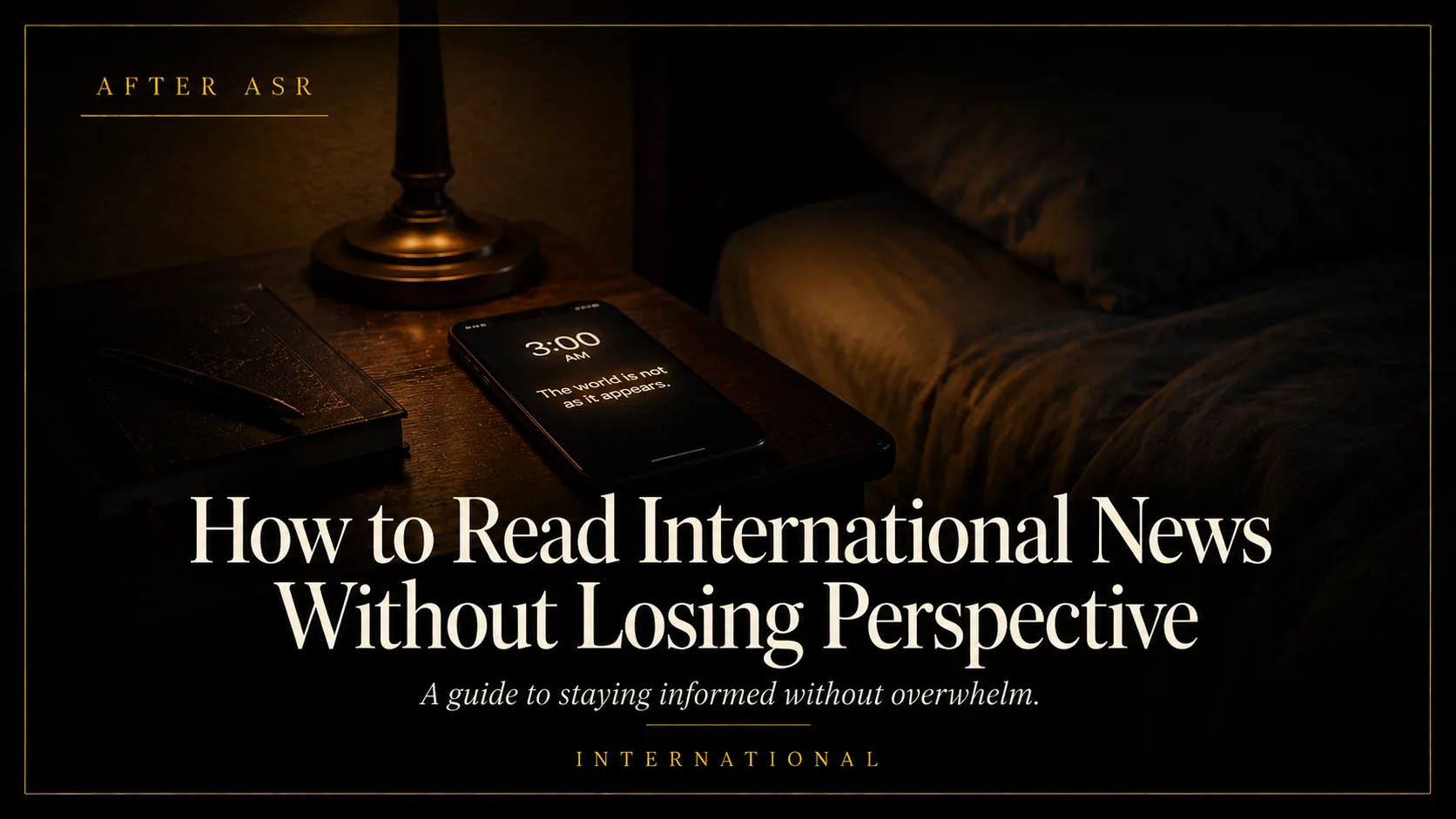
At three in the morning a phone lights up on a nightstand in Ohio.
One line of text glows in the dark. A city I cannot pronounce has been struck.
The house is asleep. The whole planet is in my hand, and I cannot put it down.
The Alert That Woke the House
That small rectangle is a strange instrument. It is a window onto everything at once.
Behind the single line lie satellites, undersea cables, wire services, and a reporter somewhere very tired. A sentence traveled through all of that to reach a nightstand in a sleeping town. The machinery is vast beyond imagining, and its final act is a buzz. A hundred editors, a dozen bureaus, and a thousand miles of cable end in one small vibration against pine.
Then the scene narrows. I am not a global citizen at that hour. I am one man deciding whether to open the message or turn the phone face down. The world is enormous, and my capacity to hold it is the size of a palm. Everything that follows in reading the news begins with that mismatch, and with learning to live inside it honestly.
A Headline Is a Door, Not a Room
A headline is built to be crossed, not to be lived in. It exists to make you enter.
Editors compress a whole event into six or eight words. Those words must survive a crowded feed and a distracted thumb. Compression is not deceit, but it is loss. Something true is always left in the hallway outside the room. A verb is chosen for force. A number is rounded for rhythm. The nuance that would slow a reader down is the first thing cut.
The reader who stops at the headline has stood in the doorway and called it the house. Walk in. Read the third paragraph, where the qualification usually hides. The first line tells you an event occurred. The middle of the article tells you how much anyone actually knows. Those are different quantities, and the gap between them is where perspective is either kept or lost.
What the Dateline Really Tells You
Near the start of a serious report sits a small word in capitals. It names a city.
That dateline is a quiet confession. It says a person stood in a particular place and saw a particular slice. It does not say the reporter saw the war. It says the reporter saw one road, one hospital corridor, one official at one briefing. Everything beyond that road was told to him by someone else, or gathered by phone, or trusted on faith.
Widen the frame and a country holds a thousand such corridors at once. A single correspondent can stand in only one. So the honest reader treats a dateline as a coordinate, not a summary. It marks where the light fell. It cannot mark all the rooms that stayed dark while one was lit. When there is no dateline at all, ask yourself who was actually present, and whether anyone was.
The Feed Was Built Never to End
A newspaper once had a last page. You reached it, and you were finished.
The feed has no last page by design. It refreshes as you approach the bottom, always offering one more. This is not a moral failing in you. It is an engineering choice made by people paid to hold your attention as long as possible. The old paper wanted you to finish and go make breakfast. The feed wants you never to finish at all.
Zoom out and this is a global industry, measured in hours captured and adverts served. Narrow back to one person on a couch at midnight, thumb moving, eyes tired, no wiser than an hour before. The endless scroll does not make a reader informed. It makes a reader occupied. Knowing the difference is the beginning of using the thing instead of being used by it.
The Algorithm Chose Before You Did
You believe you are choosing what to read. Mostly, something chose for you first.
Between the world and your eyes sits a machine that ranks stories by how likely you are to react. It has learned that anger travels farther than nuance. It has learned that your outrage keeps you scrolling. So it feeds you the version of the world most likely to keep you where you are, which is not the same as the world.
Consider two readers in two towns, each certain he is simply informed. One sees a planet on fire, the other a planet of triumphs, and each was handed his planet by the same silent sorting. Narrow to the single tap that trained it, weeks ago, when you lingered on one furious clip. The feed remembered. It has been answering that tap ever since.
The First Report Is Usually Half Wrong
In the opening hours of any large event, the facts are still wet. They have not set.
Casualty numbers move. Names are corrected. The cause announced at noon is quietly abandoned by night. This is not because journalists are careless. It is because reality arrives in fragments, and the fragments are published as they land. The first witness saw smoke and guessed at fire. The guess became a headline before anyone reached the building.
A patient reader learns to hold early numbers loosely. The instinct to know now is strong, and the world rewards the person who speaks first. But being first and being right are separate achievements, and they often arrive on different days. When a story is only hours old, the wisest posture is attention without conclusion.
Nearness Bends the Numbers
A traffic accident on your street can shake you more than a famine far away. This is human.
The mind measures by distance, not by scale. Ten thousand deaths in a place you cannot picture feel smaller than one death you can. It is a flaw in our wiring, and no amount of shame will remove it. But it can be noticed, and noticing is half the correction. The reporter fights the same flaw, which is why the best of them look for one face to carry the ten thousand.
Consider a flood that displaces two million people in a delta you have never seen. The number is too large to feel, so it is filed as weather. Then imagine one family on one rooftop, watching the water take the kitchen. The particular restores the weight the number could not carry. This is the reader’s daily work, to keep converting the abstract back into the human.
Who Is Telling You, and From Where
Every report is written by someone, funded by someone, and shaped by where it stands. There is no view from nowhere.
A wire agency, a state broadcaster, and an exile’s blog can describe the same afternoon in three different worlds. None of them is simply lying. Each is standing somewhere, and the standing place bends the light. To read well is to ask, quietly, who holds this camera and what lies just outside its frame. Who paid for the trip. Who granted the visa. Who would be embarrassed by the fuller picture.
This is not cynicism. Cynicism decides in advance that everyone lies and therefore nothing can be known. The careful reader does the opposite. He gathers several standing places and lets them correct one another, the way surveyors fix a point by measuring it from three hills. One angle is a rumor. Three angles begin to be a fact.
Translation Is Never a Clean Pane of Glass
Most of the world does not happen in your language. It reaches you already translated.
A leader’s word can mean warning in one tongue and mere firmness in another. A protest chant loses its rhyme and half its meaning on the way across a border. Somewhere a translator, usually unnamed, made a choice that shaped what a million readers now believe a foreign crowd was feeling.
Zoom out and whole conflicts have hardened around a mistranslated phrase, repeated until it seemed like evidence. Narrow back to one person at a desk, deciding whether a single verb means resist or destroy. The reader rarely sees that desk. But knowing it exists changes how firmly he trusts a quotation carried across three languages before it reached him.
The Story Beneath the Story Is Often Dull
Dramatic events usually sit on top of undramatic causes. The causes rarely trend.
A currency collapses in a single spectacular week. Beneath it lie years of debt, drought, and quiet policy, none of which made an alert. The explosion is visible. The pressure that built it was slow, boring, and mostly unreported. The riot is filmed. The decade of unpaid teachers that preceded it was not.
So the reader who wants understanding must sometimes seek out the tedious. Read the long piece on grain contracts. Read the explainer nobody shared. The headline gives you the eruption. The dull article underneath gives you the geology, and only the geology explains why the ground gave way here and not somewhere else.
Count the Sources, Then Count the Silences
A good article names where its claims come from. A great reader also notices who is missing.
When a story about a village quotes three officials and no villagers, that absence is information. When every voice sits on one side of a border, the report has a shape before it has a fact. The silences in a piece are as telling as its quotations. Ask who could not be reached, who declined to comment, and who was never thought worth asking.
Widen the lens and whole regions go quiet for want of reporters, budgets, or safe roads. Narrow back to one town that made the news only because a camera crew happened to pass through. What reaches you is not the world. It is the part of the world that someone could afford to reach and was allowed to describe.
A Country Is Not Its Worst Week
Most nations enter the global news only when something breaks. Then they vanish again.
A reader who meets a country solely at its funerals will believe the country is a funeral. He will not know its ordinary Tuesdays, its weddings, its arguments about football and bread. The archive of coverage is an archive of emergencies, and emergencies are not the average of a life. A place appears on the map of attention only when it bleeds, then falls off it the moment the bleeding stops.
I have stood in places the world knew only by their catastrophes. On the ground there were markets, schoolchildren, and men complaining about the price of onions. The catastrophe was real. It was also one week, in one district, in a place that mostly spent its days doing what all places do, which is continue.
Your Attention Is a Finite Fund
You cannot follow everything, and pretending you can is its own kind of harm. The fund runs dry.
A person who tries to grieve every disaster equally ends by grieving none of them well. Attention spread across the whole earth thins into a film too weak to move anyone to anything. This is why the endless feed can leave a caring person feeling numb rather than moved. The numbness is not a lack of heart. It is a heart asked to do the impossible and quietly failing.
So choose. Follow a handful of stories with real depth and let the rest pass with a nod. Depth in a few places teaches more about the world than a shallow glance at all of it. To look away from most things is not indifference. It is the condition of paying true attention to any.
Follow a Few Stories All the Way Down
Pick one region and stay with it for a year. Let it become particular in your mind.
At first it is a name and a flag. Then it grows faces, a currency, a coastline, a set of arguments its own people are having. After a while a new headline from that place no longer lands on blank ground. It lands on a year of context you have built. You know which party is which. You know why the river matters. The alert that once frightened you now merely informs you.
This is the difference between the tourist and the neighbor. The tourist knows a hundred places as postcards. The neighbor knows a few as homes. The reader who wants perspective becomes a neighbor to a small number of the world’s rooms, and lets that patient knowing stand in for the impossible task of knowing all of them.
The Correction Rarely Travels as Far as the Error
A false first report can reach millions in an hour. The correction reaches a fraction, days later.
This asymmetry shapes what a whole population believes. The dramatic wrong claim is shared, argued, and remembered. The quiet fix arrives after the crowd has moved on, and it changes almost no one’s mind. Truth, in the news economy, is often slower than the lie it replaces. The retraction runs on page nine. The error ran on every screen.
The careful reader builds a habit against this. When a shocking claim turns out to be false, he goes back and updates himself, on purpose, without applause. Nobody rewards this act. It happens in private, against the current. But a mind that revisits its own errors is the only mind that slowly gets the world less wrong.
What to Keep and What to Release
Not every story is yours to carry. Some are, and knowing which is a discipline.
Keep the ones near your actual life and the ones where your attention can become action. Keep the few you have chosen to know deeply. Release the rest with respect, not contempt, the way you nod to a stranger on a train and let him go on to his own stop. You are not abandoning them. You are admitting the honest limits of one mind.
The reader who keeps everything is crushed. The reader who keeps nothing is hollow. Between the crush and the hollow is a smaller, steadier practice, of knowing a little truly and holding it with care.
Reading as a Form of Respect
In the end, how we read the news is a way of treating people we will never meet.
To read carelessly is to turn a distant family into a statistic and then a scroll. To read well is to keep insisting that the number was a person, that the country was more than its worst week, that the story had a room beyond the door.
The phone still lights up at three in the morning. It always will.
What changes is the reader. He learns to open the message slowly.
He learns that being informed and being overwhelmed are not one thing, and that the difference is a choice made every day.
The world is too large to hold. A few of its rooms are not.
Begin there.