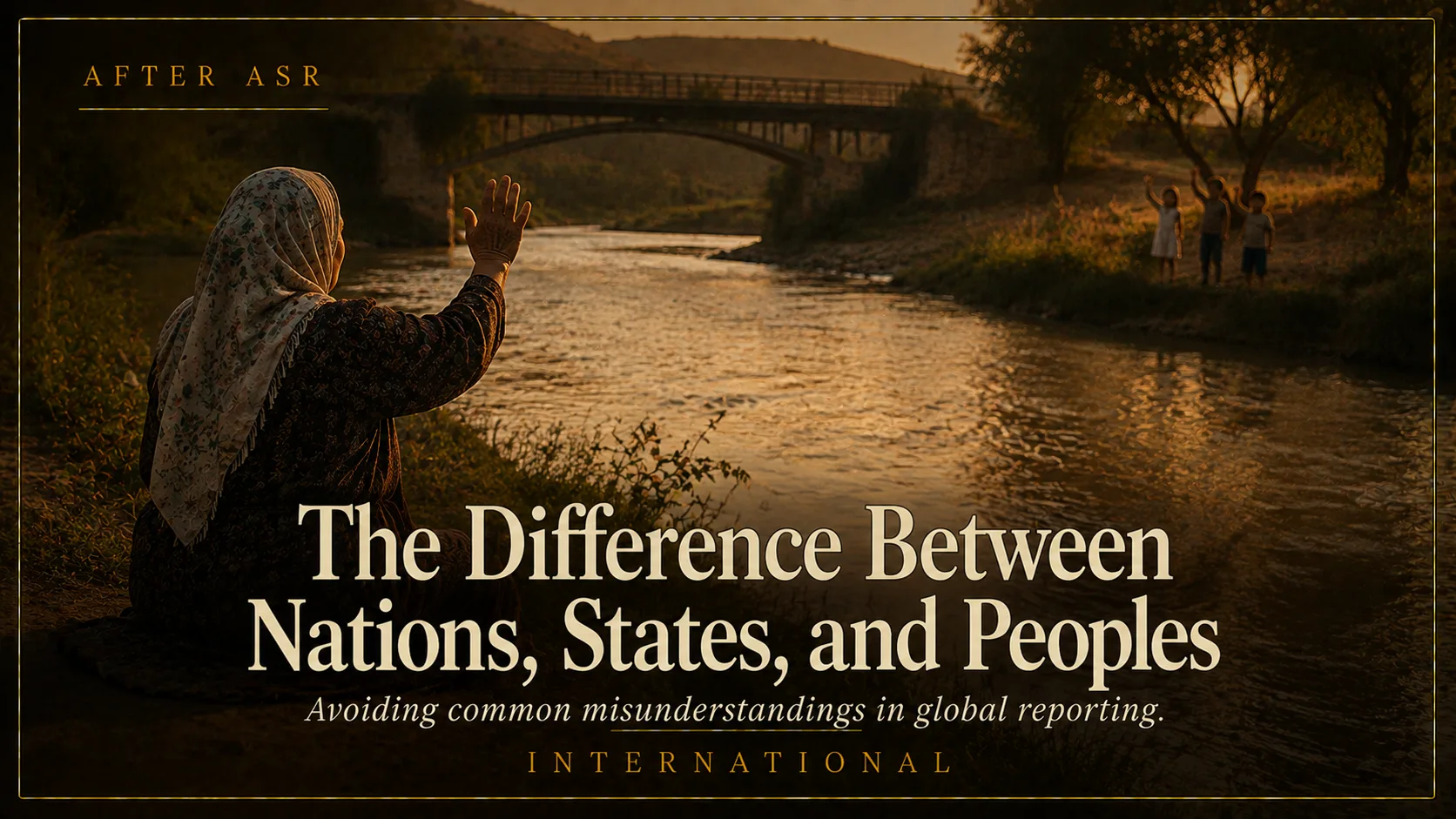
On one bank of a slow brown river, a grandmother lifts her hand to wave.
On the far bank, her grandchildren wave back. They speak her language and cook her food.
Between them runs a line no one can see, and it decides almost everything.
The Grandmother and the River
The river was here long before the line. The family was here before the river had a name.
Then, in some distant year, negotiators in a cool room drew a border down the middle of the water. On one side the children carry one passport, on the other a different one. Same blood, same grandmother, same recipes for the same bread, and yet two futures, two armies, two sets of laws that will shape their whole lives.
Zoom out and this single family is a small model of the whole confusion. We use three words as if they meant one thing. Nation, state, people. They do not mean one thing. Narrow back to the grandmother, who does not care what the words mean. She only wants to cross the bridge before it closes at dusk, and hold the children who belong to her and to no map.
A State Is a Machine, Not a Soul
Begin with the coldest of the three. A state is an apparatus. It has offices and stamps.
A state is the government, the army, the tax collector, the courts, the flag on the embassy roof. It controls a territory and claims the sole right to make and enforce the rules inside it. It sits in a chair at the great assemblies of the world and signs treaties in its own name. It is a machine for organizing power over land.
Widen the lens and there are fewer than two hundred such machines on earth, each guarding its borders and its seat at the table. Narrow back to the single clerk at the passport window, bored, sovereign, deciding whether your document is in order. That clerk is the whole state, compressed into one tired face. The state is real, but it has no soul. It has procedures.
A Nation Is a Feeling That Learned to Point at a Map
A nation is warmer and stranger than a state. It lives in the chest, not the office.
A nation is a large group of people who believe they belong together, who share a story about who they are and where they come from. Most of them will never meet. Yet each carries the same imagined family in his head, the same heroes, the same wounds, the same songs sung at funerals. A nation is a feeling that a great many strangers agree to feel at once.
Zoom out and this shared feeling can raise armies, redraw borders, and outlast the states that try to contain it. Narrow back to one man standing for an anthem in a stadium, his throat tight, though he has never met a single other person in the crowd. He is feeling the nation. It is not on any map until enough people like him decide it should be.
A People Is Older Than Both
Beneath the state and the nation lies the oldest layer. A people is a web of kinship, language, and memory.
A people is bound by descent, by a mother tongue, by generations of shared living in a place. It existed before anyone drew a border or wrote an anthem. States rise and fall on top of peoples like weather over a mountain. The mountain remains.
Widen the frame and a single people can be scattered across many states, or buried inside one, or split by a river like the grandmother’s family. Narrow back to a child learning a grandmother’s language at a kitchen table, absorbing a thousand years of a people before she can spell her own name. No parliament granted her that inheritance. She simply received it, the way one receives a face.
When the Three Line Up, We Call It a Nation-State
Sometimes, rarely, the state, the nation, and the people mostly overlap. We call the tidy result a nation-state.
In the neat version, one people shares one national feeling inside one set of borders, governed by one machine that they consider their own. This is the picture most of us carry, and it is why we say country as if it explained everything. It is a real arrangement. It is also far less common than the map makes it look.
Zoom out and the world is not a quilt of neat nation-states. It is a rough patchwork where the seams almost never fall on the borders. Narrow back to any actual country you can name, and you will find minorities, dialects, and old wounds that the tidy word conceals. The nation-state is not the rule of the world. It is the exception we mistook for the rule.
When They Come Apart, We Call It the News
Most of what we call international conflict is the three layers pulling against each other. The seams tear.
A state contains a people who do not share its national feeling. A nation spreads across borders that a state means to defend. A people is ruled by a machine it never chose. Nearly every long crisis on the map is some version of this mismatch, dressed in the language of the day.
Widen the lens and the pattern repeats across continents, in valleys and cities that share nothing but the shape of the problem. Narrow back to one checkpoint where a young soldier of the state stops an old man of another people, both trapped inside a mismatch neither designed. The soldier is not evil and the old man is not a symbol. They are two people standing on a torn seam.
The Stateless Nation
Some of the largest nations on earth have no state of their own. They are peoples without a chair at the table.
Tens of millions can share a language, a history, and a fierce sense of belonging, and still find their homeland divided among the states of others. They carry the passports of governments they did not choose. Their flag flies at weddings but not at embassies. The nation is unmistakably real. The state that would hold it does not exist.
Zoom out and these stateless nations shape the politics of whole regions, feared by the states that contain them, courted and betrayed by turns. Narrow back to a shepherd on a hillside who could tell you exactly which people he belongs to and could not tell you which country he lives in without a bitter laugh. His nation is in his bones. His state is an accident of the last war.
The Multinational State
The mirror of the stateless nation is the crowded state. One machine, many peoples inside it.
A single state can hold dozens of peoples, dozens of tongues, dozens of stories that do not agree. It binds them with a border, a currency, and a common army, and hopes the binding holds. Sometimes it does, for centuries. Sometimes it splits along the old seams the moment the machine weakens.
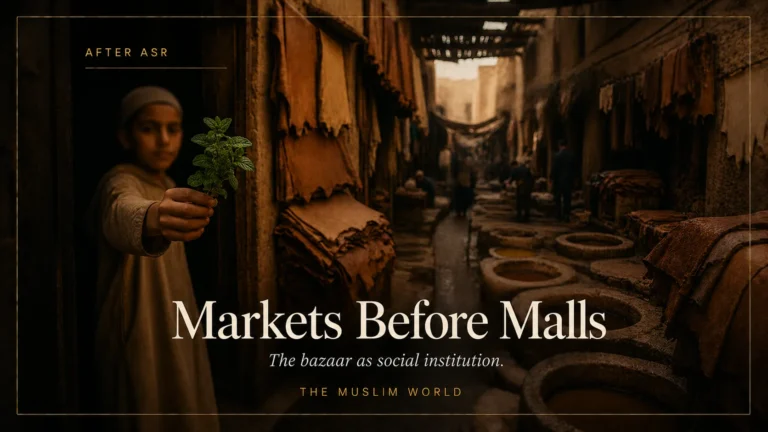
Widen the frame and some of the largest states in history were vast collections of peoples, held together by force, by trade, or by a shared idea. Narrow back to a market in such a state, where four languages are spoken across three stalls and no one finds it strange. That market is the real texture of the place. The single word on the map is only its outermost skin.
Empire Is the Ghost Behind Most Borders
Ask why a border sits where it does, and the answer is usually an empire that has since gone home. The ghost stays.
Many of the lines that now divide peoples were drawn by distant powers who never lived on the land. They split one people to weaken it, or fused rival peoples to rule them cheaply, and then departed, leaving the seams behind. The empires fell. Their handwriting remained on the map.
Zoom out and whole continents still live inside borders that a few colonial officials sketched over dinner. Narrow back to two villages that were one village until a surveyor’s pencil separated them, and have been foreign to each other ever since. The pencil belonged to a man now a century dead. The villages are still paying his bill.
The Diaspora Is a People Carried Abroad
A people does not always stay on its land. Sometimes it is scattered, and carries the homeland inside it. This is a diaspora.
Driven out by war, hunger, or hope, a people can spread across a dozen states and still remain, in memory and marriage and prayer, one people. The children born abroad may never see the old country, yet they inherit its language of longing. The land is lost. The people endures in the carrying.
Widen the lens and diasporas fund revolutions, sway distant elections, and keep dead borders alive in the heart for generations. Narrow back to a grandmother in a foreign kitchen, teaching a grandchild a song from a village neither will likely see again. The village may be gone. The song is a country that fits in a single voice.
The Passport Is a State’s Signature, Not a Soul’s
Consider the small booklet in a drawer. It seems to say who you are. It says less than that.
A passport is the state’s signature on your body, its claim that you belong to its machine. It grants the right to cross certain lines and denies the right to cross others. But it says nothing about your language, your people, or the nation you feel in your chest. Two people with the same passport may share no story at all.
Zoom out and the color of a passport quietly sorts the whole of humanity, opening borders for some and sealing them for others. Narrow back to a traveler at a counter, watching an officer weigh a document that describes his state but not his soul. The booklet decides where his feet may go. It has no opinion on who he is.
Citizenship and Belonging Travel on Different Roads
Citizenship is granted by a machine. Belonging is grown in a life. They do not always arrive together.
A person can hold a citizenship and feel like a guest in the country that issued it. Another can lack the papers entirely and belong to a place with every fiber of memory and habit. The state records citizenship in a database. Belonging is recorded nowhere, and felt everywhere.
Widen the lens and millions live in this gap, legally of one state and truly of another people, or truly of the place that will not fully claim them. Narrow back to a young woman filling out a form that asks for her nationality, pen hovering, because the honest answer will not fit in the box. The box wants one word. Her life has three.
Why Reporters Reach for the Wrong Word
The confusion is not laziness alone. The three words are genuinely hard, and deadlines are short.
It is faster to write the country than to name the actual actor, faster to say a people wants than to admit that peoples are not of one mind. Shorthand is the currency of the news, and shorthand rounds off the very distinctions that carry the meaning. The rounding feels harmless. It quietly reshapes what readers believe.
Zoom out and a generation raised on this shorthand comes to think that states are people and peoples are unanimous. Narrow back to a single sentence in a single report, where a whole diverse population is folded into one imagined mind with one imagined desire. The sentence saves the writer a clause. It costs the reader the truth.
The Danger of Calling a State a Person
We write that a country decided, wanted, or attacked. The habit is convenient and it hides the people.
When a state is spoken of as a single person, the millions inside it disappear. The soldier and the dissident, the grandmother and the general, all vanish into one pronoun. It becomes easy to hate a whole population for what its machine did, and easy for the machine to hide behind the population it claims to speak for.
Widen the frame and whole wars have been sold by shrinking a state into a face on a poster. Narrow back to one family in that state, opposed to what is done in their name, unable to stop it, and blamed for it abroad regardless. They are not the country. No one ever is. The country is a word we put over people to save ourselves the trouble of seeing them.
Borders Move, Peoples Remain
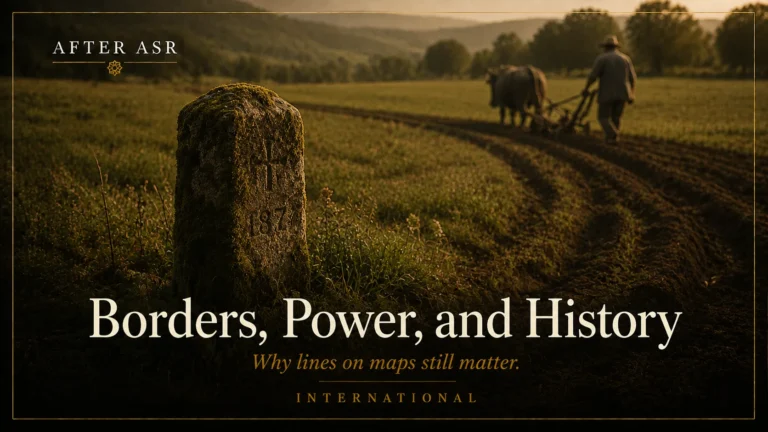
Borders are the youngest thing on the map, though they pretend to be the oldest. Most are barely a century old.
Lines have been redrawn by wars, treaties, and the retreat of empires, sometimes several times within one lifetime. A single old man may have lived, without ever moving house, in three different states. The border came to him, again and again. The people around him stayed the same people.
Zoom out and the map is not a permanent thing but a photograph of the last settlement of power. Narrow back to that old man, pointing at the hills and telling you which flag flew over them when he was a boy, and which flies now. The hills did not move. The line did. He is loyal, in the end, to the hills.
The Anthem, the Team, the Flag
A nation is invisible, so it must be made visible. It builds itself from symbols we can see and hear.
The anthem sung at dawn, the team that plays in the tournament, the flag folded at a funeral, all of these teach strangers to feel like kin. They are how a nation reminds itself, daily, that it exists. Take away the symbols and the shared feeling grows harder to hold. This is why states guard their flags so fiercely.
Widen the lens and a stateless people will pour its whole heart into a team or a song, because the symbol is the only country it is allowed to have. Narrow back to a boy in a jersey, weeping at a goal, feeling a nation the map denies him. The scoreboard is temporary. The belonging it lets him feel is not.
Why the Distinction Is Mercy, Not Pedantry
None of this is a grammar lesson. To keep the three words apart is to keep people from being crushed under them.
When we confuse a state with its people, we punish the innocent for their governments. When we confuse a nation with a state, we deny the stateless their reality. When we forget the people beneath both, we forget the only thing that was ever actually alive. Precision here is not fussiness. It is a form of care.
Zoom out and every great cruelty of the modern age leaned on one of these confusions, a people blamed, a nation erased, a state mistaken for a soul. Narrow back to the reader at a screen, deciding, in the small privacy of his own mind, to see the difference. That decision changes nothing on the map. It changes everything about how he treats the human on the other side of it.
The River Still Runs
Return to the grandmother at the water, her hand still raised in the dimming light.
The state drew the line. The nation flies its flags on either bank. But the people are one people, and the river does not know the difference.
She crosses the bridge. She holds the children. For an hour, the map means nothing.
Then dusk comes, and the border closes, and she goes back to her side.
The words will keep confusing us, because the world is stubborn and the words are blunt.
But under every state is a people, and under every map is a family.
Learn to see them, and you have learned to read the world.