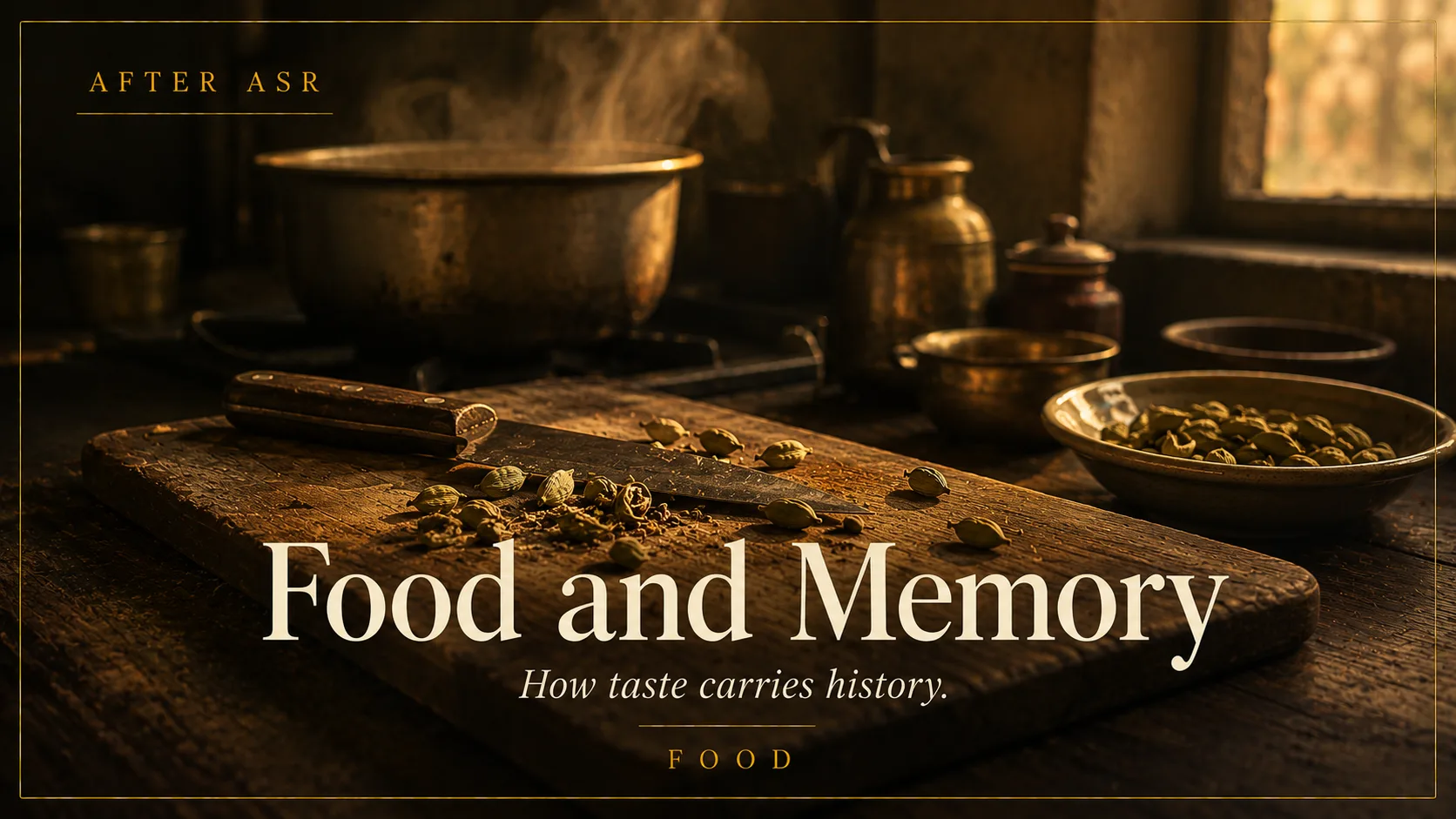
The cardamom pod cracks under the knife, and your grandmother walks into the kitchen.
She has been gone eleven years. The smell does not know that. It rounds the corner of the stove like she used to, asking whether you salted the rice.
You stand still for a moment, holding the knife. Then you keep cooking, because that is what she would have said to do.
Taste Is the Fastest Time Machine
Nothing else transports like flavor. A photograph shows you the past at a polite distance. A spoonful of your childhood puts you inside it, age eight, feet not reaching the floor.
The scientists have their explanation, and it is a good one. Smell and taste report to the oldest rooms of the brain, the ones that handle emotion and memory, without stopping at the front desk of language. The shortcut is anatomical. The homesickness is real.
This is why a grown man can stand at a hotel buffet, taste a daal that comes close enough, and feel his eyes sting in front of colleagues. His body crossed thirty years and an ocean between the fork and his mouth.
Literature made this discovery famous with a French cake dipped in tea. Every grandmother on earth had already made it with whatever her kitchen held. The novelists got the credit. The kitchens did the research.
We carry our histories in many places. Documents, albums, the stories told at weddings. But the most faithful archive sits on the tongue, and it opens without being asked.
The Tongue Learns Before the Mind Does
Your palate was educated before you could speak. Whatever simmered in the kitchen of your first years wrote itself into you as the definition of food, the baseline all later meals are measured against.
No one chooses this curriculum. The child of Lahore learns one alphabet of flavor, the child of Dakar another, the child of Dearborn some braided third. By the time we can name our preferences, they are already older than our names.
This is worth remembering before anyone sneers at comfort food. The bowl that soothes you is not a weakness of character. It is your earliest schooling, asking to be visited.
There is no shame in eating your history when the week has been long. The body is not confused about what it needs. It is remembering who fed it first, and borrowing some of that safety.
And the school never closes. A convert in her thirties builds a new shelf of taste from her first Ramadan, and within a few years those flavors summon feeling as strongly as anything from childhood. The palate is hospitable. It accepts late enrollments.
Honor the baseline. Then build on it, gently, the way all good education proceeds.
A Recipe Is a Document of Survival
Read an old family recipe closely and you are reading history in disguise. The war is in it. The rationing is in it. The year the good saffron became unaffordable is in it, hiding inside the word optional.
Why does the recipe stretch one chicken across nine people? Because it had to, in 1972, and the technique outlived the scarcity. Why so much rice, so little meat, so much skill spent making little taste like plenty? That is not a style. That is a survival record, written in grams.
Archives burn and borders move, but dinner keeps getting cooked. Families who lost everything portable often arrived with recipes intact, because that inheritance was stored in muscle and memory, where customs officers cannot search.
Even the physical card testifies. The grease spot always lands on the same paragraph, marking where the real work happens. The margins hold a second recipe in pencil, someone’s correction from a winter no one else remembers.
Your mother’s way of stretching a pot is scholarship. Treat it accordingly. Somewhere inside it, a hard year is still being outsmarted, decade after decade, in your kitchen.
What the Suitcase Carried
Ask anyone who has migrated what traveled in the luggage. Under the clothes, wrapped in socks, taped inside tins, there were spices. There was the good tea. There was a plastic bag of a lentil no American shelf stocked in those years.
Customs forms had no field for what these items actually were. Provisions is the wrong word. They were coordinates. A household orienting itself in a new hemisphere by the fixed star of a familiar pot.
The first weeks in a new country are a fog of paperwork and wrong-sounding traffic. Then one evening the old dish is finally cooked in the new kitchen, and the smell colonizes the apartment, and for one hour the address does not matter.
The early phone calls home were half recipes, too. Long-distance minutes were expensive, and whole paragraphs of them went to how much turmeric, which cut of meat, what to do when the dough refuses. Love, dictated across oceans, one step at a time.
Home, it turns out, is partially aromatic. The suitcase knew this before the theory did. Pack the spices first, the elders said. Everything else can be bought where you are going, except the taste of where you have been.
The Dish That Tastes Like a Country That Changed
Here is a strange mercy of diaspora cooking. The homeland keeps moving, but the emigrant’s kitchen stops the clock.
The bread in the old city has changed twice since your father left. Restaurants modernized, shortcuts arrived, a generation stopped making the difficult pastry. Meanwhile, in a suburb of Chicago, your aunt still cooks the version from the year of departure, unchanged, like a pronunciation preserved far from the capital.
Visitors from back home taste her cooking and grow quiet. This is how my grandmother made it, they say, surprised to find the past alive and well and living abroad.
The reverse discovery unsettles the second generation. They fly back to the ancestral city carrying the family’s sacred dish in their expectations, and the cousins there barely recognize it. What they grew up calling authentic was really a photograph of one household in one departing year.
Exile is full of losses that get counted. This is one of the gains that rarely does. The scattered kitchens of a people become its living museum, each one curating a flavor the homeland itself forgot to keep.
Substitution Is the Sound of a Recipe Breathing
Purists guard recipes like relics, and their devotion has its uses. But watch what actually happens in a new country, generation by generation.
The original squash cannot be found, so butternut steps in. The bread of one continent wraps the filling of another. A grandmother in Houston makes her stew with local greens and laughs that her own mother would squint at the pot, then ask for seconds.
Every substitution is a timestamp. It records the year the family met a new grocery aisle, a new neighbor, a new land willing to feed them. The recipe did not break. It inhaled.
The traffic runs both directions in an American Muslim kitchen. The Thanksgiving turkey arrives with a halal certificate and leaves the oven wearing a rub its pilgrim hosts never imagined. A new memory-dish is born, native to nowhere but this house, which is to say native here.
A living tradition cooks like this, faithful in essence and flexible at the market. The dish that adapts survives to carry its history forward. The dish that refuses ends up laminated in a cookbook no one opens.
Guard the soul of the recipe. Let the vegetables negotiate.
Dates at Sunset, Everywhere and Always
Consider what happens each Ramadan at sundown. On every continent, in every time zone, fasting people reach for the same first taste. A date, as the Prophet did, peace be upon him, who broke his fast with fresh dates when he had them, and with water when he did not.
Fourteen centuries of sunsets have kept that flavor in place. A taxi driver in Queens and a farmer outside Fez end the same hunger with the same sweetness, and both are following the same beloved example.
This is taste as connective tissue. Not nostalgia for one kitchen, but membership in a body that spans the planet and the centuries at once. The date belongs to no single country, which is precisely why it can carry all of them.
Whole seasons work this way in a Muslim home. Ramadan has a flavor calendar all its own, the fried things that appear nowhere else all year, the particular soup that means the month has truly begun. The body learns the liturgical year through the kitchen long before it can read.
A child who grows up breaking fast on dates is being given a memory with an enormous address book. Wherever she travels for the rest of her life, that first sweetness at maghrib will taste like belonging to something that cannot be emigrated out of.
What the Pilgrims Bring Back
Watch the luggage carousel when a hajj flight lands. The suitcases come back heavier than they left, and everyone present knows why. Dates from Madinah. Zamzam water, boxed and taped and prayed over.
The pilgrims could buy dates at any store in America. That was never the point. These particular dates carry a place in them, and the place is the point. To share them is to distribute the journey itself, one taste at a time, to everyone who could not go.
The neighbor who receives three dates and a small cup of Zamzam is not being fed. She is being included. Her tongue visits a city her feet have not yet reached.
The welcome-home gathering runs on this economy. Small cups of Zamzam make their way around the living room, and for a moment the carpet under everyone becomes slightly closer to Makkah. A journey one person took is sipped by forty.
Insha Allah, you will go too, the returning pilgrim says, handing over the little bag. The taste is half gift, half promise. Some souvenirs decorate a shelf. This one recruits.
The Body Remembers What the Photographs Miss
Scroll through any family’s photo archive and notice what is missing. The albums hold the posed moments, the matching outfits, the cake at its most photogenic. The actual texture of those years is somewhere else.
No one photographed the ordinary Sunday breakfasts. No one filmed the way the house smelled on the first cold morning of every winter, when the same soup announced the season better than any calendar.
Yet ask an adult what childhood was like, and the answers arrive as flavors. The bread torn while still too hot. The pickle stolen from the jar before it was ready. The specific sweetness of tea made by one particular hand, never quite reproduced since.
Ask an elder to describe her own mother, and watch where the answer goes. Within three sentences she is describing bread. The proportions of a loaf turn out to be how a face is remembered.
The camera archives what things looked like. The body archives what they were like. When you want to know what a family actually was, do not ask for the album. Ask what they ate on ordinary days, and watch the faces change.
When the Cook Dies, a Library Burns
Every community has felt this specific grief. The funeral ends, the guests disperse, and weeks later someone asks the unanswerable question. Does anyone know how she made it?
No one does. She measured with her palm and corrected by smell. She was the recipe, and the recipe was buried with her.
The dish can be approximated afterward, and the approximations are their own small heartbreak. Close, everyone agrees, chewing slowly. Close is its own category of loss.
Technology has lowered the cost of rescue to nearly nothing. Prop a phone on the counter and record her narrating the pot. The video will capture what no card ever has, the sound of her judging the sizzle, the exact impatience of her stirring.
This is not a reason for despair. It is a reason for urgency. The library is lending right now, this season, every time she cooks. The only failure is assuming there will always be another winter to finally pay attention.
Call her this week. Not to ask for the recipe. To ask when you can come watch.
Write It Down Wrong, Then Watch Her Hands
Here is a recipe for saving a recipe, and none of it involves ingredients.
Bring a notebook, and expect it to fail. She will say a handful, and her hand is not your hand. She will say cook until it smells ready, and your nose has not done its decade of training. Write it all down anyway. The notebook is your rough draft, not your inheritance.
The inheritance is transferred by standing there. Watch how she loses patience with the onions twice before they satisfy her. Notice what she does while the pot is quiet, because the waiting is part of the method.
Cook it beside her once, badly. Cook it alone the next week, less badly. Send her a photograph of the pot and accept the correction that comes back within minutes.
Apprenticeship is slower than transcription, and it is the only format that works. You are not copying a document. You are learning a dialect.
Cooking the Dead Back Into the Room
On the anniversary, some families visit the grave. Many also do something quieter. They cook his favorite dinner, and they give a tray of it away in his name.
The tradition smiles on this instinct. Charity given on behalf of the dead is an established mercy, and food is charity at its warmest temperature. The plate crosses the neighborhood, and somewhere an account that seemed closed receives a deposit.
There is comfort in the cooking itself, too. Aisha, may Allah be pleased with her, would direct that talbina be made for the grieving, reporting that the Prophet, peace be upon him, called it a soothing for the heart that carries away some of the sorrow. A tradition that prescribes porridge for grief understands the body well.
Hands busy with his dish are hands that remember him usefully. The kitchen fills with the smell of a man who cannot come to dinner. It is not a seance. It is a fragrance, doing what fragrances do.
The archive also opens without an appointment. Years later, at some wedding, a stranger’s kitchen produces his favorite dish, and for one bite he attends the party. You put down the fork and let him.
Grief cooked into generosity becomes something the neighborhood can eat.
Tonight Is Someone’s Future Nostalgia
All of this history has a practical edge, and it points at your stove tonight.
The ordinary dinner you are about to make, distracted and tired, is being archived by the small people at your table. Twenty years from now, one of them will stand in a faraway kitchen trying to reproduce this exact Tuesday. The dish you consider unremarkable will be the taste of their entire childhood.
You do not get to choose which meal they enshrine. It is almost never the holiday showpiece. It is the weeknight thing you made a hundred times, the one you apologized for, the one they now defend against all improvements.
The gatherings are archiving themselves too. The cousins will not remember which year the lamb was overdone. They will remember eating on the floor because the table ran out, elbow to elbow, passing bread down a line of relatives. Crowding, it turns out, preserves beautifully.
Cook accordingly. Not fancier, just more present. Somebody at the table is recording, and the recording lasts longer than you will.
Guard the Table From Perfectionism
Memory does not require that the food be good. This should be liberating, and it is.
Ask around and you will find that families treasure their disasters. The rice that burned the night the smoke alarm joined the family lore. The cake that collapsed and was eaten with spoons, straight from the pan, everyone laughing.
The meals that bind are the ones that happened, not the ones that impressed. A pot of well enough, served weekly for years, builds more memory than one spectacular feast a decade.
So retire the apology you serve before every meal. The children are not archiving your seasoning. They are archiving the fact that you kept showing up with a pot, week after week, tired or not.
Frozen dumplings on a Friday, eaten together with the phones away, will outperform a catered banquet eaten distracted. The memory is made of the together, not the menu.
Consistency is the mother of nostalgia. Perfection is barely related to it.
Keep One Taste Alive
You cannot save a whole cuisine. You can save a dish.
Choose the one that matters most, the one that tastes like your people. Learn it properly, from the hands that hold it, while those hands are still warm.
Cook it until your children complain. They will miss it in exactly this form someday.
Crack the cardamom.
Let whoever it summons come and stand beside you.
History is a smell.
Keep the pot on.