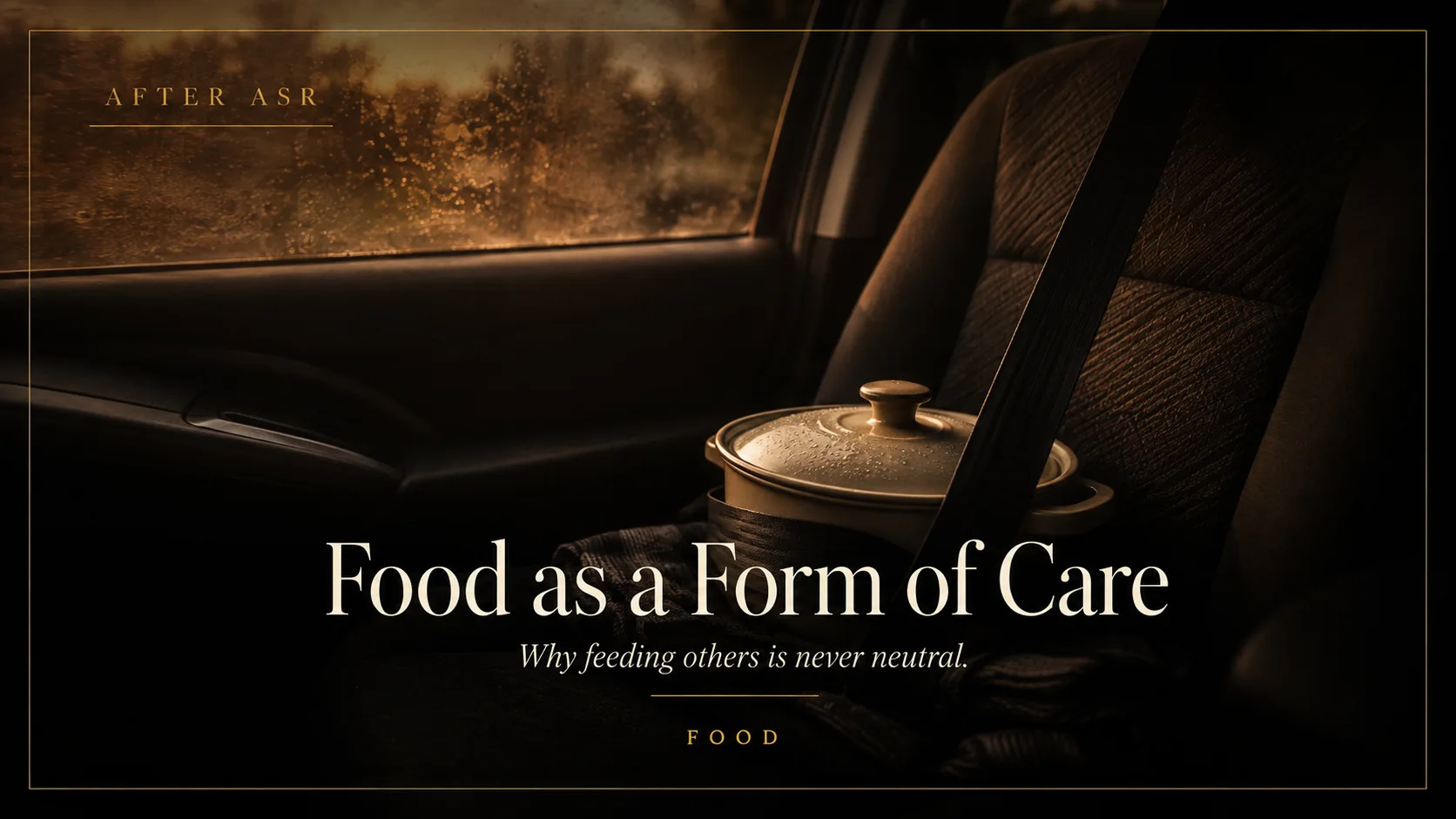
The soup rides in the passenger seat, buckled in like a child.
You drive slower than you normally would. You take the turns wide. Across town, a family you barely know is living the worst week of its year, and the only answer you could think of was a pot.
It is a good answer. It may be the oldest answer we have.
A Meal Is Never Just a Meal
Every plate carries a message, whether or not the cook intends one. Food arrives the way a letter arrives, in someone’s handwriting. You can read the care in it, or the hurry, or the plain sense of duty.
To feed someone is to make a small claim about their worth. It says that this body matters to me, and I want it to continue. No one carries a warm dish across town for a person they consider disposable.
The reverse is also true, and quieter. When food never comes, when a name never lands on the meal train, when the new family is never invited past the doorway, something has been said without a word spoken. Absence at the table is a message too.
This is why feeding others is never neutral. A meal can honor, and a meal can apologize. It can welcome a stranger or quietly repair a friendship neither party knows how to discuss.
Watch any potluck table and you can read the whole community from it. Who cooked all night, who stopped at a bakery, whose week collapsed and who covered for them without a word. All of it belongs there. None of it is silent.
The stove is a moral instrument. Most of us learned our first ethics standing beside one, watching what an adult did with the extra portion.
The First Care We Ever Received
Before we had words, we were fed. Before we could hold our own heads up, someone woke in the dark to feed us, again and again, without one word of thanks in return.
That is the original grammar of care, and the body never forgets it. Feeding and love fused in us before memory began. This is why a bowl of soup can reach places a well-made speech cannot.
At the far end of life the arrangement often returns. A daughter sits at the edge of a hospital bed, working a spoon with the patience of a watchmaker. The man who once cut her food into small pieces now waits, mouth open, trusting her aim.
Hospitals know this arithmetic. Watch a family panic when the tray goes back untouched. Eating is how the body votes to stay, and feeding is how the family campaigns.
Every act of feeding echoes that first arrangement. Someone is weak and someone is able, and the able one bends toward the weak with food. We spend our whole lives inside that sentence, first on one side of it, then on the other.
Nobody graduates from being fed. We only take turns.
What the Prophet Put First
A man once asked the Prophet, peace be upon him, which Islam is best. The answer, preserved in Bukhari and Muslim, is startlingly domestic. Feed others, he said, and greet with peace those you know and those you do not know.
He did not name the grandest deeds or the most public ones. He named the two smallest doors a stranger can walk through, a plate and a greeting. Both do the same work. Both tell a person that they have been seen, and that their presence is good news.
When revelation first came and the Prophet returned home shaken, Khadijah steadied him by telling him who he already was. You keep the ties of kinship, she said. You carry the burdens of the weary. You feed the guest.
Notice what she reached for in the most frightening hour of his life. Not his eloquence, not his lineage. His table.
Feeding was evidence of his character before it was ever an instruction for ours. The tradition begins in a kitchen doorway.
Add Water to the Broth
There is a hadith in Muslim that reads like kitchen advice, because it is kitchen advice. When you cook a broth, the Prophet said, increase the water, and look to your neighbors.
Notice how little the instruction demands. It does not ask for a second meal, or a finer one. It asks you to widen the meal already on the stove.
Care, in this teaching, is not an added burden but an added cup of water. The pot you were making anyway becomes an instrument of the street you live on.
The teaching assumes something we have mostly lost, which is knowing who lives on either side of us. You cannot look to your neighbors if you have never learned their names. Perhaps the broth is the excuse the friendship was waiting for.
Generosity begins as a decision made at the sink, before anyone knows you were generous at all. The neighbors only ever see the bowl. The intention was poured in an hour earlier, with the water.
Care That Crosses the Fence
The neighbor in that hadith comes with no conditions attached. Not the Muslim neighbor, not the friendly one, not the one who returns your dishes promptly. The neighbor.
The Prophet, peace be upon him, said that Jibril kept urging him about the neighbor until he thought the neighbor would be made an heir. An heir. The person across the fence, elevated nearly to family, on the strength of proximity alone.
A plate is the easiest ambassador we have. It requires no shared language and no shared theology. The elderly couple next door does not need you to explain your faith. They need to taste it.
For many American Muslims, a tray of food has done more neighborhood diplomacy than any pamphlet ever printed. Rice speaks every language on the street.
Feed the people you were placed beside. Placement, in this tradition, is not an accident. It is an assignment.
Care Has a Temperature
Anyone can send delivery to a doorstep now. The app confirms, the driver drops the bag, the phone lights up. Something arrives, and something is still missing.
Warmth is information. A dish that is still hot tells the receiver that the distance between your kitchen and their table was crossed quickly, and crossed for them. The towel wrapped around the pot, the foil pressed at the edges, the lid taped shut for the drive: these are the envelope, and the heat is the letter.
Our grandmothers engineered for this. The thermos in the school bag, the bread wrapped in cloth while the pan still hissed. Heat was budgeted like money, and spent deliberately on the people they loved.
Ask anyone who has grieved. They will remember, years later, one specific dish that arrived hot, and the face of the person holding it. The casseroles blur together. The warmth of that one pot does not.
Cold food can be reheated, and there is no shame in a microwave. What cannot be reheated is the moment of transfer, hand to hand at the door, steam rising between two faces.
The body reads temperature before the mind reads anything. Care arrives in degrees.
The Kitchen Is Labor Before It Is Love
We should be honest about what a meal costs. Someone stood at a stove for an hour after standing somewhere else all day. Someone chopped an onion at six in the morning and washed the same pot twice.
Calling this labor does not cheapen the love. It locates it. Affection that never touches the body stays a rumor, and the kitchen is where love agrees to sweat.
Think of the last gathering you attended. Somewhere behind it stood a woman who began cooking the day before, who ate last, standing up, from the corner of a tray. The room praised the food in general and thanked no one in particular.
For generations this work has been invisible, usually done by women, usually unthanked. The least we owe it is to see it plainly and say so at the table, by name. The biryani was Khala Rukhsana’s, not the banquet hall’s. Gratitude that stays general feeds no one in particular.
The better thing we owe it is company. When feeding others is shared work, it stops being a quiet tax on the same two hands at every gathering.
Food Speaks Where Words Embarrass
There are weeks when language fails politely. After a diagnosis, after a funeral, after a divorce becomes public, every sentence risks saying too much or too little.
A dish carries no such risk. It says I know, without demanding the story. It says I am near, without ringing the doorbell twice and waiting for a performance of being okay.
The tradition made this instinct into an instruction. When news came that Jafar had been killed, the Prophet, peace be upon him, told his household to prepare food for Jafar’s family. There has come to them, he said, that which occupies them. Grief takes the appetite hostage, so the community cooks.
If you must write something, keep it to one line on a card. No reply needed. Eat when you can. Anything longer becomes homework for a person who cannot currently read.
The one receiving the dish is spared the work of gratitude in real time. They can cry over a lasagna in private, which is one of the most humane options our species has ever invented.
Words will get their turn later, when the worst has passed. Food goes first because food does not need the room to be composed.
Feed People Without Fixing Them
The Quran, in Surah al-Insan, describes the righteous as those who give food, despite their own love of it, to the needy, the orphan, and the captive. Then it lets us hear their reasoning. We feed you only seeking the face of Allah. We desire from you no reward and no thanks.
No reward and no thanks. That rules out the subtler currencies too, like credit, and the right to give advice with the second helping.
This matters most with the people we worry about. The friend who eats poorly, the uncle with the numbers his doctor keeps circling. The meal you bring them is not a syllabus. It is a meal.
The same rule retires the commentary that stalks so many tables. No remarks about portions, no arithmetic performed aloud over someone else’s plate. A table is not a clinic, and dinner is not a weigh-in.
Compassion comes before prescription, or it was never compassion. A dish with a lecture attached is an invoice.
Feed the body first and let the counsel wait for another day, or for never. Most people already know what they should be doing. What they lack is proof that someone is glad they exist.
The Ones Nobody Thinks to Feed
Casseroles reliably find the new mother and the newly bereaved. They rarely find the caregiver in year three, or the strong friend who organizes everyone else’s meal trains and goes home to cereal.
Some hunger is not for food. The man who eats adequately but eats alone every night is undernourished in a way no lab result will flag. The aunty who cooks for forty and is cooked for by no one is owed a debt her community forgot it was carrying.
The list of the unfed is longer than we think. The convert whose first Eid has no family table attached to it. The nurse whose shift ends when every kitchen in town is dark. The student three states from home, eating over a sink on a night everyone else calls a feast.
Check the edges of your community. The edges are where the plates run out first.
Feeding belongs to the crisis, and also to the long, unphotographed middle of other people’s lives. Bring food to people who seem fine.
Seeming fine is a full-time job. It burns more than anyone admits.
A Recipe of Conduct
Here is a recipe, though it contains no ingredients.
Ask once what they cannot eat, and never make them repeat it. Write it in your phone under their name, next to the birthday. An allergy remembered is love made administrative, which is still love.
Use containers you do not need back, so the gift ends at the door instead of becoming an errand. Label the dish with what it is and the day you made it, because a grieving mind cannot do math. Make it something that freezes well, since the hardest week is often the fourth one, after the other cars have stopped coming.
Text before you arrive, and offer the porch as an option. Some weeks a face is too much to receive. Do not ask how they are doing at the door, because the door is not where that answer lives.
Leave without being seen if that is the kinder exit. The food is the visit.
The Meal Train Is a Technology of Mercy
Somewhere right now, a woman is building a spreadsheet so that a stranger will not have to cook for a month. Rows for dates, columns for dishes, a note about the nut allergy. It is unglamorous, and it is holy work.
We sometimes talk as if organized care were colder than spontaneous care. The grieving disagree. Spontaneity delivers four lasagnas on Tuesday and nothing at all in week three. The spreadsheet delivers dinner on the night the widow finally stops answering her phone.
Coordination is what compassion looks like when it plans ahead. The sign-up sheet is not bureaucracy. It is the community deciding, in advance, that no one will fall through.
So volunteer for the unpopular slots. Take the far date, the weekday, the month-later check-in that no one else remembers to claim.
Anyone can love loudly in the first week. The schedule is how a community loves long.
Receiving Is Half the Practice
Some of us can cook for thirty and cannot accept a single plate. We treat being fed as failure, as if need were a stain on the tablecloth.
But every act of care requires a receiver, and receiving well is its own quiet skill. The Prophet, peace be upon him, said he would accept an invitation even if only a sheep’s trotter were offered. He ate what was set before him without complaint. Receiving graciously was part of his generosity, not a break from it.
When you accept the dish, you grant someone else the dignity of being useful. Refuse everyone long enough and you will teach your whole community to stop trying.
So say yes to the soup. Say yes even when your freezer is full, because the freezer is not the point.
Return the container full if you like, or return only your thanks. The exchange was never about the Tupperware. It was about the thread now running between two houses.
When the Cupboard Is Almost Bare
The Prophet, peace be upon him, taught that a person should guard against the Fire even with half a date given away. Half a date, the humblest possible transfer, still counts in full.
Care in this tradition is never means-tested. You do not need a groaning table or a stocked pantry to feed someone. Tea made properly counts. Toast cut the way a sick friend likes it counts.
The two eggs split with a roommate at the end of a hard month may count double. Scale was never the measure. Aim was.
The same mercy prices a cheerful face as charity. If the pot is truly empty this week, the warmth with which you open the door still feeds somebody.
This should come as a relief in the seasons when you are the tired one. You are not excused from care when money is thin, but you are not disqualified either. The tradition priced its smallest deed at half a date so that no one could plead poverty of means.
Well enough is a real standard, and in a tired season it is the right one. Give what the week allows, and let the week be what it is.
What the Body Knows Before the Mind Agrees
Watch someone take the first bite of a meal made for them. The shoulders come down half an inch. The breath lengthens. Something old in the nervous system files a short report: you are somewhere safe.
The body remembers being fed the way skin remembers sun. Long after the conversation is forgotten, the salt and the warmth stay filed under safety, next to the voices of people who stayed.
You have felt this yourself. A dish appears in front of you, seasoned by someone who knows how you like it, and something in your chest unclenches before you have taken a bite. The proof of care arrived through the nose, ahead of all argument.
This is why care that travels through food outlasts care that travels through advice. Advice lodges in the mind, where it is argued with.
A meal goes straight to the oldest part of us. There, it is simply believed.
Begin With Someone Hungry
You do not need a plan to start this practice. You need a pot and a name.
Think of the person you know who is having the year nobody envies. Make one more portion of whatever tonight was already going to be.
Add water to the broth.
Drive slowly. Take the turns wide.
Hand it over without a speech.
The food will say it.
It always has.