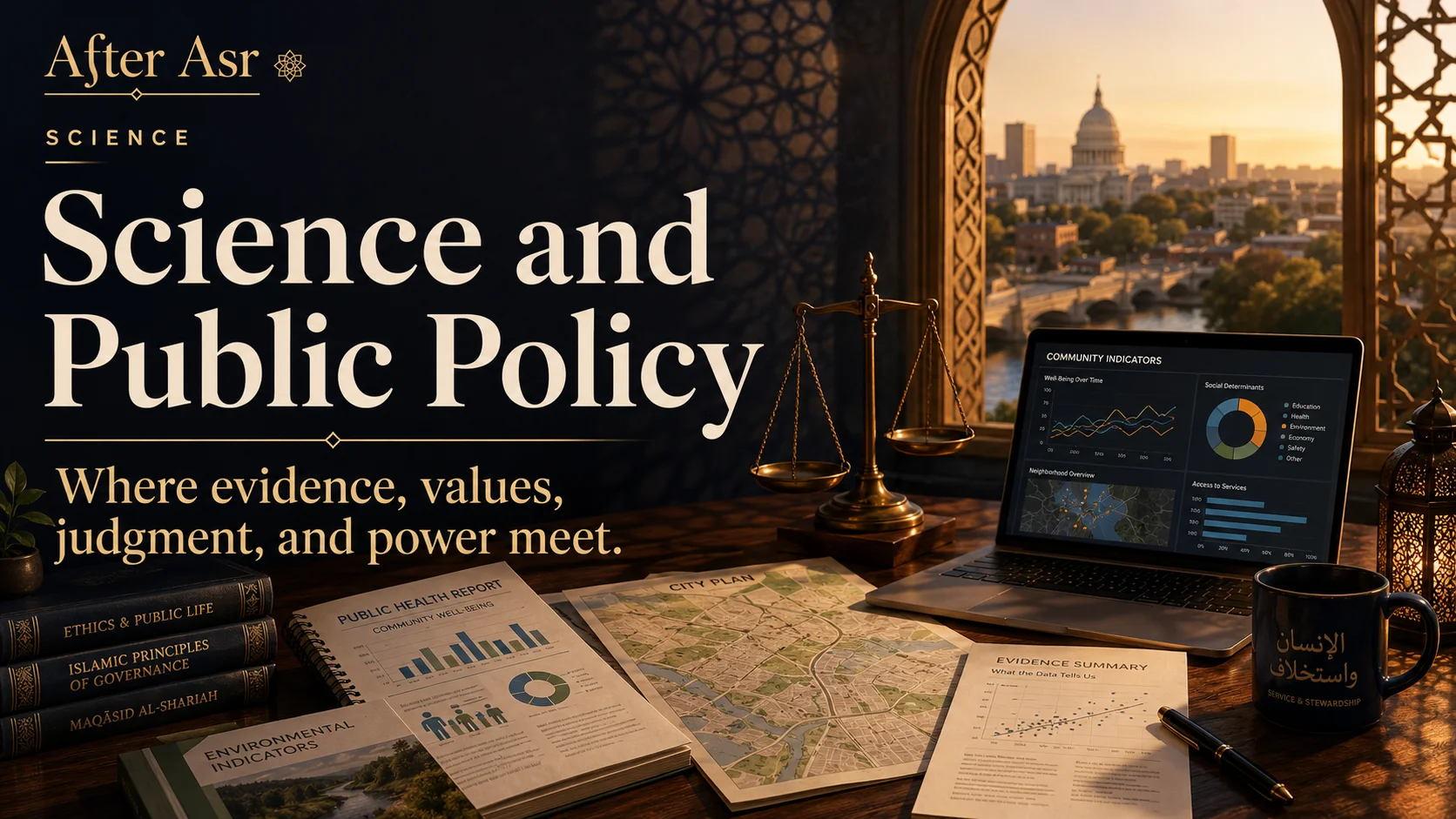
Where evidence, values, judgment, and power meet
Science can tell a city that its water is unsafe.
It can measure contaminants, compare levels to health standards, identify likely sources, estimate risk, and recommend methods of treatment. It can show which neighborhoods are most affected, which children are most vulnerable, and what long-term exposure may do to the body.
But science alone cannot decide whether the city will act quickly.
That decision belongs to public policy.
Someone must decide how much money to spend, which communities receive help first, who is held accountable, what level of risk is considered unacceptable, how the public is informed, whether officials admit past failure, and whether the poor are protected with the same urgency as the wealthy.
The science matters deeply. Without it, harm may remain hidden. But evidence does not walk into the world by itself and become justice.
Public policy is where evidence meets values, judgment, institutions, power, fear, money, law, and moral courage.
This is why the relationship between science and policy is both necessary and dangerous. Necessary because public decisions without evidence become vulnerable to ignorance, ideology, rumor, and neglect. Dangerous because scientific language can be misused to hide moral choices, justify power, or make political decisions appear more neutral than they really are.
A wise society needs science to inform policy.
But it also needs moral clarity to interpret evidence, weigh competing goods, protect the vulnerable, and decide what should be done when knowledge is incomplete.
Evidence does not eliminate judgment
A common phrase in public life is “follow the science.”
At its best, this phrase means that leaders should not ignore evidence. They should not pretend pollution is harmless when measurements show danger. They should not dismiss disease patterns because the findings are politically inconvenient. They should not build public policy on fantasy, fear, or donor preference when strong evidence exists.
In that sense, following the science is a call to honesty.
But the phrase can also become misleading if it suggests that science automatically produces one obvious policy answer.
Often, science tells us what is happening, what may happen, what risks exist, and what interventions might help. Policy must then decide what to prioritize, what tradeoffs are acceptable, how burdens should be shared, and how rights, duties, costs, freedoms, and protections are balanced.
Science can estimate the health effects of air pollution. Policy decides how strictly to regulate industry, how quickly to transition, who pays, and how affected workers are supported.
Science can study how diseases spread. Policy decides how to design public guidance, whether to require certain precautions, how to protect religious practice, how to support small businesses, and how to communicate uncertainty.
Science can evaluate educational outcomes. Policy decides how to fund schools, support disabled students, train teachers, and define what counts as a good education.
Science informs judgment. It does not replace judgment.
This distinction is essential because policy is never only technical. It is also moral.
Values are always present
Public policy always contains values, whether leaders admit it or not.
A budget expresses values. A regulation expresses values. A safety standard expresses values. A zoning decision expresses values. A public health recommendation expresses values. A transportation plan expresses values. The choice to act slowly or quickly expresses values. The choice to gather more data before acting expresses values too.
Even deciding what counts as a problem is value-laden.
If a city studies traffic speed but not pedestrian safety, that reflects a value. If a hospital measures efficiency but not patient dignity, that reflects a value. If a government studies economic growth but not environmental harm, that reflects a value. If a school measures test scores but not student formation, that reflects a value.
Science can help clarify consequences. But values determine what consequences matter most.
This does not make policy irrational. It makes policy human.
A wise policy process should name its values honestly. Are we prioritizing protection of life? Freedom of movement? Economic stability? Equity? Religious accommodation? Environmental stewardship? Long-term resilience? Privacy? Efficiency? Cost reduction? Care for the vulnerable?
When values are unnamed, they do not disappear. They simply operate in the background, often protecting the powerful.
Honesty requires bringing them into the light.
Power shapes which evidence matters
Not all evidence receives equal attention.
Some studies are amplified. Others are ignored. Some harms become urgent. Others remain invisible. Some communities are believed quickly. Others must produce overwhelming proof before anyone listens.
This is where power enters.
A wealthy neighborhood reporting environmental concern may receive faster testing than a poor one. A powerful industry may challenge evidence that threatens profit. A politically inconvenient study may be buried or delayed. A community without legal resources may struggle to prove what residents already experience in their bodies.
Evidence does not enter a neutral world.
It enters a world of unequal influence.
This does not mean evidence is meaningless. It means evidence must be protected from distortion. Policymakers must ask not only what the evidence says, but whose evidence has been gathered, whose suffering has been measured, whose risk has been normalized, and whose testimony has been dismissed.
The poor often have to wait for data before their pain is believed. The powerful often receive action before harm is fully proven.
That imbalance is moral, not merely administrative.
A just policy culture should be especially attentive to the people least able to force their concerns onto the public agenda.
The danger of hiding behind science
Sometimes leaders use science as a shield.
They say “the evidence made us do it,” when in reality the evidence informed the decision but did not fully determine it. They present policy as purely technical so they do not have to defend the values behind it. They use expert language to avoid public accountability.
This is unfair to both science and the public.
If a policy requires sacrifice, leaders should explain why that sacrifice is justified. If a regulation protects one group but burdens another, leaders should name the tradeoff. If evidence is uncertain but action is still necessary, leaders should say so. If moral values are guiding a decision, leaders should not pretend the decision is only data.
Science can be misused when it becomes a costume for power.
This does not mean leaders should avoid expert advice. They should seek it. But expert advice should not become a way to silence moral debate.
A public policy decision may be evidence-informed and still open to ethical disagreement.
The public deserves honesty about where science ends and judgment begins.
The danger of ignoring science
The opposite error is also dangerous.
Some leaders ignore evidence when it is inconvenient. They dismiss public health warnings, environmental risk, infrastructure danger, workplace exposure, educational data, or medical evidence because action would be costly or politically difficult.
This is not humility. It is negligence.
A society that ignores evidence will eventually harm people, often the vulnerable first. Buildings collapse when engineering is ignored. Diseases spread when public health is dismissed. Children suffer when pollution is denied. Patients are harmed when medical evidence is replaced by ideology or marketing. Communities flood when environmental data is ignored.
Evidence is not morally optional when lives are at stake.
Faith does not excuse ignorance here. Trust in God does not mean refusing to measure water quality, inspect bridges, prepare for storms, study disease, or protect workers from known hazards. To ignore available knowledge while claiming virtue is a distortion of trust.
Knowledge creates responsibility.
Once evidence shows harm, inaction becomes harder to defend.
Policy under uncertainty
Public policy often must be made before all evidence is complete.
This is one of the most difficult realities of leadership.
If officials wait for perfect certainty, preventable harm may continue. If they act too quickly on weak evidence, they may impose unnecessary burdens or create new harms. The challenge is to act proportionally under uncertainty.
This requires humility and transparency.
Leaders should explain what is known, what is uncertain, what risks are being weighed, why action is being taken now, and what would cause the policy to change. They should build review into the process. They should monitor outcomes. They should be willing to revise.
Uncertainty should not become an excuse for either recklessness or paralysis.
A city facing possible water contamination cannot wait forever while residents drink unsafe water. A public health agency facing a spreading disease cannot wait for perfect data before issuing guidance. A government facing climate risk cannot delay action until every local consequence is known with precision.
But urgency must not erase accountability.
Policies made under uncertainty should be revisable, proportionate, clearly explained, and attentive to those who carry the burden.
Tradeoffs are real
Policy involves tradeoffs.
This can be uncomfortable to admit, because public debate often rewards moral simplicity. People prefer policies that sound purely good and opponents who sound purely careless. But real decisions often involve competing goods.
A public health measure may reduce disease spread but burden small businesses, schools, worship gatherings, or mental health. An environmental regulation may protect children from pollution but affect workers in an industry that supports families. A transportation policy may reduce traffic deaths but increase commute time. A medical policy may expand access but raise difficult questions about cost and allocation.
Naming tradeoffs does not mean all sides are equal. Some policies are clearly more just than others. Some burdens are necessary. Some objections are selfish or dishonest.
But pretending tradeoffs do not exist damages trust.
A mature policy conversation says: Here are the harms we are trying to prevent. Here are the burdens this policy may create. Here is why we believe this approach is justified. Here is how we will reduce unfair burdens. Here is how we will evaluate whether it is working.
This kind of honesty respects the public.
It also prevents science from being blamed for decisions that are actually moral and political.
The vulnerable should not be an afterthought
One measure of good policy is how it treats the vulnerable.
Scientific evidence often shows that harm is not distributed equally. Children, the elderly, disabled people, low-income workers, pregnant women, chronically ill patients, immigrants, rural communities, and polluted neighborhoods may face risks others do not. Yet policy is often designed around the average person.
The average person may not exist in practice.
A heat advisory affects a healthy adult with air conditioning differently from an elderly person living alone. A remote learning policy affects a student with stable internet differently from a child without quiet space at home. A medical recommendation affects a wealthy patient differently from one who cannot afford follow-up care. A flood plan affects homeowners differently from renters with nowhere to go.
Science can reveal these differences. Policy must respond to them.
A just policy does not simply ask, “What works overall?” It asks, “Who is still harmed? Who is left out? Who cannot access the benefit? Who carries the cost?”
Faith sharpens this question. The vulnerable are not statistical exceptions. They are moral tests.
A society that designs policy only for the comfortable will deepen injustice, even if its averages look good.
Public participation matters
Public policy should not be made only by experts and officials.
Expert knowledge is necessary, but communities have knowledge too. Residents know local conditions. Patients know lived experience. Workers know workplace risks. Parents know the practical effects of school policies. Religious communities know how guidance interacts with worship, family, and moral life.
This does not mean every public opinion is scientifically valid. It means policy becomes wiser when affected people are heard.
Public participation can reveal practical barriers experts may miss. It can build trust. It can identify unintended consequences. It can help leaders communicate more clearly. It can prevent communities from feeling ruled by distant institutions that do not understand their lives.
Consultation is not weakness.
In Islamic ethics, shura reflects the importance of counsel and collective wisdom. Leaders remain responsible for decisions, but responsible leadership listens. It does not treat people as obstacles to efficient governance.
Science can provide evidence. Communities can provide context. Policy needs both.
The role of experts
Experts have a serious role in public policy.
They should clarify evidence, identify risks, explain uncertainty, and distinguish strong findings from weak ones. They should help policymakers understand what is likely, what is unknown, what interventions may work, and what unintended consequences should be considered.
But experts should also know the limits of their role.
A scientist may be qualified to estimate the risk of pollution exposure, but not alone to decide all economic, legal, ethical, and religious dimensions of a policy response. A doctor may understand a disease, but public policy also involves education, transportation, labor, worship, family life, and law. An engineer may assess infrastructure safety, but a city must also decide priorities, funding, and equity.
Experts should not be dismissed. They should also not be turned into rulers by default.
Their authority is strongest when they speak clearly within their expertise and honestly about where policy judgment begins.
The best experts help the public see reality more clearly without pretending that technical knowledge settles every moral question.
The role of elected leaders and institutions
Leaders must make decisions.
They cannot simply hide behind experts. They also cannot ignore them. Their responsibility is to gather evidence, consult widely, weigh values, consider burdens, explain decisions, and accept accountability for outcomes.
This requires courage.
Sometimes the evidence points toward action that is unpopular. Sometimes the public wants reassurance that would be dishonest. Sometimes donors, industries, or political allies resist necessary regulation. Sometimes protecting the vulnerable requires spending money or limiting convenience.
Leadership is tested in those moments.
A leader who only follows public mood is not governing. A leader who ignores public concern is not serving. A leader who invokes science when convenient and dismisses it when costly is not trustworthy.
Public policy requires amanah.
Power is a trust. The authority to shape conditions affecting millions is not a prize. It is a burden.
Science, law, and moral boundaries
Not every scientific possibility should become legal permission.
Policy must sometimes set boundaries around what can be done, even when science makes it possible. This appears in genetics, reproductive technology, surveillance, environmental exposure, artificial intelligence, medical research, weapon development, and end-of-life decisions.
The law must ask more than whether a technique works.
It must ask whether it protects dignity, consent, justice, privacy, life, and the common good. It must ask whether the powerful will exploit the weak. It must ask whether future harms are being ignored. It must ask whether some areas of human life require special reverence.
This is where faith communities can contribute meaningfully to public debate.
They should not speak carelessly about technical matters. But they should bring moral questions that technical systems often avoid. What is the human being? What is dignity? What do we owe to the unborn, the disabled, the elderly, the poor, and the dying? What should never be sold? What should never be automated? What should never be treated as disposable?
Public policy needs moral vocabulary.
Science can describe capability. Law must sometimes restrain capability.
Policy and the common good
Public policy exists because private choices alone cannot solve every shared problem.
Clean air, safe water, disease prevention, infrastructure, disaster preparation, food safety, workplace protection, environmental stewardship, and public education require collective action. A person may act responsibly within their home, but if the water system is contaminated, individual virtue is not enough. A family may care about health, but if air pollution is high, private discipline cannot fully protect children.
Science often reveals shared conditions.
Policy asks how we will respond together.
This is why the common good matters. Public life is not merely a collection of individual preferences. We live in systems that shape one another’s bodies and futures. My waste may affect your water. My industry may affect your child’s lungs. My refusal to repair infrastructure may affect your safety. My data system may affect your access to services.
A society that forgets the common good becomes cruel.
It tells individuals to solve problems that were created collectively. It blames families for conditions shaped by policy. It treats vulnerability as personal failure.
Science can help reveal these shared realities. Faith can remind us that we are accountable for one another.
The danger of technocracy
Technocracy is rule by technical experts or technical logic.
It becomes dangerous when public life is reduced to management, metrics, efficiency, and optimization without deeper moral debate. In a technocratic culture, the question becomes “What works?” but the meaning of “works” is often left unexamined.
Works for whom?
Works according to what value?
Works at what cost?
Works while preserving dignity?
Works while protecting the vulnerable?
Works only because the weak have no power to object?
Efficiency can become an idol.
A policy may efficiently process applications while unjustly denying people. A hospital may efficiently move patients while failing to care for them. A school may efficiently raise scores while weakening curiosity. A city may efficiently move traffic while endangering pedestrians. A platform may efficiently increase engagement while damaging attention.
Technical competence is necessary. But technical competence without moral wisdom can become inhuman.
Public policy needs experts, but it also needs citizens, ethicists, religious voices, families, workers, patients, and communities who can ask what kind of life the policy serves.
The danger of populist rejection
If technocracy is one danger, populist rejection of expertise is another.
Sometimes public frustration with experts becomes a rejection of evidence itself. Leaders may dismiss science as elitist, inconvenient, or corrupt. People may treat personal intuition as equal to specialized knowledge. Policies may be shaped by outrage rather than reality.
This too can harm the vulnerable.
A bridge does not become safe because voters dislike engineering warnings. A disease does not stop spreading because people are tired of guidance. Pollution does not become harmless because regulation is unpopular. A medication does not become effective because a crowd believes in it.
Public participation is essential, but public feeling cannot replace evidence.
The challenge is to build democratic policy that respects expertise without surrendering all judgment to experts.
That balance is difficult, but necessary.
Communication is part of policy
A policy is not only what leaders decide. It is also how they explain it.
Poor communication can ruin even a well-designed policy. If people do not understand why a measure is needed, what evidence supports it, what uncertainty remains, how long it will last, who is affected, and how burdens will be reduced, distrust grows.
Communication should not be treated as public relations after the real work is done.
It is part of the ethical work.
People deserve clarity. They deserve honesty about tradeoffs. They deserve explanations when guidance changes. They deserve language that respects their intelligence. They deserve access to information in ways they can actually use.
A policy that cannot be explained truthfully may not be ready.
And a policy explained with arrogance will often fail even if the evidence behind it is strong.
Muslim engagement with science policy
Muslim communities should not stand outside these conversations.
Science and public policy affect prayer spaces, schools, healthcare, burial practices, fasting, food systems, environmental justice, family life, technology use, disability access, and community safety. Muslims should be prepared to engage thoughtfully, neither rejecting evidence nor surrendering moral judgment.
This requires knowledge and organization.
Mosques and Muslim institutions can help communities understand public health guidance, environmental risks, medical issues, technology ethics, and civic responsibilities. Muslim professionals in science, medicine, law, education, and policy can contribute expertise. Scholars can help frame moral questions. Families can bring lived experience. Communities can advocate for policies that protect the vulnerable and preserve religious dignity.
Muslim engagement should be principled, not reactionary.
We should ask: What does the evidence show? What values are at stake? Who is harmed? Who benefits? How are religious obligations affected? What does justice require? How can we serve the common good while remaining faithful to God?
Public policy is one of the places where moral responsibility becomes collective.
Evidence with conscience
The best public policy is neither evidence without conscience nor conscience without evidence.
Evidence without conscience can become cold. It may optimize systems while ignoring dignity. It may pursue efficiency while accepting unjust burdens. It may measure what is easy and neglect what matters.
Conscience without evidence can become reckless. It may act on emotion, rumor, or ideology. It may produce policies that feel righteous but fail in practice. It may ignore harms because they are inconvenient to a preferred story.
We need both.
Evidence helps conscience see clearly.
Conscience helps evidence serve rightly.
Science can show where asthma rates are high. Conscience asks why children are breathing unsafe air. Science can show that a policy reduces harm overall. Conscience asks whether the burden falls unfairly on the poor. Science can show that a technology works. Conscience asks whether it should be used in this way.
A faithful society should not fear evidence. It should fear evidence used without moral accountability.
Judgment under accountability
Public policy is judgment under accountability.
Leaders must judge between options. Experts must judge evidence. Communities must judge trust. Citizens must judge what they support. Institutions must judge how to use power. Religious voices must judge how moral principles apply to complex circumstances.
These judgments will not always be easy. People of good faith may disagree. Evidence may be incomplete. Values may compete. Costs may be real. The vulnerable may have different needs. Policies may need revision.
This is why humility is essential.
Humility does not mean refusing to act. It means acting without pretending to be God. It means explaining decisions, listening to those affected, correcting course, and remembering that power will be judged.
For the believer, public policy is not only administration. It is an arena of amanah. Decisions about water, housing, medicine, schools, labor, environment, technology, and public safety are decisions about human bodies and human dignity.
They are not morally neutral.
Where evidence meets responsibility
Science and public policy meet because knowledge eventually asks something of us.
If we know water is unsafe, we must respond.
If we know children are harmed by pollution, we must respond.
If we know a medicine works, we must ask who can access it.
If we know a technology is biased, we must correct or restrain it.
If we know a community is vulnerable, we must not design policy as if everyone is equally protected.
Evidence reveals. Policy acts. Values guide. Power decides. Justice judges.
This is why science in public life must be handled with care. It should not be ignored. It should not be worshiped. It should not be used as a shield for hidden values. It should not be twisted to serve power. It should not be dismissed because it is inconvenient.
Science should be invited into policy as a truthful witness.
But policy must still ask the questions science alone cannot answer: What do we owe one another? Who must be protected first? What burdens are just? What risks are unacceptable? What does human dignity require? What will we answer for before God?
The task is difficult because public life is difficult.
But difficulty does not excuse carelessness.
A society that wants just policy must become honest about evidence, clear about values, humble in judgment, and accountable in the use of power.
Only then can science serve what it should serve: not domination, not image, not profit alone, but the protection of life, the repair of harm, the stewardship of creation, and the dignity of those whose lives are shaped by decisions made in rooms they may never enter.