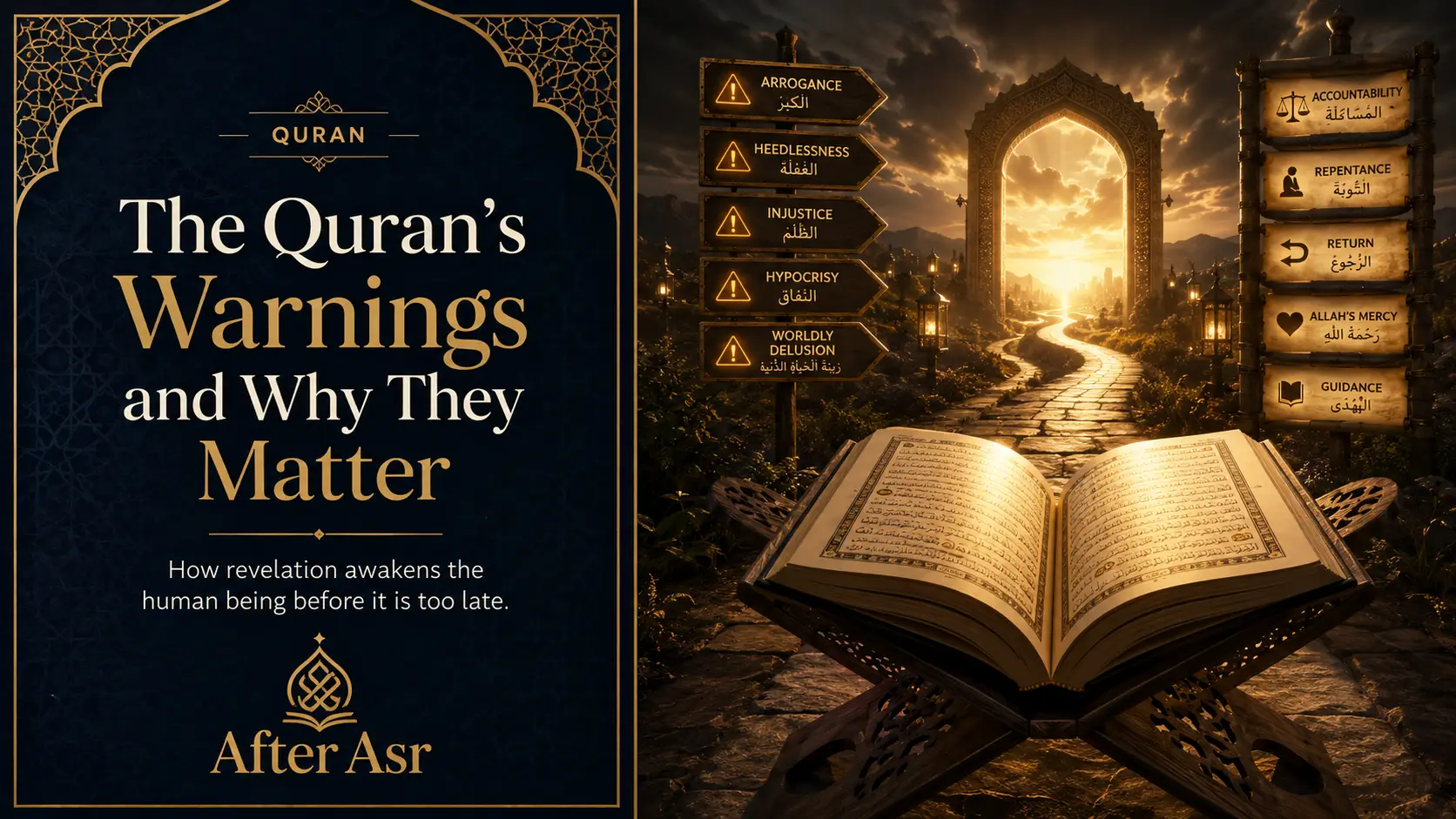
How revelation awakens the human being before it is too late.
The Quran warns because human beings are capable of destroying themselves while feeling confident. This is one of the most unsettling truths revelation teaches. People do not always walk toward ruin in obvious misery. Sometimes they walk toward it with wealth, laughter, influence, intelligence, applause, religious vocabulary, political power, and the approval of their own circles. A person can be spiritually endangered while appearing successful to everyone around them, including themselves.
This is why the Quran does not speak only in comfort. It does comfort, and its mercy is vast, repeated, and central. But the same Quran that calls the servant back from despair also shakes the servant out of heedlessness. It warns of arrogance, injustice, hypocrisy, ingratitude, denial, worldly delusion, misuse of wealth, abuse of power, false worship, moral carelessness, and the Day when every soul will see what it sent forward.
To modern ears, warning can sound harsh. Many people prefer religious language that soothes, affirms, and reassures. There is a place for reassurance. The wounded heart needs mercy. The repentant sinner needs hope. The oppressed need consolation. But the Quran knows that not every human problem is solved by being soothed. Some hearts need to be softened. Some egos need to be interrupted. Some habits need to be exposed. Some illusions need to be broken before they become permanent.
A warning, when it comes from Allah, is not cruelty.
It is mercy before consequence.
Warnings Are Part of Guidance
A person who warns you of danger is not necessarily against you. A doctor who tells a patient that their habits may destroy their health is not being hateful. A parent who stops a child from walking into traffic is not being oppressive. A sign warning of a cliff is not an attack on the traveler’s freedom. In each case, warning exists because harm is real and because the person being warned still has time to respond.
The Quran’s warnings function in this way, but at a far deeper level. They do not only warn against immediate worldly harm. They warn against spiritual collapse, corrupted worship, moral blindness, and eternal loss. They reveal dangers that the human being might not recognize on their own because those dangers can be hidden beneath pleasure, success, habit, and social approval.
This is why warning is guidance. It identifies the path that leads away from Allah before the servant reaches its end. It tells the arrogant that arrogance is not strength. It tells the greedy that accumulation is not security. It tells the heedless that delay is not escape. It tells the unjust that power is not protection. It tells the sinner that concealment is not safety. It tells the comfortable that comfort is not proof of divine approval.
Without warning, guidance would be incomplete. A map that shows beautiful destinations but never marks dangerous roads is not truly useful. The Quran guides by showing both what leads to Allah and what leads away from Him.
The Human Being Forgets Consequences
One of the reasons Quranic warnings matter is that human beings are remarkably skilled at forgetting consequences. We remember consequences when they are immediate, visible, and socially enforced. We worry about losing money, reputation, employment, relationships, or comfort. But when consequences are delayed, hidden, or spiritual, we become careless.
A person may know that lying corrodes the soul, but if the lie brings advantage today, they may treat the future cost as unreal. A person may know that oppression is evil, but if power shields them now, they may imagine accountability will never arrive. A person may know that death is certain, but because death is not scheduled on their calendar, they live as if it belongs only to other people.
The Quran repeatedly interrupts this forgetfulness. It brings the future into the present. It speaks of death, resurrection, judgment, Paradise, Hell, record, witness, regret, and return, not to overwhelm the believer with dread, but to prevent life from being lived under false assumptions. The human being needs to remember that actions are not weightless. Time is not endless. Privacy is not invisibility. Delay is not denial.
Warnings restore the connection between choice and consequence. They teach the believer to take life seriously before seriousness is forced upon them.
Warnings Protect Against Arrogance
Few diseases are more consistently exposed in the Quran than arrogance. Arrogance is spiritually dangerous because it blocks correction. A person who is weak may still ask for help. A person who is sinful may still repent. A person who is confused may still seek guidance. But an arrogant person often sees no need to return. They turn their own opinion, status, race, wealth, knowledge, power, or lineage into a shield against truth.
The Quran’s warnings against arrogance are therefore not abstract moral commentary. They are urgent protection. Arrogance can make a human being admire themselves while disobeying the One who created them. It can make a nation celebrate its strength while walking toward collapse. It can make a religious person use knowledge as self-praise rather than humility. It can make a sinner defend the very thing that is killing their heart.
The stories of earlier peoples repeatedly show this pattern. They were warned, but warning felt beneath them. They had power, wealth, numbers, buildings, armies, arguments, and inherited confidence. They looked at the messengers and saw weakness. They looked at themselves and saw permanence. Their destruction did not come because they lacked reminders. It came because they despised reminders.
The Quran repeats such warnings because arrogance repeats. It is not an ancient disease. It appears wherever people treat truth as offensive simply because it challenges them.
Warnings Reveal the Seriousness of Injustice
The Quran does not allow injustice to be treated as a minor social flaw. Oppression is a spiritual crime. It violates the rights of people, corrupts communities, and places the oppressor in danger before Allah. This includes the obvious injustice of tyrants and abusers, but it also includes the quieter injustices of dishonesty, betrayal, slander, exploitation, neglect, and violating trusts.
Warnings about injustice matter because oppressors often feel safe. They may control the story. They may silence the victim. They may manipulate religious language. They may enjoy institutional protection. They may be admired by people who do not know the truth. They may even convince themselves that their actions are justified.
The Quran removes that illusion. Allah sees what people hide. He knows what institutions bury. He hears what victims cannot prove. He knows the intention behind the polished explanation. He knows when power has been used to crush rather than protect. He knows when a person cries in private because of harm done publicly or quietly.
For the oppressed, these warnings are also a form of comfort. They announce that injustice has not disappeared simply because human systems failed to answer it. For the oppressor, they are a mercy if they awaken repentance before the Day when excuses no longer work. The warning is severe because the matter is severe. Human rights are not small before Allah.
Warnings Keep Mercy From Becoming Carelessness
The Quran repeatedly speaks of Allah’s mercy, forgiveness, and compassion. But the Quran also warns because mercy can be misunderstood by a careless heart. A person may say, “Allah is forgiving,” while refusing to stop the sin. They may say, “Allah is merciful,” while continuing to harm others. They may speak of hope while avoiding repentance, responsibility, and repair.
This is not hope. It is self-deception using religious language.
Warnings protect mercy from being abused. They remind the believer that Allah’s mercy is not an invitation to mock accountability. The door of repentance is open, but a door is meant to be entered. Forgiveness is vast, but it is sought through return, not through arrogance. The sinner should hope in Allah, but hope should move them toward Allah, not make distance feel safe.
This balance is one of the Quran’s great gifts. Without mercy, warnings could crush the heart. Without warnings, mercy could be twisted into indifference. Together, they form a mature spiritual life. The believer fears enough to leave sin and hopes enough to return after falling. They do not despair of Allah, and they do not feel safe from their own wrongdoing.
Warnings Are Not Meant to Create Despair
Some people hear Quranic warnings and become overwhelmed. They may already carry guilt, shame, anxiety, or fear. They may read verses about punishment and feel that they are beyond hope. This is a misunderstanding, even if it comes from sincerity. The Quran’s warnings are not meant to push the servant away from Allah. They are meant to push the servant away from what destroys them.
The difference is crucial. Shaytan uses sin to create despair. The Quran exposes sin to create return. Shaytan tells the sinner, “You are too far gone.” The Quran tells the sinner, “Come back before it is too late.” Shaytan turns shame into paralysis. The Quran turns warning into movement.
A person who feels fear after reading the Quran should ask what that fear is doing. If it leads to repentance, humility, prayer, apology, honesty, and renewed hope in Allah, then it is a beneficial fear. If it leads to despair, avoidance, hopelessness, or the belief that Allah does not want the servant to return, then that fear has been distorted.
Quranic warning is not the closing of the door.
It is the urgent knock before the door closes.
Warnings Expose False Security
Many people feel safe because of things that cannot actually save them. Wealth, status, intelligence, family name, political influence, religious identity, community approval, and public reputation can all create a false sense of security. The Quran repeatedly warns that none of these can replace sincerity, faith, repentance, and righteous action.
A person may belong to a Muslim family and still neglect Allah. A person may speak religious language and still oppress others. A person may be praised in the community and still be corrupt in private. A person may possess knowledge and still lack humility. A person may give charity publicly while seeking admiration rather than Allah. A person may assume that identity alone guarantees safety, while the heart is distant from the One being claimed.
The Quran’s warnings cut through inherited and performed religion. They ask not only, “What do you call yourself?” but “Whom do you worship? How do you live? What do you hide? What do you love? What do you obey? What do you do when Allah’s command conflicts with your desire?”
This is deeply uncomfortable, but necessary. False security is one of the most dangerous spiritual conditions because the person does not seek rescue. They believe they are already safe.
Warnings Give Weight to the Unseen
The Quran constantly teaches that the unseen is real. Allah is unseen to us in this life, but He is real. The angels are unseen, but real. The record of deeds is unseen, but real. The grave, resurrection, judgment, Paradise, and Hell are unseen, but real. One function of warning is to make the unseen morally present in daily life.
Without this, people tend to live only by what is visible. They fear visible punishment and ignore hidden sin. They pursue visible success and neglect hidden sincerity. They protect visible reputation and corrupt the private self. The Quranic warning changes the scale. It teaches that the unseen reality is not less important because it is unseen. In fact, the unseen may be more decisive than everything people are currently applauding.
This affects ordinary decisions. A person who remembers the unseen may refuse a private sin because Allah sees. They may give charity secretly because Allah knows. They may avoid humiliating someone because words are recorded. They may endure a trial with patience because reward is not limited to what people notice. They may forgive when appropriate because Allah’s pleasure matters more than the ego’s victory.
Warnings make the unseen impossible to dismiss. They teach the believer to live before Allah, not merely before people.
Warnings Against the Dunya
The Quran often warns about the deceptive nature of worldly life. This does not mean the world is evil in itself. The world contains signs of Allah, lawful blessings, family, beauty, work, knowledge, service, and opportunities for worship. The danger is not that the dunya exists. The danger is that the human being treats it as ultimate.
The world deceives by appearing more permanent than it is. It gives people immediate feedback: money can be counted, praise can be heard, beauty can be admired, power can be felt, pleasure can be tasted. The akhirah, by contrast, requires faith. It is unseen, promised by Allah, and approached through patience. The test is whether the servant will trade lasting reality for immediate display.
Warnings against the dunya are therefore warnings against mismeasurement. They tell the believer not to confuse what is near with what is lasting. They teach that success is not proven by luxury, nor failure by hardship. They remind the human being that graves are filled with people who once had urgent plans, powerful emotions, unfinished arguments, beautiful homes, feared reputations, and future ambitions.
The dunya is a place of action, not a place of permanent possession. Quranic warnings restore that scale.
Warnings and the Stories of Past Nations
The Quran repeatedly tells the stories of past nations that rejected warnings. These stories are not included for historical entertainment. They are mirrors. They show how communities decline when arrogance becomes normal, when wealth produces entitlement, when leaders manipulate truth, when public opinion mocks revelation, and when people mistake delay for safety.
A striking feature of these stories is how familiar the patterns remain. The details differ, but the diseases remain recognizable. People still mock moral limits. They still call sincere warning backward. They still trust power more than truth. They still treat wealth as proof of worth. They still follow leaders who flatter their desires. They still assume that because nothing has happened yet, nothing will happen.
The Quran’s historical warnings prevent the reader from imagining that previous nations were strange people with strange failures. They were human beings. Their failures are human possibilities. The believer is meant to read these accounts and ask, “Where does this pattern appear in me? Where does it appear in my community? Where are we repeating the same arrogance with different language?”
The stories matter because they turn history into guidance.
Warnings Against Hypocrisy
Among the Quran’s most serious warnings are those concerning hypocrisy. This is because hypocrisy is not simple ignorance. It is the gap between appearance and reality, between what a person claims and what they are inwardly serving. It is spiritually dangerous because it can hide inside religious environments. A hypocrite may know the language of faith, appear among believers, and perform enough outward religion to avoid suspicion, while the heart remains committed to something else.
Warnings against hypocrisy should make the believer cautious, not obsessive in judging others. The Quran is not inviting Muslims to search every person’s heart and accuse them. It is inviting each person to examine their own. Do I perform faith more than I live it? Do I seek people’s approval more than Allah’s? Do I become religious only when seen? Do I use Islam for status, argument, control, or belonging while resisting its claim over my desires?
This self-examination is uncomfortable, but it is mercy. Hypocrisy thrives when the self is never questioned. Quranic warnings force the believer to ask whether the inner life and outer claim are moving toward unity. The goal is not despair, but sincerity.
Warnings Teach Urgency
The Quran teaches urgency because life is brief and the time of repentance is limited. Human beings are masters of postponement. They delay prayer, delay apology, delay charity, delay ending a sin, delay learning, delay reconciliation, delay seriousness, and delay return. They imagine a future version of themselves who will be more disciplined, more spiritual, more honest, and more ready.
Warnings interrupt this fantasy. They remind the human being that the future is not guaranteed. Death does not wait for personal readiness. The heart may harden through repeated delay. A sin may become easier each time it is practiced. An apology may become impossible because the person harmed is gone. A chance to give may pass. A moment of guidance may be ignored until the soul becomes less sensitive to it.
Urgency is not panic. It is spiritual realism. The believer does not need to transform everything in one emotional moment, but they do need to stop treating return to Allah as a distant project. The Quran warns because now matters. This breath matters. This prayer matters. This choice matters. This chance to repent matters.
Warnings Strengthen Moral Courage
Warnings are not only directed at personal sin. They also strengthen believers to resist social pressure. A person who fears only people will eventually obey people in disobedience to Allah. A person who fears Allah learns to place human pressure in proper perspective. This is one of the moral fruits of Quranic warning.
When the Quran warns of accountability before Allah, it frees the believer from making society the highest judge. A person may be mocked for modesty, honesty, restraint, faith, or refusing corruption. They may lose opportunities because they will not lie. They may feel isolated because they will not join what is wrong. In such moments, warnings about the Hereafter become a source of courage. They remind the believer that public approval is temporary, while divine judgment is final.
This does not make the believer harsh or antisocial. It makes them anchored. They can live among people, serve people, and show mercy to people without worshiping people’s opinions. Quranic warning teaches that the greater danger is not being disliked by creation. The greater danger is standing before Allah with a life shaped by cowardice.
Warnings Must Be Delivered With Wisdom
Because warnings matter, they must not be mishandled. Some people use warnings in a way that misrepresents the Quran’s guidance. They shout when they should teach. They humiliate when they should advise. They speak about punishment without opening the door of repentance. They enjoy frightening people more than guiding them. They use religious warning to control, dominate, or display their own righteousness.
This is not the Quranic model. The Quran warns with truth, but it also calls with mercy, wisdom, signs, stories, reminders, promises, and invitations to return. The Prophet, peace and blessings be upon him, carried warning as part of mercy, not as an expression of personal harshness. To warn properly, one must care about the person being warned. The goal is not to win, crush, embarrass, or perform seriousness. The goal is guidance.
A warning delivered without wisdom may harden the heart it was meant to awaken. This does not mean truth should be softened until it disappears. It means truth should be carried with sincerity, knowledge, timing, proportion, and concern for the listener’s path back to Allah.
The Believer Needs Both Warning and Hope
A mature Quranic life includes both warning and hope. The heart needs both, though not always in the same measure at every moment. A person drowning in despair may need to hear more of mercy. A person comfortable in disobedience may need to hear more of warning. A person oppressed may need comfort that Allah sees. A person oppressing others may need fear that Allah sees. Wisdom is knowing which medicine is needed.
The Quran contains both because human beings are not all in the same condition. Even the same person changes from day to day. Sometimes we are broken and need hope. Sometimes we are arrogant and need warning. Sometimes we are ashamed and need mercy. Sometimes we are careless and need to be shaken awake.
A religion reduced to comfort becomes weak. A religion reduced to fear becomes unbearable. The Quran is neither. It is guidance from the One who knows the human being fully. It gives the soul what it needs, not merely what it prefers.
Conclusion
The Quran’s warnings matter because the human being is forgetful, vulnerable, and easily deceived. We forget death. We underestimate sin. We excuse injustice. We trust appearances. We delay repentance. We mistake comfort for safety and success for approval. We hide from ourselves and then imagine that we are hidden from Allah.
The Quran warns to break these illusions before they become eternal regret. Its warnings are not separate from mercy. They are mercy in a serious form. They tell the servant that danger is real, but return is still possible. They reveal the cliff before the fall, the disease before death, the consequence before judgment, and the truth before the excuses run out.
A believer should not run from the Quran’s warnings. Nor should they read them with despair. They should receive them as part of Allah’s care: a call to wakefulness, humility, repentance, justice, sincerity, and preparation for the Day when nothing hidden will remain hidden.
The Quran comforts the broken, but it also disturbs the careless.
Both are mercy.
The question is not whether the warnings are severe.
The question is whether we are willing to be warned while there is still time.