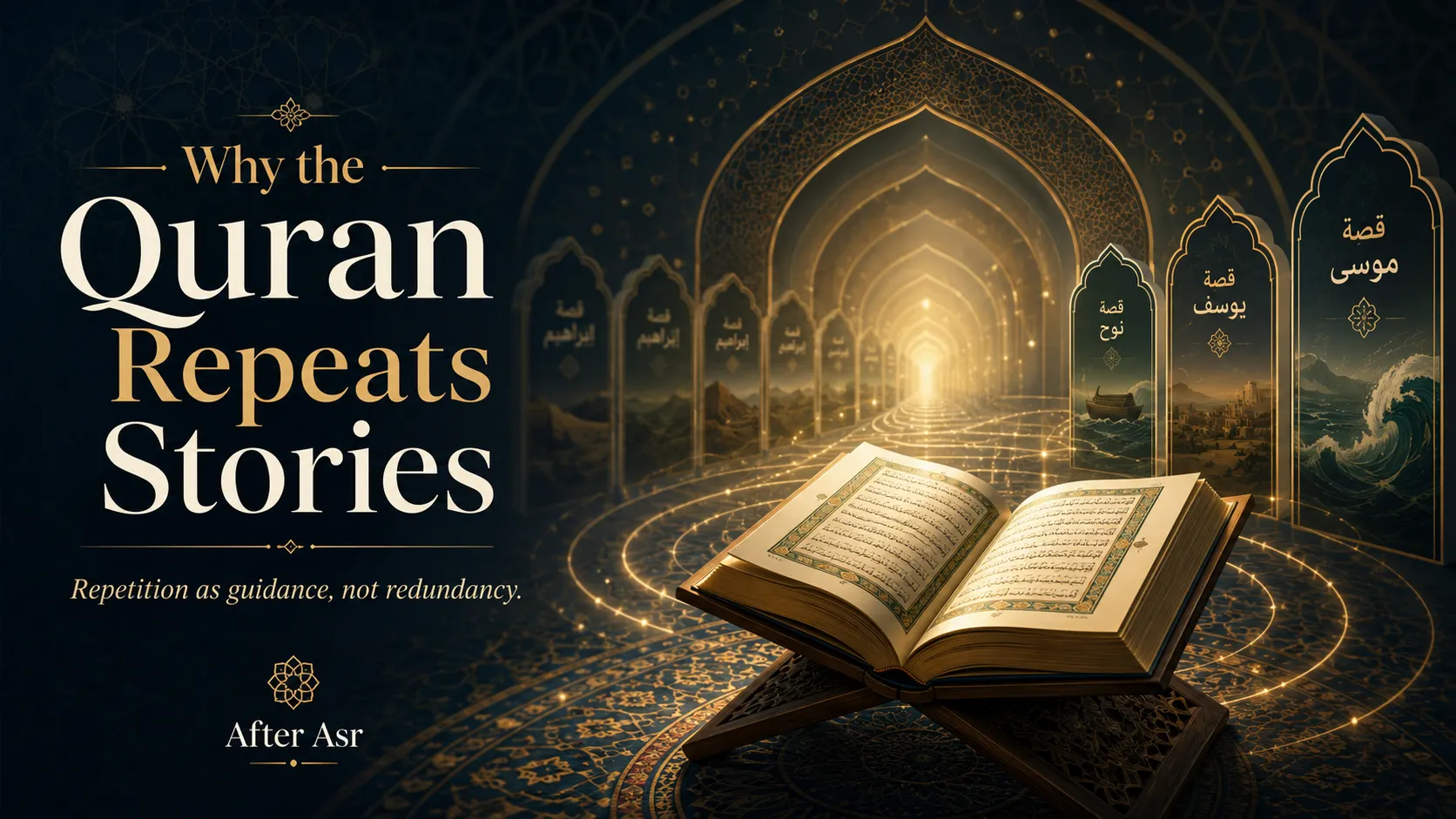
Repetition as guidance, not redundancy.
At first glance, repetition can seem like a flaw.
Modern readers are trained to expect efficiency. A story should be told once. A point should be made clearly and then left behind. A book should move forward without circling back too often. In much of contemporary writing, repetition is treated as a sign that something could have been edited more tightly.
But the Quran does not read like a modern textbook, novel, essay collection, or historical archive.
It returns.
It circles.
It reminds.
It brings the reader back to Adam, Nuh, Ibrahim, Musa, Maryam, Isa, Yusuf, Yunus, and others. It revisits moments of warning, patience, rejection, rescue, arrogance, repentance, and trust. Sometimes the same prophet appears in different surahs with different details. Sometimes a familiar story arrives with a new emotional weight. Sometimes the same event is recalled in a different rhythm, for a different audience, at a different stage of revelation.
For some readers, this raises a question:
Why does the Quran repeat stories?
The answer begins with understanding that Quranic repetition is not redundancy. It is guidance.
The Quran is not merely telling us what happened.
It is teaching us how to see.
The Quran Is Not Arranged Like a History Book
One reason repetition feels surprising is that many readers expect sacred history to unfold chronologically.
If the Quran were organized like a conventional history book, the story of Adam would appear once, followed by the stories of later prophets, nations, messengers, and communities in order. Each narrative would have a beginning, middle, and end. Once a story concluded, the reader would move on.
But the Quran does something different.
It does not present prophetic stories as museum pieces from the past. It presents them as living signs. The stories are not locked inside their historical moments. They are brought into the reader’s present life, again and again, because the human condition keeps producing the same spiritual dangers.
Arrogance repeats.
Forgetfulness repeats.
Fear repeats.
Injustice repeats.
The temptation to reject truth repeats.
The need for patience repeats.
So the Quran repeats, not because it lacks organization, but because it is organized around guidance rather than chronology.
The Quran does not simply ask, “What happened before?”
It asks, “What is happening inside you now?”
The Same Story Is Not Always the Same Lesson
When the Quran returns to a story, it often does so with a different purpose.
The story of Musa, peace be upon him, appears many times. But it is not repeated as a flat copy. In one passage, the focus may be Pharaoh’s arrogance. In another, the focus may be Musa’s fear and reliance upon Allah. Elsewhere, the focus may be the Children of Israel, the magicians, the mother of Musa, the sea, the confrontation with power, or the burden of leadership.
The reader is not simply hearing “the story of Musa” again.
The reader is being invited to stand in a different place within it.
Sometimes we are asked to notice the tyrant.
Sometimes the believer.
Sometimes the frightened mother.
Sometimes the public crowd.
Sometimes the prophet carrying a mission heavier than himself.
This is one of the Quran’s great literary and spiritual qualities: it can return to the same event without giving the same experience. Each retelling opens another door.
A person may read one passage during a time of fear and notice courage. They may read another during a time of injustice and notice Allah’s support. They may read another while struggling with patience and notice the long burden of calling people to truth.
The event may be ancient.
The guidance is immediate.
Repetition Builds Moral Recognition
Human beings often do not fail because they have never heard the truth.
We fail because we forget it.
We fail because we hear a lesson once, agree with it, and then slowly return to our habits. We know arrogance is dangerous, yet we still defend our pride. We know wealth is a test, yet we still measure people by it. We know life is temporary, yet we behave as if the world owes us permanence. We know Allah sees us, yet we still become careless in private.
The Quran’s repetition responds to this human weakness.
It does not assume that hearing something once is enough.
It trains recognition.
When the Quran repeats stories of destroyed nations, it is not merely telling us that past peoples were punished. It is teaching us to recognize patterns before they destroy us. When it repeats the rejection faced by prophets, it is not simply recounting opposition. It is teaching believers that truth has always been resisted. When it repeats Allah’s mercy toward those who return to Him, it is not offering a passing comfort. It is training the heart not to despair.
Repetition helps a lesson move from information to awareness.
A person may know something in the mind long before the heart is shaped by it.
The Quran speaks to both.
Every Audience Needs a Different Entrance
The Quran was revealed over time, addressing real people, real events, real struggles, and real stages of the Prophet’s mission, peace and blessings be upon him.
A story revealed in Makkah may carry a different emphasis than a story recalled in Madinah. Early Muslims facing persecution needed reminders of patience, trust, and the fate of those who mocked messengers before them. A growing Muslim community needed guidance on law, identity, responsibility, and moral discipline. People encountering Islam for the first time needed signs, warnings, and invitations. Believers already committed to Islam needed refinement.
The same story could serve each of these audiences differently.
A prophet rejected by his people may console a persecuted believer.
The same prophet may warn a hostile listener.
The same prophet may teach a Muslim community how to remain faithful when numbers, power, or social pressure change.
This is part of the Quran’s depth. It does not treat stories as one-use examples. It brings them into different circumstances because guidance must meet people where they are.
The Quranic story is not static.
It moves through life with the reader.
Repetition Creates Spiritual Memory
Every community is shaped by what it remembers.
Families repeat certain stories because those stories carry identity. Nations repeat founding moments because they shape public imagination. Communities repeat sacrifices, victories, losses, and turning points because memory teaches people who they are.
The Quran forms a believing memory.
It teaches Muslims to remember the world through revelation. It gives the believer a vocabulary of human experience: Adam and repentance, Nuh and perseverance, Ibrahim and surrender, Yusuf and patience through betrayal, Musa and confrontation with tyranny, Maryam and dignity under accusation, Yunus and the darkness of calling upon Allah, the People of the Cave and faith under pressure.
These are not simply stories to admire.
They become part of how a Muslim understands life.
When someone is falsely accused, Maryam is not distant.
When someone is betrayed by family, Yusuf is not distant.
When someone feels swallowed by darkness, Yunus is not distant.
When someone stands before power, Musa is not distant.
Repetition makes these stories available to the heart before crisis arrives. It places them into memory so that when life becomes difficult, the believer is not spiritually empty-handed.
The Quran repeats because the soul needs stored light.
The Quran Teaches Through Pattern, Not Just Plot
Modern storytelling often depends on suspense. The reader wants to know what happens next.
Quranic storytelling often works differently. In many cases, the outcome is already known or quickly made clear. The emphasis is not always on suspense, but on recognition, reflection, and moral pattern.
A messenger comes to his people.
The people deny.
The powerful mock.
The sincere few believe.
The warning is ignored.
The truth becomes undeniable.
The consequences arrive.
This pattern appears repeatedly because it is not only about one nation. It is about the structure of moral life. The Quran teaches that societies do not collapse merely because they lack information. They collapse when arrogance, injustice, denial, and corruption become normal.
The repetition forces the reader to ask uncomfortable questions.
Where have I dismissed truth because it challenged me?
Where have I followed the crowd because it felt safer?
Where have I admired power more than sincerity?
Where have I mistaken delay for escape?
The repeated pattern becomes a mirror.
The reader is not allowed to treat past nations as strange people who failed in strange ways. Their failures become warnings about possibilities inside every human being.
Repetition Slows the Reader Down
The Quran does not always satisfy the impatient reader.
It does not rush to provide novelty at every turn. It often asks the reader to stay with what matters. To look again. To listen again. To reconsider what was assumed to be familiar.
This is spiritually important because familiarity can become a veil.
A person may say, “I already know the story of Musa.”
But do they know what it means to speak truth while afraid?
A person may say, “I already know the story of Yusuf.”
But do they know how to resist bitterness after betrayal?
A person may say, “I already know the story of Adam.”
But do they know how to repent without losing hope?
A person may say, “I already know Pharaoh was arrogant.”
But do they recognize the smaller Pharaohs of the ego?
Repetition challenges the arrogance of “I already know.”
The Quran returns to familiar stories because the believer has changed since the last reading. A verse that passed quietly years ago may strike deeply today. A story once read as history may later become personal. A warning once heard as general may later feel painfully specific.
The Quran is repeated in recitation.
The believer is repeated through life.
Each return may reveal something new.
Repetition Strengthens the Prophet and the Believers
The stories of earlier prophets were not revealed as abstract material. They strengthened the Prophet Muhammad, peace and blessings be upon him, and the early believers.
The Prophet was insulted, rejected, accused, and opposed. His followers were mocked, pressured, and persecuted. In that context, the stories of earlier messengers carried reassurance.
You are not the first to be denied.
Your pain is not proof of failure.
The truth has always faced resistance.
Allah’s support may come after hardship.
The powerful are not beyond accountability.
This is one reason repetition matters. Trials themselves repeat. A believer may need reassurance more than once. A community under pressure may need to hear again that rejection is not new, that patience is not wasted, and that Allah’s promise is not fragile.
The Quran does not offer comfort as a one-time statement.
It returns with comfort because human hardship returns too.
Repetition Also Warns the Comfortable
Not all repetition is soft.
Some repeated stories disturb the reader. They warn against arrogance, heedlessness, hypocrisy, mockery, and the illusion of security. They remind people that wealth, status, numbers, and worldly achievement do not protect a person from moral collapse.
This matters because people become comfortable quickly.
A person may begin with sincerity and later become impressed with themselves. A community may begin in hardship and later forget humility. A society may receive blessings and mistake them for entitlement.
The Quran repeats warnings because comfort makes people forget danger.
Stories of past nations are not included so Muslims can look backward with superiority. They are there so every generation can ask whether it is walking toward the same cliff while using different language.
The details change.
The disease may remain.
Repetition Reveals the Quran’s Oral Power
The Quran is not only read silently on a page. It is recited, heard, memorized, taught, and lived in worship.
Repetition has a special role in oral revelation. It creates rhythm, memory, emphasis, and recognition. Repeated themes and stories help the believer carry the Quran within the heart. They make guidance easier to remember and harder to escape.
A phrase heard again in a different surah may awaken the listener. A familiar story recited in prayer may land differently because of the surrounding verses. A repeated warning may become heavier each time it is heard. A repeated mercy may become more comforting.
The Quran’s repetition is not merely textual.
It is devotional.
It shapes the soundscape of Muslim life. It allows believers across languages and generations to share a common world of remembered signs.
The story returns because the Quran is meant to be returned to.
Repetition Is Not Carelessness
A careless repetition says the same thing because the writer has nothing else to say.
Quranic repetition does the opposite.
It shows that revelation can revisit the same truth from multiple angles without exhausting it. It teaches that guidance is layered. It reminds the reader that divine speech is not bound by the habits of human publishing, where novelty is often valued more than transformation.
The Quran is not trying to impress the reader with constant newness.
It is trying to guide the human being toward Allah.
That requires return.
Prayer itself is repetition. Dhikr is repetition. Ramadan returns every year. Jumu’ah returns every week. The Fatiha is repeated in every unit of prayer, yet Muslims do not treat it as unnecessary because it has been said before.
The deepest things in Islam are often repeated because the deepest things in human life must be renewed.
Love is renewed.
Faith is renewed.
Repentance is renewed.
Gratitude is renewed.
Guidance is renewed.
The Quran repeats because the heart leaks.
Familiarity Should Become Reverence, Not Boredom
One danger of repeated stories is that a person begins to treat them casually.
The names become familiar. The events become predictable. The lessons become phrases. The reader moves quickly because they assume there is nothing left to receive.
But the problem is not that the Quran has repeated itself too much.
The problem may be that the reader has stopped arriving with need.
A believer does not return to Quranic stories only to gather information. A believer returns to be corrected, softened, strengthened, and reoriented. The story may be familiar, but the heart may not be healed. The lesson may be known, but the ego may still resist it. The warning may be memorized, but the life may not yet reflect it.
The Quran does not become shallow because we have heard a story before.
Sometimes we become shallow in how we listen.
Conclusion
The Quran repeats stories because human beings need more than information.
We need remembrance.
We need patterns made visible.
We need warnings that return after comfort makes us careless.
We need mercy repeated after sin makes us despair.
We need courage repeated after fear makes us small.
We need prophetic stories placed into our memory so that when our own trials arrive, we recognize that we are not the first to walk through difficulty under the gaze of Allah.
The repetition of the Quran is not a weakness in its structure.
It is part of its mercy.
A story returns because guidance returns. A warning returns because danger returns. A comfort returns because pain returns. A truth returns because the heart, left alone, forgets.
The Quran repeats stories not because Allah needs to say them again.
But because we need to hear them again.