Understanding the foundation before seeking meaning
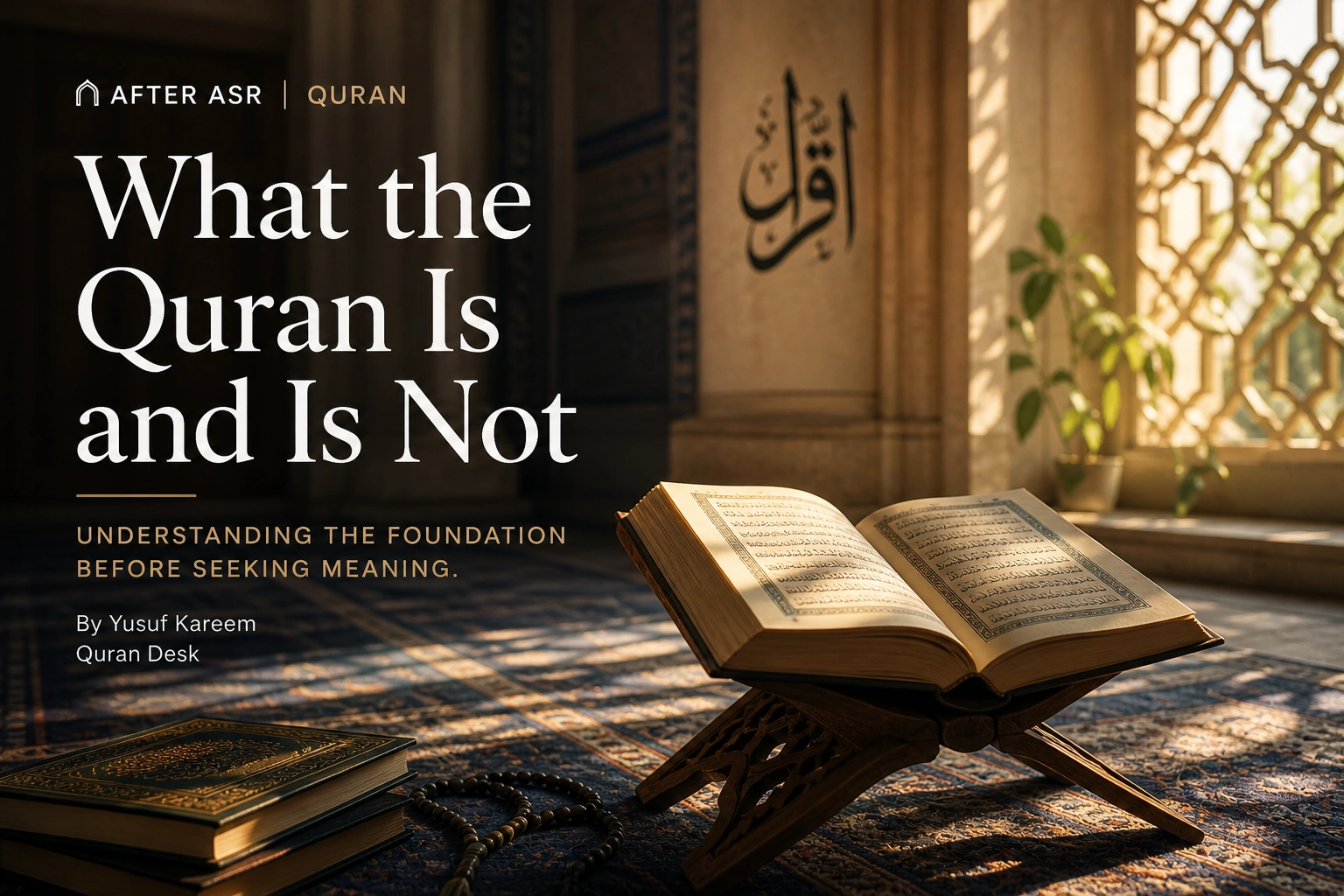
For many Muslims, the Quran is ever-present. It is recited in prayer, heard in gatherings, and placed in homes with deep respect. Yet familiarity does not always lead to clarity. Before asking what the Quran says about specific issues, it is essential to understand what the Quran is, and just as importantly, what it is not.
This distinction shapes how it is approached, read, and lived.
The Quran as Revelation
At its core, the Quran is understood by Muslims to be the revealed word of Allah, sent to the Prophet Muhammad over a period of twenty-three years. It is not viewed as a human composition, nor as a collection of reflections or experiences. Rather, it is considered divine speech, preserved and transmitted with care across generations.
Because of this, the Quran occupies a unique position. It is not simply a religious text among others. It is the primary source of guidance in Islam, forming the foundation upon which belief, practice, and understanding are built.
A Book of Guidance
Scholars consistently describe the Quran as a book of guidance. Its purpose is not limited to informing, but extends to shaping how a person thinks, acts, and understands their place in the world.
This guidance appears in different forms. There are verses that establish beliefs, others that recount the stories of earlier peoples, and others that call to reflection on creation and human behavior.
Not every passage functions in the same way. Some are direct and clear. Others require explanation and context. Recognizing this variety is essential to reading the Quran with care.
What the Quran Is Not
Clarity also comes from understanding what the Quran was not intended to be.
It is not a chronological narrative. The arrangement of chapters does not follow a linear timeline, and stories often appear in different places with different emphases.
It is not a comprehensive legal manual. While it contains legal guidance, many details of practice are explained through the teachings and example of the Prophet.
It is not a text that can be fully understood through translation alone. While translations provide access to meaning, the Quran in its original Arabic carries linguistic depth that scholars have studied for centuries.
It is also not a book that lends itself to isolated reading without context. Extracting individual verses without considering their setting or explanation can lead to misunderstanding.
The Role of Scholarship
Throughout Islamic history, scholars have played a central role in helping communities understand the Quran. They studied language, context, and the circumstances in which verses were revealed. Their work helped clarify meanings and establish principles for interpretation.
When engaging with the Quran, Muslims have traditionally relied on this accumulated knowledge. This does not prevent personal reflection, but it grounds that reflection within a broader and established understanding.
Reading With the Right Expectations
Approaching the Quran requires a shift in expectation. It is not meant to be consumed quickly or treated as a source of immediate answers to every question.
Instead, it invites repeated reading, careful listening, and ongoing reflection. A single passage may offer new insight over time, depending on a person’s circumstances and level of understanding.
This process is gradual. It is shaped by sincerity, patience, and a willingness to learn.
A Living Relationship
The Quran is not only something to be read. It is something to live with. Its guidance is meant to influence daily decisions, character, and perspective.
For many, this relationship begins with recitation, develops through study, and deepens through reflection and application. Each stage builds on the other.
Understanding what the Quran is and is not helps prevent confusion at the beginning of this journey. It allows a person to approach the text with clarity, respect, and the right intentions.
Conclusion
The Quran holds a central place in the life of a Muslim, but that centrality requires understanding.
It is divine revelation, a source of guidance, and a text that has been preserved and studied across generations. At the same time, it is not a simple or self-contained manual that can be approached without context or care.
Recognizing both sides of this distinction allows for a more grounded and meaningful engagement. It sets the foundation for reading the Quran not only with familiarity, but with understanding.