A history of transmission, memory, and continuity
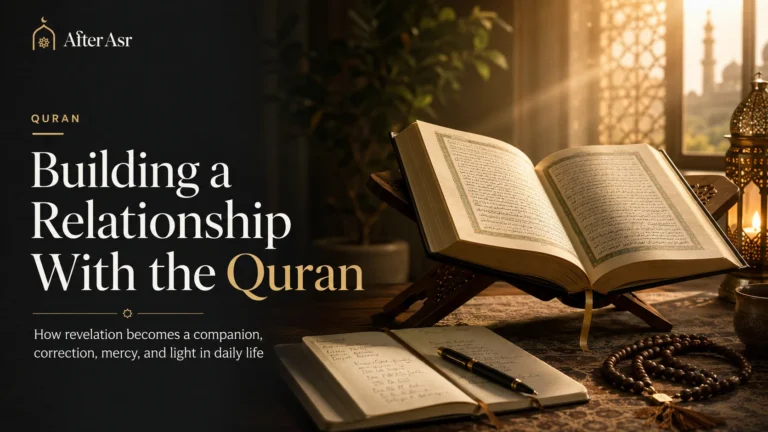
For Muslims, the preservation of the Quran is not simply a historical claim. It is a central part of how the text is understood and trusted. The Quran is regarded as the revealed word of Allah, and its preservation is seen as both a divine promise and a human responsibility carried out across generations.
Understanding how the Quran was preserved requires looking at two interconnected processes: oral transmission and written compilation. Together, they formed a system that has maintained the text with remarkable consistency over time.
Revelation and Early Transmission
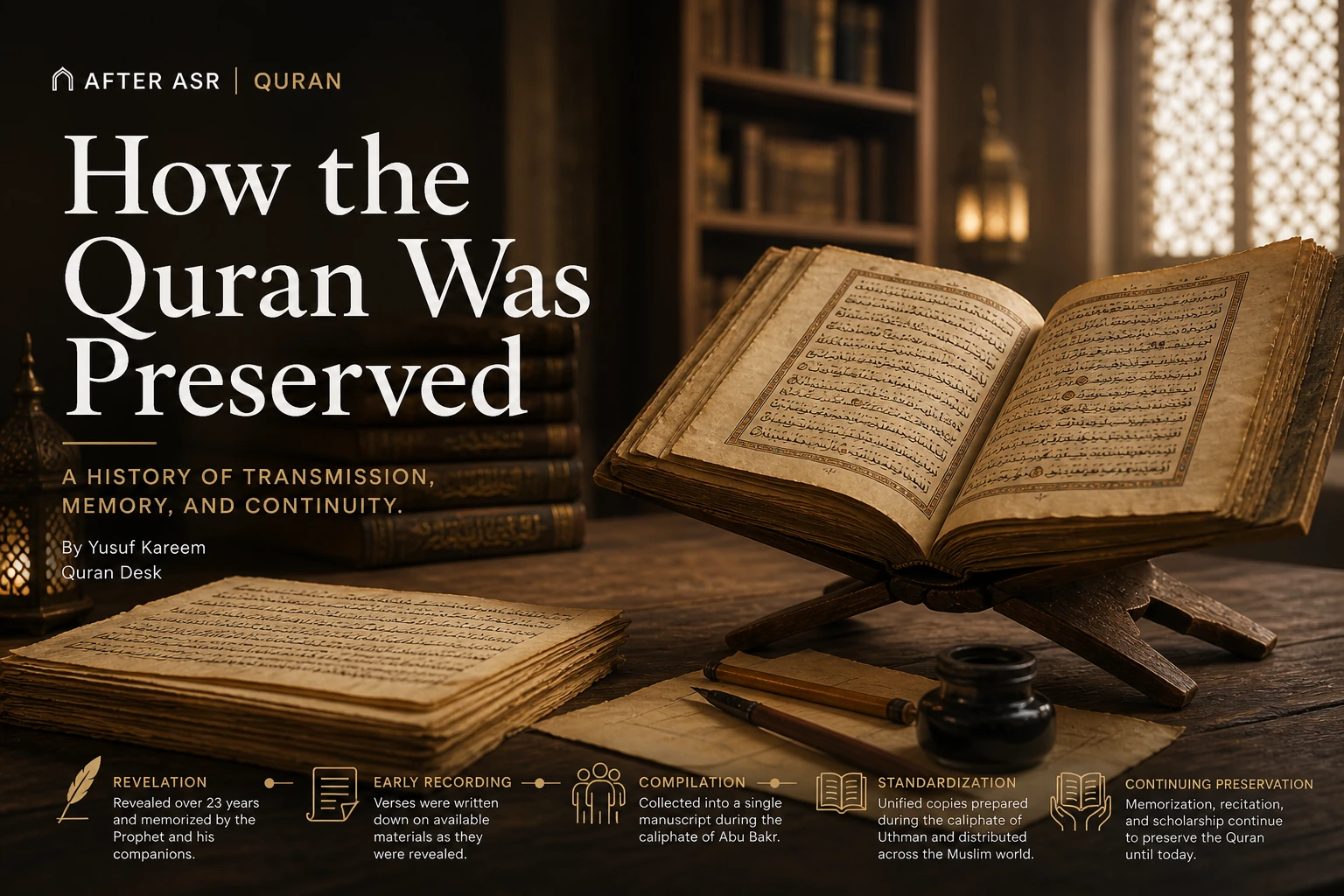
The Quran was revealed to the Prophet Muhammad over a period of approximately twenty-three years. These revelations were not delivered as a single, bound text. They were received in portions, often in response to specific moments, questions, or circumstances.
When verses were revealed, they were memorized immediately by the Prophet and by his companions. Memorization was not a secondary method. It was the primary mode of preservation in a society where oral transmission was highly developed and widely practiced.
At the same time, the Prophet instructed scribes to write down the revealed verses. These were recorded on materials available at the time, including parchment, bone, and other surfaces. In addition, the Prophet guided where each verse belonged within the overall structure of the Quran.
By the time of his passing, the Quran existed in a complete form through memorization and in written fragments, though not yet compiled into a single physical volume.
Compilation After the Prophet
After the death of the Prophet, the Muslim community faced the responsibility of ensuring that the Quran remained preserved in a unified and accessible form. This process took place in stages.
During the caliphate of Abu Bakr, a formal effort was undertaken to gather the written fragments of the Quran into a single collection. This effort was led by companions who had both memorized the Quran and were directly involved in its recording during the Prophet’s lifetime. The process involved careful verification, requiring that written material be confirmed alongside memorization.
Later, during the caliphate of Uthman ibn Affan, the expansion of the Muslim world introduced new linguistic contexts. To maintain consistency in recitation, a standardized written copy was prepared and distributed to major centers. Copies that differed from this standardized version were not retained, in order to preserve a unified text.
This step did not introduce a new Quran. It ensured that the existing text was consistently represented across regions.
The Role of Memorization
While written manuscripts played an essential role, memorization remained central to preservation. From the earliest generations to the present day, individuals have committed the entire Quran to memory.
This tradition continues globally. In many parts of the world, students dedicate years to memorizing the text with precision, including pronunciation and recitation. These individuals, often referred to as huffaz, serve as living links in the chain of transmission.
Because the Quran is preserved both in written form and in the memories of countless individuals, the two reinforce one another. Errors in one can be corrected by the other. This dual system has been a defining feature of Quranic preservation.
Continuity Across Generations
The preservation of the Quran is not limited to its earliest history. It is an ongoing process. Each generation receives the text, studies it, and passes it forward.
Scholars developed detailed methods to ensure accurate recitation, including systems of pronunciation and rules governing how the text is read. Chains of transmission, known as isnad, link students to teachers across generations, tracing back to the Prophet.
This structure has allowed the Quran to remain consistent not only in wording, but also in its recited form.
A Unique Model of Preservation
When viewed together, these elements form a model of preservation that is both textual and lived. The Quran is not preserved solely as a document stored in libraries. It is preserved through continuous engagement, recitation, and study.
This distinguishes it from many other historical texts, which may rely primarily on written transmission. In the case of the Quran, preservation is supported by a community-wide commitment that spans centuries and continents.
Conclusion
The preservation of the Quran reflects a combination of early efforts and ongoing practice. From the memorization of the companions to the compilation of written manuscripts, and from the standardization of copies to the continued tradition of recitation, each stage has contributed to maintaining the text as it was received.
For Muslims, this continuity is not only historical. It is part of their lived experience. The Quran that is read and recited today is understood to be the same Quran that was revealed more than fourteen centuries ago.
Understanding this process provides context for the confidence with which the text is approached. It also highlights the collective responsibility that has sustained it across time.