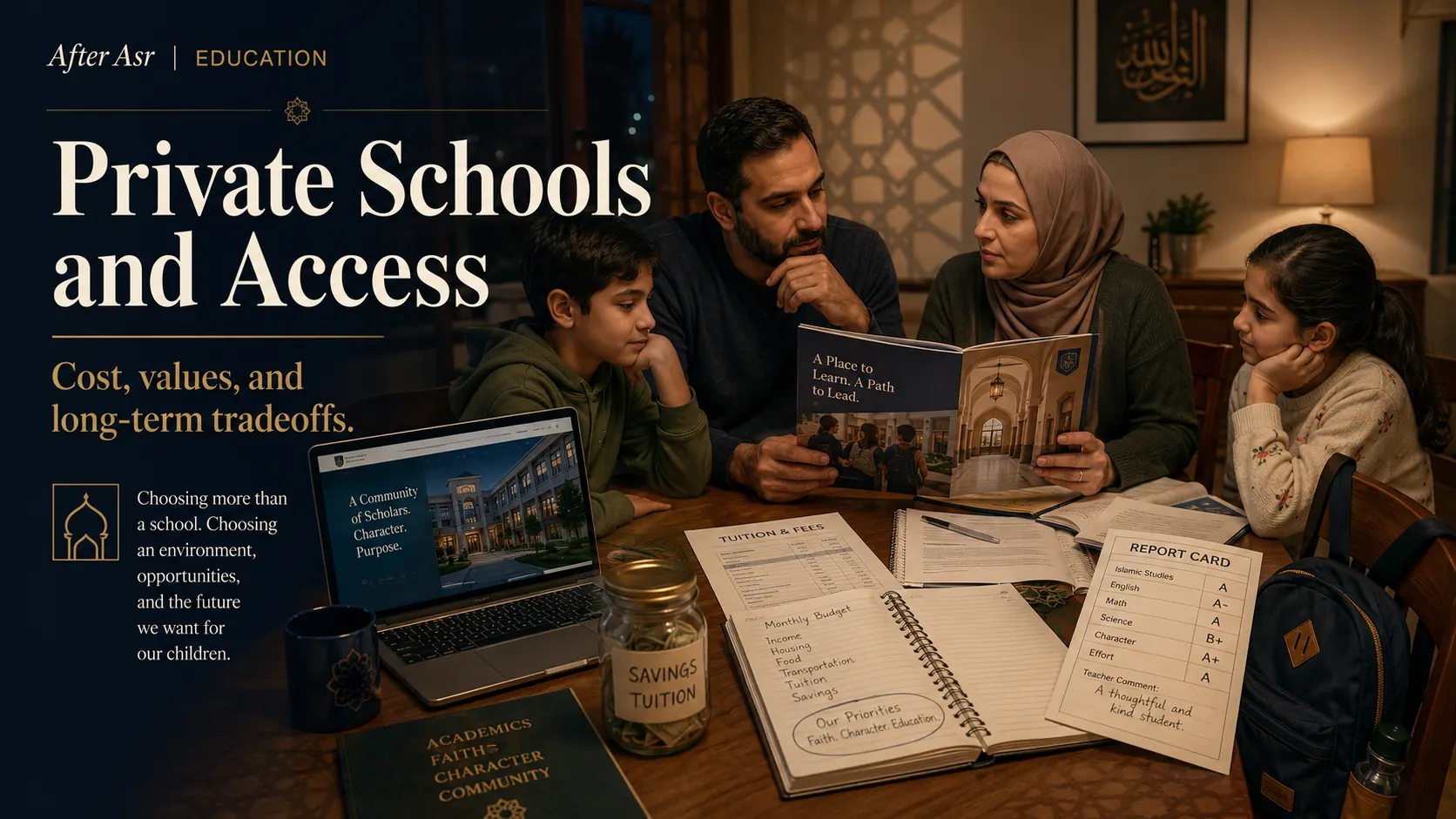
Cost, values, and long-term tradeoffs.
Private school decisions are rarely just about school.
They are about money.
They are about values.
They are about safety.
They are about class.
They are about faith.
They are about opportunity.
They are about fear.
They are about sacrifice.
They are about what parents hope their children will become.
For many families, especially Muslim families trying to raise children with both academic strength and religious confidence, private school can feel like a possible answer to several anxieties at once.
Maybe the public school feels too chaotic.
Maybe the curriculum raises concerns.
Maybe the child is being bullied.
Maybe the family wants smaller classes.
Maybe the parents want stronger discipline.
Maybe an Islamic school promises a daily environment where faith is normal.
Maybe a college-preparatory school promises future opportunity.
Maybe a private academy offers sports, arts, advanced courses, or a culture of achievement.
Maybe parents simply want their child to be seen.
These hopes are understandable.
But private school is not magic.
A private school can be excellent. It can also be disappointing. It can protect a child in some ways while limiting them in others. It can align with family values or merely advertise them. It can open doors, create pressure, deepen belonging, produce isolation, strengthen faith, weaken humility, support learning, or hide problems behind polished language.
The question is not whether private school is good or bad.
The question is whether a particular private school, for a particular child, in a particular family situation, is worth the cost and tradeoffs.
That is a harder question.
And it deserves more honesty than families often receive.
Private does not automatically mean better
One of the first illusions to remove is the belief that private school is automatically better because it is private.
Tuition can create the appearance of quality. Brochures can create confidence. Uniforms can create seriousness. Small class sizes can create comfort. A beautiful campus can create trust. A selective admissions process can make a school feel prestigious.
But none of these things guarantees a good education.
A private school may have weak teachers.
A private school may lack support for students who learn differently.
A private school may have poor leadership.
A private school may be socially toxic.
A private school may be academically shallow.
A private school may care more about image than truth.
A private school may use religious or moral language without embodying it well.
A private school may serve confident students while quietly failing struggling ones.
Public schools can fail children. Private schools can fail children too.
The difference is that private schools often fail children behind a different kind of curtain. Families may hesitate to criticize because they are paying tuition. Schools may protect reputation because reputation affects enrollment. Parents may convince themselves that sacrifice must be worth it because admitting disappointment is painful.
This does not mean private schools should be viewed with suspicion. It means they should be evaluated carefully.
A school should not be trusted merely because it is private.
It should be trusted because it is worthy of trust.
What families are really buying
When families pay private school tuition, they are not only buying instruction.
They are buying an environment.
They are buying peer culture.
They are buying access to certain teachers.
They are buying a school philosophy.
They are buying expectations.
They are buying discipline norms.
They are buying class size.
They are buying community.
They are buying religious or moral atmosphere.
They are buying administrative responsiveness.
They are buying distance from some public school problems.
They may also be buying entrance into a social network.
This is why private school evaluation must go beyond test scores and college acceptance lists.
A family should ask: what kind of child does this school tend to produce?
Not just where graduates attend college.
Not just what scholarships they receive.
Not just what awards appear on the website.
What are the students like?
Are they curious?
Are they kind?
Are they arrogant?
Are they anxious?
Are they disciplined?
Are they spiritually grounded?
Are they respectful to workers?
Are they able to think clearly?
Are they sheltered in a healthy way or an unrealistic way?
Are they serious without becoming joyless?
Are they confident without becoming entitled?
The hidden curriculum matters.
A private school teaches through what it rewards and what it tolerates. If it rewards prestige, students will learn prestige. If it rewards humility, responsibility, service, and intellectual seriousness, students will learn something deeper.
Families should not only ask what the school says it values.
They should ask what the students are becoming.
The cost is more than tuition
The cost of private school is not only the number printed on the tuition page.
There may be registration fees, application fees, uniforms, books, technology fees, activity fees, transportation, lunches, field trips, sports fees, fundraising expectations, aftercare, summer programs, testing fees, donations, and social costs connected to belonging in the school community.
Then there is the hidden cost: pressure.
A family paying thousands of dollars may feel trapped. If the school is not working, parents may hesitate to leave because they have sacrificed so much. If the child struggles, parents may become angry because the investment feels threatened. If the school asks for more money, families may feel guilty saying no.
The child may also feel pressure.
“I am paying so much for this school” can become a heavy sentence in a child’s life. Even when parents do not mean harm, children may learn that their performance must justify the sacrifice.
This can create anxiety, especially if the child is already struggling.
Private school should not become a family idol.
A school is a means. It is not the child’s worth. It is not the family’s salvation. It is not proof that parents care more than other parents. It is not a guarantee of success.
If tuition places a family under severe financial strain, the spiritual and emotional cost must be counted. A child may benefit from a smaller school but suffer from a home filled with money stress. A family may gain a religious environment but lose peace through debt, resentment, or exhaustion.
Sacrifice can be noble. But not every sacrifice is wise.
Access and inequality
Private schools raise serious questions about access.
Who gets to attend?
Who can afford it?
Who receives scholarships?
Who is welcomed?
Who is quietly excluded?
Who is told the school cannot meet their needs?
Whose children are considered worth investing in?
Private education often benefits families who already have more resources: money, transportation, flexible work schedules, English fluency, social networks, and confidence navigating institutions.
This does not make private school families bad. Parents naturally seek good opportunities for their children. But it does mean communities should be honest about inequality.
A private school may speak about values while being inaccessible to the very families who most need support.
An Islamic school may say it serves the ummah, but if only wealthier families can attend, then the community must ask difficult questions. Are scholarships serious or symbolic? Are donors helping low-income families access the school? Are single parents considered? Are refugee families supported? Are children with disabilities welcomed? Are payment plans realistic? Are families treated with dignity when they cannot pay full tuition?
Access is not only a financial issue. It is a moral issue.
A school that claims to form character must examine its own character.
If private education becomes only a shelter for the comfortable, it may protect some children while deepening community divides.
Islamic private schools and the question of values
For Muslim families, Islamic schools occupy a special place in this conversation.
An Islamic school may offer something a secular private school cannot: an environment where Islam is woven into the day. Prayer can be normal. Ramadan can be understood. Eid can be celebrated. Qur’an and Arabic can be taught. Muslim identity can be affirmed rather than explained constantly.
For a child, this can be powerful.
A Muslim child who spends years in a healthy Islamic school may develop confidence, belonging, friendships, and habits that remain long after graduation. They may learn that faith is not something hidden at the edge of life. It is part of time, language, manners, learning, and community.
But an Islamic school must be more than a private school with Muslim decoration.
The question is not only whether students pray.
The question is whether prayer shapes the culture.
The question is not only whether Qur’an is taught.
The question is whether Qur’an is honored in behavior.
The question is not only whether teachers are Muslim.
The question is whether teachers embody patience, fairness, excellence, humility, and adab.
The question is not only whether boys and girls follow dress codes.
The question is whether modesty is taught with dignity rather than shame.
The question is not only whether the school avoids certain public school problems.
The question is whether it builds something better.
A weak Islamic school can still harm children. It can make religion feel harsh, shallow, disorganized, or hypocritical. It can teach students to associate Islam with poor quality if academics are neglected. It can create resentment if authority is careless. It can confuse cultural control with spiritual formation.
A strong Islamic school, however, can be one of the greatest gifts a community gives its children.
The difference is leadership, sincerity, structure, and accountability.
Academic quality still matters
Some families choose private religious schools because they want values alignment. That is understandable. But values cannot become an excuse for weak academics.
A Muslim school should care about reading.
It should care about writing.
It should care about mathematics.
It should care about science.
It should care about history.
It should care about reasoning.
It should care about student support.
It should care about teacher development.
It should care about organization.
Faith-based education should not mean lower expectations.
Islamic identity and academic seriousness should strengthen each other. A student who believes knowledge is an amanah should be taught to study with excellence. A school that says learning is sacred should not tolerate laziness, disorganization, or underprepared teaching.
Parents should ask direct questions.
How is reading taught in early grades?
How does the school identify struggling students?
What math curriculum is used?
How much writing do students produce?
Are science labs available?
How are teachers trained and evaluated?
What happens if a child falls behind?
What advanced options exist for strong students?
How does the school prepare students for college, trades, or adult life?
Does the school track graduate outcomes honestly?
A school may not have everything. Smaller private schools often operate with limited resources. But honest limitations are different from careless weakness.
Parents can accept modest facilities if the teaching is serious.
They can accept limited electives if the core education is strong.
They can accept growing pains if the school is transparent and improving.
But families should be careful when schools hide weak academics behind moral language.
Children deserve both faith and competence.
Discipline and school culture
Many parents seek private schools because they want better discipline.
They may worry that public schools are too chaotic, too permissive, too overwhelmed, or too slow to address disruptive behavior. Private schools often promise order, clear expectations, and stronger consequences.
Order matters. Children cannot learn well in constant chaos. Teachers cannot teach well if classrooms are unsafe or uncontrolled. A school culture with serious behavioral expectations can be a great blessing.
But discipline must be examined carefully.
Is discipline fair?
Is it consistent?
Is it humiliating?
Is it overly harsh?
Does it teach responsibility or merely enforce obedience?
Are some students protected because of family status?
Are boys and girls disciplined differently in unfair ways?
Are children with disabilities punished for needs the school does not understand?
Does the school explain rules clearly?
Does discipline include repair and growth?
A school can be orderly and still emotionally unhealthy. It can produce quiet students who are afraid, resentful, or skilled at hiding. It can mistake control for character.
Good discipline is not simply making children comply.
Good discipline teaches self-command. It helps students understand consequences. It protects the learning environment. It corrects without degrading. It distinguishes immaturity from defiance, disability from disrespect, and mistakes from patterns.
For Muslim schools especially, discipline must reflect Islamic adab. Authority should not be abusive. Mercy should not mean permissiveness. Correction should not become public shaming. Rules should not be arbitrary. Students should learn that obedience to Allah is not the same as fear of adults.
The best school cultures combine warmth and firmness.
Children need both.
The question of social environment
Private schools shape a child’s social world.
This can be one of their strongest benefits or one of their greatest risks.
A smaller school may give children closer friendships, more adult attention, and a stronger sense of belonging. A religious school may help children form friendships with peers who share faith practices. A academically serious school may surround students with motivated classmates.
But small environments can also become socially intense.
If a child is excluded, there may be few alternatives.
If gossip spreads, it may feel inescapable.
If the school is dominated by a few families, social hierarchy may become suffocating.
If everyone knows everyone, privacy may be limited.
If the school lacks diversity, students may develop narrow assumptions.
If the culture prizes wealth or status, students may absorb class arrogance.
Parents should ask about social health.
How does the school handle bullying?
Are new students welcomed?
Do students from less wealthy families feel included?
Are converts, immigrants, Black Muslims, Latino Muslims, Arab Muslims, South Asian Muslims, white Muslims, mixed families, and different madhhab backgrounds treated with dignity?
Are students with disabilities socially supported?
Does the school teach respect across difference?
Does the school culture produce humility or elitism?
For Muslim schools, this is essential. An Islamic school should not reproduce ethnic division, classism, racism, or social cruelty under an Islamic banner.
A school that teaches Qur’an while tolerating contempt among students has misunderstood its mission.
Special education and learning differences
Private school families must be especially careful when a child has a disability, learning difference, or emotional need.
Public schools are legally required to provide certain supports for eligible students. Private schools may have fewer resources, fewer legal obligations, or less specialized staff, depending on the situation.
Some private schools do excellent work with learning differences. Others are honest that they cannot provide what a child needs. Still others accept tuition while quietly failing to support the child.
Parents should ask specific questions before enrollment.
Does the school support students with dyslexia, ADHD, autism, speech challenges, anxiety, or other needs?
Are there trained specialists?
Can accommodations be provided?
How are teachers trained?
How does the school respond to behavior connected to disability?
What happens if a child needs services beyond what the school offers?
Will the school work with outside therapists or specialists?
Has the school successfully served students with similar needs before?
A loving environment is not enough if the child needs specialized instruction.
A religious environment is not enough if the child is constantly misunderstood.
A small class is not enough if teachers do not know how to support learning differences.
Families should not be ashamed to ask. A school’s answer reveals much about its maturity.
A child who learns differently should not be treated as a burden on the school’s image.
The prestige trap
Some families choose private school for values. Others choose it for prestige.
The prestige trap is subtle.
It can sound like concern for excellence, but underneath it may be fear of ordinary people, fear of public institutions, fear of social mixing, or desire for status.
Parents may want their child around “the right kind of students.” They may want access to elite networks. They may want the school name to signal family success. They may want college admissions advantages. They may want to say their child attends a respected academy.
Again, not every desire for quality is vanity. Parents should care about environment and opportunity.
But prestige becomes spiritually dangerous when it teaches children to measure themselves and others by institutional status.
A child may learn that expensive means better.
A child may learn that wealth means worth.
A child may learn that public school students are inferior.
A child may learn that success is about being associated with impressive people.
A child may learn to hide weakness because image matters.
Education should not train arrogance.
If private school makes a child more grateful, disciplined, humble, capable, and service-minded, it is doing good work. If it makes a child entitled, contemptuous, sheltered, and status-conscious, something has gone wrong.
Parents should examine their own intentions.
Are we choosing this school because it serves our child’s formation?
Or because it makes us feel safer, higher, or more respectable?
The answer may be mixed. Human intentions often are.
But the question must still be asked.
Financial sacrifice and family peace
Some parents make enormous sacrifices for private education.
They work extra hours. They delay home repairs. They drive long distances. They cut expenses. They ask relatives for help. They give up vacations. They carry stress quietly because they believe the school is worth it.
This sacrifice can be beautiful.
A parent who gives up comfort for a child’s education is acting from love. Many communities have been built by such sacrifice.
But sacrifice must be sustainable.
If tuition creates constant marital conflict, resentment, debt, or emotional pressure, the family must pause and reassess. A child’s school environment matters, but so does the home environment.
A peaceful home with engaged parents, strong faith routines, books, conversation, community support, and a decent school may be better than an expensive school that leaves the family financially and emotionally exhausted.
Families should calculate honestly.
What is the total yearly cost?
What will we give up?
Will we need debt?
Is financial aid available?
What happens if income changes?
Can we afford this for multiple children?
Will younger siblings receive the same opportunity?
Will we resent the child if they struggle?
Is this sustainable for one year or many years?
Private school decisions should be made with both hope and realism.
Love should not require financial blindness.
Scholarships, aid, and community responsibility
If private schools, especially Islamic schools, want to serve more than wealthy families, financial aid must be taken seriously.
Scholarships should be dignified. Families should not be humiliated for needing help. The process should be clear, confidential, and fair.
Communities should also consider education funds as a serious form of investment.
A mosque may raise money for buildings, renovations, banquets, and events. These may all have value. But helping children access strong Islamic education can also be a major communal obligation.
We should ask:
Can donors sponsor students?
Can zakat or sadaqah be used appropriately for eligible families?
Can schools create work-study models?
Can tuition be scaled based on income?
Can alumni give back?
Can local businesses sponsor scholarships?
Can families volunteer in ways that reduce costs without exploiting labor?
Can schools publish transparent financial needs?
Access requires structure.
If a community says Islamic education matters but does not create pathways for poor and middle-income families, then the message becomes hollow.
A school for the ummah cannot be priced as if only the affluent belong.
When private school is worth it
Private school may be worth the sacrifice when it provides something genuinely important that the family cannot reasonably obtain elsewhere.
It may be worth it when the child needs a safer environment.
It may be worth it when the school’s religious life strengthens faith beautifully.
It may be worth it when teachers know the child well.
It may be worth it when the academic program is strong and humane.
It may be worth it when the child is thriving emotionally and intellectually.
It may be worth it when public school options are deeply inadequate.
It may be worth it when the school supports the family’s values without isolating the child from reality.
It may be worth it when the cost is difficult but manageable.
The key word is “worth.”
Not impressive.
Not fashionable.
Not guilt-driven.
Not fear-driven.
Worth it.
Worth must be judged over time. A school that seemed perfect during admissions may not be perfect in daily life. Parents should remain observant.
Is the child growing?
Is the child safe?
Is the child learning?
Is the child becoming more confident and humble?
Is the child’s faith deepening or becoming performative?
Is the family able to sustain the arrangement?
Are concerns taken seriously?
Does the school improve when problems are raised?
A good school does not need to be flawless. No school is.
But it should be honest, responsive, and oriented toward the good of the child.
When private school may not be the answer
Private school may not be the answer when the family assumes it will solve problems that require parenting, therapy, tutoring, community, or spiritual work.
Changing schools will not automatically fix a child’s anxiety.
It will not automatically create love for Islam.
It will not automatically remove peer pressure.
It will not automatically produce discipline.
It will not automatically repair family conflict.
It will not automatically make a struggling reader fluent.
It will not automatically give a teenager purpose.
Sometimes a school change helps. Sometimes it only moves the same issues into a more expensive setting.
Private school may also not be wise if the child’s needs exceed what the school can provide. A child who requires specialized support may suffer in a school that looks wholesome but lacks trained staff.
It may not be wise if tuition forces the family into harmful debt.
It may not be wise if the school culture is elitist, harsh, disorganized, or dismissive of concerns.
It may not be wise if parents choose it mainly out of panic.
Fear can identify danger, but it does not always choose wisely.
Public, private, Islamic, homeschool: no perfect option
Many families want a perfect school option.
There is none.
Public school may offer resources and diversity but raise value concerns.
Private secular school may offer academics and order but lack Islamic environment.
Islamic school may offer faith and belonging but struggle with funding, staffing, or advanced programs.
Homeschooling may offer flexibility and family control but require major time, structure, and support.
Every option has tradeoffs.
The goal is not to find a school with no weaknesses. The goal is to understand the weaknesses honestly and build around them.
If a child attends public school, the family must build stronger Islamic formation at home and in community.
If a child attends Islamic school, the family must still monitor academic quality and social health.
If a child attends elite private school, the family must guard against arrogance, pressure, and spiritual neglect.
If a child is homeschooled, the family must ensure academic structure, social connection, and accountability.
No school choice removes parental responsibility.
The school is part of the child’s education. It is not the whole of it.
Questions families should ask
Before choosing a private school, families should slow down and ask deeper questions.
Not only, “Can we get in?”
But:
What does this school believe education is for?
How does the school form character?
How are teachers selected and supported?
What is the daily student culture like?
How does the school handle bullying?
How does it support students who struggle?
How does it challenge students who excel?
How does it communicate with parents?
How does it handle discipline?
What are the real costs?
What kind of families feel welcome here?
What kind of families feel out of place?
What does the school do when it makes mistakes?
What does our child need right now?
What are we hoping this school will solve?
Are those hopes realistic?
A school tour can show the polished version. These questions help reveal the lived reality.
Parents should also speak with current families if possible, including families whose children are not the easiest students. A school may look wonderful for high-performing, socially confident children. The deeper test is how it treats children who need patience.
The child must not disappear from the decision
In school decisions, adults often speak around the child.
Parents discuss tuition. Administrators discuss admissions. Teachers discuss performance. Communities discuss values. But the child’s actual experience can become secondary.
This is a mistake.
A child should not be the only decision-maker. Children do not always know what they need. But their experience matters.
Does the child feel safe?
Does the child feel known?
Does the child have friends?
Does the child respect the teachers?
Does the child feel challenged in a healthy way?
Does the child dread school every day?
Does the child’s personality seem more alive or more diminished?
Does the child feel that faith is becoming meaningful or merely enforced?
Does the child feel constant pressure to perform?
Parents should observe changes.
Some difficulty is normal. A child may resist a good school because it requires discipline. A teenager may complain about rules that are actually beneficial. But ongoing distress should not be ignored.
The purpose of education is formation, not institutional loyalty.
If the school is not serving the child’s formation, parents must be willing to reconsider.
Private school as partnership
A healthy private school is not a product purchased by parents. It is a partnership.
Parents provide trust, tuition, communication, and home formation. Teachers provide instruction, guidance, attention, and professional care. Administrators provide leadership, structure, vision, and accountability. Students gradually provide effort, honesty, responsibility, and openness to growth.
When this partnership works, private school can be deeply meaningful.
The school becomes more than a building. It becomes a community of formation.
But partnership requires honesty.
Schools should be honest about what they can and cannot provide. Parents should be honest about their child’s needs. Teachers should be honest about progress and concerns. Administrators should be honest about finances, staffing, and limitations.
Pretending helps no one.
A school that admits weakness can improve. A school that only protects image becomes fragile.
Families should look for schools that are not merely polished, but trustworthy.
The long-term tradeoff
Every school choice teaches a child something about what the family values.
Choosing private school may teach that faith matters, environment matters, excellence matters, or safety matters.
It may also accidentally teach that status matters, wealth matters, separation matters, or perfection matters.
The lesson depends on how parents frame the choice.
A family can say:
“We are choosing this school because we believe it will help you learn and grow. We are grateful for the opportunity, and we know many good families make different choices. This does not make us better than anyone. It gives us a responsibility to use this opportunity well.”
That framing matters.
Children should understand privilege as responsibility, not superiority.
If parents sacrifice for private school, children should be taught gratitude without being crushed by guilt. If financial aid makes attendance possible, children should be taught dignity without shame. If the school is Islamic, children should be taught that faith is a gift and a trust, not a reason for arrogance. If the school is academically strong, children should be taught that knowledge is for service.
The long-term tradeoff is not only financial.
It is moral.
What will this school help our child become?
And what must we teach at home so the school’s strengths do not become spiritual weaknesses?
Choosing with clear eyes
Private schools can be blessings.
They can create safe and serious environments. They can preserve values. They can offer strong academics. They can provide religious belonging. They can give teachers more freedom to know students well. They can build community. They can help children flourish.
But private schools can also disappoint. They can exclude. They can pressure. They can hide weakness behind polish. They can deepen inequality. They can create arrogance. They can overpromise. They can cost more than a family can wisely bear.
The answer is not blind trust or blanket rejection.
The answer is clear-eyed evaluation.
Parents should not choose private school merely because they are afraid. They should not reject it merely because it costs money. They should not assume public school is inferior. They should not assume Islamic school is automatically spiritually healthy. They should not assume prestige equals formation.
They should ask what their child needs, what the family can sustain, what the school truly offers, and what tradeoffs must be accepted.
A school is not only a place where children learn subjects.
It is a place where they learn what adults value.
If a family chooses private school, let it be for more than image. Let it be for formation. Let it be for safety without isolation, excellence without arrogance, faith without harshness, discipline without humiliation, and opportunity without contempt.
And if a family cannot afford private school, let them not believe their child is doomed. Many children have been beautifully educated in public schools, homeschools, modest schools, libraries, masjids, kitchens, workshops, and homes filled with books, prayer, conversation, and love.
Private school can help.
But it cannot replace the deeper work.
The child still needs parents who listen.
Teachers who care.
A community that supports.
A home that remembers Allah.
Friends who strengthen rather than weaken.
Books that nourish the mind.
Responsibilities that build maturity.
And adults who know that education is not purchased.
It is cultivated.