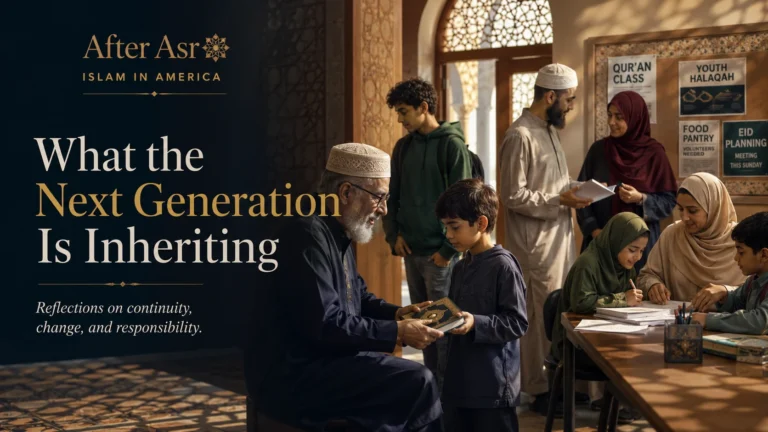

Strengths, growing pains, and expectations.
An Islamic school in the United States carries more than the ordinary burden of education.
It is expected to teach reading, writing, mathematics, science, history, and technology. It is expected to prepare students for college, careers, adulthood, and civic life. It is expected to provide discipline, safety, emotional care, academic support, social belonging, moral formation, and religious instruction.
But it is also expected to do something deeper.
It is expected to help Muslim children grow up without feeling that Islam is foreign to their own lives.
That is no small task.
For many families, the Islamic school is not merely a school. It is a hope. It is the hope that children can pray during the day without embarrassment. It is the hope that Ramadan will be understood without explanation. It is the hope that Eid will be celebrated, Qur’an will be honored, halal food will be normal, modesty will not be mocked, and Muslim identity will not have to be translated every hour.
It is the hope that children can become educated without being spiritually uprooted.
This hope is beautiful. It is also heavy.
Because Islamic schools are asked to do what few institutions can do easily: provide academic excellence, spiritual formation, cultural belonging, moral discipline, financial accessibility, professional administration, and community trust all at once.
Some Islamic schools rise beautifully toward this challenge. Others struggle. Many do both at the same time.
They are among the most important Muslim institutions in America. They are also among the most difficult to build well.
To speak honestly about Islamic schools, we must avoid both romantic praise and careless criticism.
An Islamic school is not automatically excellent because it is Islamic.
An Islamic school is not a failure because it has growing pains.
An Islamic school is not merely a refuge from public school.
An Islamic school is not simply a private school with Qur’an class added.
An Islamic school is a serious educational and spiritual institution that must be built with vision, competence, mercy, and accountability.
The question is not whether Islamic schools matter.
They do.
The question is whether Muslim communities are willing to support, improve, evaluate, and mature them with the seriousness they deserve.
The gift of a Muslim environment
One of the greatest strengths of an Islamic school is simple but profound: Islam becomes normal.
For a child, this matters.
The child does not have to explain why they are fasting.
The child does not have to ask whether Eid counts.
The child does not have to wonder if their name is strange.
The child does not have to feel alone during prayer time.
The child does not have to hide that Qur’an matters.
The child does not have to watch every religious practice become an exception to the school day.
In a healthy Islamic school, Muslim identity is not treated as an interruption.
It is part of the rhythm.
Students may begin the day with Qur’an. They may hear Arabic words used with love. They may see teachers pause for salah. They may experience Ramadan as a school-wide reality. They may learn that Islamic manners are not only family rules, but shared expectations. They may see Muslims from different backgrounds studying, playing, disagreeing, praying, and growing together.
This does something powerful.
It gives children a sense of belonging before they are forced to defend themselves.
Many Muslim adults who grew up in non-Muslim school environments remember the exhaustion of constant explanation. Why do you dress like that? Why do you not eat that? Why are you fasting? Why do you pray like that? Are you allowed to date? Are you oppressed? Are your parents strict? Are you from somewhere else?
Some children answer these questions with confidence. Others grow tired. Some begin to associate Islam with awkwardness. Some quietly distance themselves from visible practice because difference feels costly.
An Islamic school does not eliminate every identity struggle. But it can give children years in which Islam is not always the thing that makes them different.
That can be a mercy.
More than protection
Many parents turn to Islamic schools because they want protection.
They worry about bullying, peer pressure, dating culture, sexualized environments, ideological confusion, substance use, disrespect toward parents, immodesty, social media pressure, and curriculum conflicts.
These concerns should not be dismissed. Parents are not wrong to care about environment.
But protection alone is not enough.
If an Islamic school defines itself mainly by what it keeps children away from, it may become defensive rather than formative.
A good Islamic school should protect, but it should also build.
It should build love of Allah.
It should build love of the Prophet ﷺ.
It should build intellectual seriousness.
It should build adab.
It should build emotional maturity.
It should build confidence.
It should build service.
It should build academic skill.
It should build moral courage.
It should build the ability to live faithfully in the wider world.
A school cannot simply shelter children from every challenge and call that education.
Eventually, students will leave. They will enter colleges, workplaces, neighborhoods, online spaces, public institutions, and social environments that are not designed around Islam. If their Islamic education only taught avoidance, they may not know how to engage.
Protection must become preparation.
An Islamic school should not raise children who can only be Muslim inside Muslim-controlled spaces. It should raise children who know how to carry Islam into life with humility, courage, and wisdom.
The strength of shared rhythm
Islamic schools have a unique opportunity to shape time.
This is one of their underrated strengths.
In many American schools, time is organized around buses, bells, sports seasons, standardized testing, lunch schedules, holiday breaks, and academic quarters. Islamic life has to fit somewhere inside that structure, usually as an accommodation.
In an Islamic school, the day can be shaped differently.
Salah can be part of the schedule.
Ramadan can reshape expectations.
Eid can be anticipated with joy.
Qur’an can have a regular place.
Islamic history can be taught as living inheritance.
Character can be connected to worship.
Service can be tied to accountability before Allah.
The school calendar can reflect sacred time, not only secular time.
Children learn from rhythm.
When prayer is built into the day, students learn that worship is not an emergency squeezed between “real” obligations. When Ramadan is recognized, students learn that fasting is not merely a private inconvenience. When Islamic manners are reinforced across classrooms, students learn that adab is not limited to the masjid.
This shared rhythm can quietly form the soul.
But rhythm must be meaningful. If prayer becomes rushed, chaotic, or treated as a discipline tool, students may learn the wrong lesson. If Qur’an class becomes only memorization pressure without reflection or love, students may associate revelation with anxiety. If Islamic reminders are used mainly to control behavior, students may experience religion as surveillance rather than guidance.
The power of an Islamic school is not simply that Islamic practices happen.
It is how they happen.
Academic seriousness is not optional
A common mistake is to treat Islamic identity as a substitute for academic quality.
It cannot be.
An Islamic school must teach well.
Students need to read deeply, write clearly, reason carefully, calculate accurately, understand science, study history, use technology wisely, speak with confidence, and develop habits of disciplined learning.
If an Islamic school fails academically, it harms students and damages the reputation of Islamic education.
Children may begin to believe that Muslim spaces are loving but unprofessional, spiritual but disorganized, sincere but weak. Parents may begin to feel forced to choose between faith and academic excellence. Students may leave the school unprepared for higher education or skilled work. Communities may lose confidence.
This is not acceptable.
Islamic education should not mean lower standards. If knowledge is an amanah, then weak teaching is not a small problem. It is a breach of trust.
A school does not need luxury facilities to be academically serious. It does not need every elective, every sport, every advanced program, or every technology trend. Many excellent schools begin with modest resources.
But it does need seriousness.
It needs qualified teachers.
It needs coherent curriculum.
It needs honest assessment.
It needs academic support.
It needs professional development.
It needs leadership that understands instruction.
It needs clear expectations.
It needs attention to reading, writing, mathematics, science, and critical thinking.
It needs a plan for students who struggle and students who excel.
Faith should deepen academic responsibility.
A Muslim student should not be told, directly or indirectly, that Islamic character and weak academics belong together. Excellence is not vanity when it is pursued for the right purpose.
The teacher problem
Islamic schools often rise or fall on teachers.
A strong teacher can make a simple classroom feel rich. A weak teacher can make even a beautiful building feel empty.
But Islamic schools face a difficult teacher challenge.
Many cannot pay salaries competitive with public schools or elite private schools. Some rely on teachers who are deeply sincere but undertrained. Others hire qualified academic teachers who may not understand Islamic school culture. Some expect teachers to be instructors, mentors, religious role models, disciplinarians, counselors, parent communicators, club sponsors, and community representatives all at once.
This is a lot to ask.
Teachers in Islamic schools are often expected to sacrifice for the mission. Many do. But sacrifice cannot become exploitation.
A community that wants excellent Islamic schools must care about teacher compensation, training, workload, respect, and retention.
If teachers are underpaid, overworked, and unsupported, the school will suffer. Students will suffer. Families will complain. Administrators will scramble. Good teachers may leave. New teachers will repeat the cycle.
Islamic schools need a more mature teacher culture.
They need to recruit well.
They need to train new teachers.
They need to observe classrooms constructively.
They need to mentor younger staff.
They need to pay as fairly as possible.
They need to protect teachers from unreasonable parent pressure.
They need to remove teachers who harm students or refuse improvement.
They need to honor the teaching profession as sacred work, not cheap labor.
A school cannot claim to value education while treating teachers as disposable.
Islamic studies and Qur’an need depth
Many Islamic schools include Qur’an, Arabic, Islamic studies, seerah, fiqh, hadith, aqeedah, adab, or related subjects.
This is one of their main reasons for existing.
But the quality of Islamic instruction varies widely.
Some students memorize without understanding. Some study rules without wisdom. Some learn stories without moral connection. Some learn Arabic letters for years without meaningful language growth. Some receive Islamic studies as a set of disconnected facts. Some are taught by loving teachers who lack structure. Others are taught by knowledgeable teachers who lack child development skills.
Islamic instruction must be taken seriously as a discipline.
Teaching Islam to children and teenagers is not simply a matter of knowing Islam. It requires pedagogy. It requires mercy. It requires developmental awareness. It requires the ability to answer questions honestly. It requires knowing when to simplify and when to deepen. It requires connecting belief to life.
Students should not leave Islamic school knowing only how to perform Muslim identity externally.
They should know why salah matters.
They should know how Qur’an guides the heart.
They should know the Prophet ﷺ as more than a timeline.
They should know Islamic law as more than a list of prohibitions.
They should know adab as more than school discipline.
They should understand mercy, repentance, sincerity, gratitude, justice, humility, and accountability.
They should be able to ask difficult questions without being shamed.
An Islamic school must be especially careful not to make religion feel small.
If Islam is presented only through rules, warnings, competitions, punishments, or cultural habits, students may obey outwardly while disconnecting inwardly.
The goal is not merely Muslim behavior.
The goal is Muslim formation.
Diversity inside the Muslim student body
Muslim communities in the United States are not one culture.
An Islamic school may include students whose families are Arab, South Asian, African American, Black immigrant, East African, West African, Latino, white American, Turkish, Bosnian, Persian, Malay, Indonesian, Afghan, Central Asian, mixed-race, convert, immigrant, refugee, wealthy, working-class, professional, newly practicing, deeply traditional, or still learning the basics.
This diversity is a strength. It is also a challenge.
If the school is dominated by one ethnicity or class, other students may feel like guests. If certain languages, foods, cultural habits, or family names are treated as more “normal,” children notice. If converts are exoticized, Black Muslims overlooked, refugee families marginalized, or less wealthy students embarrassed, the school’s Islamic mission is weakened.
An Islamic school must teach students that the ummah is not an abstract slogan.
It is the child sitting next to them.
This requires intentional culture-building.
Students should learn Muslim history beyond one region. They should see diverse Muslim role models. They should be taught to pronounce names with care. They should learn that Islam is not owned by any ethnicity. They should understand racism, classism, nationalism, and cultural arrogance as spiritual diseases, not merely social problems.
A school that gathers Muslim children but allows ethnic division to flourish has missed an opportunity.
The Islamic school should be one of the places where children learn the beauty and difficulty of belonging to a global ummah.
Discipline, authority, and mercy
Islamic schools often emphasize discipline, and rightly so.
Children need order. Teachers need classrooms where learning can happen. Parents often choose Islamic schools because they want an environment with clear moral expectations.
But Islamic discipline must be more than control.
It must be just.
It must be consistent.
It must be humane.
It must distinguish between immaturity and defiance.
It must understand disability and trauma.
It must avoid public humiliation.
It must not use religion as a weapon.
It must help students repair harm and grow.
When schools use Islamic language to enforce arbitrary authority, children may become confused about Islam itself.
If a teacher shames a student harshly and calls it adab, the student may resent adab.
If a principal dismisses a child’s pain and calls it sabr, the child may misunderstand patience.
If religious reminders are used only when students misbehave, Islam becomes associated with getting in trouble.
If girls are disciplined for modesty in ways that feel degrading, modesty becomes linked with humiliation.
If boys are excused for disrespect because “boys will be boys,” justice is undermined.
Islamic school discipline should reflect prophetic character.
That does not mean permissiveness. Mercy is not chaos. Children need boundaries, consequences, and correction.
But correction should aim at growth, not domination.
A student should leave discipline knowing what was wrong, why it mattered, how to repair it, and how to do better.
The parent-school relationship
Islamic schools often have intense parent-school relationships.
This is understandable. Parents are paying tuition, trusting the school with faith formation, and often making sacrifices to keep children enrolled. They may feel personally invested in every decision.
But parent involvement can become unhealthy if expectations are unclear.
Some parents expect the school to solve problems that begin at home. Some expect elite private school services at a modest community-school budget. Some defend their children even when correction is needed. Some criticize teachers harshly. Some compare the school constantly to public schools, elite academies, or imagined ideals.
Schools also make mistakes. Some communicate poorly. Some resist feedback. Some hide behind religious language. Some treat parent concerns as attacks. Some lack clear policies. Some change rules without explanation. Some expect trust without transparency.
This creates frustration on both sides.
A healthy Islamic school needs a mature parent partnership.
Parents should be respected, informed, and welcomed.
Teachers should be protected, supported, and heard.
Administrators should communicate clearly and act consistently.
Families should understand what the school can and cannot provide.
Concerns should have a clear process.
Gossip should not become the main accountability system.
The adab of disagreement matters.
A school community can teach children how Muslims handle conflict by the way adults handle conflict.
If parents and administrators speak with suspicion, contempt, and rumors, students learn that too. If adults handle disagreement with clarity, documentation, patience, humility, and fairness, students learn something better.
Funding and the price of excellence
Islamic schools often face a painful financial reality.
Families want affordable tuition. Teachers need fair pay. Buildings require maintenance. Curriculum costs money. Technology costs money. Insurance costs money. Security costs money. Counselors, specialists, administrators, and support staff cost money. Financial aid costs money. Growth costs money.
Many Islamic schools live in the tension between mission and math.
If tuition is too high, families are excluded.
If tuition is too low, the school may underpay staff or weaken programs.
If donors do not contribute, pressure falls on parents.
If the school expands too quickly, quality may suffer.
If the school refuses to grow, students may lack opportunities.
Communities must become more honest about this.
Excellence has a cost. Access also has a cost. If Muslim communities want Islamic schools that are academically strong, spiritually healthy, professionally managed, and available to families beyond the wealthy, then fundraising cannot be occasional and emotional. It must be strategic and sustained.
Donors should not see Islamic schools as optional side projects.
Supporting Islamic education is an investment in the next generation of Muslim life in America.
But schools must also earn donor trust. They need transparent budgets, clear priorities, responsible governance, measurable improvement, and honest communication.
A school cannot ask for sacrifice while operating carelessly.
Financial maturity is part of institutional maturity.
Governance and leadership
A school’s quality depends heavily on governance.
Who makes decisions?
Who supervises the principal?
Who hires and evaluates leadership?
Who manages finances?
Who sets policy?
Who handles complaints?
Who protects the mission?
Who prevents one family, donor, imam, board member, or administrator from controlling everything irresponsibly?
Many Islamic schools begin with sincere founders and volunteers. This is often necessary. But as schools grow, informal leadership can become a weakness.
A serious school needs serious governance.
It needs a board that understands its role.
It needs administrators with educational competence.
It needs policies that are written and followed.
It needs financial oversight.
It needs conflict-of-interest rules.
It needs child safety procedures.
It needs teacher evaluation systems.
It needs parent communication protocols.
It needs long-term planning.
It needs succession planning.
Good intentions are not enough to run a school.
A school is not a halaqah in a living room. It is an institution entrusted with children. Sincerity must be joined with competence.
Weak governance creates instability. Principals burn out. Teachers lose trust. Parents become angry. Students feel inconsistency. Donors hesitate. Rumors spread. The mission suffers.
Leadership in an Islamic school should be humble, but not amateur.
Accreditation and legitimacy
Many parents ask whether an Islamic school is accredited.
Accreditation can matter. It may help with transfer credits, college recognition, academic standards, and institutional accountability. But accreditation alone does not guarantee excellence.
A school can be accredited and still have cultural problems.
A school can be unaccredited and still be serious, though it may face limitations.
A school can pursue accreditation for appearance rather than true improvement.
A school can use accreditation as one tool among many to strengthen quality.
Families should ask what accreditation means in practice.
Does it require curriculum review?
Does it involve teacher qualifications?
Does it examine governance?
Does it require improvement plans?
Does it affect college admissions?
Does it help students transfer to other schools?
Is the accrediting body reputable?
Accreditation should not be treated as a magic stamp. But neither should it be dismissed.
Islamic schools need legitimacy not because they seek approval from others, but because children deserve institutions that can stand up to scrutiny.
Preparing students for the wider world
One criticism of some Islamic schools is that they may shelter students too much.
This concern should be taken seriously, but carefully.
There is healthy shelter and unhealthy shelter.
Healthy shelter protects children from what they are not ready to carry. It gives them time to develop identity, faith, knowledge, and character. It recognizes that innocence and stability are valuable.
Unhealthy shelter prevents students from developing judgment. It hides every difficulty, avoids every hard question, and creates the illusion that life outside Muslim spaces can be managed through avoidance alone.
Islamic schools should not imitate every feature of public school culture. That would defeat part of their purpose. But they must prepare students to live in the real world.
Students should learn how to speak with non-Muslims respectfully.
They should understand American society and institutions.
They should be able to answer common questions about Islam.
They should study history honestly.
They should discuss technology, sexuality, racism, materialism, politics, career pressure, and doubt with Islamic grounding.
They should learn civic responsibility without losing religious identity.
They should encounter difference with confidence, not panic.
Graduates should not leave Islamic school either naïve or cynical.
They should leave rooted.
Rooted people can engage the world without being easily uprooted by it.
The danger of comparison
Islamic schools are often compared to public schools, elite private schools, or overseas models of Muslim education.
Some comparison is useful. Schools should learn from strong institutions wherever they find them. But constant comparison can become destructive.
Parents may expect the Islamic school to offer the public school’s resources, the elite academy’s facilities, the masjid’s religious seriousness, the homeschool’s flexibility, the university’s academic pathways, and the family’s personal preferences—all at a tuition they can barely afford.
No school can satisfy every expectation.
This does not excuse poor quality. But it does call for realism.
A young Islamic school may not have every program. A small Islamic school may not offer every advanced class. A community school may not have the athletic facilities of a wealthy academy. A school serving diverse income levels may not look polished.
The question is not whether the school has everything.
The question is whether it is honest, improving, mission-centered, and educationally sound.
Parents should ask: is this school growing in the right direction?
Schools should ask: are we using our limitations as excuses, or are we addressing them seriously?
Both questions matter.
Students are not symbols
Muslim communities sometimes place symbolic burdens on Islamic school students.
They are expected to represent the future of the ummah. They are expected to be morally better than public school students. They are expected to know more Qur’an, have better manners, avoid all the common youth struggles, and make the community proud.
These expectations can be inspiring. They can also be crushing.
Islamic school students are still children and teenagers.
They will make mistakes. They will have questions. They may struggle with salah. They may experience doubts. They may be tempted by the same things other young people are tempted by. They may be anxious, lonely, immature, distracted, or confused. They may test limits. They may disappoint adults.
An Islamic school should have high expectations without pretending students are not human.
If students feel they can only be praised when they perform piety, they may learn hypocrisy. If they feel there is no room to admit struggle, they may hide. If they feel every mistake becomes proof that the school or family failed, they may carry shame.
The goal is not to produce children who merely look religious in front of adults.
The goal is to help them become sincere.
Sincerity requires room for growth, repentance, questions, and honest guidance.
What families should expect
Families should expect Islamic schools to take both Islam and academics seriously.
They should expect safety, professionalism, communication, and care. They should expect teachers to be treated respectfully. They should expect discipline to be fair. They should expect religious instruction to be meaningful. They should expect leadership to be transparent. They should expect the school to improve over time.
But families should not expect perfection.
They should not expect the school to replace parenting.
They should not expect teachers to undo every home problem.
They should not expect Islamic identity to form without family reinforcement.
They should not expect unlimited services from limited tuition.
They should not expect their child to be exempt from correction.
They should not expect the school to match every family’s cultural preference.
They should not expect religious language to remove the need for institutional structure.
A healthy expectation is firm but fair.
Parents should hold schools accountable while also supporting them.
Complaining is easy. Institution-building is harder.
Muslim communities need more people willing to build.
What schools should expect from families
Islamic schools also have the right to expect seriousness from families.
They should expect parents to read communication, attend meetings when possible, pay tuition responsibly or communicate honestly, reinforce school expectations at home, support learning routines, teach respect for teachers, and bring concerns through proper channels.
They should expect parents not to weaponize gossip. They should expect families not to treat the school as a consumer product where every preference must be satisfied. They should expect parents to understand that Islamic education is a partnership.
If a child hears at home that teachers are foolish, administrators are useless, and the school is always wrong, the child will bring that attitude into the classroom.
Parents do not need to pretend the school is perfect. But they should be careful how they speak in front of children.
Respect for teachers is part of education.
So is honest accountability.
The balance is difficult, but necessary.
The promise of Islamic schools
Despite the challenges, Islamic schools remain one of the most promising institutions in American Muslim life.
At their best, they offer something rare.
They give children a place where faith and learning are not separated. They allow students to see Muslim adulthood modeled by teachers and staff. They create friendships rooted in shared worship. They preserve religious identity while preparing students for public life. They help families feel less alone. They give communities a concrete way to invest in the future.
A strong Islamic school can shape generations.
Its graduates may become parents, teachers, imams, doctors, engineers, writers, business owners, scholars, artists, public servants, and neighbors who carry Islam with confidence and humility.
But this promise will not fulfill itself.
It requires money.
It requires trained educators.
It requires wise leadership.
It requires strong governance.
It requires parent partnership.
It requires academic seriousness.
It requires spiritual depth.
It requires honesty about weaknesses.
It requires patience through growth.
It requires a refusal to confuse image with excellence.
Islamic schools must be loved enough to be supported and respected enough to be held accountable.
A school worthy of the trust
Children are an amanah.
Every school that receives them receives a trust.
An Islamic school receives that trust with an added weight because it invokes the name of Islam. It teaches not only subjects, but an imagination of what Muslim life can be. It shows children whether Muslim institutions are beautiful, organized, sincere, merciful, serious, and trustworthy.
That is why Islamic schools matter so much.
They are not merely alternatives to public school. They are not merely private schools with religious branding. They are places where communities attempt to answer one of the most urgent questions of Muslim life in America:
How do we raise children who are educated, faithful, capable, rooted, and ready to serve?
The answer will not come from slogans.
It will come from classrooms where teachers are supported.
From boards that govern wisely.
From parents who partner sincerely.
From students who are challenged and loved.
From donors who invest generously.
From curricula that join knowledge with meaning.
From discipline that reflects justice and mercy.
From prayer that is not rushed or performative.
From Qur’an taught with reverence and understanding.
From schools brave enough to improve.
Islamic schools in the United States are still growing.
Some are young. Some are fragile. Some are impressive. Some are struggling. Some are beloved and underfunded. Some are ambitious and inconsistent. Some are quietly doing beautiful work with limited recognition.
They deserve neither blind praise nor easy dismissal.
They deserve serious care.
Because when an Islamic school is built well, it becomes more than an institution.
It becomes a place where a child can learn that Islam is not only something their family practices at home or something they hear about in the masjid.
It is a way of seeing, learning, speaking, serving, thinking, praying, and becoming.
And that is a gift worth building carefully.
About the Author
Dr. Yūsuf Hale writes about education, moral formation, learning, family life, and the future of communities. Trained in philosophy of education and cognitive science, his work explores how schools, homes, teachers, and institutions shape not only what people know, but who they become.