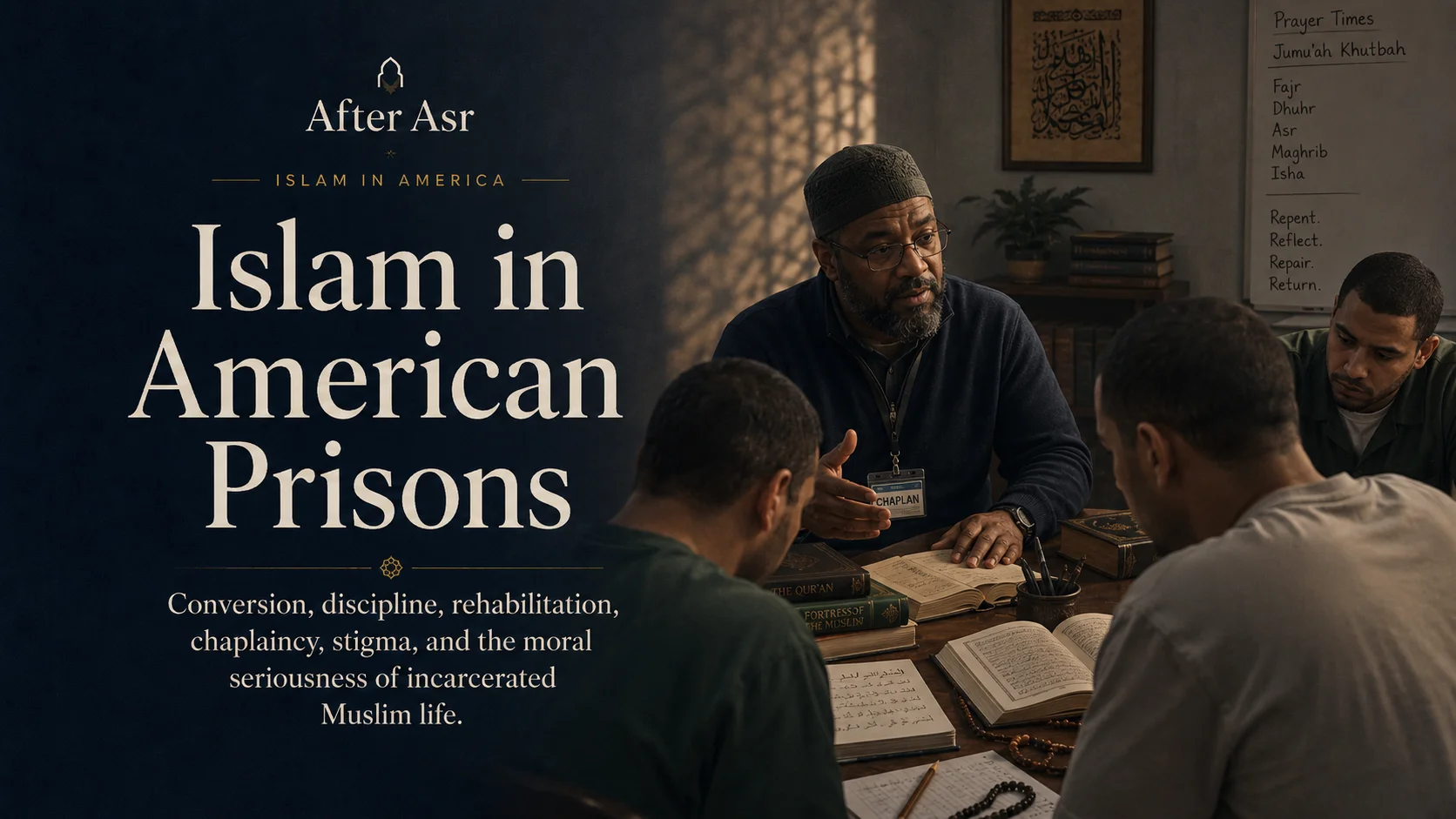
Conversion, discipline, rehabilitation, chaplaincy, stigma, and the moral seriousness of incarcerated Muslim life.
There are places in America where Islam is learned under fluorescent lights, behind locked doors, on concrete floors, in classrooms with correctional officers nearby, in cells where time moves heavily, and in prayer circles formed by men and women whom much of society has already decided not to see.
A person in prison may first encounter Islam through another incarcerated Muslim. Through a Qur’an passed hand to hand. Through a chaplain’s visit. Through a book requested from the library. Through fasting in a place where the body is already controlled by schedules. Through the discipline of salah in a life stripped of ordinary freedoms. Through a question that becomes impossible to avoid when the noise of the outside world has gone silent: Who am I before Allah?
Islam in American prisons is not a marginal story.
It is one of the serious chapters of Islam in America. It touches Black Muslim history, conversion, repentance, discipline, prison conditions, religious rights, chaplaincy, family rupture, rehabilitation, stigma, and the question of whether Muslim communities truly believe what they say about mercy and accountability.
It is also a story easily misunderstood.
Some romanticize prison conversion as pure transformation, as if saying shahadah immediately resolves the damage a person caused, endured, or carries. Others treat incarcerated Muslims with suspicion, as if faith behind bars must be manipulative, political, or dangerous. Some invoke prison Islam only when discussing extremism. Others mention it only as evidence of Islam’s power to reform. All of these frames are too small.
Incarcerated Muslims are human beings. Some have done grave wrong. Some have been wronged. Many are both responsible and wounded. Some are sincere. Some are struggling. Some are learning. Some are performing. Some are repenting. Some are using religious structure to survive. Some are discovering Islam with a seriousness that should humble those of us who practice with far more freedom.
The prison is not a pure place. Neither is the outside world.
Islam enters both as guidance.
The prison cell and the question of the self
Prison strips away many illusions, but not all of them.
A person loses freedom of movement, privacy, control over time, access to family, ordinary work, and many comforts. They may be reduced by the institution to a number, a sentence, a risk category, a file. They may be reduced by society to the worst thing they have done. They may reduce themselves to regret, anger, survival, or reputation.
Islam enters with a different question.
Not, “What is your charge?”
Not, “What is your sentence?”
Not, “What do people call you?”
But, “Who are you before Allah?”
This question does not erase legal accountability. It does not deny victims. It does not make wrongdoing small. But it opens a door that punishment alone cannot open. It tells a person that they are not only the institution’s category. They are still morally alive. They can still repent. They can still pray. They can still tell the truth. They can still discipline the nafs. They can still seek knowledge. They can still use the time left to them, whether short or long, for return.
This is part of why Islam has had such power in prison settings. It gives structure to people whose lives may have been marked by disorder. It gives accountability to people who may have avoided it. It gives dignity to people who have been humiliated. It gives language for guilt, anger, grief, and hope. It gives brotherhood or sisterhood inside environments that often reward hardness. It gives the body practices that reshape the day: wudu, salah, fasting, Qur’an, dhikr.
A person in prison cannot control many things.
They can still control whether they stand before Allah.
Conversion behind bars
Conversion to Islam in prison can be profound.
It may come after years of searching. It may come after a crisis. It may come through witnessing the discipline of Muslim prisoners. It may come through reading the Qur’an alone. It may come through a chaplain’s teaching. It may come through Black Muslim religious presence that has shaped American prison life for generations. It may begin with curiosity and become conviction.
The shahadah behind bars is no less real because it happens in prison.
Allah guides whom He wills, where He wills. A person does not need public respectability before Allah can open their heart. Some people meet Islam in universities. Some in family homes. Some in hospital rooms. Some in war. Some in grief. Some in prison.
But prison conversion requires careful support.
A new Muslim in prison may face pressure from other inmates, misunderstanding from staff, limited access to reliable knowledge, and complicated motives in the environment around them. They may need to distinguish Islam from prison culture. They may need to learn prayer properly. They may need protection from harshness, misinformation, or groups that mix religious language with power dynamics. They may need consistent chaplaincy and sound materials.
Communities outside should not assume every prison conversion is insincere. Nor should they assume every prison conversion is immediately stable. New Muslims everywhere need teaching, patience, and companionship. In prison, that need is intensified because the environment is high pressure and resources are limited.
A person who says shahadah in prison has entered Islam.
Now they need formation.
Discipline and the body
Prison is built on external discipline: counts, schedules, uniforms, rules, surveillance, movement control, permissions, consequences.
Islam teaches another kind of discipline: inward accountability before Allah.
For incarcerated Muslims, the two can collide and interact. The prison controls when doors open. Islam teaches the believer to rise for Fajr. The prison controls meals. Islam teaches fasting in Ramadan. The prison controls movement. Islam teaches rows for prayer where possible. The prison may reduce the body to a managed object. Islam dignifies the body through purification, posture, restraint, and worship.
Salah becomes especially powerful in this setting.
Five times a day, the Muslim prisoner remembers a reality beyond the facility. They face the qiblah, joining a direction shared by Muslims across the world. They recite words that do not belong to the prison. They bow and prostrate in a place designed to confine them, but the sujood opens a space no institution can own.
Fasting also carries meaning. Hunger in prison may already be familiar, but fasting for Allah transforms hunger into worship. It is chosen obedience within a life of imposed limits. Ramadan can become a month of extraordinary seriousness, even when conditions are difficult. It can also be logistically challenging: meal timing, suhoor, iftar, medication, work assignments, and facility policy all matter.
Discipline is not automatically spiritual. A person can follow prison rules without repentance. A person can perform religious routines without sincerity. But when Islam reaches the heart, discipline becomes more than control. It becomes training for freedom before Allah, even in confinement.
Black Muslim foundations in prison Islam
No serious account of Islam in American prisons can ignore Black Muslim history.
Black Muslims have been central to the growth, visibility, discipline, and struggle for Islamic practice behind bars. Incarcerated Black men and women, Black Muslim movements, prison litigation around religious rights, Muslim chaplains, and community networks all shaped the religious landscape long before broader Muslim communities paid sustained attention.
For many Black Americans, Islam in prison became a language of dignity in an institution that often intensified the racial wounds of American society. It offered a way to reject degradation, rebuild self-respect, discipline the body, study, speak differently, eat differently, and belong to something larger than the state’s judgment. It gave men and women a framework for repentance without surrendering their humanity.
This history is complicated, as all human history is complicated. Some prison Islamic movements were connected to theological currents that later required correction for those entering Sunni orthodoxy. Some communities had internal struggles. Some individuals used religious language poorly. But none of this cancels the central fact: Black Muslim prison life has been foundational to American Islam.
The wider Muslim community owes this history more than occasional acknowledgment.
It should study it. Support it. Learn from its discipline and its warnings. Recognize the leadership that emerged under conditions many comfortable Muslims have never known. Understand that prison Islam is not a strange side road of the American Muslim story. It is tied to the story of race, punishment, conversion, reform, and the search for dignity in America.
When Muslim communities ignore Black Muslim prison history, they misunderstand both prisons and Islam in America.
Chaplaincy behind the walls
A Muslim prison chaplain carries a difficult trust.
They may lead Jumu’ah, teach classes, provide Qur’ans and Islamic books, help coordinate Ramadan meals, advocate for religious accommodations, counsel individuals, support converts, mediate misunderstandings with staff, and help inmates distinguish Islam from rumor, anger, or prison politics. They may work with people serving short sentences and people serving life. They may meet men and women who are sincere, manipulative, broken, brilliant, angry, repentant, traumatized, disciplined, or all of these at once.
The chaplain must bring mercy without naivety.
They cannot treat every story as simple innocence. They also cannot treat every person as reducible to guilt. They must understand institutional rules without becoming merely an agent of the institution. They must serve incarcerated Muslims without encouraging hostility or fantasy. They must teach Islam clearly while navigating security restrictions, limited resources, and suspicion from multiple sides.
Good chaplaincy can change lives.
A chaplain may be the first qualified Muslim teacher someone has ever met. The first person to explain repentance without humiliation. The first person to say, “You are responsible for what you did, and Allah’s mercy is still open.” The first person to help someone pray correctly. The first person to challenge false religious claims circulating inside the prison. The first person to connect an incarcerated Muslim to a path of learning that continues after release.
Prison chaplaincy should not be treated as an afterthought in Muslim communal life. It requires training, scholarship, pastoral skill, institutional literacy, racial awareness, trauma awareness, and spiritual strength. It also requires support from the outside community.
A chaplain behind the walls should not be carrying the ummah’s prison responsibility alone.
Religious rights and institutional suspicion
Prison religious practice often depends on policy.
Can Muslims gather for Jumu’ah? Is halal food available? Are prayer oils allowed? Are kufis permitted? Can inmates keep Qur’ans? Are prayer rugs treated as religious items or security concerns? Are Ramadan meals provided at proper times? Can Muslim prisoners attend study circles? Is there a Muslim chaplain, or only occasional volunteer access? Are women prisoners given equal religious support? Are converts able to register their religion without retaliation or delay?
These questions are not minor.
For a person whose movement is controlled by the institution, religious rights depend heavily on the institution’s willingness to accommodate. A Muslim outside prison can choose another grocery store, another masjid, another schedule, another room. An incarcerated Muslim cannot simply leave. If the facility denies or obstructs access, worship becomes much harder.
This is why advocacy matters.
Muslim prisoners, chaplains, lawyers, civil rights organizations, scholars, and community members have long worked to secure religious accommodations. These efforts are part of the broader struggle for religious freedom in America. They also reveal how suspicion attaches itself to incarcerated Muslims. Islamic practice behind bars is sometimes viewed through the lens of security first, sincerity second. Of course prisons have safety concerns. But safety should not become a blanket excuse for denying lawful religious practice.
A Qur’an is not a threat because it is a Qur’an.
A prayer group is not suspicious because it is Muslim.
A halal meal request is not manipulation simply because it comes from a prisoner.
Institutions must distinguish real security issues from religious bias. Muslim communities must be prepared to advocate with knowledge, patience, documentation, and legal seriousness.
The right to worship does not end at the prison door.
Stigma and the outside Muslim gaze
Many Muslims outside prison are uncomfortable with incarcerated Muslims.
Some discomfort comes from fear. Some from class distance. Some from racial prejudice. Some from not knowing how to think about crime, victims, accountability, and repentance together. Some Muslims have been harmed by crime and do not want prison stories romanticized. Others have family members incarcerated and carry shame quietly. Some communities prefer respectable Muslim narratives: doctors, engineers, entrepreneurs, students, public servants, athletes, soldiers, scholars. Prison disrupts that image.
But Islam is not a religion only for the respectable.
The masjid is not only for people with clean public records. The Qur’an is not only for those whose sins remained hidden. Repentance is not only for sins that do not disturb middle-class comfort.
At the same time, incarcerated Muslims should not be sentimentalized. Some have committed serious harm. Victims matter. Families of victims matter. Public safety matters. Accountability matters. The pain caused by crime should not be erased because the person later found religion.
The Islamic path holds both truths: no person should be dehumanized, and wrongdoing should not be minimized.
Stigma becomes spiritually dangerous when it denies the possibility of repentance. Romanticism becomes dangerous when it denies the reality of harm. A mature Muslim community must reject both.
It should be possible to say: what happened was wrong, accountability is real, victims deserve justice, and this person is still a servant of Allah who may repent, learn, and return.
That moral balance is difficult. It is also Islamic.
Victims, harm, and repentance
Any conversation about Islam in prison must remember victims.
Repentance is not a way of bypassing harm. A person who harmed others cannot use Islam as a shield against accountability. They cannot say, “Allah forgave me,” as a way to silence those they hurt. They cannot perform piety while refusing truth. They cannot expect immediate trust because they now pray.
Tawbah requires sincerity. Where rights of other people are involved, the matter is serious. Seeking forgiveness from Allah does not erase the need to restore rights where possible, tell the truth, accept consequences, and avoid further harm. Sometimes direct contact with victims is not appropriate or legally possible. Sometimes repair takes other forms. Sometimes the person must live with the fact that not all worldly damage can be undone.
This is part of the moral seriousness of prison Islam.
A chaplain or teacher must guide incarcerated Muslims away from cheap repentance. Islam is not emotional relief without responsibility. It is return to Allah through truth. A person must be able to say, at least to themselves and before Allah, “I did wrong.” Not in vague language. Not only, “I made mistakes.” But with moral clarity.
At the same time, despair is not piety. A person who did wrong may repent. Allah’s mercy is vast. The door remains open while life remains. Many incarcerated Muslims need to hear this because guilt can become either denial or hopelessness. Islam calls them to neither.
Repentance is not escape.
It is the beginning of accountability before the Most Merciful.
Women, incarceration, and spiritual care
Incarcerated Muslim women are often less visible than men.
Their needs may be overlooked by Muslim communities, prison systems, and chaplaincy programs. Some are born Muslims. Some convert in prison. Some are mothers separated from children. Some are survivors of abuse, trafficking, addiction, poverty, domestic violence, or coercive relationships. Some committed serious harm. Some carry trauma that shaped, but does not erase, responsibility.
Muslim women in prison need access to Qur’an, prayer, Ramadan accommodations, modest clothing where possible, halal food, religious classes, chaplaincy, menstrual guidance, trauma-informed pastoral care, and reentry support. They may also need help maintaining relationships with children, navigating shame, and rebuilding identity beyond both crime and victimhood.
A Muslim woman who converts in prison may face unique vulnerability. She may not have family support. She may be isolated from the broader Muslim community. She may struggle with hijab or modesty in an institutional environment. She may need female teachers or chaplains who can answer intimate questions with knowledge and dignity.
The outside community often forgets incarcerated women because their stories are less publicly discussed. This forgetting is a failure of imagination and mercy.
If we believe Islam is guidance for every human being, then women behind bars are included in that claim. Their spiritual care is not optional. It is part of the ummah’s trust.
Ramadan behind bars
Ramadan in prison can be a month of immense beauty and immense difficulty.
For incarcerated Muslims, fasting may be one of the clearest ways to assert spiritual agency. The prison controls meals, movement, lights, visits, work assignments, and sound. But the fast is for Allah. The person abstains, remembers, recites, and waits for sunset with believers around the world.
Yet Ramadan behind bars depends heavily on institutional cooperation. Suhoor must be provided before dawn. Iftar must be available at sunset. Work schedules and medication needs may require attention. Lockdowns can disrupt access. Staff may misunderstand fasting. Non-Muslim inmates may mock, respect, or simply not care. Muslim prisoners may gather for iftar where permitted, or break fast alone.
The emotional weight of Ramadan can be strong. Some remember family meals they cannot attend. Some feel regret more sharply. Some find Qur’an more deeply. Some experience brotherhood or sisterhood through shared hunger. Some make du’a for release, forgiveness, children, parents, victims, and a life they hope to rebuild.
Outside Muslim communities should remember Ramadan in prisons. Send approved books where possible. Support chaplains. Advocate for proper accommodations. Make du’a. Include incarcerated Muslims in community concern. If local rules allow, volunteer with proper training and approval.
Ramadan is not only happening in decorated masjids and family kitchens.
It is also happening in cells.
Eid without freedom
Eid in prison is complicated.
The day of joy arrives, but the doors remain locked. The believer may attend Eid prayer if the facility permits it. There may be a special meal, or there may not. There may be a chaplain, or only a small gathering of inmates. There may be letters from family. There may be silence. For converts, it may be their first Eid, and they may have no one outside who understands the day.
Still, Eid matters.
It tells the incarcerated Muslim that sacred joy is not owned by the free. It reminds them that they are part of the ummah. It offers a moment of dignity in an environment where dignity is often scarce. It may also intensify grief: grief over absence, regret, missed childhoods, damaged families, and the distance between the life one lives and the life one wishes they had lived.
Muslim communities should not forget prison Eid. Chaplains and volunteers who organize Eid prayer and meals behind bars are doing work that may never be publicly praised, but Allah knows it. Families with incarcerated loved ones should be supported without shame. Children with parents in prison may need special care around Eid, when absence becomes especially painful.
A community that celebrates Eid while forgetting incarcerated Muslims has left part of the ummah outside its joy.
The doors may be locked, but du’a can enter.
Knowledge, books, and the danger of fragments
Islamic knowledge in prison often depends on what is available.
A Qur’an translation. A few pamphlets. Books donated by outside groups. Lessons from another inmate. A chaplain’s class. Audio materials if allowed. Correspondence courses. Occasional volunteer visits. Sometimes the material is sound and beneficial. Sometimes it is incomplete, overly harsh, sectarian, poorly translated, or disconnected from qualified scholarship.
This matters because religious hunger without sound guidance can become vulnerable.
An incarcerated person may study intensely, but without teachers to correct misunderstandings. They may memorize arguments but lack adab. They may become rigid because rigidity feels like safety in a chaotic environment. They may adopt prison-specific interpretations that do not translate well outside. They may confuse cultural practice, political anger, and Islamic obligation. They may learn enough to speak confidently but not enough to be humble.
This is not unique to prison. Many Muslims outside prison also learn Islam through fragments. But prison intensifies the problem because access is limited and social dynamics are charged.
Muslim communities should support sound prison education. Approved book programs, correspondence courses, chaplaincy support, recorded lessons where permitted, and trained volunteers can help. Materials should teach foundations: tawheed, prayer, purification, seerah, Qur’an, adab, repentance, family responsibility, lawful conduct, and preparation for reentry. They should avoid overwhelming new Muslims with advanced disputes before basics are established.
Knowledge should soften the heart and discipline the self.
If learning makes a person harsher, more arrogant, or more detached from accountability, something has gone wrong.
Brotherhood, sisterhood, and prison politics
Muslim community inside prison can be a mercy.
A group of Muslims may remind one another to pray, study together, share food, encourage fasting, avoid trouble, and create a disciplined environment within a difficult place. Brotherhood or sisterhood can help a person survive spiritually. It can replace destructive associations with relationships shaped by worship.
But prison social life is complicated.
Groups can become protective, but also territorial. Religious identity can become mixed with status. Leadership can be contested. A person with limited knowledge may claim authority. Tensions from race, gang affiliation, sentence length, personality, or facility politics can enter Muslim spaces. Some may join religious groups for protection rather than conviction. Some may perform piety for reputation.
This requires wise chaplaincy and mature leadership.
Muslim prison groups need structure, but not domination. They need knowledge, but not arrogance. They need discipline, but not harshness. They need unity, but not group pride that replaces humility before Allah. They need leaders who understand that serving the Muslim group is not ruling over it.
Outside Muslims should not be naive about prison dynamics. But they also should not assume every prison Muslim group is suspect. Human communities are mixed everywhere. The answer is not withdrawal. It is sound guidance, oversight, support, and du’a.
The brotherhood of Islam is sacred.
It must not be turned into another form of prison power.
Reentry and the shock of freedom
Release from prison is often imagined as a happy ending.
For many, it is also terrifying.
A person leaves a highly controlled environment and enters a world that has moved on. Technology may have changed. Children may have grown. Parents may have aged or died. Housing may be unstable. Employment may be difficult. Old friends may be dangerous. The terms of parole or probation may be strict. The masjid may feel unfamiliar. Family may be cautious. The person may want a new life but not know how to build one.
For Muslim returning citizens, faith can be a source of structure, but only if community exists.
A person who prayed every day in prison may struggle to maintain prayer when freedom removes the external schedule. Someone who fasted Ramadan inside may find outside temptations stronger. Someone who studied Qur’an in a cell may become overwhelmed by bills, job applications, transportation, and family conflict. Someone who was respected as a religious leader inside may have to accept being a beginner socially outside.
The transition requires support.
A masjid can help with mentorship, rides to Jumu’ah, employment connections, housing referrals, Islamic classes, addiction recovery resources, counseling, family mediation, and simple companionship. Not every masjid can provide every service, but every community can build relationships with organizations that help.
Reentry also requires boundaries and wisdom. Some returning citizens may need supervision. Some offenses require safeguards. Communities must protect children, women, and vulnerable people. Mercy does not mean ignoring risk. But caution should not become total exclusion.
A person returning from prison needs a path, not just a warning label.
The masjid after prison
Entering a masjid after prison can be emotionally difficult.
The returning Muslim may feel hope, shame, anxiety, gratitude, and fear of judgment. They may worry that people will know. They may be asked intrusive questions. They may not know whether to mention their past. They may feel more comfortable with Muslims from prison than with suburban mosque members. They may be used to a disciplined prison Muslim group and surprised by the casualness of outside Muslim life.
The masjid must be ready to receive people with pasts.
This does not mean making every person’s history public. It does not mean ignoring safety. It means cultivating a culture where repentance is real, people are not reduced to records, and support exists for those trying to live differently. It means imams and boards should know how to refer, how to maintain appropriate boundaries, and how to protect dignity.
A returning citizen may have knowledge and discipline that benefits the community. They may also have trauma and practical needs. They may be both strong and fragile. They may need to serve, but not be exploited. They may need accountability, but not humiliation.
The masjid should not be a place where only respectable sinners feel comfortable.
All believers need Allah’s mercy. Some of us simply have hidden records, while others have public ones.
Families of the incarcerated
Prison does not only confine one person.
It affects families. Children grow up with a parent absent. Spouses carry financial, emotional, and social burdens. Parents visit sons and daughters behind glass. Siblings feel shame or anger. Families navigate phone calls, commissary costs, long drives, legal processes, parole hearings, and the emotional strain of loving someone who may have caused harm.
Muslim families may carry this quietly because of stigma.
A mother may not tell the masjid her son is incarcerated. A wife may avoid community events because people ask questions. Children may hide where their father is. A family may need support but fear judgment. Converts in prison may have non-Muslim families who do not know how to help them remain connected to Islam.
Communities should care for families of the incarcerated.
Not by gossiping. Not by romanticizing. Not by ignoring victims. But by recognizing that family members often carry punishment socially, emotionally, and financially. Children especially should not be shamed for a parent’s incarceration. They need mentorship, stability, and inclusion. Spouses may need practical help. Parents may need someone to listen.
A family affected by prison should not feel they must disappear from Muslim life.
The ummah is responsible for people in complicated pain.
Stigma after release
Even after release, stigma can follow for years.
A job application asks about criminal history. A landlord refuses. A marriage prospect withdraws. Community members whisper. A volunteer role is denied, sometimes for valid safety reasons, sometimes out of fear. The person’s past becomes the first and last thing people know.
Islam does not require us to be foolish. Certain histories matter for certain responsibilities. A person convicted of harming children should not be placed around children. Someone with financial fraud history may not be suited for treasury work. Communities must protect people.
But stigma often goes beyond wisdom. It becomes permanent social exile.
A person may be allowed to pray in the masjid but never truly belong. They may be forgiven in theory but not in relationship. They may be told Allah is merciful while people keep them at a distance forever. This can push returning citizens back toward isolation, old networks, and despair.
A mature community distinguishes between prudent boundaries and dehumanizing exclusion.
Not every door opens immediately. Trust takes time. But there should be some door. A person should be able to attend classes, pray, volunteer appropriately, receive mentorship, and build a new reputation through consistency.
If Muslims believe in repentance, they must believe in the possibility of changed conduct over time.
The role of outside volunteers
Prison outreach volunteers can be a mercy, but they must be prepared.
Entering a prison to teach, visit, or support Muslims is not like giving a casual halaqah at the masjid. Volunteers must understand facility rules, boundaries, confidentiality, manipulation risks, trauma, religious questions, security protocols, and the emotional intensity of the environment. They must not make promises they cannot keep. They must not carry messages improperly. They must not become saviors. They must not seek emotional significance through prison work.
The intention must be sincere, and the training must be serious.
A good volunteer can bring hope, knowledge, and connection to the outside ummah. They can teach basics, support Ramadan, provide approved materials, encourage reentry preparation, and remind incarcerated Muslims that they are not forgotten. They can also learn humility, seeing sincerity in places society ignores.
But poor volunteering can cause harm. Inconsistent visits may create disappointment. Unqualified teaching may spread confusion. Boundary violations may endanger the volunteer, the incarcerated person, and the program. Emotional overattachment can distort judgment.
Prison outreach should be organized through chaplains, institutions, and trained teams where possible. It should be grounded in knowledge, adab, and accountability.
The people inside deserve more than enthusiasm. They deserve responsible care.
The public fear of prison Islam
American public discourse has often viewed Islam in prisons through suspicion.
Concerns about radicalization, security, and extremism have sometimes overshadowed the much broader reality of Muslims practicing, studying, repenting, fasting, and seeking discipline behind bars. Real security issues should not be dismissed. Any ideology that promotes violence, hatred, or harm must be addressed. But reducing prison Islam to a security concern distorts the lives of thousands of Muslims whose faith is a path toward restraint, responsibility, and moral repair.
This suspicion affects policy.
It may influence access to books, group prayer, chaplaincy, halal meals, religious clothing, and outside volunteers. It may make staff view Muslim gatherings with more anxiety than similar gatherings from other faith traditions. It may cause sincere religious practice to be interpreted through a lens of threat.
Muslim communities should respond with clarity. Islam in prison is overwhelmingly about worship, discipline, identity, repentance, and community, not danger. Chaplaincy and sound education are part of the solution to confusion, not a risk to be minimized. Denying access to legitimate religious guidance can actually make misinformation more likely.
The answer to fear is not defensiveness alone. It is transparency, qualified chaplaincy, clear standards, lawful advocacy, and the visible fruits of Islamic discipline in people’s conduct.
A man who learns to lower his gaze, restrain his anger, pray on time, tell the truth, and repent is not becoming more dangerous.
He is becoming more accountable.
Rehabilitation and the Islamic view of change
The word rehabilitation is used often in criminal justice, but Islam gives it deeper meaning.
A person is not rehabilitated simply because they completed a program, followed rules, or avoided new charges, though these matter. Real change involves the heart, the tongue, the body, the habits, the relationships, the understanding of harm, and the direction of life. It requires truthfulness before Allah.
Islamic rehabilitation includes repentance, prayer, knowledge, restitution where possible, discipline, service, avoiding old harms, rebuilding family ties where healthy, accepting consequences, and developing a life oriented toward the akhirah. It also requires community, because human beings rarely change in isolation.
Prison can create conditions for reflection, but prison alone does not produce rehabilitation. Some people become harder inside. Some learn survival strategies that harm them outside. Some perform compliance without transformation. Others truly change, often because they find meaning, faith, education, accountability, and support.
Islam can be a powerful force for rehabilitation because it addresses the whole person. It does not say, “You are fine.” It says, “You are accountable, and Allah’s mercy is open.” It does not say, “Your past does not matter.” It says, “Your past must be faced, and your future is not closed.” It does not say, “Society’s judgment is irrelevant.” It says, “Allah’s judgment is final, so live truthfully.”
This is moral seriousness.
It is neither soft nor cruel.
The outside community’s test
Islam in American prisons tests the outside Muslim community.
Do we believe incarcerated Muslims are part of the ummah?
Do we make du’a for them?
Do we support chaplaincy?
Do we provide sound books and classes?
Do we remember women in prison?
Do we help families?
Do we prepare for reentry?
Do we protect victims and vulnerable people while still believing in repentance?
Do we challenge anti-Blackness and class arrogance in how we think about prison?
Do we treat prison Muslims as human beings, or only as stories when convenient?
A community’s answer to these questions reveals something about its understanding of mercy.
It is easy to speak of compassion in abstract terms. It is harder to extend structured, responsible care to people with criminal records. It is easy to praise conversion stories. It is harder to mentor someone after release. It is easy to condemn mass incarceration. It is harder to visit, write, fund, advocate, and build pathways home. It is easy to say Allah forgives. It is harder to sit beside someone whose repentance is still becoming visible.
The ummah cannot be only a feeling. It must become a set of responsibilities.
What prison Muslims can teach the free
There are incarcerated Muslims whose discipline should humble free Muslims.
Men who pray every salah in difficult conditions. Women who memorize Qur’an with limited resources. Converts who learn Arabic letters from photocopied sheets. People who fast Ramadan under institutional strain. Brothers who wake others for Fajr. Sisters who teach one another basic fiqh. People who have little privacy but still seek sincerity. People who have lost years of freedom and still say alhamdulillah.
This does not romanticize prison. Freedom is a blessing. Prison is a place of hardship, pain, and often injustice. But sincerity can appear in places of hardship. Sometimes deprivation reveals the value of what others neglect.
Free Muslims have more access than any generation before us. Apps, lectures, mosques, books, teachers, halal food, prayer spaces, transportation, online classes. Yet many struggle to pray, study, or repent consistently. The incarcerated Muslim with one Qur’an and a strict schedule may remind us that guidance does not depend on comfort.
This reminder should not become voyeurism. We should not consume prison piety as inspiration while doing nothing for prisoners. But we can be humbled by it.
Allah may raise people in places the world lowers them.
The person in the cell
Imagine a cell at night.
The noise has quieted, though never fully. The light is harsh. The air is heavy. A man or woman sits with a Qur’an translation, a notebook, perhaps a few Arabic letters practiced slowly. Somewhere in the facility, someone calls another person by a number. Somewhere, doors close. Somewhere, regret rises. Somewhere, anger returns. Somewhere, a person wonders whether Allah still hears them.
Then they stand for prayer.
There is no beautiful masjid. No family behind them. No public honor. No reputation to protect. No one outside may know whether the prayer happens. But Allah knows.
This is the center of the matter.
Islam in American prisons is not only a topic of policy, conversion, chaplaincy, or rehabilitation. It is the story of human beings standing before Allah in places designed to confine them. Some are guilty. Some are wounded. Some are sincere. Some are still learning sincerity. All are accountable. All are seen by Allah.
The community outside must learn how to speak about them truthfully.
Without romanticism.
Without contempt.
Without forgetting victims.
Without denying mercy.
Without reducing prison Islam to fear.
Without using incarcerated Muslims as symbols.
They are part of the American Muslim story. They are part of the ummah’s test. Their prayer, repentance, discipline, and struggle matter. Their families matter. Their victims matter. Their reentry matters. Their access to sound knowledge matters. Their chaplains matter. Their humanity matters.
A society often decides that prison is where people disappear.
Islam says no one disappears from the sight of Allah.
That truth should make us careful.
Careful with our judgments.
Careful with our neglect.
Careful with our mercy.
Careful with our trust.
Careful enough to remember that a locked door may restrict movement, but it cannot prevent a heart from turning back to its Lord.