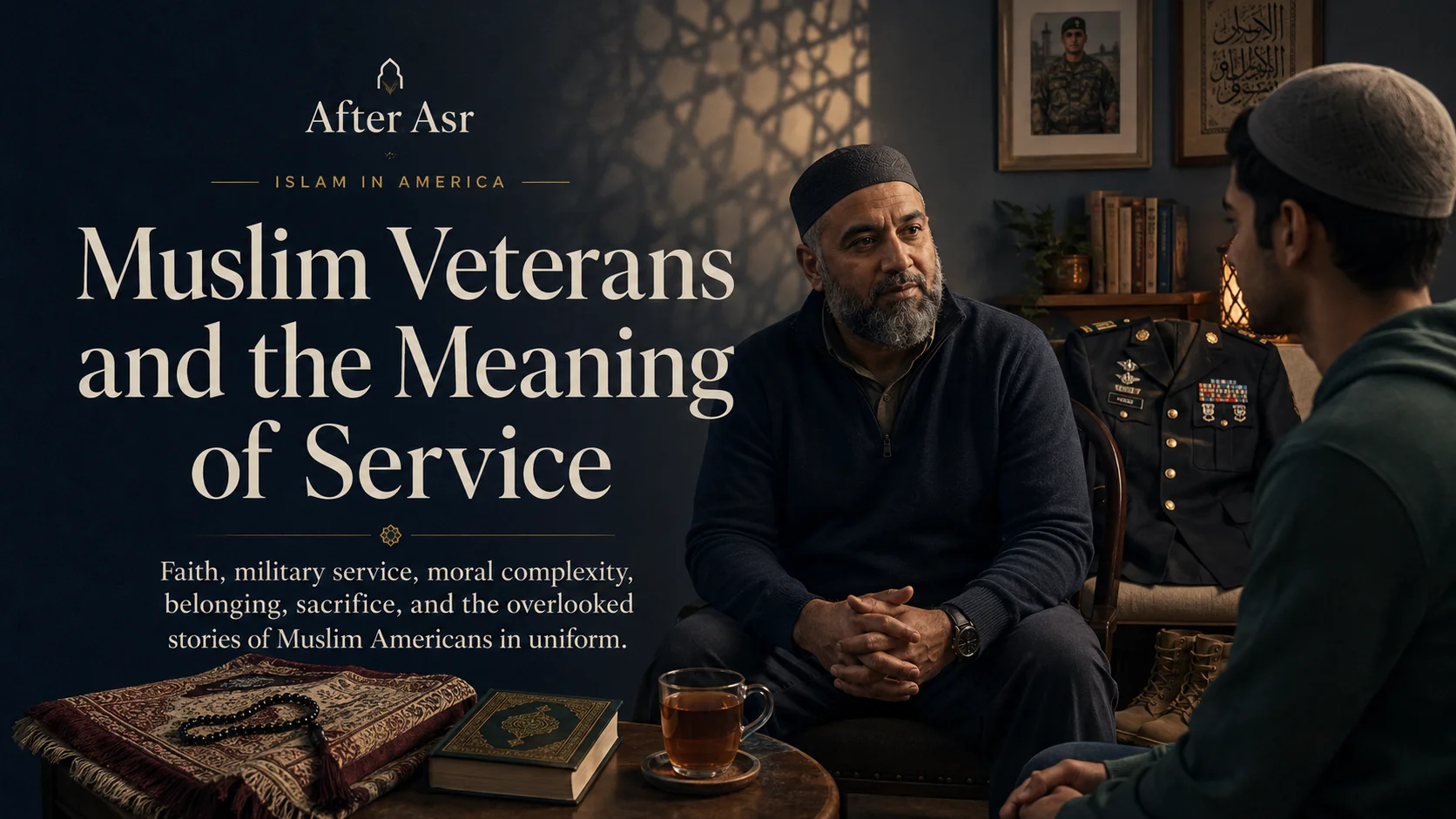
Faith, military service, moral complexity, belonging, sacrifice, and the overlooked stories of Muslim Americans in uniform.
The Muslim veteran is often spoken of too simply, when spoken of at all.
In some public settings, the Muslim veteran becomes proof of belonging. A patriotic image. A reminder that Muslims have served, sacrificed, deployed, worn the uniform, buried friends, and stood under the same national obligations as others. In other settings, the Muslim veteran becomes a contradiction, treated with suspicion by those who cannot imagine Muslim faith and American military service occupying the same life. In some Muslim spaces, the veteran is honored with gratitude. In others, they are met with discomfort, silence, or moral unease because war, empire, foreign policy, and Muslim suffering abroad are not abstract questions.
The real person is more complicated than any of these uses.
A Muslim veteran may be a convert who found Islam during or after service. An immigrant’s child who joined for opportunity, education, citizenship, discipline, escape, family tradition, or a desire to serve. A Black Muslim whose family history includes both American military service and American racial struggle. A woman who wore the uniform while navigating gender, modesty, and faith. A chaplain carrying the spiritual needs of Muslim service members and non-Muslim service members alike. A combat veteran wrestling with memory. A logistics specialist who never saw battle but still carries the culture of military life. A reservist trying to balance Jumu’ah, drill weekends, Ramadan, and civilian work. A disabled veteran living with injuries others cannot see.
There is no single Muslim veteran story.
There are stories of faith strengthened in hardship. Stories of prayer in barracks, desert heat, ships, training fields, hospital rooms, and lonely base housing. Stories of discrimination and brotherhood. Stories of moral conflict. Stories of pride. Stories of regret. Stories of service that felt honorable and service that became difficult to understand later. Stories of Muslims who found belonging in uniform, and stories of Muslims who never fully felt trusted by the country they served.
To write about Muslim veterans with honesty, we must refuse both easy glorification and easy dismissal.
Service is real. Sacrifice is real. Moral complexity is real. Faith is real. And the people who carry all of this deserve to be seen as whole human beings before Allah.
Service as intention and test
Many people join the military before they fully understand what service will ask of them.
This is true for Muslims and non-Muslims alike. Some join young, before marriage, children, or deeper political awareness. Some join because they want structure. Some want education benefits. Some want to leave a difficult hometown. Some want to follow parents or grandparents. Some believe sincerely in protecting others. Some are drawn to discipline, travel, technical training, or the promise of becoming part of something larger than themselves.
For Muslims, intention matters deeply, but intention alone does not make every situation simple.
A person may intend service, stability, sacrifice, or lawful employment. They may also find themselves inside an institution connected to war, violence, foreign policy, and decisions far beyond their control. They may serve honorably in a medical, administrative, logistical, intelligence, engineering, or combat role. They may support missions they understand, or missions they later question. They may serve alongside people of deep character and also encounter prejudice, moral injury, or institutional harm.
Islam teaches that actions, intentions, obedience, justice, harm, and accountability matter. It does not allow human beings to outsource conscience entirely to institutions. It also does not allow outsiders to flatten another person’s life into slogans.
The Muslim service member lives inside this tension.
They may ask: What does it mean to serve a country whose policies may harm Muslims elsewhere? What does it mean to fulfill a contract? What does it mean to obey orders within limits? What does it mean to refuse unlawful or immoral conduct? What does it mean to protect fellow service members? What does it mean to be Muslim in a chain of command? What does it mean to carry both gratitude for opportunity and grief over what military power can do?
These are not easy questions.
They should be handled with knowledge, not noise.
Prayer in uniform
For many Muslim service members, salah becomes the most visible sign that faith has not been left behind.
Prayer in uniform may happen in a barracks room, beside a cot, in a field, in an office, on a ship, in a hangar, behind a vehicle, in a chapel, in a desert tent, in a training environment, or quietly in a corner between duties. The body that stands in formation also stands before Allah. The hands that carry equipment are raised in takbir. The forehead that has worn a helmet touches the ground in sujood.
The contrast can be powerful.
Military life is built around time, command, readiness, and discipline. Islam is also a discipline, but of a higher order. The prayer reminds the service member that no rank outranks Allah. No order erases accountability before Him. No uniform defines the soul more deeply than servanthood.
But prayer in military life can be difficult. Training schedules may be rigid. Field conditions may limit privacy. Wudu may require planning. Fajr may come after too little sleep. Ramadan may fall during physically demanding periods. A service member may not know their accommodation rights. A convert in basic training may be newly learning prayer under pressure. A Muslim woman may face additional concerns around modesty and safety. A deployed Muslim may pray in conditions far from ideal.
This is where Muslim chaplaincy and religious accommodation matter. Service members need access to prayer spaces where possible, halal meals, Ramadan support, Jumu’ah arrangements, religious items, and guidance on prayer under hardship and travel. They also need leaders who understand that religious practice can coexist with discipline and readiness when handled properly.
Still, the service member must carry responsibility too. Learn the fiqh of prayer in hardship. Communicate early. Be reliable in duties. Do not use religion carelessly. Seek guidance when unsure. Protect prayer without neglecting the trust of assigned work.
A Muslim in uniform does not pray as decoration.
They pray because they are still accountable to Allah in every uniform, every country, every hour.
The Muslim chaplain and the burden of presence
Muslim military chaplains occupy a difficult and necessary role.
They serve Muslim service members who need religious guidance, prayer support, Ramadan accommodation, halal access, counseling, grief care, and someone who understands the particular loneliness of being Muslim in military life. They may also serve non-Muslim service members, as chaplains often care for all who seek support. They advise command on religious matters. They respond to death, trauma, family crisis, deployment stress, and moral injury.
Their work is pastoral, institutional, and spiritually delicate.
A Muslim chaplain must be rooted enough in Islam not to become merely a religious representative of the institution. They must also understand the institution well enough to serve effectively within it. They may sit with a young Muslim who is afraid to request Ramadan accommodations. They may comfort a family after death. They may help a commander understand why a service member needs time for Jumu’ah. They may advise someone wrestling with conscience. They may lead Eid prayer on a base where only a handful attend.
The chaplain’s presence says to Muslim service members: you are not invisible here.
But Muslim chaplaincy also raises serious questions. How does one provide spiritual care within an institution tied to war? How does one support service members without baptizing every military decision as morally uncomplicated? How does one maintain loyalty to Allah above loyalty to institution, while still honoring the trust of the role? How does one care for those carrying guilt, grief, or uncertainty?
There are no shallow answers.
A good Muslim chaplain does not erase complexity. They helps people remain spiritually alive inside it.
Belonging and suspicion
Muslim service members often carry a strange burden: they may be asked to prove loyalty in ways others are not.
They wear the uniform, follow orders, deploy, sacrifice family time, endure training, and serve beside others. Yet some still face suspicion because of their names, appearance, prayer, fasting, country of family origin, mosque attendance, or the global politics projected onto Muslim identity. A Muslim may be serving the country and still be asked where their real allegiance lies.
This suspicion can wound deeply.
For some, military service becomes a way to assert belonging. “I served. I sacrificed. I am part of this country.” That claim is understandable. Muslim Americans have the right to insist that they are not outsiders. Muslim veterans have earned a hearing in a society that too often speaks about Muslims without knowing them.
But belonging should not have to be purchased through military service.
A Muslim who never wore a uniform is not less American. A Muslim who critiques war is not disloyal by default. A Muslim veteran should not be used as proof that the rest of the community deserves rights. The dignity of Muslims does not depend on service records. It depends on humanity before Allah and the civic reality that Muslims are part of this country.
At the same time, Muslim veterans’ stories matter because they complicate public assumptions. They show that Muslims are not a foreign abstraction. They have served in America’s institutions, carried its burdens, and returned to its neighborhoods. Their presence challenges suspicion not by begging for approval, but by telling the truth.
The Muslim veteran belongs.
Not because the uniform made them human.
Because they always were.
Moral injury and the soul after service
Some wounds are not only physical or psychological. They are moral.
A veteran may struggle not only with what happened to them, but with what they participated in, witnessed, enabled, failed to prevent, or cannot reconcile. Moral injury can arise when a person feels they have violated, or been forced near violation of, deeply held moral beliefs. For a Muslim, these questions may be tied to accountability before Allah, the sanctity of life, obedience to authority, complicity, fear, survival, and repentance.
This is tender ground.
Some veterans do not want to speak about it. Some do not have words. Some fear judgment from Muslims who oppose military action, or from military peers who do not understand religious conscience. Some carry memories from combat. Others carry guilt from non-combat roles, intelligence work, maintenance, logistics, detention operations, or simply being part of a system whose consequences became clearer later. Some are certain they served honorably. Some are not. Some are proud and grieving at the same time.
Communities must not offer cheap answers.
“Thank you for your service” may be sincere, but it may not reach the wound. “You should never have joined” may be morally blunt but spiritually careless, especially when spoken to someone already struggling. A veteran needs truthful, compassionate care: scholars who can speak about repentance and responsibility with wisdom, therapists who understand trauma, chaplains who understand military life, and communities that can listen without turning the veteran into an argument.
Islam has room for repentance, moral repair, accountability, du’a, charity, service, and transformation. A person is not healed by denial. Nor are they helped by despair. The path back to Allah remains open, but walking it may require guidance, tears, and time.
The veteran carrying moral injury should not be left alone between slogans.
Muslim women in uniform
Muslim women veterans often carry stories that are even less visible.
They may have served in environments where being Muslim, being a woman, and being visibly religious created layered pressures. Some wore hijab. Some did not. Some converted during service. Some faced harassment, suspicion, or isolation. Some found strength, discipline, and opportunity. Some became leaders. Some navigated modesty, prayer, field conditions, deployment, motherhood, marriage, and community expectations that did not know what to do with women in uniform.
Their stories disrupt easy categories.
In some Muslim communities, military service is imagined mainly through men. Women veterans may be overlooked, questioned, or treated as exceptions. In wider veteran spaces, Muslim women may be treated through stereotypes about oppression, loyalty, or foreignness. A hijabi veteran may be asked to explain both Islam and service repeatedly. A non-hijabi Muslim veteran may feel unseen as Muslim. A convert woman veteran may navigate both new faith and old military identity.
Muslim women veterans need community care that does not flatten them.
They need spaces where they can speak about service without being made into symbols. They need access to veteran benefits, mental health support, mosque belonging, family support, and spiritual guidance. They need to be included in Muslim veteran narratives. Their experiences of harassment, leadership, injury, faith, and resilience matter.
A community that speaks of Muslim veterans but forgets women veterans is telling an incomplete story.
Converts, service, and finding Islam in uniform
Many Muslims encountered Islam while serving.
Some met Muslim peers who prayed with discipline. Some heard the adhan on deployment and felt something open. Some read the Qur’an during lonely hours. Some were stationed in Muslim-majority countries and began asking questions. Some saw the contrast between public narratives about Muslims and the kindness of actual Muslims. Some found Islam after service, when discipline, trauma, or searching led them toward revelation.
Conversion in or after military life can be profound.
A service member may be used to structure, chain of command, physical discipline, and sacrifice. Islam may enter as a higher discipline, one that orders not only the body but the soul. Prayer may feel like the first command that heals rather than merely demands. The Qur’an may offer language for guilt, longing, fear, and meaning. The brotherhood of the ummah may resemble and exceed the brotherhood of the unit.
But the convert veteran may also face difficulty. Old military friends may not understand. Muslim communities may not understand military culture. Family may be confused by both service and conversion. The veteran may need help learning prayer, halal, Ramadan, and mosque life while also carrying service-related wounds. They may feel too military for some Muslim spaces and too Muslim for some veteran spaces.
Convert veterans need patient belonging.
They should not be romanticized as dramatic stories of transformation, nor judged simplistically for where they came from. They are servants of Allah beginning or deepening the path like anyone else, with particular experiences that require wisdom.
A masjid that welcomes a convert veteran well may become a place where two forms of searching meet: the search for home after service and the search for Allah after a life before Islam.
Black Muslim veterans and layered service
Black Muslim veterans occupy a long and complex American history.
Black Americans have served in the military while facing racism at home and within military institutions. Black Muslims have carried an additional layer, navigating both Black American struggle and Muslim identity. Some entered Islam before service. Some found Islam during service. Some returned from service to Black Muslim communities that gave language to dignity, discipline, and moral repair. Some served in wars for a country that did not fully honor their rights. Some wore the uniform while knowing that their families still faced discrimination in housing, policing, education, and employment.
Their stories should be central, not peripheral, to any account of Muslim veterans.
Black Muslim veterans challenge the idea that service automatically produces uncomplicated belonging. They know that a person can sacrifice for a country and still be denied dignity by it. They also challenge Muslims to remember that Islam in America has deep Black roots, including histories of military service, prison conversion, community discipline, and spiritual rebuilding.
A Black Muslim veteran may be honored in veteran spaces while overlooked in immigrant-dominated mosques. Or they may be centered in Black Muslim communities but ignored in broader Muslim narratives. This erasure must be corrected.
If American Muslims want to speak honestly about service, sacrifice, and belonging, they must listen to Black Muslim veterans. Their stories carry the moral complexity of America in concentrated form.
Immigrant families and military service
For some immigrant Muslim families, a child joining the military brings pride. For others, fear. For many, both.
Parents may see service as opportunity, discipline, education, citizenship, career stability, or a path into American belonging. They may also fear war, discrimination, loss of faith, deployment, injury, moral compromise, or public suspicion. Some come from countries where the military was associated with corruption, state violence, coups, or mandatory service. Others come from cultures where military service carries honor. Their children grow up in America negotiating these meanings.
An American-born Muslim may join with reasons their parents do not fully understand.
The family may argue. The mosque may be silent. Community members may congratulate or question. The young person may feel caught between patriotic language from recruiters and moral discomfort from Muslims who know the consequences of American military power abroad. They may need religious guidance before signing, but not know whom to ask. They may receive advice from people who either glorify service or condemn it without understanding the specific role.
Muslim communities need more mature conversations for young people considering military service.
They need to discuss intention, lawful income, roles, contracts, obedience and conscience, prayer, Ramadan, chaplaincy, moral risk, career alternatives, family responsibility, and long-term consequences. They need scholars familiar with military realities, not only abstract opinions. They need veterans who can speak honestly without recruiting or shaming.
A young Muslim should not make such a serious decision through pressure, ignorance, or romantic imagination.
Service may shape the rest of a life. It deserves moral preparation.
Veterans in the masjid
What place does the Muslim veteran have in the masjid?
The answer should be simple: the same place as any Muslim seeking Allah. A place in the prayer row. A place in community life. A place where their service is neither idolized nor treated as contamination. A place where they can be known as a whole person.
In practice, veterans may not always feel this.
Some Muslim veterans feel welcomed warmly, especially in communities with other veterans, converts, or military families. Others feel that the masjid does not understand them. Khutbahs may discuss war and oppression in ways that are true but leave veterans unsure whether they are being personally judged. Community members may ask intrusive questions. Some may treat them as patriotic symbols. Others may distance themselves. Veterans with trauma may struggle with crowded spaces, loud sounds, or emotional regulation, but the masjid may not know how to respond.
Mosques can do better.
They can include veterans in pastoral care conversations. They can build relationships with Muslim chaplains and veteran support organizations. They can provide quiet support for those navigating disability, trauma, benefits, family strain, or moral injury. They can invite veterans to speak when appropriate, but not pressure them to perform. They can remember Muslim veterans in du’a without turning the masjid into a place of military spectacle.
The masjid should be a place where a veteran can lay down both pride and pain before Allah.
Not every story needs to be told publicly to be honored.
Sacrifice without spectacle
Military culture often speaks in the language of sacrifice.
Time away from family. Physical risk. Injury. Discipline. Deployment. Death. The loss of friends. The strain on marriages. The difficulty of returning to civilian life. These sacrifices are real, and Muslim veterans may carry them quietly.
But Islam teaches Muslims to handle sacrifice carefully.
Sacrifice should be honored, but not worshipped. A person who sacrificed in uniform deserves dignity, care, and gratitude where appropriate. Yet no human institution should be made sacred in a way that silences moral questions. Muslim communities can thank veterans without turning every military act into virtue. They can care for veterans without endorsing every war. They can honor pain without converting it into political theater.
This balance is difficult in America because military service is often surrounded by powerful cultural rituals. Public gratitude can become automatic. Critique can be treated as disrespect. Veterans themselves may be used by political projects that do not care for them well after service ends.
Muslim ethics should be more careful.
The veteran is not a prop for nationalism. The veteran is also not a convenient target for anti-war frustration. The veteran is a human being who served, sacrificed, chose, endured, and now stands before Allah like everyone else.
To honor sacrifice truthfully is to care for the person beyond the ceremony.
The cost to families
Military service is never only individual.
Families serve in hidden ways. Spouses manage households during deployments. Children grow up with absence, moving, base life, anxiety, and pride. Parents worry through every phone call. Marriages are tested by distance, stress, reintegration, injury, trauma, and changing identity. Muslim families add another layer: finding halal food near bases, locating mosques, teaching children Islam through moves, navigating Ramadan in military schedules, seeking Eid community in unfamiliar places, and explaining Muslim identity in environments where they may be one of few.
The family’s sacrifice is often underrecognized.
A Muslim spouse may become the religious anchor of the home while the service member is away. A child may learn to pray in different states or countries. A family may attend small base prayer gatherings rather than large mosques. A wife may carry loneliness while community assumes she is fine. A husband may manage children while his wife serves. Parents may struggle to understand military bureaucracy. Extended family may judge choices they do not understand.
When the service member returns, the family must adjust again. The person who left may not be the same. The home that functioned in their absence has its own rhythm. Injuries, trauma, or moral struggle may enter the household. Faith may have strengthened, weakened, or changed. The masjid may see the veteran, but not the family carrying the aftermath.
Muslim communities should care for military families, not only veterans. Meals, childcare, counseling referrals, Eid inclusion, youth support, and simple companionship can matter. Families need spaces where their particular burdens are understood without being romanticized.
Service continues in the home long after deployment ends.
Disability, benefits, and the bureaucracy after service
Many veterans return with needs that are practical, not symbolic.
Medical care. Disability claims. Mental health support. Housing assistance. Employment transition. Education benefits. Legal paperwork. Documentation. Appeals. Transportation. Family counseling. Addiction recovery. Physical therapy. Pain management. Sleep treatment. Spiritual care.
Navigating veteran systems can be exhausting. Muslim veterans may also face cultural barriers to seeking help. Some communities stigmatize mental health treatment. Some veterans feel shame about disability. Some do not want to be seen as weak. Some do not trust institutions. Converts may lack family support. Immigrant families may not understand the benefits system. Women veterans may face dismissal. Black veterans may carry additional mistrust shaped by broader experiences of racism in healthcare and bureaucracy.
The masjid does not need to become a veterans’ agency, but it can become a bridge.
Know local veteran resources. Invite Muslim veterans who understand the system to advise others. Partner with credible organizations. Help elders and families understand benefits. Encourage mental health care when needed. Include disabled veterans in accessibility planning. Do not assume that the person who looks physically fine is not carrying injury. Do not spiritualize every struggle as weak iman.
Sometimes caring for a veteran means helping them fill out paperwork.
That too can be service for Allah.
Faith after service
Leaving the military can be disorienting.
Military life provides structure, identity, rank, routine, community, mission, and clear expectations. Civilian life may feel loose, fragmented, and lonely. A veteran may miss the clarity of orders and the closeness of a unit, even if they do not miss the hardship. They may struggle to explain themselves to people who never served. They may feel older than peers. They may feel restless in ordinary life.
For a Muslim veteran, faith can become the deeper structure after service.
Prayer offers rhythm. The masjid offers community. Qur’an offers meaning. Service to others offers purpose. Repentance offers a path through regret. Knowledge offers orientation. Dhikr offers steadiness. Ramadan offers discipline. Charity offers repair. Family offers trust. The akhirah offers a horizon larger than career transition.
But this does not happen automatically.
Some veterans drift spiritually after service. Some return to faith. Some enter Islam. Some struggle with anger, guilt, numbness, addiction, isolation, or cynicism. Some are praised publicly but privately lost. They need community that does not only thank them, but helps them become whole.
A veteran may need a brother to call them for Fajr. A sister to include them in a halaqah. An imam who can listen without rushing. A therapist who understands trauma. A chaplain who understands both Islam and service. A family that gives patience without enabling harm. A community that offers responsibility without exploiting them.
Faith after service is not a slogan. It is a rebuilding.
The politics of being used
Muslim veterans are often politically useful to others.
Some want to use them to prove that Muslims are patriotic. Others want to use them to criticize American wars. Some want them in public ceremonies but not in difficult conversations. Some want their photos, uniforms, or stories because they complicate stereotypes. Some want to hear only pride. Others want to hear only regret.
The veteran may feel pulled between narratives.
If they speak proudly, some Muslims may accuse them of ignoring harm. If they speak critically, some Americans may accuse them of disloyalty. If they remain silent, others speak for them. If they discuss moral complexity, people may become uncomfortable because complexity does not serve easy public messaging.
Muslim veterans deserve the freedom to speak honestly, or not speak, about their own lives.
Their stories should not be flattened into community public relations. A veteran is not proof that Muslims deserve civil rights. Civil rights do not depend on military service. A veteran is not proof that every military action is noble. Nor are they proof that every service member is morally compromised. They are human beings with experiences that may contain honor, confusion, pain, discipline, friendship, regret, faith, and sacrifice.
A mature Muslim community does not use veterans.
It listens to them, cares for them, learns from them, and allows them to remain complicated.
Islamic guidance before enlistment
One of the most neglected needs in Muslim communities is serious guidance for young Muslims considering enlistment.
This guidance should not be reduced to recruitment encouragement or blanket condemnation. It should be grounded, specific, and morally serious.
What role are you considering? What contract are you signing? What obligations will you have? What religious accommodations exist? What are the risks to prayer, fasting, halal food, modesty, and community? What are the moral implications of the field? What alternatives exist? Are you joining from desperation, pressure, anger, desire for escape, or informed intention? Have you consulted people of knowledge? Have you spoken with Muslim veterans who will tell the truth? How will your family be affected? What will you do if ordered to participate in something unlawful? Do you understand that military culture may shape you long after you leave?
These questions are not meant to frighten. They are meant to honor the seriousness of the decision.
Young people deserve more than slogans. They deserve elders, scholars, chaplains, and veterans who can guide them with honesty. Some may still choose to serve. Some may choose another path. Either way, the decision should be made with knowledge and prayer, not romanticism or pressure.
The Muslim community must become mature enough to hold these conversations before the contract is signed, not only after the damage is done or the veteran returns.
Service beyond the military
One reason military service carries such weight in America is that it is one of the few forms of sacrifice publicly honored across many communities.
Muslims should ask why.
Islam values service broadly: caring for parents, feeding the poor, teaching children, visiting the sick, building institutions, protecting neighbors, pursuing justice, raising families, mentoring youth, serving in emergency medicine, social work, chaplaincy, education, disaster relief, and countless forms of quiet labor. Military service may be one kind of service, but it should not become the only service publicly recognized as sacrifice.
This matters especially when speaking to young Muslims. Some may believe joining the military is the primary way to prove discipline, belonging, or usefulness. Others may avoid service altogether because they associate the word only with war. The community should widen the imagination of service.
A Muslim can serve as a doctor, teacher, firefighter, counselor, prison chaplain, food pantry volunteer, engineer, caregiver, foster parent, community organizer, legal advocate, neighbor, or masjid custodian. These forms of service may lack ceremony, but they can be deeply beloved to Allah.
Honoring Muslim veterans should not narrow our understanding of service. It should deepen it. Their sacrifices can remind us that service has costs, and that every form of service must be measured by intention, ethics, and accountability before Allah.
A veteran’s place in American Muslim memory
Muslim veterans should be part of American Muslim memory.
Not as propaganda. Not as proof of loyalty. Not as contradiction. As part of the real history of Muslims in this country.
They served in different wars, branches, roles, and generations. Some were immigrants. Some were Black Americans. Some were converts. Some were women. Some were chaplains. Some returned to build communities. Some struggled silently. Some are buried in veteran cemeteries. Some sit in the masjid without anyone knowing what they carried. Some have stories their children barely know.
Their lives belong in the archive of Islam in America.
American Muslim schools, mosques, and media should tell these stories carefully. Include moral complexity. Include Black Muslim veterans. Include women. Include converts. Include chaplains. Include those who served proudly and those who returned with questions. Include families. Include the wounded. Include those who found Islam through service. Include those who left service and rebuilt life through faith.
Memory should not be used to recruit or condemn. It should be used to understand.
A community that remembers honestly becomes wiser.
The overlooked stories
The overlooked Muslim veteran is not always standing on a stage.
He may be the older brother at the back of the masjid who never mentions his service. The sister who served years ago and now teaches Qur’an. The convert who found Islam after deployment but still has nightmares. The father who wakes for Fajr because military discipline became spiritual discipline. The young veteran using education benefits while trying to find a Muslim community. The chaplain whose phone is never fully off. The Black Muslim elder whose service and faith carry the layered history of America. The disabled veteran navigating benefits paperwork alone. The Muslim woman veteran who does not fit anyone’s assumptions. The reservist who fasts during training. The service member who prays in a supply room and asks Allah for steadiness.
These stories are not always dramatic. Many are ordinary, and that is part of their importance.
They remind us that Muslims in America live inside institutions, contradictions, responsibilities, and histories that cannot be explained by slogans. They remind us that faith is carried in places where the community may not be watching. They remind us that service can be sincere and morally complex at the same time. They remind us that belonging is not simple, and neither is sacrifice.
The Muslim veteran deserves a community with enough maturity to honor without simplifying, question without dehumanizing, and care without using.
Standing before Allah after service
There is a moment after service when a veteran is no longer surrounded by the structure that once defined daily life.
No formation. No command. No deployment schedule. No uniform required. No rank called across a room. The person returns to civilian time, family life, medical appointments, job searches, mosque visits, quiet mornings, and memories that do not always obey the calendar.
What remains?
For the Muslim, what remains should be what was always deepest: standing before Allah.
The uniform is folded. The medals are placed away. The boots are no longer worn. The stories may or may not be told. The body may carry injury. The mind may carry images. The heart may carry pride, regret, gratitude, grief, or all of them at once.
Still, the prayer remains.
Allahu akbar.
Allah is greater than the institution. Greater than the war. Greater than the praise. Greater than the blame. Greater than the injury. Greater than the memory. Greater than the flag. Greater than the fear. Greater than the self.
This is where the Muslim veteran, like every Muslim, finds the truest identity. Not in being hero, suspect, symbol, patriot, critic, victim, or contradiction. Those words may describe parts of a public story, but they do not reach the soul.
The soul is a servant of Allah.
American Muslim communities must make room for veterans to return to that truth. With care. With honesty. With du’a. With resources. With moral seriousness. With gratitude where gratitude is due. With repentance where repentance is needed. With companionship where loneliness has settled. With listening where words have been withheld too long.
Muslim veterans have been part of American life in uniform, in war, in peace, in chaplaincy, in disability, in family, in conversion, in grief, and in service.
Their stories should not be overlooked.
But they should also not be taken from them and turned into someone else’s argument.
Let them be human.
Let them be Muslim.
Let them be held in a community mature enough to say: we see the service, we see the complexity, we see the sacrifice, and we know that every one of us returns finally to Allah, where all records are complete and all hidden things are known.