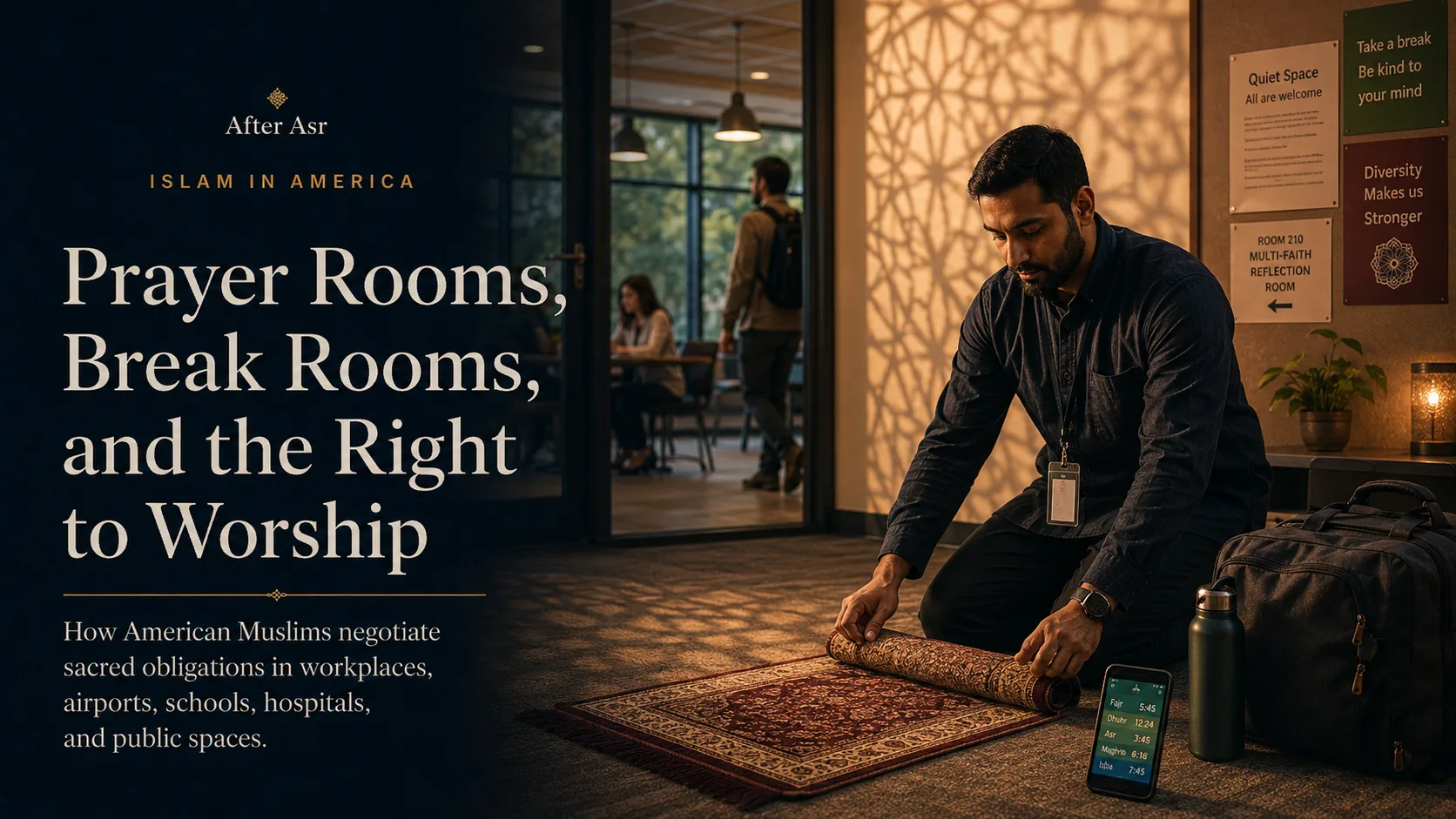
How American Muslims negotiate sacred obligations in workplaces, airports, schools, hospitals, and public spaces.
A Muslim learns to read rooms differently.
Not only for exits, seating, noise, or social cues, but for prayer. A quiet corner near the stairwell. An unused office. A clean spot behind a bookshelf. A hospital chapel between visiting hours. An airport reflection room near the gates. A classroom after students leave. A break room before the lunch rush. A patch of grass outside a rest stop. A corner of a convention center hallway where the carpet is clean enough and the foot traffic light enough.
The believer checks the time.
Dhuhr is entering. Asr is narrowing. Maghrib will be short. Isha can wait, perhaps, but not forever. Fajr came before the flight. The meeting is running long. The shift has no obvious pause. The school schedule is rigid. The airport gate changed. The hospital waiting room is full. The body is tired, the day is crowded, and still the obligation remains.
Prayer does not become optional because America is busy.
This is one of the ordinary disciplines of Muslim life in the United States. Muslims negotiate sacred obligation inside institutions not designed around salah. They ask supervisors for a few minutes. They explain to teachers. They search airports. They use phone apps. They carry travel prayer rugs. They combine prayers when traveling according to valid guidance. They pray in parked cars when necessary. They make wudu in public bathrooms while trying not to splash water everywhere. They learn when to speak, when to be discreet, when to request accommodation, and when to simply pray.
The public conversation often treats religious accommodation as a legal issue, and it is. Rights matter. Policies matter. Schools, workplaces, hospitals, airports, prisons, and public institutions should not make worship needlessly difficult. But for Muslims, the question is deeper than accommodation. It is about how a servant of Allah lives under obligation in a society whose daily rhythms do not naturally pause for Allah.
Prayer in America is sometimes visible, sometimes hidden, sometimes easy, sometimes awkward, sometimes protected, sometimes misunderstood.
Always, it is a return.
The prayer that interrupts the day
Salah interrupts.
It interrupts productivity, travel, entertainment, sleep, meetings, shopping, classes, appointments, and the illusion that time belongs fully to us. This interruption is not a flaw. It is part of the mercy. Prayer breaks the day open and reminds the believer that the schedule is not sovereign.
In American life, this interruption can feel especially sharp because public time is organized around work, school, commerce, and personal convenience. The day is divided into shifts, meetings, lunch breaks, class periods, appointments, boarding groups, and deadlines. Religion may be respected in theory, but it is often expected to fit politely around these structures.
Islam does not fit only around life. It orders life.
This does not mean Muslims should be careless, disruptive, or inconsiderate. A Muslim employee should work honestly. A student should respect class responsibilities. A traveler should plan wisely. A patient or family member should follow necessary hospital procedures. But planning around prayer is not an inconvenience added to Muslim identity. It is part of obedience.
The challenge is practical and spiritual.
Practically, a Muslim must ask: Where can I pray? When can I step away? How do I make wudu? Who needs to know? What is the cleanest place? What is safe? What does the policy allow? How do I avoid missing prayer without causing unnecessary difficulty?
Spiritually, a Muslim must ask: Do I treat prayer as the center, or as something I fit in only if nothing else resists? Am I embarrassed? Am I delaying without reason? Am I hiding prayer because of wisdom, or because of fear? Am I asking for accommodation with humility and confidence? Am I remembering that Allah is greater than the room I am worried about?
Prayer interrupts the day so that the believer does not forget what the day is for.
The workplace break room
For many Muslims, the workplace is where prayer becomes a daily negotiation.
A person may work in an office, warehouse, hospital, hotel, school, restaurant, factory, call center, laboratory, retail store, airport, construction site, military unit, delivery route, or remote job. Each setting has its own pressures. Some jobs have flexible breaks. Others are tightly monitored. Some supervisors are supportive. Others are confused or suspicious. Some coworkers barely notice. Others ask questions every time.
The break room becomes important.
It may be the only quiet space available. It may smell like reheated food. It may have a vending machine humming loudly. Someone may walk in halfway through prayer. A coworker may apologize. Another may stare. The Muslim may fold a prayer rug between a fridge and a table, stand toward the qiblah as best they can, and pray while the ordinary machinery of work continues nearby.
This can feel humbling.
There is no grand architecture. No adhan. No congregation. No beautiful carpet. Just a few minutes carved out of a workday, offered to Allah in a room designed for coffee and leftovers. Yet the prayer is real. The servant is seen. The break room, for that moment, becomes a place of worship.
Workplaces should take this seriously. A prayer accommodation is often simple: a clean, quiet place for a few minutes, flexibility around break timing, understanding during Ramadan, and respect for religious obligation. Most prayers do not require long absences. Many employees can coordinate responsibly with supervisors. Problems often arise not because prayer is difficult to accommodate, but because institutions have not learned to see it as normal.
Muslims also carry responsibility. Request accommodations clearly. Explain needs without assuming hostility. Be punctual. Do not abuse break times. Keep prayer areas clean. Avoid creating unnecessary tension. Thank supportive coworkers. Document important conversations when needed. Know your rights, but also practice adab.
A Muslim should not have to choose between employment and prayer.
A Muslim also should not use prayer as an excuse for poor work.
Both truths matter.
The courage to ask
Sometimes the hardest part is not praying.
It is asking.
“Is there a quiet place I can pray for a few minutes?”
“Could I use this room during my break?”
“Can I adjust my lunch slightly during Ramadan?”
“Would it be possible to step away for Friday prayer?”
“Can my child be excused briefly to pray?”
The words may be simple, but they can feel heavy. Many Muslims carry memories of being misunderstood. Some fear being seen as difficult. Some worry that a supervisor will retaliate quietly. Some do not want to explain Islam. Some are the only Muslim in the workplace or school. Converts may feel especially nervous because they are still learning what to ask for. Youth may fear standing out. Women who wear hijab may feel already visible and hesitate to add another point of difference.
Asking for prayer space requires a kind of spiritual confidence.
Not arrogance. Not entitlement. Confidence rooted in the knowledge that worship is legitimate. A Muslim is not asking for special treatment in the sense of privilege. They are asking for reasonable space to fulfill a sacred obligation. This distinction matters. Religious accommodation is not a personal favor granted by the kindness of whoever happens to manage the schedule. It is part of living in a society that recognizes conscience and worship.
Still, the way one asks matters. A calm explanation can open doors. “I pray five daily prayers. One or two may fall during work hours depending on the season. Each prayer takes about five minutes. I can use my regular break time when possible and would only need a clean, quiet space.” Such clarity helps people understand.
Some will respond with respect. Some will be awkward but willing. Some will ask sincere questions. Some may resist. When resistance comes, Muslims may need to seek policy guidance, human resources support, school administration, union representation, legal advice, or community advocacy. But the first act is often the same: asking without shame.
A believer should not apologize for needing to worship Allah.
Prayer in schools
For Muslim children and teenagers, school prayer can be formative.
A child who learns to pray at school learns that Islam does not stay home. A teenager who protects Dhuhr or Asr during the school day learns that prayer matters even when peers do not understand. A school that provides respectful accommodation teaches Muslim students that their religious life is recognized. A school that refuses or mocks prayer teaches another lesson.
Many Muslim students face practical challenges. Where can they pray? Who supervises? Will they miss instruction? Can they make wudu? Will other students tease them? Will teachers understand? Are prayer times changing with the seasons? Can Friday prayer be accommodated? What happens during Ramadan?
Parents and schools need communication before problems arise. A simple letter at the beginning of the year can explain prayer needs. Administrators can identify a clean, appropriate space. Teachers can understand that a student stepping out briefly is not avoiding class. Counselors can help coordinate. Students can be taught to be respectful, timely, and discreet.
The goal is not to turn school into a masjid. The goal is to allow Muslim students to fulfill their obligations with dignity.
This is especially important for adolescents. A teenager may miss prayer not because they reject Islam, but because the social pressure is heavy. They may not want classmates to see them. They may fear questions. They may feel awkward making wudu. Parents may assume the child is praying, while the child silently struggles.
Families should not only command, “Pray at school.” They should help. Practice what to say. Ask the school for space. Connect Muslim students to each other if possible. Teach practical fiqh. Encourage without humiliating. Let young people speak honestly about embarrassment and pressure.
A student who learns to pray in school carries a powerful lesson into adulthood: worship belongs in the middle of life.
Airports and the traveler’s prayer
Airports are among the most spiritually revealing places in modern life.
They are full of movement, waiting, anxiety, delay, security, announcements, hurried meals, sleeping strangers, expensive bottled water, and people trying to remain composed while time keeps changing. For Muslims, airports are also places of prayer.
Some airports have prayer rooms, meditation rooms, chapels, or interfaith spaces. Some are clean, quiet, and easy to find. Others are hidden, poorly marked, or far from the gate. Some have rugs and qiblah markers. Others have chairs, religious materials from several traditions, or nothing at all. In many airports, Muslims pray near windows, in empty gate areas, beside walls, in family rooms, or wherever a clean and safe spot can be found.
Travel has its own fiqh, and Muslims should learn it. Shortening prayers, combining prayers when permitted, wiping over socks according to proper conditions, tayammum in exceptional circumstances, qiblah estimation, and prayer on planes all require knowledge. The traveler who knows the religion is less anxious and less careless.
But even with knowledge, airports can be stressful. A gate change can consume the time set aside for prayer. A long security line can narrow the window. A flight delay can make a prayer room suddenly accessible, or make everything more difficult. A Muslim woman may worry about praying in a visible space. A family with children may struggle to coordinate wudu and bags. A convert may not know what to do.
Airports should make prayer rooms easier to locate and use. Public spaces serve people of many faiths, and quiet rooms for worship and reflection are not extraordinary demands. They are humane infrastructure. But until every airport does this well, Muslims continue to practice a familiar skill: finding a place.
There is something moving about seeing a traveler pray near a gate.
Suitcase beside them. Shoes placed carefully. Boarding announcements overhead. The whole terminal moving around a still body in sujood.
It is a reminder that no journey is greater than the journey back to Allah.
Hospitals and the prayer of vulnerability
Hospitals are places where prayer becomes urgent in another way.
A patient may not be able to stand. A family member may be afraid to leave the bedside. A doctor may come in at any moment. A mother may pray in a waiting room while her child is in surgery. A nurse may try to pray during a twelve-hour shift. A hospital chaplain may help locate a reflection room. A Muslim patient may need to know how to pray sitting, lying down, with limited movement, or while connected to medical equipment.
The hospital tests both knowledge and trust.
Islam does not demand what a person cannot do. A sick person has concessions. A patient who cannot stand may sit. A person who cannot make wudu may perform tayammum when conditions allow. A person unable to face the qiblah may do what they can. The details should be learned from qualified guidance, but the principle is merciful: prayer remains, and Allah knows the condition of the servant.
Hospitals should be attentive to Muslim needs. Prayer space, halal meals, modesty concerns, end-of-life practices, chaplaincy access, and family presence all matter. For Muslim staff, break-time prayer accommodations should be handled respectfully. For Muslim patients, spiritual care is part of whole-person care.
But hospitals can be overwhelming. Families may forget prayer in crisis, then feel guilty. Patients may feel too weak. Loved ones may not know the rulings. This is where Muslim chaplains, imams, and trained community volunteers can be invaluable. They can remind gently, not harshly. They can say, “Allah has made the religion merciful. Let us see what you are able to do.”
A hospital prayer may be physically small. A slight movement of the head. A whispered recitation. A du’a through tears. A prayer offered beside a bed between medical updates.
Allah is not absent from such rooms.
Public prayer and private sincerity
Praying in public can feel exposed.
A Muslim may pray in a park, airport, school, convention center, office, mall, roadside, or hospital hallway. Some people pass respectfully. Some stare. Some ask questions. Some take photos without permission. Some may make comments. In an age when everything can become content, public prayer can feel vulnerable.
Muslims should not make prayer performative. The goal is not visibility for visibility’s sake. Salah is for Allah. When a private or semi-private space is available, it is often better. But sometimes public prayer is necessary. The time is short. The space is limited. The obligation remains.
The believer must hold two truths.
First, prayer should be protected from showiness. Do not seek attention. Do not turn worship into a statement if a quieter option exists. Do not film yourself praying to prove courage. Do not make sujood into public branding.
Second, do not let fear of being seen cause you to neglect Allah’s command. If the clean and available place is public, pray with dignity. You are not doing something shameful. You are worshipping your Lord.
This balance is part of American Muslim maturity. Muslims should not be reckless with public spaces, blocking pathways or ignoring safety. They should also not internalize the idea that prayer is embarrassing. A person standing before Allah in a public corner may be more dignified than all the noise around them.
Sincerity is not determined by whether others can see.
It is determined by who the prayer is for.
Wudu in public bathrooms
Wudu is one of the ordinary challenges of Muslim public life.
Many American bathrooms were not designed for ritual washing. Sinks may be high or shallow. Floors may become slippery. People may stare when someone washes their feet. A workplace bathroom may be crowded. A school bathroom may be socially uncomfortable. An airport bathroom may be rushed. A hospital bathroom may be difficult for patients. A Muslim may try to balance religious obligation with cleanliness, safety, and public perception.
Wudu requires adab.
Do not leave water everywhere. Do not place feet in sinks carelessly where it creates disgust or danger. Use disabled-access sinks only when appropriate and without blocking those who need them. Wipe surfaces if needed. Be considerate. Carry a small towel if helpful. Learn valid options, such as wiping over socks when conditions are met. Plan ahead. Make wudu before leaving home when possible.
At the same time, institutions should understand that ritual washing is part of Muslim life. Some workplaces, universities, airports, and mosques have installed foot-washing stations or ablution areas. This is helpful where Muslim populations are significant. It reduces awkwardness and improves cleanliness for everyone.
Public wudu reminds Muslims that worship includes preparation. The few minutes before prayer are also part of submission. A person washing for Allah in an ordinary bathroom is engaging in sacred preparation inside ordinary infrastructure.
That requires humility.
It also requires not making the next person step into a puddle.
Friday prayer and the workweek
Jumu’ah is one of the most visible points of tension between Islamic time and American work time.
For Muslims, Friday prayer is not optional for those upon whom it is obligatory. For employers and schools, Friday midday may be one of the busiest parts of the week. Meetings, classes, shifts, lunch periods, and deadlines often collide with Jumu’ah. Some Muslims can leave easily. Others cannot.
American Muslim communities have developed practical solutions. Multiple Jumu’ah prayers. Workplace prayer groups. Campus Jumu’ah. Shorter khutbahs in office buildings. Letters for employers. Shift swaps. Remote work arrangements. Students coordinating with professors. Hospital staff finding coverage. Taxi drivers, delivery workers, and service workers planning routes around prayer where possible.
Still, many struggle.
A worker may be denied time. A student may have a required class. A manager may not understand why Friday matters. A Muslim may fear losing hours. A convert may not yet know how to ask. A person may tell themselves they will make it next week, then next week becomes a habit of absence.
Communities should teach both obligation and strategy. Do not only say, “You must attend Jumu’ah.” Help people figure out how. Provide employer letters. Offer multiple prayer times where valid and feasible. Build relationships with local businesses and campuses. Encourage Muslim professionals to advocate before crisis. Support workers with less flexibility, not only salaried professionals.
The workweek is powerful because income feels urgent. Jumu’ah reminds the believer that rizq is from Allah. This does not mean being irresponsible. It means not letting the fear of provision erase the Provider.
The law and the soul
Religious accommodation law matters.
Muslims should know that they have rights in many workplaces, schools, prisons, hospitals, and public institutions. They should know that discrimination may be challenged. They should know that reasonable accommodation is part of American legal life. They should know that policies exist and that documentation can matter. Communities should connect people with credible legal resources when needed.
But rights language is not enough.
The law can protect space for prayer. It cannot make the heart pray. A policy can allow a student to leave class. It cannot make salah beloved. A workplace can provide a room. It cannot make a Muslim use it. An airport can build a prayer space. It cannot give khushu. A hospital can call a chaplain. It cannot replace trust in Allah.
Muslims need both outer protection and inner formation.
Rights should be pursued because injustice should not be normalized. A Muslim should not be punished for prayer, fasting, hijab, beard, Eid observance, halal needs, or Jumu’ah. Institutions should be held accountable when they violate religious freedom. At the same time, Muslims must not reduce worship to rights claims. Prayer is not only something America permits. It is something Allah commands.
The believer does not pray because the law allows it.
The believer prays because Allah is Lord.
This order gives dignity. It allows Muslims to use legal protections without making legal recognition the source of religious legitimacy.
Converts and the awkward first requests
For converts, public prayer accommodation can be especially difficult.
A born Muslim may have grown up watching parents ask for Eid off or finding prayer spaces. A convert may be learning everything at once. They may need to tell an employer they are now Muslim. They may need to explain new prayer needs to family, roommates, teachers, or coworkers who knew them before conversion. They may feel watched because their religious change is new. They may fear being judged if they do not pray perfectly. They may not know which accommodations are reasonable.
Communities should help converts practically.
Provide sample workplace emails. Teach how prayer times work. Explain which prayers may fall during work or school depending on the season. Help them learn wudu and travel prayer. Discuss family dynamics. Encourage gradual confidence without neglecting obligations. Pair them with mentors who can answer small questions without making them feel foolish.
A convert’s first prayer at work may be emotionally significant. They are not only praying in a break room. They are publicly living a new allegiance. The same coworker who once invited them to lunch may now ask why they need a room. The same family that knew their old habits may wonder why they are washing before prayer. These moments can carry vulnerability.
A kind mentor can make a difference. “Here is what I say to my supervisor.” “Here is how I find qiblah.” “Here is what to do if someone walks in.” “Here is how to combine prayers when traveling.” “Here is who to ask if you need legal help.”
The convert should not have to invent Muslim public life alone.
Women praying in public spaces
Muslim women may experience public prayer differently.
A visibly Muslim woman may already attract attention through hijab or other clothing. Praying in public can increase that visibility. She may worry about safety, modesty, being photographed, or being approached. In some spaces, there may be no private area. In others, the available room may be unsafe or inaccessible. A mother may need to pray while supervising children. A woman in a workplace may hesitate to ask because she does not want to be seen as demanding.
Women’s prayer needs should not be treated as secondary.
Workplaces, schools, airports, and hospitals should offer spaces that are safe, clean, and dignified. Mosques and Muslim organizations should include women’s experiences when advocating for prayer rooms. Families should teach girls how to navigate prayer outside the home with confidence and practical knowledge. Muslim men should understand that what feels simple for them may carry additional concerns for women.
Communities should also avoid shaming women who struggle with public prayer. A woman may be balancing safety, modesty, children, work pressure, and social attention. Encourage her. Support her. Help identify spaces. Do not reduce the issue to courage alone.
At the same time, Muslim women have shown extraordinary steadiness in protecting prayer across public life. In offices, schools, airports, hospitals, campuses, and military settings, they carve out worship with dignity. Their example teaches the community that modesty and public religious life are not opposites.
A woman praying quietly in an airport corner may be carrying more courage than anyone passing by realizes.
The prayer room as institutional recognition
A prayer room is more than a room.
It is an acknowledgment that human beings are not only workers, students, patients, travelers, or clients. They are souls. For Muslims, a designated prayer space can transform experience. It reduces anxiety. It makes prayer easier to protect. It signals that worship is not an intrusion. It can create community among Muslims who might otherwise never meet.
But not all prayer rooms are equal.
Some are thoughtful: clean, accessible, quiet, with qiblah marked, shoe space, prayer rugs or open floor, and respectful signage. Others are storage closets renamed for diversity purposes. Some are multi-faith rooms where Muslims, Christians, Jews, Hindus, Buddhists, and others share space respectfully. Others are dominated by one tradition’s symbols, making others feel like guests. Some are easy to reserve. Others require keys no one can find. Some are in safe locations. Others are isolated in ways that make women or students uneasy.
Institutions should consult users when creating prayer spaces. Ask what is needed. Consider cleanliness, access, privacy, scheduling, signage, ablution, safety, and religious neutrality where appropriate. A room does not need to be elaborate. It needs to be usable.
Muslims using such rooms also have responsibilities. Keep them clean. Share respectfully with others. Do not monopolize multi-faith spaces beyond need. Avoid leaving personal items in ways that create clutter. Treat the room as a trust.
A well-kept prayer room can become one of the quiet mercies of public life.
Prayer in public parks, malls, and roadsides
Not every prayer has a room.
Sometimes Muslims pray in public parks during family outings, in malls while shopping, at highway rest stops during travel, beside cars on road trips, at beaches, campsites, conferences, weddings, and public events. These prayers may be brief, simple, and deeply memorable.
A family spreads a mat on the grass. A group prays near a rest area picnic table. A father and daughter pray behind their parked car while trucks pass. A student prays in a quiet corner of a convention center. A group of friends at a theme park finds a clean place near a wall. A Muslim at the beach prays as the sun lowers, with towels and bags nearby.
These prayers teach children that the earth belongs to Allah. They also teach practical adab. Choose clean places. Do not block walkways. Be aware of safety. Respect private property. Keep prayer sincere. Do not treat public prayer as spectacle. Be calm if people look. Answer questions kindly when appropriate.
There is beauty in the portability of Muslim worship. A prayer rug can transform a corner of the world into a place of sujood. The qiblah unites spaces that otherwise have nothing in common. The believer may be far from the masjid, but not far from Allah.
Public prayer should be humble, not theatrical.
But it should not be hidden as though it is shameful.
When accommodation is denied
Sometimes Muslims are refused.
A supervisor says no. A teacher dismisses the request. A manager mocks prayer. A school has no process. A prison fails to provide access. A hospital staff member does not understand. A public space treats prayer as suspicious. A Muslim is told to use a dirty area, pray later without regard for time, or choose between worship and consequence.
This is painful.
The first response should be wisdom. Clarify the need. Ask respectfully. Provide written explanation. Seek compromise where possible. Involve human resources, school administrators, chaplains, union representatives, or community advocates. Keep records. Consult knowledgeable people. If rights are violated, seek legal guidance from credible organizations or attorneys.
But the inner response matters too.
Do not let someone’s refusal make you feel that prayer is strange. The problem is not the obligation. The problem is the lack of accommodation. Do not internalize contempt. Do not respond with uncontrolled anger if patience may open the door. Do not abandon prayer because one person made it difficult. Seek Allah’s help, then take the means available.
Communities should support people facing denial. A worker risking retaliation should not be left alone. A student being mocked needs parental and institutional support. A prisoner denied religious access needs advocacy. A hospital patient needing prayer assistance should have chaplaincy support.
Religious freedom is not self-enforcing. Communities must defend it with knowledge, organization, and adab.
The danger of delaying until the heart hardens
The greatest threat to prayer in America is not always open hostility.
Often, it is delay.
A meeting runs long. “I’ll pray after.” A class starts. “I’ll pray later.” The break room is occupied. “I’ll make it up.” The airport is crowded. “I’ll wait.” Friends are watching. “Not now.” The day keeps moving. Prayer is pushed to the edge. At first the heart feels guilty. Later, less guilty. Eventually, missing prayer becomes part of life.
This is spiritually dangerous.
The environment may be difficult, but the nafs also looks for ease. A Muslim must be honest. Sometimes there is a real obstacle. Sometimes there is embarrassment. Sometimes poor planning. Sometimes laziness. Sometimes ignorance. Sometimes fear of people outweighs fear of Allah.
Prayer requires planning because life will not always open space automatically.
Check prayer times before leaving home. Make wudu early. Carry a small prayer mat. Know nearby mosques and prayer rooms. Schedule meetings when possible. Block a few minutes on the calendar. Learn travel rulings. Speak to supervisors early. Teach children to plan. Build friendships with coworkers or classmates who respect your worship. Do not wait until the last five minutes and then feel trapped.
Planning is not lack of tawakkul. It is part of taking worship seriously.
A heart that protects prayer becomes stronger. A heart that repeatedly delays without excuse becomes weaker.
America is busy. The believer must become intentional.
Coworkers, classmates, and the quiet da’wah of prayer
Prayer often invites questions.
“Are you meditating?”
“How many times do you pray?”
“Why do you face that direction?”
“Do you have to do it at work?”
“Can I be in the room?”
“Is it okay if I ask what you’re saying?”
Some questions are sincere. Some are awkward. Some are intrusive. Muslims do not have to answer everything, especially when rushed or uncomfortable. But prayer can become quiet da’wah through calm explanation and good character.
A simple answer is often enough. “Muslims pray five times a day, and this is one of the prayers.” “It only takes a few minutes.” “I face Makkah.” “Thank you for giving me the space.” “I can explain more after I finish.”
A coworker who sees prayer practiced calmly may come to understand Islam differently. A classmate who watches a Muslim student protect salah may learn respect. A supervisor who sees that accommodation does not harm work may become more supportive. A child who sees their parent pray publicly may learn courage.
But da’wah should not be the main intention in salah. Prayer is for Allah. Any benefit to others is secondary. The quiet dignity of worship may teach, but the believer is not performing.
Sometimes the best da’wah is simply being faithful without making a spectacle of faith.
The Muslim employer and institutional responsibility
Muslim-owned businesses and organizations should model excellence in prayer accommodation.
It is a contradiction for a Muslim employer to make it difficult for Muslim employees to pray. A restaurant that advertises halal but gives workers no prayer flexibility has a problem. A Muslim-owned store that closes for Jumu’ah but overworks staff without breaks has a problem. A Muslim nonprofit that speaks about Islamic values while burning out employees has a problem. A Muslim school that teaches salah but treats staff prayer as inconvenience has a problem.
Muslim employers carry a special responsibility because they know what prayer means.
Provide reasonable break structures. Designate clean prayer spaces. Respect Jumu’ah. Account for Ramadan. Treat workers fairly. Do not use religious language to demand unpaid labor. Do not assume employees can sacrifice rights because the business serves the community. Ethical employment is part of Islamic public life.
A Muslim workplace can become a model of how worship and work coexist. It can show that productivity need not erase prayer, that employees are human beings before they are labor, and that Allah’s command has a place in business operations.
This does not mean prayer becomes disorder. Good Muslim management plans around obligations. Schedules, coverage, communication, and fairness all matter. Worship should be protected with professionalism.
The Muslim marketplace must not ask non-Muslim institutions to respect prayer while Muslim employers neglect it.
Prayer, humility, and public belonging
Public prayer in America teaches humility.
It reminds Muslims that they are not in control of every environment. They must ask, adapt, explain, plan, and sometimes endure awkwardness. It also teaches courage. A believer learns not to disappear simply because worship is inconvenient to public norms.
This combination is important.
Muslims should not approach prayer accommodation with arrogance, as though everyone else’s needs are irrelevant. Public spaces are shared. Workplaces have responsibilities. Schools have schedules. Hospitals have urgent care. Airports have security. Adab requires consideration.
But Muslims should also not approach worship with inferiority. Prayer is not embarrassing. The need to pray is not unreasonable. Sacred obligation does not become less real because the surrounding society is not built around it.
American Muslim belonging must include the right to worship openly and responsibly. Not loudly for approval. Not hidden from shame. Openly enough that a Muslim can live as a Muslim without constant concealment. Responsibly enough that others see worship joined with good character.
The break room prayer, the airport prayer, the school prayer, the hospital prayer, the roadside prayer, all of these are small acts of rootedness.
They say: we live here, we work here, we study here, we travel here, we serve here, and we worship Allah here.
Teaching the next generation to pray anywhere
Children should learn that prayer is not confined to ideal conditions.
They should see parents pray at home, yes. They should see masjid prayer, yes. But they should also learn how to pray during travel, at school, in public spaces, and during busy days. Not casually, but with reverence.
Teach them how to find qiblah. How to make wudu before leaving. How to carry a prayer mat. How to ask a teacher respectfully. How to pray discreetly without shame. How to avoid blocking people. How to handle questions. How to combine prayers during travel according to valid guidance. How to make up for mistakes. How to return if they miss a prayer. How to understand that prayer is a meeting with Allah, not a burden parents invented.
If children only see prayer happen when convenient, they may learn that convenience decides worship. If they see prayer protected with gentleness and consistency, they learn that Allah comes first.
This teaching must be warm. A child who associates prayer with panic, yelling, or shame may struggle later. The goal is to build love and responsibility together.
A family that stops at a rest area to pray teaches more than a ruling.
It teaches orientation.
The room that becomes sacred
Imagine a workplace break room.
A microwave. A table. A refrigerator with old magnets. A few chairs. A bulletin board with safety notices. Someone’s lunch bag. Nothing about it seems sacred.
Then a Muslim enters quietly, checks the time, lays down a small mat, faces the qiblah, and says Allahu akbar.
For a few minutes, the room changes.
Not because the walls change. Not because everyone understands. Not because the institution has become Muslim. It changes because a servant of Allah has remembered what the day is for. The break room becomes a place where the world’s rhythm is interrupted by revelation’s rhythm. Work is still work. The shift continues. The emails wait. The announcements continue. But the believer has stepped into a deeper order.
This is the story of Muslim prayer in America.
Ordinary spaces become sites of obedience. Public institutions become places where sacred obligation is negotiated. Muslims learn to ask, adapt, advocate, and remain humble. The country does not pause five times a day, but the believer does.
Prayer rooms matter. Legal rights matter. Accommodations matter. Break schedules matter. Airport facilities matter. School policies matter. Hospital chaplaincy matters. All of these make worship easier and more dignified.
But the heart of the matter is still the believer standing before Allah.
In a classroom.
In a warehouse.
In an airport.
In a hospital.
In a public park.
In a break room that smells faintly of coffee.
The place may be ordinary.
The act is not.
A Muslim lowers their head to the ground and remembers that no institution, no schedule, no public expectation, no awkward glance, no deadline, no flight, no meeting, no fear of being seen is greater than Allah.
This is not disruption.
It is worship.
And a society mature enough to make room for that worship becomes more humane, not less.