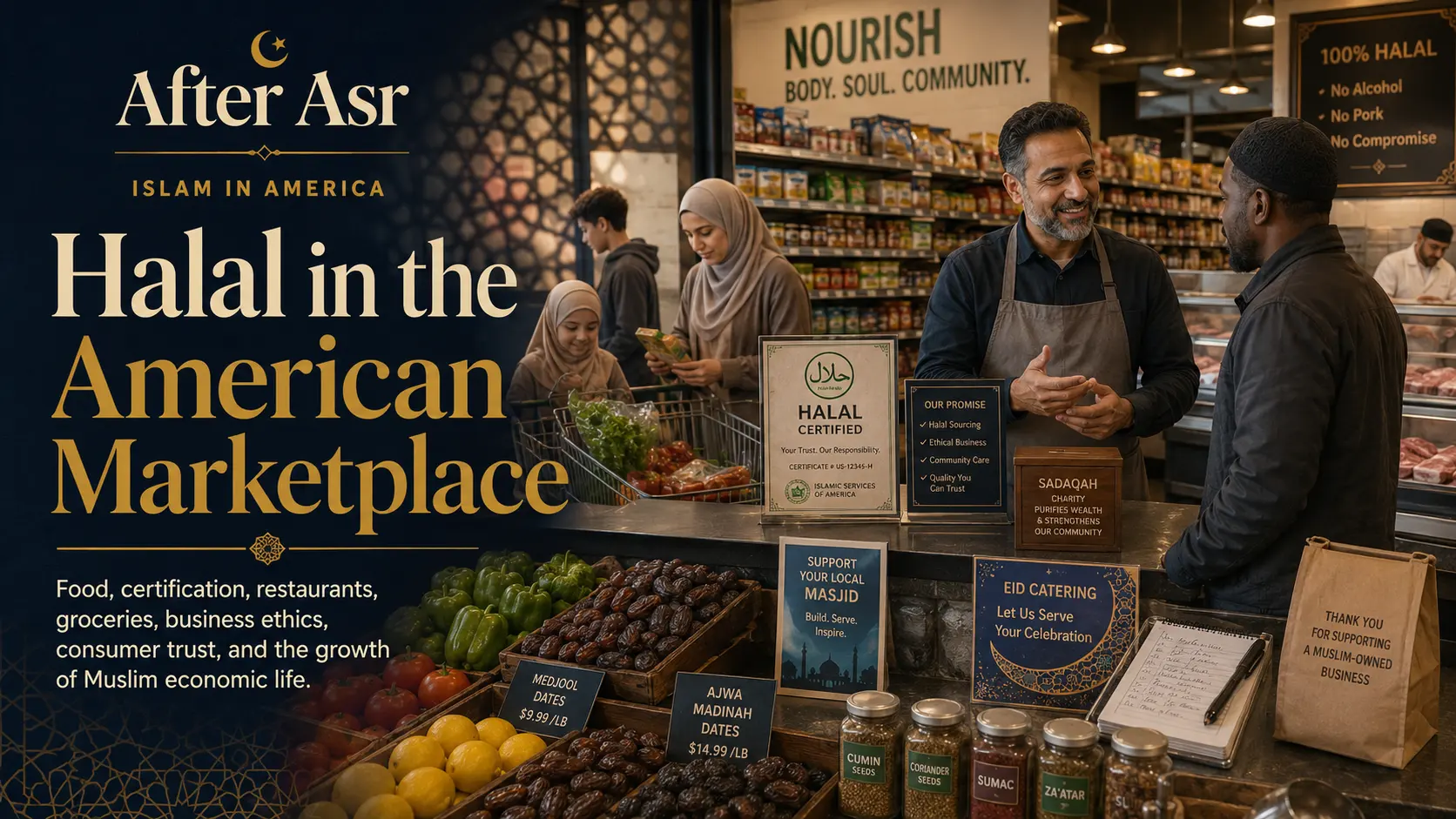
Food, certification, restaurants, groceries, business ethics, consumer trust, and the growth of Muslim economic life.
The word halal sits quietly on signs across America.
It appears in grocery store windows, restaurant menus, butcher counters, frozen food aisles, food trucks, catering flyers, school lunch requests, campus dining forms, festival booths, and online delivery apps. Sometimes it is written in careful script. Sometimes it is a small sticker near the register. Sometimes it appears beside words like organic, Mediterranean, Pakistani, Somali, Turkish, Afghan, Arab, Indian, fusion, burger, pizza, tacos, wings, or groceries. Sometimes it is printed confidently. Sometimes it is implied because the owner is Muslim and everyone knows the family.
To the casual observer, halal may look like a food category.
To Muslims, it is more than that.
Halal is obedience before it is branding. It is trust before it is marketing. It is worship entering the marketplace. It is the believer asking whether appetite, money, trade, slaughter, sourcing, labels, labor, and profit have been brought under the gaze of Allah. It is the daily discipline of caring what enters the body and how it reached the plate.
In America, halal has become increasingly visible. Muslim families look for trustworthy meat. Students request halal dining options. Restaurants advertise halal burgers, wings, sushi, tacos, barbecue, and fine dining. Grocery stores serve immigrant communities and converts alike. Certification bodies, suppliers, entrepreneurs, and consumers participate in a growing halal economy. Non-Muslims also buy halal products, sometimes for taste, sometimes for perceived quality, sometimes through neighborhood familiarity.
This growth is a sign of Muslim rootedness.
But growth also brings questions. What does halal mean in a marketplace shaped by branding, competition, supply chains, convenience, and profit? Who verifies it? Whom do consumers trust? What happens when Muslim businesses use religious language but fail in business ethics? How do restaurants balance transparency and survival? How do small stores serve communities with limited resources? How does halal remain worship when it becomes a market segment?
The American halal marketplace is not only about food.
It is about whether Muslims can build economic life with integrity.
Halal begins with Allah
Before certification, before menus, before business plans, before consumer demand, halal begins with submission to Allah.
The Muslim does not eat halal because it is fashionable, cleaner by assumption, culturally familiar, or part of ethnic identity. Those may become attached to halal practice, but they are not its foundation. The foundation is that Allah commands and forbids, and the believer’s body is not outside that command.
This matters because modern consumer culture often turns religious practices into lifestyle preferences. Halal can become a brand category, an aesthetic, a cuisine marker, or a way of signaling community belonging. But halal is not only an identity tag. It is part of taqwa. The believer asks not only, “Do I like this?” but “Is this lawful for me?” That question trains the soul.
It teaches restraint in an age of appetite.
A Muslim child learning not to eat school pepperoni is learning more than food avoidance. They are learning that not everything available is permissible. A college student searching for halal meals is learning that convenience does not decide morality. A family driving across town to buy halal meat is teaching that worship enters the weekly grocery routine. A convert reading labels for the first time is learning that Islam reaches ordinary details.
Halal is one of the ways Islam makes the unseen visible in daily life. No one may know what a person eats alone, but Allah knows. No one may see the decision to avoid something doubtful, but Allah sees. The marketplace becomes a test of sincerity because the body desires, the wallet calculates, and the believer remembers.
This is why halal must not be reduced to commerce. Commerce may serve it. Certification may protect it. Restaurants may make it accessible. But the meaning is deeper than the market.
Halal is the believer saying, even while hungry, “I belong to Allah.”
The immigrant grocery as community institution
Many American Muslim communities were sustained by small halal grocery stores long before halal became visible in mainstream spaces.
These stores were often more than retail. They were informal community centers. A place to find meat, spices, dates, tea, prayer rugs, Qur’ans, phone cards, imported sweets, Eid decorations, Islamic books, charity boxes, and community flyers. A place where elders spoke their languages. A place where new arrivals asked for help. A place where families heard news from home. A place where children learned the smell of cardamom, cumin, fresh bread, butcher paper, and freezer aisles full of familiar labels.
The halal grocery helped Muslims make a home in America.
For immigrant families, it carried memory. For converts, it could be an entry point into Muslim life. For students, it provided affordable staples. For small-town Muslims, it may have been a monthly destination. For families preparing Ramadan, it became essential. For communities without large mosques, the store sometimes carried the social weight of the masjid hallway.
Yet these stores often operate under pressure. Rent rises. Supply chains fluctuate. Customers demand low prices but expect high trust. Owners work long hours. Family members help after school. Competition from larger chains and online retailers grows. Certification questions become more complicated. Some customers assume Muslim ownership guarantees everything without asking. Others distrust without understanding the realities of sourcing.
The community should see these stores with gratitude and seriousness. A halal grocery is not automatically ethical because Muslims own it. But many have served as anchors of Muslim life, especially before halal became easier to find.
They deserve support, and they also carry responsibility.
A store that sells halal must care about accuracy. A store that serves a Muslim community must avoid exploiting community loyalty. A store that depends on religious trust must communicate clearly. The owner, like the consumer, stands before Allah.
The small halal grocery reminds us that economic life and religious life have never been fully separate. Food, trust, memory, and worship meet at the counter.
Restaurants and the taste of public belonging
Halal restaurants have changed the social experience of American Muslims.
For many families, eating out used to mean limited options: vegetarian dishes, seafood, fries, or careful questions about ingredients. A halal restaurant changed that. Children could order freely. Youth could gather after halaqah. Families could celebrate graduations and Eid. Students could meet without compromising. Converts could experience Muslim public life outside the mosque. Non-Muslim friends could be invited without awkward substitutions.
The halal restaurant became a place of belonging.
It also made Muslim life visible in ordinary American streets. A halal burger shop near a campus. A Somali restaurant in a strip mall. A Pakistani buffet in a suburb. A Turkish bakery near a mosque. A halal taco truck at a festival. A fried chicken spot run by Muslims. A Palestinian cafe with family recipes. A fusion restaurant where young Muslim entrepreneurs combine American food culture with halal sourcing.
This visibility matters because it tells Muslim children that their religious boundaries can exist in public, not only at home. It tells converts that halal is livable. It tells non-Muslim neighbors that Muslim presence is not abstract. It is part of dinner plans, lunch breaks, family outings, and local business life.
But restaurants also test the ethics of halal branding.
If a restaurant advertises halal, what exactly is halal? All meat? Some meat? Chicken only? No pork, but not certified? Muslim-owned, but mixed sourcing? Alcohol served? Cross-contamination? Machine-slaughtered meat? Hand-slaughtered? Certified by whom? Does the staff know how to answer? Is the claim clear or vague?
Consumers may differ in their standards, but businesses should not hide behind ambiguity. A Muslim business does not need to satisfy every opinion, but it should be transparent enough for customers to make informed choices according to their conscience and scholarly guidance.
Trust is part of the meal.
A halal restaurant can be a blessing, but only if the religious language it uses is handled carefully.
Certification and the problem of trust
Halal certification exists because trust needs structure.
In small communities, people may know the butcher, supplier, family, and slaughter process. In larger markets, supply chains become more complex. Meat may pass through farms, slaughterhouses, distributors, warehouses, restaurants, and grocery stores before reaching the plate. Consumers cannot personally inspect every step. Certification attempts to provide verification.
But certification itself can become confusing.
Different organizations use different standards. Consumers may not understand the difference between hand slaughter, machine slaughter, stunning, supervision, imported meat, domestic sourcing, and various scholarly opinions. Some certification labels are widely trusted. Others are questioned. Some businesses claim halal without certification. Some communities rely on the word of owners. Some Muslims accept broader standards. Others require stricter verification.
This can create tension. One person asks, “Is it certified?” Another says, “The owner is Muslim.” Another asks, “Who is the supplier?” Another says, “Don’t make the religion hard.” Another says, “Don’t be careless with halal.” The conversation can become heated because food is intimate. It enters the body. Parents are feeding children. Converts are trying to learn. Business owners are trying to survive.
The community needs more knowledge and less accusation.
Halal standards should be taught clearly by qualified scholars and trustworthy certifiers. Consumers should learn how to ask questions respectfully. Businesses should be honest about sourcing. Certification bodies should be transparent about their criteria. Communities should avoid turning every difference into a public fight, while also refusing to treat halal as a casual claim.
Trust does not mean never asking.
Suspicion does not mean being religious.
The best path is informed care: asking because Allah matters, answering because amanah matters, and differing where legitimate without destroying community bonds.
The Muslim business owner and amanah
A Muslim business owner who sells halal food carries a trust.
They are not only selling meat, meals, spices, or groceries. They are selling confidence. A customer may feed their child based on the owner’s word. A convert may rely on the sign because they do not yet know how to ask detailed questions. A family may break fast with food believing it is lawful. A student may spend limited money because the restaurant claims halal.
This trust is serious.
The owner must fear Allah more than lost sales. If only some items are halal, say so. If sourcing changes, say so. If certification lapses, say so. If alcohol is served, be transparent. If pork is handled in the kitchen, disclose what customers need to know. Do not rely on vague phrases that make people assume more than what is true. Do not use Arabic calligraphy, Islamic décor, or Muslim identity to create trust that the business has not earned.
A Muslim business should also uphold broader business ethics. Halal meat does not excuse underpaying workers. A halal restaurant should not mistreat employees, cheat vendors, lie on taxes, ignore cleanliness, manipulate customers, or exploit family labor. A Muslim grocery should not overcharge unfairly because customers feel religiously dependent. A Muslim caterer should honor contracts. A Muslim supplier should deliver what was promised.
Halal is not only about the animal. It is also about the transaction.
A meal made from lawfully slaughtered meat but purchased through dishonesty carries a contradiction. The Shariah cares about what we eat and how we earn. Muslim economic life must remember both.
The halal sign should signal more than permissible ingredients. It should signal amanah.
Consumer responsibility
Consumers also have responsibilities.
It is easy to demand perfect transparency, low prices, beautiful service, ethical sourcing, convenient hours, generous portions, and community loyalty while forgetting that businesses operate under real constraints. Halal supply can be expensive. Certification costs money. Rent rises. Labor is difficult. Small businesses face pressure from delivery apps, competition, inflation, and customer expectations shaped by large corporations.
Muslim consumers should ask questions, but with adab.
Do not humiliate a worker at the counter. Do not spread rumors without verification. Do not destroy a business publicly because of something heard secondhand. Do not assume every mistake is deception. Do not demand detailed fiqh answers from a cashier who may not know the supply chain. Ask respectfully. Speak to the owner when needed. Seek clarity. Make personal decisions according to knowledge and conscience.
Consumers should also support businesses that show integrity. If a restaurant is transparent, clean, fair, and trustworthy, support it. If a grocery serves the community well, do not abandon it immediately for a slightly cheaper chain without considering what local Muslim infrastructure means. If a business corrects a mistake honestly, value that honesty.
At the same time, loyalty should not become blind. Muslim consumers should not excuse bad conduct because the owner is Muslim. Community identity should not protect dishonesty. A business that uses Islam to gain customers must be accountable to Islamic ethics.
The consumer and business owner meet before Allah. Both have rights. Both have duties.
Halal and class access
Halal access is not equal.
Some Muslim families live near abundant halal markets and restaurants. Others live in rural areas, small towns, or suburbs where the nearest halal butcher is an hour away. Some can afford premium halal meat, restaurant meals, organic products, and specialty groceries. Others struggle to buy enough food at all. Some students depend on campus meal plans that barely accommodate them. Some converts live with non-Muslim families and cannot control the household kitchen. Some refugees and low-income families rely on food pantries that may not understand halal needs.
This matters because halal is an obligation, but access is shaped by economics and geography.
Communities should think beyond consumer convenience. How can halal meat reach low-income families? Can mosques organize bulk purchases? Can zakat and sadaqah programs include grocery support? Can food pantries provide halal options with dignity? Can campus MSAs advocate for meal access? Can Muslim businesses offer community discount days or Ramadan packages? Can wealthier families sponsor meat for those who cannot afford it? Can rural Muslims coordinate deliveries?
The halal marketplace should not serve only the comfortable.
If halal becomes associated mainly with premium branding, restaurant culture, and expensive specialty goods, the community risks forgetting those for whom halal practice requires sacrifice. A mother trying to feed children on a tight budget may not be impressed by luxury halal food festivals. A student eating rice and eggs may not feel included in the celebration of Muslim consumer growth. A convert in a small town may need practical guidance more than debate.
The Prophet ﷺ taught concern for the hungry. A halal economy that forgets hunger has missed something essential.
The rise of halal convenience
American Muslim life has changed as halal convenience has grown.
Frozen meals. Meal kits. Delivery apps. Packaged snacks. School lunch options in some districts. Campus dining programs. Halal food trucks. Fast-casual chains. Online meat delivery. Eid catering. Airport options in some cities. Grocery chains carrying halal products. Muslim-owned food brands shipping nationwide.
For many families, this is a mercy. It reduces daily friction. It helps parents. It supports students. It makes travel easier. It allows Muslim children to experience ordinary social life without constant exclusion. It creates economic opportunity for Muslim entrepreneurs.
But convenience can also change our relationship with halal.
When something becomes easy, its spiritual meaning may become less visible. A child who grows up surrounded by halal options may not realize the sacrifice previous generations made. A family may treat halal food as another consumer preference rather than a discipline of obedience. Restaurants and brands may compete for Muslim dollars through aesthetics more than ethics. Convenience can make halal more accessible, but it can also make it easier to forget why halal matters.
Parents and teachers should explain the meaning, not only provide the product. Tell children why we eat halal. Teach gratitude for access. Share stories of earlier difficulty without turning them into guilt. Explain that halal is not only a label, but a relationship to Allah’s command.
Convenience is good when it serves obedience.
It becomes spiritually thin when it replaces remembrance.
Halal fusion and American Muslim creativity
The growth of halal food has also created new cultural forms.
Halal burgers, wings, barbecue, pizza, tacos, ramen, sushi, brunch, soul food, food trucks, meal prep, fine dining, and fusion concepts show that Muslims are not only preserving food from elsewhere. They are creating American Muslim food culture. Children of immigrants, Black Muslim entrepreneurs, Latino converts, white converts, African immigrant families, Arab and South Asian restaurateurs, and young Muslim chefs are all expanding what halal can taste like in America.
This creativity is not trivial.
Food helps Muslims feel at home. When a halal version of a familiar American food becomes available, it can reduce the feeling that Islam always means exclusion. A Muslim child can attend a birthday party at a halal pizza place. A convert can adapt family recipes. A halal barbecue restaurant can speak to regional American culture. A halal taco truck can reflect Latino Muslim life. A halal soul food kitchen can honor Black Muslim culinary inheritance.
This creativity also challenges the idea that halal belongs to one ethnic cuisine. Halal is not Arab food, South Asian food, or any one region’s food. It is a moral category that can shape many cuisines.
But creativity still needs boundaries. Not everything marketed as Muslim-friendly is spiritually meaningful. A business may create exciting food while neglecting prayer, modesty, worker rights, or honest sourcing. A halal nightlife-adjacent dining culture may offer permissible meat in environments that normalize other problems. A Muslim brand may chase trendiness while losing adab.
American Muslim creativity is a gift when governed by taqwa.
The question is not whether halal can be innovative. It can. The question is whether innovation remains obedient.
Groceries, labels, and everyday vigilance
Much of halal practice in America happens in grocery aisles.
A parent turns over a package to read ingredients. A convert searches online to understand gelatin, enzymes, broth, emulsifiers, alcohol flavoring, vanilla extract, rennet, and animal-derived additives. A child asks whether marshmallows are allowed. A shopper wonders whether “natural flavors” are a problem. Someone texts a group chat from the store. Someone else says, “Just buy the certified one.”
This ordinary vigilance is part of American Muslim life.
It can become burdensome, especially for new Muslims and parents. It can also become a source of unnecessary anxiety if people lack guidance. Not every ingredient question is simple, and scholarly opinions may differ. Some Muslims become careless because constant checking feels hard. Others become obsessive, fearing every product. Communities need balanced education.
Muslims should learn general principles, reliable resources, and when to ask scholars. Parents should teach children in age-appropriate ways. Converts should be given beginner-friendly guidance instead of overwhelming lists. Communities should avoid turning ingredient discussions into moral superiority contests.
The goal is not panic. It is conscientiousness.
Food labels remind Muslims that modern consumption is complex. We are often far removed from the origins of what we eat. Halal practice asks us to slow down, ask, verify where necessary, and remember that convenience does not erase accountability.
Even a grocery aisle can become a place of taqwa.
Schools, campuses, and institutional accommodation
Halal in America is not only a private consumer matter. It is also an institutional accommodation issue.
Muslim students in public schools may need halal lunches, or at least vegetarian options that are not nutritionally poor. College students on mandatory meal plans may need real halal dining access. Hospitals should provide halal meals for patients. Prisons must address religious dietary needs. Military dining facilities may need accommodations. Elder care facilities increasingly must understand Muslim dietary requirements.
These are not luxuries.
Food is part of religious practice. When institutions provide meals, they should take religious dietary needs seriously. This is especially important where people have limited choice: students, prisoners, patients, service members, elderly residents, and detained individuals. A Muslim patient recovering from surgery should not have to worry whether they can eat. A Muslim prisoner should not be forced to choose between nutrition and conscience. A Muslim student paying for a meal plan should not survive on salad and fries.
Advocacy around halal access teaches Muslim communities how to engage public institutions with clarity. It requires documentation, respectful communication, persistence, and sometimes legal knowledge. It also requires internal education so Muslim advocates can explain what is needed and why.
Institutional halal access is part of Muslim belonging in America. It says Muslims are not temporary guests expected to solve every religious need privately. They are students, patients, soldiers, workers, residents, and citizens whose worship matters in public systems.
But access should not make Muslims passive consumers. If a school offers halal lunch, families should still teach children gratitude and religious meaning. If a campus provides halal meals, students should still build prayer and community. Accommodation supports faith. It does not replace formation.
Certification as public confidence
As halal products enter mainstream markets, certification becomes part of public confidence.
A Muslim family may buy frozen halal meals from a national grocery chain. A non-Muslim school district may contract with a halal supplier. A hospital may rely on certification for patient meals. A restaurant may use certified meat to reassure customers. A packaged food company may seek certification to reach Muslim consumers.
This creates opportunity and responsibility.
Certification bodies should operate with transparency, consistency, qualified oversight, and accountability. If standards differ, they should be explained. If fees are charged, they should be fair and not exploitative. If a certifier’s seal appears on products, consumers should be able to learn what the seal means. If mistakes occur, they should be corrected publicly and responsibly.
The halal certification space can become confusing when organizations compete, standards are unclear, or consumers lack education. In some cases, disagreements are legitimate. In others, mistrust grows because people do not know what questions to ask.
Muslim communities need educational literacy around certification. Not every consumer must become a technical expert, but families should understand the basics. Businesses should avoid using unfamiliar seals without explanation. Mosques can host sessions with qualified scholars and certifiers. Schools can teach children why halal matters beyond the logo.
A certification mark is not magic. It is a system of trust. That system must be worthy of the religious confidence people place in it.
Non-Muslim consumers and the halal table
Halal food increasingly serves non-Muslim customers.
Some enjoy the taste. Some trust the preparation. Some live near Muslim restaurants and become regulars. Some encounter halal through food trucks, campus dining, grocery stores, or workplace catering. For many non-Muslims, halal food may be one of their first positive encounters with Muslim life.
This can be a bridge.
A neighbor who loves the local halal restaurant may begin to see Muslims less through media and more through hospitality. A coworker eating halal catering at an office iftar may ask sincere questions. A non-Muslim relative invited to a halal Eid meal may feel included. A student eating at a halal food truck may learn something about Muslim practice without a formal lecture.
But Muslims should not reduce halal food to public relations. The primary meaning remains obedience to Allah. Non-Muslim appreciation is welcome, but not the measure of success. A halal business should not dilute its Muslim commitments to appear more marketable. It can serve everyone while remaining clear.
There is also a responsibility in how halal is presented to broader audiences. Avoid making it seem like halal is simply “clean meat” in a vague wellness sense. Avoid overclaiming. Avoid exoticizing Islam through food aesthetics. Explain simply and truthfully: halal refers to what is lawful for Muslims, including specific rules around food, sourcing, and preparation.
Food can open doors. Truth should walk through them.
The ethics of marketing Islam
Halal businesses often use Islamic language and symbols in marketing.
Bismillah. Crescent imagery. Arabic calligraphy. Ramadan specials. Eid catering. Islamic phrases. Community donation campaigns. Masjid partnerships. Modest branding. Muslim influencer endorsements. These can be sincere and culturally meaningful.
They can also be misused.
When religious symbols sell products, the business must be careful. Do not use sacred language casually. Do not imply piety where there is only branding. Do not attach Islamic aesthetics to unethical practice. Do not exploit Ramadan spirituality to push wasteful consumption. Do not use charity campaigns without transparency. Do not make customers feel that buying from a particular brand is a measure of religious loyalty unless the claim is justified.
Muslim consumers are not only a demographic. They are believers. Marketing to them should be done with fear of Allah.
Ramadan especially reveals the tension. Businesses offer iftar boxes, sweets, clothing, décor, catering, and gifts. Many of these are useful and joyful. But Ramadan can become over-commercialized. A month meant for fasting, Qur’an, charity, restraint, and repentance can become a season of consumption with Islamic colors.
Halal marketing should serve Muslim life, not reshape Muslim life around buying.
A beautiful Eid product is not wrong. A convenient iftar package is not wrong. A halal brand growing successfully is not wrong. But the heart must remain awake. Commerce should not train Muslims to confuse spiritual seasons with shopping seasons.
Muslim economic life beyond food
The halal marketplace often begins with food, but points toward a larger question: what kind of economic life are Muslims building in America?
Halal food businesses are part of a wider Muslim economy: clothing brands, bookstores, schools, financial services, real estate, tech companies, health clinics, counseling practices, law firms, media platforms, travel agencies, event planning, publishing, nonprofits, and community services. Food is often the most visible because everyone eats, but the same ethical questions apply everywhere.
Is the income halal? Are contracts honored? Are employees treated fairly? Are customers told the truth? Are community relationships exploited? Is charity transparent? Are Muslim consumers respected? Are women treated with dignity? Are Black Muslims and other marginalized groups included? Are converts welcomed as customers and workers? Does the business support the community or only extract from it? Does success increase gratitude or arrogance?
Muslim economic growth can be a blessing if it builds independence, service, employment, community infrastructure, and ethical alternatives. It can become dangerous if it merely creates Muslim-branded consumerism.
A halal economy should not mean only that Muslims buy from Muslims. It should mean Muslims conduct business under Allah’s command.
That is harder, and more important.
The worker behind the halal counter
Behind every halal business are workers.
Butchers, cooks, cashiers, delivery drivers, dishwashers, servers, stockers, cleaners, family members, managers, and suppliers. Some are Muslim. Some are not. Some are immigrants. Some are students. Some are relatives helping without formal pay. Some work long hours in physically demanding conditions.
A community serious about halal must care how these workers are treated.
Are they paid fairly? Are tips handled honestly? Are schedules humane? Are workers given prayer breaks where possible? Are women employees safe from harassment? Are family members exploited because the business is “for the family”? Are undocumented workers treated as disposable? Are non-Muslim workers respected? Are employees trained properly so they do not unknowingly misrepresent halal status?
The halal sign should not cover labor injustice.
A meal cannot be spiritually healthy if the business behind it is built on oppression. Of course small businesses face real pressures. Owners may work harder than anyone. Margins may be thin. Family businesses can blur boundaries. But difficulty does not erase responsibility.
The Prophet ﷺ taught justice in trade and treatment. Muslim business owners should fear the du’a of the wronged worker as much as they fear losing customers.
The person behind the counter is part of the halal story.
Community accountability without public destruction
When halal trust is broken, communities can react strongly.
A restaurant is accused of mislabeling food. A supplier is questioned. A certification claim is challenged. A rumor spreads that a business uses non-halal meat. Social media posts circulate. Customers feel betrayed. Owners feel attacked. Scholars are pulled into disputes. Sometimes wrongdoing is real. Sometimes misunderstanding grows faster than facts.
Communities need ways to handle these matters responsibly.
First, verify. Do not spread claims without evidence. Speak to the business. Ask for documentation. Consult qualified people. Distinguish between a fiqh difference and deception. Distinguish between a mistake and a pattern. Distinguish between uncertainty and proof.
Second, protect consumers. If there is real deception, it must be addressed. Religious trust cannot be violated without consequence. Communities may need public clarification when public harm exists.
Third, avoid cruelty. Even when correction is needed, the tongue remains accountable. Do not lie, exaggerate, insult, or enjoy another Muslim’s downfall. A business may employ families whose livelihoods are affected. Accountability should be firm, but not vengeful.
Fourth, build better systems. Many crises happen because expectations were unclear. Certification, sourcing transparency, menu labeling, and community education can prevent future harm.
A community that cares about halal must also care about justice in how disputes are handled.
Local halal and community rootedness
Local halal businesses often become part of community memory.
The restaurant where families go after Eid. The butcher who knows everyone’s parents. The grocery where students buy dates. The food truck at the masjid fundraiser. The bakery that makes Eid cookies. The market that posts janazah announcements. The owner who extends credit quietly to a family in need. The restaurant that feeds volunteers after a long event. The store that donates cases of water for Ramadan.
These businesses can become woven into the social fabric of American Muslim life.
Supporting them is not only economic. It can be communal. When local halal businesses thrive with integrity, they create jobs, serve families, support events, and make Muslim life more livable. They also become visible signs that Muslims are rooted in the neighborhood.
But local loyalty should be mutual. Businesses should not demand support without earning trust. Communities should not expect endless donations from small owners. Mosques should not pressure every Muslim business for free catering or sponsorship. Customers should not treat small businesses with less patience than they give national chains. Owners should not treat community members as guaranteed revenue.
A healthy local halal ecosystem is built on respect. Businesses serve the community. The community supports businesses. Both remember Allah.
Teaching children halal with love
Children often experience halal as restriction before they understand it as worship.
They cannot eat the school pizza. They cannot have certain candies. They ask why their classmates eat things they cannot. They may feel embarrassed at birthday parties. They may trade snacks or hide questions. They may wonder why Allah cares what they eat.
Parents should teach halal with love and clarity.
Explain that Allah gives good things and sets limits for our benefit and obedience. Make halal food joyful at home. Provide alternatives when possible. Help children navigate school kindly. Teach them to ask questions without shame. Do not make them feel superior to others, but do not make them feel embarrassed either. Let them know that being Muslim sometimes means saying no, and saying no can be an act of love for Allah.
Muslim schools and weekend programs should also teach halal practically. Children should understand not only pork avoidance, but gratitude, waste, animal care, lawful earnings, sharing food, and feeding the poor. They should learn that halal is part of a whole way of life, not a list of forbidden snacks.
A child who learns halal as love may carry it into adulthood more willingly than a child who learns it only as inconvenience.
Halal, tayyib, and the question of goodness
The Qur’anic language of halal is often connected with tayyib, what is good, wholesome, pure, and beneficial.
This pairing should make Muslims think more deeply.
Something may be technically halal but still not spiritually or physically good in excess. Fast food may be halal. Sugary drinks may be halal. Overeating may involve halal food. Waste may involve halal food. A business may sell halal meat but produce unhealthy habits. A consumer may eat halal and still neglect gratitude, moderation, and concern for the poor.
Halal is the legal minimum. Tayyib invites a fuller ethic.
This does not mean every Muslim must become a health perfectionist or afford premium products. Such thinking can become classist quickly. Many families are doing their best with limited time and money. But communities can still teach moderation, nutrition, food justice, environmental responsibility, animal welfare, and gratitude as part of Islamic food consciousness.
Tayyib also includes emotional and communal goodness. Is the table peaceful? Is the worker treated well? Is the food shared? Is the business honest? Is the consumer grateful? Is the meal helping the body serve Allah or only feeding impulse?
The American halal marketplace should mature toward tayyib. Not as a marketing upgrade, but as spiritual deepening.
The future of halal in America
Halal in America will likely continue to grow.
More products. More restaurants. More certification debates. More Muslim entrepreneurs. More institutional accommodations. More mainstream interest. More regional halal food cultures. More fusion. More online meat delivery. More school and campus advocacy. More questions about ethics, sustainability, labor, and trust.
Growth is not automatically success.
The future of halal will depend on whether Muslims preserve its meaning as it expands. If halal becomes only a profitable label, it will lose moral force. If certification becomes opaque, trust will weaken. If Muslim businesses neglect ethics, consumers will become cynical. If halal access remains class-bound, poor Muslims will be left behind. If families teach halal only as restriction, children may resent it. If communities fight harshly over every difference, halal will become a source of division rather than taqwa.
But if Muslims approach halal with knowledge, transparency, mercy, and accountability, the marketplace can become a place of worship.
Restaurants can feed with integrity. Grocers can serve with honesty. Certifiers can protect trust. Consumers can ask with adab. Parents can teach with love. Mosques can support access for the poor. Entrepreneurs can create jobs. Schools and hospitals can accommodate sincerely. Non-Muslim neighbors can encounter Islam through hospitality. Children can grow up knowing that obedience to Allah belongs in ordinary life.
The halal marketplace can help Muslims root themselves in America without dissolving into its consumer culture.
That is the challenge.
The sign in the window
Imagine a small storefront on an ordinary American road.
A halal sign hangs in the window. Inside, there are shelves of spices, bags of rice, dates near the register, a freezer of meat, a flyer for the local masjid fundraiser, and a child helping their parent carry groceries. The owner greets customers by name. Someone asks about certification. Someone else asks whether the restaurant next door is fully halal. A convert buys their first prayer rug along with chicken. A mother picks up ingredients for iftar. A student counts dollars before choosing what to buy. A non-Muslim neighbor stops in for the bread they have come to love.
Nothing about the scene is dramatic.
But a whole story lives there.
Migration. Conversion. Family. Worship. Trust. Business. Appetite. Memory. Law. Community. Money. Ethics. Children. Neighbors. Allah’s command entering the market.
The halal sign is not merely an advertisement. It is a claim. It says: you may trust what is here. It says: this food has been considered before Allah. It says: Muslim life belongs in this neighborhood. It says: commerce can serve obedience. It says: even buying dinner can become part of a larger moral life.
Such a sign should make both customer and owner careful.
Because halal is not only what we consume.
It is what we answer for.
The American Muslim marketplace will continue to grow, by Allah’s permission. The question is whether it will grow with taqwa. Whether its businesses will be honest, its consumers fair, its certifiers trustworthy, its food accessible, its workers respected, its children taught, its poor remembered, and its success measured not only in sales, but in barakah.
A halal economy worthy of the name must begin where the believer begins.
Bismillah.
And it must end where every blessing ends.
Alhamdulillah.