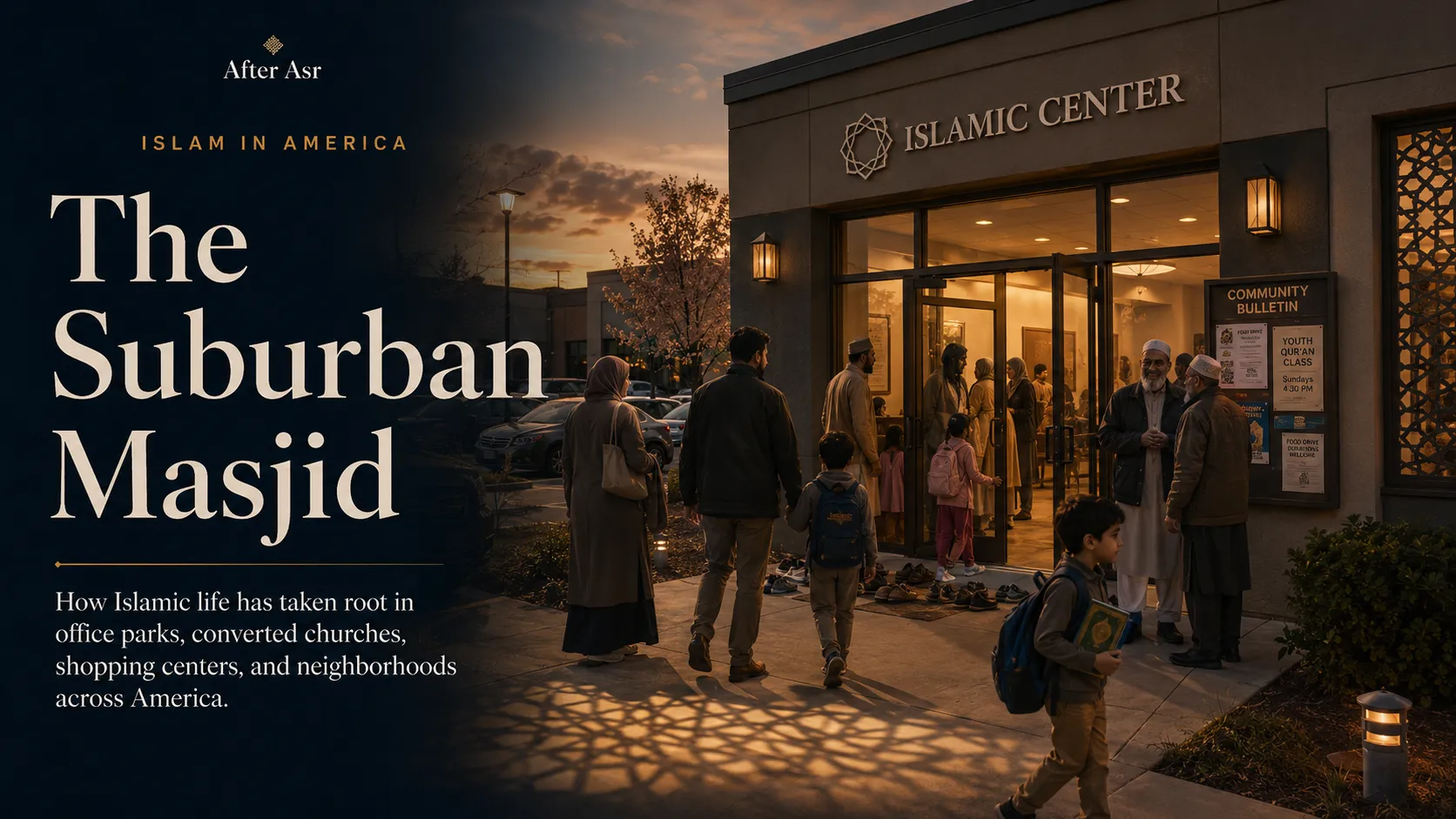
How Islamic life has taken root in office parks, converted churches, shopping centers, and neighborhoods across America.
The American masjid does not always look like the imagination expects.
Sometimes it has no dome. No minaret. No courtyard. No tilework. No fountain. No call to prayer moving through the streets. Sometimes it is tucked between a tax office and a pediatric clinic. Sometimes it occupies a former church with the cross removed and the qiblah carefully marked. Sometimes it sits in an office park where the other suites hold dentists, accountants, tutoring centers, and insurance agencies. Sometimes it is a converted house on a busy road, a rented school gym on Fridays, a storefront in a shopping plaza, a warehouse with carpet and fluorescent lights, or a modest brick building behind a gas station.
From the outside, it may look ordinary.
Inside, people are learning how to live toward Allah.
This is one of the quiet stories of Islam in America: the sacred has taken root in ordinary suburban architecture. Muslims have made prayer spaces in buildings designed for commerce, administration, worship of other traditions, professional services, and retail traffic. They have turned drop ceilings, parking lots, multipurpose rooms, and borrowed classrooms into places of sujood, Qur’an, janazah prayer, weekend school, iftar, marriage counseling, youth halaqah, convert care, fundraising, and community memory.
The suburban masjid tells us something important about American Muslim life. Islam here is not only in historic urban neighborhoods, university campuses, prison chaplaincy programs, immigrant enclaves, or major metropolitan centers. It is also in cul-de-sacs, office parks, commuter towns, subdivisions, strip malls, school districts, and small cities where families are building lives between mortgage payments, school pickup, work schedules, soccer practice, Qur’an class, and Maghrib.
The masjid may look plain from the road, but it carries an enormous spiritual project.
The sacred inside the ordinary
There is something quietly beautiful about a masjid in an office park.
During the day, cars move in and out for appointments, invoices, consultations, deliveries, and professional errands. Then, as sunset approaches, a different rhythm enters the same asphalt geography. A father pulls into a parking space with children in the backseat. A nurse arrives still wearing scrubs. A student comes with a backpack. An elder steps slowly from a car while someone holds the door. Shoes gather near the entrance. Someone turns on the lights. Someone adjusts the thermostat. Someone checks the prayer time. Someone straightens the rows.
The building may not have been designed for worship, but worship has claimed it.
This is not a lesser sacredness. A place becomes honored by what is done there for Allah. The carpet may be commercial grade. The windows may face a parking lot. The walls may have once held cubicles or Sunday school rooms or retail shelving. But when believers stand in salah, the space changes. It becomes part of the sacred map of American Islam.
Muslims have always prayed in varied places. The earth has been made a place of prayer. Yet there is a special tenderness in seeing communities carve out stability in environments that were not built with them in mind. The suburban masjid is not only a building. It is a statement of persistence: we are here, we pray here, our children will learn here, our dead will be remembered here, and our neighbors will come to know us here.
The ordinary building becomes extraordinary through repetition.
Fajr in a dark parking lot. Jumu’ah in a crowded room. Children reciting Arabic letters on Sundays. Ramadan nights stretching past exhaustion. Eid plans taped to the wall. A convert saying shahadah near a folding table. A janazah prayer offered in a multipurpose hall. A mother making du’a in a small women’s space while her child sleeps beside her.
This is how sacred geography grows.
The masjid after migration
Many suburban masjids exist because Muslim families moved.
Some moved from city neighborhoods to suburbs for schools, safety, space, work, and housing. Some came directly to suburban areas because jobs were there: hospitals, universities, tech offices, engineering firms, factories, logistics centers, small businesses, military bases, and medical practices. Some were immigrants searching for stability. Some were Black Muslim families navigating changing neighborhoods and new opportunities. Some were converts who found themselves far from older urban Muslim centers. Some were young families priced out of cities. Some were professionals who wanted both community and a backyard.
As Muslims moved, religious life had to move with them.
A family can drive an hour to the nearest mosque for a while, but children need weekly learning. Parents need community. Elders need accessible prayer. Ramadan needs local iftar. Jumu’ah needs a place. Converts need companionship. A Muslim presence in the suburb cannot remain dependent on distant institutions forever. Eventually someone asks, “Could we rent a room?” Then, “Could we buy a building?” Then, “Could we start weekend school?” Then, “Could we hire an imam?” Then, “Could we expand?”
This is often how institutions begin: not with grandeur, but with need.
The suburban masjid is therefore a sign of Muslim settlement. Not assimilation, but rootedness. It means Muslim families are no longer passing through the suburbs as isolated households. They are building shared religious life there. They are claiming the right to organize time and space around Allah in places where public life often assumes religion is private, optional, and secondary.
This rootedness brings responsibilities. When a masjid enters a suburb, it becomes part of local life. It has neighbors, zoning requirements, traffic patterns, school relationships, emergency contacts, and public perception. It must think not only as a prayer group, but as an institution. It must learn how to be visible without becoming performative, rooted without becoming closed, and faithful without waiting for the wider environment to become Islamic.
The converted church
Some American masjids carry another layer of meaning: they were once churches.
There is often a tenderness and complexity in these buildings. A sanctuary becomes a prayer hall. A fellowship room becomes a multipurpose space. A Sunday school hallway becomes weekend Islamic classes. A pastor’s office becomes an imam’s office. A church sign becomes an Islamic center sign. The architecture may still whisper its previous life: stained glass, wooden beams, pew marks on the floor, a fellowship kitchen, a bell tower, a baptismal area covered or repurposed.
For some Muslims, this feels strange at first. For others, it feels natural. A building once used for worship becomes a place where Allah is worshipped without partner. The space is transformed, not through hostility toward those who came before, but through a new religious reality.
Converted churches also tell a broader American story. Religious buildings change hands because neighborhoods change, congregations shrink, populations move, and communities rise and decline. A church that once held one community’s prayers may become the place where Muslim children learn al-Fatihah. This can create sadness for some neighbors and gratitude for others. It can also create an opportunity for mutual respect. The building continues as a place of worship rather than becoming a restaurant, office, or abandoned property.
Inside the converted church masjid, Muslim life unfolds with its own rhythms. The adhan is called inside. Qur’an replaces hymnals. Ramadan calendars replace church bulletins. Shoes gather where pews once stood. Children run through hallways that once heard different Sunday lessons. The qiblah reorients the room.
There is symbolism here, but it should not be overstated. Most Muslim communities buying converted churches are not making grand civilizational statements. They are looking for parking, square footage, affordability, classrooms, and a place to pray. The practical and the spiritual meet. The building is available. The community needs space. Allah opens a door.
And slowly, the place becomes known as the masjid.
The strip mall prayer space
If there is a distinctly American form of Muslim institution, it may be the strip mall masjid.
Between a laundromat, grocery store, insurance office, martial arts studio, halal restaurant, or tax preparer, there may be a door with modest signage. Inside is a prayer room, perhaps a small office, a bookshelf, a shoe rack, a few classrooms divided by temporary walls, and a kitchen area that works harder than it should. From the outside, a person could drive past without noticing. From the inside, it may be the spiritual center of dozens or hundreds of lives.
The strip mall masjid is humble, but it has a special kind of accessibility. It is close to work, shops, apartments, and daily errands. A Muslim can pray Dhuhr during lunch. A convert can attend a beginner class without entering an imposing campus. A worker can stop by between shifts. A student can come after school. The masjid sits inside ordinary life rather than apart from it.
There is also a certain theological beauty in this. Muslims do not need sacredness to be separated from daily life by distance and grandeur. Islam enters buying groceries, paying rent, filling prescriptions, commuting, picking up children, and closing the store for Jumu’ah. The prayer space beside commerce reminds the believer that worship is not an escape from life, but its orientation.
Of course, strip mall masjids face constraints. Parking may be limited. Noise travels through thin walls. Expansion is difficult. Women’s space may be inadequate. Children’s classes may be cramped. Landlords may be unpredictable. Neighbors may not understand Friday traffic. Ramadan may stretch the facility beyond capacity.
Still, many communities begin there, and some remain there for years. They learn to improvise. They schedule multiple Jumu’ah prayers. They use curtains, bookshelves, and folding partitions. They store supplies in closets. They make do.
Making do is not failure. Sometimes it is the first chapter of permanence.
Parking as a spiritual test
Every suburban masjid eventually learns that parking is not a small issue.
Parking is logistics, neighbor relations, accessibility, safety, zoning, volunteer management, and, often, a test of character. Jumu’ah fills the lot. Ramadan overflows it. Eid makes it almost absurd. Cars line nearby streets. Volunteers wear reflective vests. Someone blocks a driveway. Someone insists they will only be inside for five minutes. Someone double parks. Someone tells the volunteer they are late for prayer and cannot move. Someone complains to the city. Someone’s elderly parent cannot find a close space. Someone decides the rules do not apply because the khutbah has started.
The parking lot reveals the gap between pious intention and communal discipline.
A masjid can preach adab inside while chaos unfolds outside. It can teach brotherhood in the prayer row while people cut one another off leaving the lot. It can speak of neighborly rights while frustrating actual neighbors every Friday. This does not make the masjid hypocritical. It makes the masjid human. But it also means the community must learn.
Parking is part of Islamic character because it affects other people. Blocking a neighbor, ignoring a volunteer, taking accessible spaces without need, creating unsafe conditions, or treating public roads as private extensions of the masjid are not minor matters simply because one is going to pray. Worship does not excuse bad conduct on the way to worship.
The suburban masjid teaches Muslims that institution-building requires details. Good signage matters. Volunteer training matters. Multiple prayer times may matter. Agreements with neighboring lots may matter. Clear announcements matter. Respect for local residents matters. Accessibility for elders and disabled worshippers matters.
A community that learns parking adab may also learn something deeper: Islam is not only in the prayer hall. It is in how we arrive, how we make space, and how we leave.
The neighborhood’s first questions
When a masjid appears in a suburban neighborhood, questions often follow.
Some are sincere. Who are you? What happens there? Will there be noise? What are your prayer times? Can neighbors visit? Is it open to the public? What is Ramadan? Do you have programs for children? Will traffic increase?
Some questions are anxious. Will this change the neighborhood? Is it safe? Are these people from here? Why do they need a mosque? Will there be a call to prayer outside? What are they teaching? Why are there so many cars on Fridays?
Some questions are shaped by prejudice, but not always with the same intensity. A neighbor may have absorbed years of media suspicion without knowing any Muslims personally. A zoning meeting may reveal fears that are less about parking and more about Islam. A local rumor may spread faster than facts. The masjid becomes a screen onto which people project what they think Muslims are.
Suburban Muslim communities learn that neighbor relations cannot be an afterthought. Open houses, clear communication, service projects, respectful traffic plans, interfaith relationships, and simple personal connections can reduce fear. But Muslims should not have to earn basic rights through endless reassurance. The right to worship is not dependent on being perfectly understood.
This balance is important. The masjid should be a good neighbor because Islam commands good neighborliness, not merely because it wants approval. It should care about noise, traffic, cleanliness, safety, and local relationships because neighbors have rights. But it should not internalize the idea that Muslim worship is a problem requiring apology.
A rooted masjid can say, through action and tone: we are here to worship Allah, care for our community, and live responsibly among you.
The children of the suburban masjid
Children who grow up in suburban masjids inherit a particular religious geography.
They may remember the smell of carpet and pizza after youth night. The sound of Qur’an class through thin walls. The line of shoes near the entrance. The auntie who always had candy. The uncle who controlled the thermostat like a public trust. The parking lot games during Ramadan. The whiteboard with Arabic letters. The awkwardness of asking public school teachers for Eid off. The pride of seeing their masjid sign from the road. The embarrassment of being scolded for running. The comfort of sleeping on a prayer rug during taraweeh.
For them, the masjid may not feel exotic or foreign. It may feel like part of the suburban landscape, as ordinary as the library, school, grocery store, and soccer field. This is a profound shift from earlier generations who had to create Muslim space from scarcity. Children who grow up with local masjids may assume access. That assumption is a blessing, but it must be educated.
They need to know that the masjid did not appear automatically. People donated, negotiated, cleaned, argued, planned, sacrificed, taught, and persisted. They need to see the masjid not as a service provider, but as an amanah, a trust. They should be invited into responsibility early: setting up chairs, helping younger students, cleaning after iftar, greeting newcomers, caring for elders, organizing service projects, learning the history of the building, and understanding what it means to maintain a house of Allah.
The suburban masjid can give children rootedness if it is more than a place their parents drag them. It must become a place where they are known, taught, corrected with mercy, trusted with responsibility, and shown that Islam is not only inherited, but lived.
The women’s space in the suburban masjid
The design of a suburban masjid often reveals how a community imagines women’s belonging.
Some converted spaces were not built with Muslim prayer arrangements in mind. Some have awkward side rooms, small balconies, multipurpose areas, or temporary partitions. Some communities do their best with difficult buildings. Others hide behind architectural constraints to avoid addressing deeper issues. Women may find themselves praying in overheated rooms, behind poor sound systems, in spaces that double as storage areas, or far from the main entrance and community life.
This matters.
A woman’s spiritual experience should not depend on whether the leftover room happens to be available. Mothers should not feel that children make them unwelcome. Girls should not grow up feeling that the masjid is mainly for men and that women are accommodated after the fact. Converts should not enter a women’s section and feel unseen. Elderly women should not struggle with stairs because no one planned access. Women teachers and organizers should not carry the community while being physically marginalized.
A suburban masjid often has to make compromises, especially in early stages. But compromise should not become complacency. If the building is limited, the community should still communicate care. Good sound, cleanliness, visibility where appropriate, safety, childcare planning, accessible entrances, consultation with women, and serious women’s programming all matter.
The question is not whether every masjid can be architecturally ideal. Many cannot. The question is whether women can feel that their presence is valued, not merely tolerated.
A masjid that grows into a permanent building should let women’s dignity shape the design from the beginning.
The convert and the suburban mosque door
For converts, the suburban masjid can be both comforting and intimidating.
A storefront or office park masjid may feel less grand than a large mosque, which can make it easier to enter. But it can also feel socially closed. Everyone may seem to know one another. Families gather in language groups. Children run to familiar teachers. Elders sit in familiar corners. A convert walks in wondering where to put shoes, where to stand, how to pray, whether someone will notice them, and whether being noticed will feel like kindness or exposure.
The suburban masjid has a special responsibility to make the door truly open.
This means more than saying “everyone is welcome” on a website. It means having greeters who know how to welcome without overwhelming. It means beginner classes. It means clear signage. It means explaining prayer space etiquette. It means inviting converts to meals without turning them into inspirational stories. It means making Eid plans for those without Muslim family. It means teaching the community that converts are not guests in ethnic Muslim space. They are part of the family.
Suburban mosques often serve families, and family culture can unintentionally isolate single adults and converts. A convert who does not arrive with a spouse, children, or relatives may feel invisible after prayer. They may stand at the edge of conversations built on years of shared background. The community may assume someone else is caring for them.
Someone must care intentionally.
A masjid that welcomes converts well becomes more aware of itself. It learns to explain what it has assumed. It learns to distinguish Islam from culture. It learns to turn social warmth into actual belonging.
Black Muslims in suburban Muslim spaces
As Muslim families move into suburbs, Black Muslims often experience complicated realities.
Some Black Muslim families have long histories in America and may have been part of urban masjids or Black-led communities before moving into suburban areas. Some are converts. Some are multigenerational Muslims. Some are professionals raising children in diverse suburbs. Some attend immigrant-led suburban masjids because they are nearby. Yet proximity does not always mean belonging.
A suburban masjid may be diverse in attendance but not in leadership. It may mention Black Muslim history occasionally but not integrate it into education. It may welcome Black Muslims socially while remaining shaped by immigrant cultural assumptions. It may treat Black Muslim concerns about racism as secondary to other institutional priorities. It may assume that because everyone prays together, racial hierarchy has been solved.
It has not.
The suburban masjid must not reproduce the exclusions of broader suburban life. Suburbs in America have their own histories of race, housing, schooling, policing, and class. A Muslim community located in suburban space should be aware of that history, not pretend it is above it. If Islam is to take root there with integrity, Black Muslim presence, leadership, scholarship, and experience must be treated as central to American Muslim life, not as diversity added to an immigrant institution.
This means teaching children that Islam in America did not begin with their local mosque. It means inviting Black Muslim scholars to teach more than race. It means supporting Black-led institutions. It means addressing marriage racism and social exclusion. It means asking who feels at home in the masjid lobby, not only who appears in the prayer row.
A suburban masjid can be a place where American Muslim diversity becomes real. But only if it refuses to mistake proximity for justice.
The multipurpose room as community heart
Many suburban masjids revolve around the multipurpose room.
It is the classroom, cafeteria, lecture hall, youth room, overflow prayer space, janazah gathering area, board meeting room, Eid planning headquarters, conflict mediation site, convert class space, fundraiser hall, and children’s play area. It may hold folding tables, stackable chairs, a whiteboard, mismatched bookshelves, a projector that works most of the time, and a storage closet no one wants to organize.
This room may not look sacred, but it holds much of the community’s life.
Here children learn the Arabic alphabet. Families break fast. Volunteers pack food boxes. Elders drink tea. Youth ask questions after everyone else leaves. Parents discuss school problems. Converts learn how to make wudu. Women organize meal trains. Board members argue over budgets. Someone cries after receiving bad news. Someone laughs too loudly after taraweeh. Someone teaches a class with three people in attendance, not knowing that one of them will remember it for years.
The multipurpose room teaches that community is not only built in formal worship. It is built in the spaces around worship, where people become known to one another. The prayer hall forms rows. The multipurpose room forms relationships.
But it also reveals tension. Who gets to use the space? Are youth trusted there? Are women’s programs displaced? Is the room clean? Is it accessible? Is it dominated by one group? Does the community invest in making it welcoming, or does it become a storage overflow with chairs?
How a masjid treats its multipurpose room often shows how it treats community life. A room used by everyone requires everyone’s care.
Suburban comfort and spiritual risk
The suburban masjid often serves communities with a measure of stability: professionals, families, homeowners, students, business owners, and children in decent schools. This stability can be a blessing. It allows institutions to grow, schools to form, donations to increase, and families to feel safe.
But comfort carries spiritual risk.
A mosque surrounded by professional success can begin to measure itself by expansion, aesthetics, fundraising totals, and public respectability. Families may treat Islamic education as one more enrichment activity among many. Children may learn that success means career first, faith around the edges. Donors may expect influence. The poor may become invisible. Converts may feel socially out of place. Working-class Muslims may feel the masjid is not for them. Youth may absorb the material ambitions of suburbia with Islamic vocabulary placed on top.
The suburban masjid must therefore teach against the spiritual diseases of its environment.
Consumerism. Status competition. Career worship. Isolation behind private homes. Class blindness. Racial avoidance. Comfort that dulls urgency. Charity that remains distant from the poor. Parenting that prioritizes academic success over prayer. Marriage expectations shaped by income and prestige more than deen and character.
This does not mean suburban Muslim life is spiritually inferior. Every environment has tests. Urban poverty has tests. Rural isolation has tests. Immigrant enclaves have tests. Suburban comfort has its own.
A wise masjid names them. It teaches zakat seriously. It serves beyond its immediate membership. It reminds families that children are not resumes. It honors laborers as much as professionals. It builds relationships with poorer communities. It teaches simplicity, gratitude, and accountability. It keeps the akhirah in view.
A beautiful building is not dangerous if the heart remains awake. It is dangerous if the building becomes the proof of success.
The masjid as neighborhood institution
Over time, a suburban masjid can become part of the local landscape.
Neighbors recognize the Friday traffic. Schools know whom to contact about Ramadan. City officials know the imam or board members. Interfaith groups invite the community to service projects. Local families donate coats or food. The masjid hosts open houses. Scouts visit. A neighbor asks about Eid. A librarian invites Muslim speakers. A police department reaches out, sometimes helpfully, sometimes awkwardly. The masjid becomes known.
This local rootedness matters.
It reduces isolation. It allows Muslims to advocate for accommodations with less fear. It helps children feel that their faith has a place in their town. It creates channels of trust before crises. It gives neighbors a chance to know Muslims beyond headlines. It helps the masjid serve not only Muslims, but the wider community through food drives, disaster relief, tutoring, counseling referrals, and civic care.
But becoming a neighborhood institution requires spiritual discipline. The masjid should be engaged, but not diluted. Friendly, but not desperate for approval. Public-facing, but not hollow inside. It should invite neighbors to understand Islam without turning worship into performance. It should cooperate in good works without concealing belief. It should be transparent and responsible without allowing outsiders to define its religious priorities.
The suburban masjid is often one of the main ways non-Muslim neighbors encounter Islam. That encounter should be truthful. Let them see hospitality, prayer, discipline, family, charity, and worship. Let them see Muslims as people, not symbols. But let them also see that Islam is not merely culture or civic service. It is submission to Allah.
The architecture of adaptation
Many suburban masjids are masterclasses in adaptation.
A former office becomes a prayer hall. A storage closet becomes a library. A conference room becomes a classroom. A church nursery becomes a children’s Islamic studies room. A retail counter becomes a donation table. A parking lot becomes overflow Eid planning. A hallway becomes a social space. A whiteboard becomes the center of Arabic instruction. A folding partition becomes the difference between chaos and order.
This adaptation is not only physical. It is cultural and spiritual.
Muslims adapt prayer schedules to work lives. Weekend schools to public school calendars. Ramadan programs to suburban commutes. Youth programming to American adolescence. Khutbah language to multilingual congregations. Marriage conversations to cross-cultural realities. Convert education to people without Muslim families. Governance to nonprofit law. Security to public anxieties. Hospitality to people from many backgrounds.
Adaptation can be faithful or careless. The question is always: what are we adapting for, and what must never be compromised?
A masjid may adapt architecture without compromising prayer. It may adapt teaching language without compromising meaning. It may adapt programming without compromising adab. It may adapt outreach without compromising belief. It may adapt governance without compromising trust. It may adapt youth work without compromising moral clarity.
The suburban masjid shows that Islam does not require one architectural form to be real. It can live in many spaces. But it also reminds us that adaptation must be guided. Otherwise a community may slowly reshape Islam to fit comfort rather than reshaping life to serve Allah.
Eid in school gyms and rented halls
Many suburban Muslim communities outgrow their prayer spaces on Eid.
So Eid moves to school gyms, hotel ballrooms, convention centers, park fields, fairgrounds, rented churches, community centers, or high school auditoriums. Volunteers arrive early. Prayer lines are taped. Sound systems are tested. Children wear new clothes under winter coats or in summer heat. Families take photos near temporary banners. Someone gets lost. Someone forgot cash for the donation box. Someone’s toddler runs between rows. The takbir fills a room built for basketball, theater, or civic events.
There is a strange beauty in this.
Eid becomes both temporary and rooted. The space is borrowed, but the joy is real. The room returns to ordinary use afterward, but for a morning it holds sacred celebration. Muslim children learn that their community can gather in numbers large enough to transform a public space. Converts experience the scale of the ummah after perhaps entering Islam alone. Elders see children carrying forward what they feared might be lost.
But the rented Eid space also reveals the unfinished nature of American Muslim infrastructure. Many communities still lack buildings large enough for their needs. Some struggle with cost. Some must negotiate dates around school or venue availability. Some families cannot attend if transportation is difficult. Some women find inadequate arrangements. Some communities split into multiple Eid prayers due to space, madhhab, ethnicity, or moon sighting differences.
Eid teaches both gratitude and work. Gratitude that Muslims can gather openly. Work because the community still needs institutions, planning, unity, and care.
A rented gym can be sacred for a morning. But a maturing community should ask how to make that sacredness easier to access for everyone.
The suburbs and the lonely Muslim
Suburbs can be isolating.
Houses are private. Cars replace sidewalks. Families move through school, work, errands, and home routines without deep neighborly ties. A Muslim family may live near other Muslims but rarely see them outside the masjid. A convert may live fifteen minutes from the Islamic center and still eat every iftar alone. An elderly couple may stop attending when driving becomes difficult. A divorced parent may feel socially invisible among family-centered programs. A teenager may have Muslim acquaintances but no one they trust with serious questions.
The suburban masjid can either relieve this loneliness or unintentionally reproduce it.
If the masjid functions mainly through events, people may attend and still remain unknown. If social belonging depends on ethnicity, family networks, or long-term membership, newcomers may hover at the edge. If programming centers only on families with children, single adults, converts, elders, and childless couples may feel secondary. If people leave immediately after salah, the prayer row may not become community.
A rooted masjid must create pathways from attendance to belonging.
Small halaqahs. Convert mentorship. Sisters’ circles. Brothers’ circles. Youth mentorship. Elder ride programs. Meal trains. New family welcomes. Neighborhood clusters. Service teams. Study groups. Volunteer roles. Follow-up after someone disappears. Not every connection must be formal, but someone must think intentionally about social care.
The suburban masjid is not only competing with secular culture. It is competing with loneliness. And loneliness cannot be solved by a larger building alone.
From borrowed space to permanent trust
Many suburban masjids dream of permanence.
A larger property. A purpose-built prayer hall. Classrooms. A library. A gym. A kitchen. A funeral preparation space. A youth room. Offices. Outdoor play areas. Better parking. Women’s space designed properly from the beginning. Accessibility. Maybe a school. Maybe a community garden. Maybe affordable housing nearby. Maybe an endowment.
These dreams matter. Muslims should build well where they can. A beautiful, functional masjid can serve generations. But permanence should be understood as a trust, not a trophy.
A community can become so focused on construction that it neglects formation. Fundraising can dominate Ramadan. Building committees can become power centers. Donors can gain excessive influence. Youth and converts may be used in campaigns but neglected in planning. Women may raise funds for spaces designed without them. The poor may be asked to give to buildings they do not feel welcomed in. Debt, ambition, and prestige can enter disguised as religious zeal.
Building is noble when it serves worship and community care. It becomes dangerous when the building becomes the community’s identity.
A permanent masjid should ask: Will this help us pray better? Teach better? Welcome better? Serve better? Include better? Care for the vulnerable better? Remember Allah better? Or are we trying to prove success through size?
The Prophet’s masjid was not built for display. It was built for worship, learning, consultation, justice, mercy, and community. Every suburban masjid project should return to that measure.
The sacredness of maintenance
The masjid is built not only by donors and architects, but by those who maintain it.
The person who changes light bulbs. The volunteer who vacuums after Jumu’ah. The sister who notices the bathroom needs supplies. The brother who fixes the broken door. The youth who stack chairs. The auntie who labels food containers. The treasurer who pays the utility bill. The administrator who updates the website. The teacher who erases the board. The board member who handles insurance paperwork. The family that sponsors cleaning. The person who arrives early to unlock.
Maintenance is a spiritual act when done with sincere intention.
American Muslims often celebrate groundbreaking ceremonies, grand openings, and expansion campaigns. We should also honor the slow, unglamorous work that keeps a masjid usable. A neglected masjid can make people feel neglected. Cleanliness, safety, organization, and care communicate that worshippers matter. They also communicate reverence for the house of Allah.
The suburban masjid especially depends on maintenance because many buildings were adapted from other uses. HVAC systems, parking lots, roofs, carpets, plumbing, signage, and classrooms all require attention. Communities that want permanence must budget for care, not only expansion.
A masjid is not only established once. It is established every day by those who keep it ready for prayer.
The masjid and the American Muslim future
The suburban masjid will shape the future of Islam in America in ways we may not fully see yet.
It is where many children will learn whether Islam feels like home. It is where converts will decide whether the community knows how to receive them. It is where women will learn whether their presence is valued. It is where immigrant memory will be handed to American-born generations. It is where Black Muslim history will either be honored or ignored. It is where youth will ask questions, or learn to hide them. It is where families will seek marriage, counseling, burial, education, and friendship. It is where neighbors will encounter Islam in ordinary life.
The suburban masjid is not a lesser form of Islamic institution because it lacks grandeur. Its plainness may be part of its power. It shows that Islam does not need ideal conditions to take root. It can grow between errands and commutes, in spaces designed for other purposes, among people who are tired from work and still come to pray.
But its future is not automatic. A masjid can grow numerically and remain spiritually shallow. It can become more visible and less welcoming. It can expand physically while neglecting the heart. It can preserve culture while losing youth. It can serve families while isolating converts. It can preach unity while maintaining racial and class divisions. It can build classrooms without forming students.
The suburban masjid must choose what kind of institution it will become.
A community center with prayer attached.
An ethnic association with Islamic symbols.
A public-facing organization seeking approval.
Or a house of Allah that serves as the spiritual heart of a local Muslim community, open to neighbors, rooted in worship, serious about knowledge, honest about its flaws, and generous in belonging.
A house of Allah beside the highway
There is a particular image worth holding.
A modest Islamic center beside a suburban road. Cars passing. A fast-food sign nearby. A school down the street. A dentist office next door. A grocery store across the lot. Nothing about the setting announces grandeur. Yet inside, someone is reciting Qur’an. A child is learning how to pray. A convert is asking a beginner question. An elder is making dhikr. A mother is making du’a. A teenager is pretending not to listen while a reminder reaches them anyway. A volunteer is setting up chairs. A worker has stopped by between shifts. A family is breaking fast. A janazah will be prayed there next week. An Eid flyer is taped to the bulletin board.
This is not an imitation of Islamic civilization elsewhere. It is Islam being lived here.
The suburban masjid teaches American Muslims that sacred life is not always dramatic. Sometimes it is hidden in plain sight. Sometimes it is in a former office suite with carpet lines that do not quite match. Sometimes it is in a converted church where the qiblah changed the room. Sometimes it is in a shopping center where the smell of pizza meets the sound of Qur’an class. Sometimes it is in a neighborhood that did not expect a masjid, but slowly learns what one is.
The masjid does not need to look ancient to carry eternity.
It only needs people who remember why they came.
To stand before Allah.
To teach their children.
To welcome the stranger.
To serve the neighbor.
To bury the dead.
To repair the heart.
To turn ordinary American space toward the One who owns every place.