Why conversion is central to Islam in America, not an exception
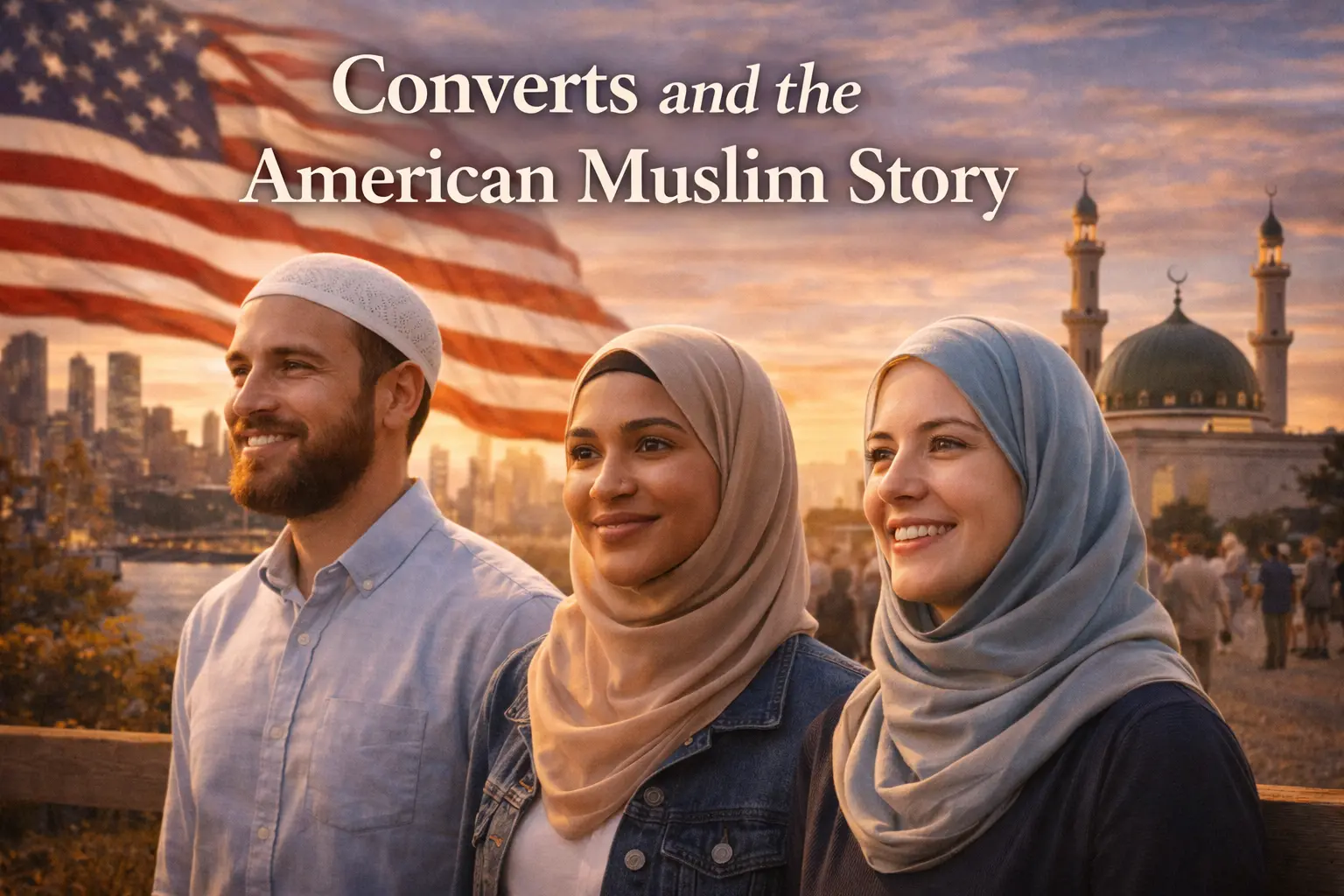
When Maryam walks into the mosque, some of the aunties still do a double take. Ten years after her shahada, her blonde hair tucked under hijab still surprises sisters who expect Muslims to look a certain way. They ask where she’s from, meaning what Muslim country are her parents from, and seem confused when she says Ohio. They compliment her Arabic pronunciation as if it’s remarkable that a white woman can learn to recite Quran. They mean well, mostly, but the message is clear: she’s an unexpected Muslim, an exception to the rule, a curiosity rather than a norm.
But here’s what those aunties miss: Maryam is not exceptional to American Islam. She is central to it. Converts are not footnotes to the Muslim American story but essential authors of it. From the very beginning, Islam in America has been shaped, sustained, and transformed by people who chose this faith rather than inheriting it. The African Americans who found Islam in the 20th century, the white Americans who converted through study or marriage, the Latino Muslims redefining what American Islam looks like, these are not peripheral figures. They are the heart of the story.
Understanding why requires rethinking common assumptions about what makes someone authentically Muslim. In Muslim-majority countries, Islam is often inherited culture as much as chosen faith. You’re Muslim because your parents were Muslim, because everyone around you is Muslim, because it’s woven into the social fabric. Faith and ethnicity blend together until they’re almost indistinguishable.
But in America, that equation breaks down. Here, being Muslim requires active choice. Even children of immigrants must decide whether to maintain the faith their parents brought with them. And converts make that choice most explicitly, often at great personal cost. They are Muslims by conviction rather than convention, and their presence forces American Muslim communities to grapple with what Islam means when it’s separated from inherited culture. Converts aren’t exceptions to American Islam. They reveal what American Islam actually is.
The Long History
Converts have been central to Islam in America from the beginning. The first Muslims in this land were enslaved Africans, many of whom maintained their faith despite brutal attempts to erase it. When their children and grandchildren lost connection to Islamic practice under slavery’s crushing weight, Islam in America went underground but didn’t disappear entirely.
The rediscovery began in the early 20th century with African Americans converting to Islam or Islamic-influenced movements. Noble Drew Ali’s Moorish Science Temple in 1913 and the Nation of Islam in 1930 introduced millions of Black Americans to Islamic concepts, terminology, and identity. These movements diverged from orthodox Islam in significant ways, but they created the foundation for what came next.
When Malcolm X traveled to Mecca in 1964 and discovered orthodox Sunni Islam’s racial universalism, his transformation catalyzed a mass movement of Black Americans toward mainstream Islamic practice. After Warith Deen Mohammed led the Nation of Islam toward Sunni orthodoxy in the 1970s, millions of African Americans became Muslims not through immigration but through conversion.
Today, African American Muslims constitute between 20 and 40 percent of all American Muslims, depending on whose estimates you trust. Their presence fundamentally shaped American Islam’s character, making it more racially diverse, more socially conscious, and more engaged with American cultural forms than it might otherwise have been. Mosques founded by Black American Muslims developed distinct preaching styles, community structures, and theological emphases. They made Islam speak American English, literally and figuratively.
Meanwhile, white Americans were converting too, though in smaller numbers. Some found Islam through academic study, reading the Quran in translation and being moved by its message. Others converted through marriage to Muslim immigrants. Still others were searching for spiritual meaning and found in Islam something Christianity or secularism couldn’t provide. These converts brought their own questions and perspectives, pushing American Muslim communities to articulate Islam in ways that made sense to people with no cultural connection to Muslim-majority countries.
Latino Muslims represent the newest major wave of conversion. Concentrated in cities like Los Angeles, New York, and Houston, they’re creating Spanish-language Islamic resources, blending Islamic practice with Latino cultural forms, and challenging assumptions about what Muslims look like and sound like. Some are converting from Catholicism, finding in Islam a direct relationship with God without intermediaries. Others are reclaiming what they see as Iberian Islamic heritage, connecting to the history of Al-Andalus.
Each wave of conversion has enriched and complicated American Islam. Each group brought new questions, challenged existing norms, and forced communities to grow. Converts didn’t just join American Islam. They built it.
Why People Convert
The reasons people embrace Islam in America are as diverse as the converts themselves. Some are drawn by the intellectual clarity of tawhid, the absolute oneness of God. After growing up with the theological puzzles of the Trinity, the straightforward declaration that there is no god but Allah feels like coming home. Others appreciate Islam’s emphasis on direct relationship with God, no priests or saints mediating between human and divine.
Many converts describe Islam as logical, a faith that makes sense. The five pillars provide clear structure. The prayers offer consistent rhythm. The rules about halal and haram create boundaries that feel freeing rather than restrictive. In a culture that often seems morally relativistic and spiritually vague, Islam’s definiteness appeals.
For women, particularly white women, the decision to convert often surprises people who assume Islam oppresses women. But many female converts report finding empowerment in Islamic practice. The emphasis on modesty shifts focus from appearance to character. The clearly defined rights and responsibilities provide structure. The community of women offers support. They’re not blind to sexism in Muslim communities, but they distinguish between Islam and Muslim culture, finding in the faith itself something that dignifies rather than diminishes them.
African Americans who convert often describe Islam as a return rather than a new beginning. They’re reclaiming heritage stolen by slavery, reconnecting with African Islamic traditions their ancestors practiced. They’re finding a faith that never blessed their enslavement, never told them to wait for justice in the afterlife, never made white supremacy compatible with divine will. Islam offers both spiritual home and political framework, a way to be devoted to God while committed to liberation.
Social justice draws many converts, particularly young Americans frustrated with American foreign policy and looking for ways to resist imperialism and racism. They see Muslims as targets of unjust wars and discriminatory policies, and converting becomes a form of solidarity, an embodiment of the values they claim. Some of these conversions prove shallow, more about political identity than spiritual transformation. But others deepen into genuine faith.
Marriage remains a common pathway, though it’s more complicated than stereotypes suggest. The white woman who marries a Muslim man and converts is a cliché that obscures real spiritual journeys. Many who initially convert for marriage later develop deep, independent relationships with Islam. The faith becomes theirs, not just their spouse’s. Others struggle, feeling pressure to convert without genuine conviction, performing Muslim identity without authentic belief.
For some, conversion comes through mystical experience, a moment of recognition that Allah is real and Islam is true. These sudden conversions can be the most difficult for others to understand, but they’re also often the most durable because they’re grounded in personal encounter rather than intellectual assent or social pressure.
The Perpetual Outsider
Despite being central to American Islam’s story, converts often feel like perpetual outsiders in Muslim spaces. Immigrant Muslims treat them as curiosities, asking invasive questions about why they converted and whether their families have disowned them. They receive unsolicited advice about how to practice properly, as if their lack of cultural background means they need constant correction.
Cultural assumptions dominate many mosques. Events feature food from specific countries, lectures given in Urdu or Arabic, programs designed for people who already understand cultural references and community dynamics. Converts walk into these spaces and immediately feel foreign, aware that they don’t look right, don’t know the unspoken rules, don’t have the cultural competence that immigrant Muslims take for granted.
The assumption that Muslim equals Arab or South Asian runs deep. Converts constantly face the question “Where are you from?” followed by confusion when they say Kansas or Michigan. They’re complimented on their English as if it’s not their first language. They’re told they don’t look Muslim, as if Islam has a look. They’re treated as perpetual beginners even after decades of practice.
Women who convert and choose to wear hijab face particular scrutiny. Immigrant Muslim women sometimes view them with suspicion, questioning their motives or suggesting they’re trying too hard. Men sometimes assume they’re available for marriage simply because they’re converts without family to arrange things. The hijab that’s meant to reduce attention often increases it.
Male converts navigate different dynamics. African American Muslim men must distinguish themselves from Nation of Islam members in the eyes of immigrant Muslims who view that movement as heretical. White male converts sometimes get fast-tracked into leadership positions, their opinions valued more than those of immigrant Muslim women who’ve practiced Islam their entire lives. Latino Muslim men work to make their presence visible in communities that often overlook them entirely.
The children of converts face their own challenges. They’re Muslim by birth but not ethnically connected to Muslim-majority countries. They don’t fit neatly into weekend Islamic school classes organized by ethnicity. They’re neither immigrants nor children of immigrants, occupying an ambiguous space. Some thrive in this ambiguity, becoming bridges between different communities. Others feel rootless, belonging fully to neither Muslim nor mainstream American culture.
Redefining Islamic Practice
Yet converts are doing more than navigating existing Muslim spaces. They’re creating new ones and transforming old ones. Convert-led mosques and organizations often develop different cultures than immigrant-led institutions. They emphasize theological education over cultural preservation, prioritize English-language programming, and create structures that welcome people without assuming prior knowledge.
Converts ask questions that lifelong Muslims might not think to ask. Why do we do things this way? What’s Islamic principle and what’s cultural tradition? Could we organize differently? These questions can be annoying to people who’ve always done things a certain way, but they’re also productive. They force communities to articulate and sometimes revise their practices.
Women converts have been particularly influential in pushing for gender equity in mosques. Without cultural baggage about how things have always been done, they ask why women pray in basements or behind barriers, why women can’t serve on boards or give talks. Their questions, grounded in study of Islamic texts rather than inherited practice, have challenged communities to reconsider whether their treatment of women reflects Islam or patriarchal culture.
Converts are creating English-language Islamic scholarship and resources. They’re translating not just Arabic to English but Islamic concepts into American cultural frameworks. They’re writing books, producing podcasts, developing curricula, and building institutions that make Islam accessible to people who don’t speak Arabic or Urdu. This work is essential to American Islam’s future, to making the faith sustainable beyond the immigrant generation.
Black American Muslims in particular have created distinctly American Islamic expressions, from hip-hop with Islamic themes to community organizing that draws on both Islamic principles and Black liberation traditions. They’ve made Islam relevant to American social justice movements, connecting Islamic concepts of justice to domestic struggles against racism and inequality.
The Gift of Clarity
What converts bring to American Islam is clarity about what’s essential. When you choose Islam as an adult, you have to figure out what Islam actually is, stripped of cultural accoutrements. You can’t rely on inherited practice or unexamined tradition. You must study, question, and decide what you believe and how you’ll practice.
This process of conscious choice creates Muslims who know why they believe what they believe. They may not know all the cultural details or have perfect Arabic pronunciation, but they often have a clearer understanding of theological principles and ethical foundations than people who inherited Islam without questioning it.
Converts also bring fresh perspective on how Islam can address American life. They’re navigating Islamic ethics in contexts that classical scholars never imagined and that immigrant Muslims might not have considered. How does Islam speak to student loan debt? What does Islamic finance mean when you have a 401k? How do you practice Islam in a workplace that assumes Christian or secular norms? Converts are working out practical Islamic living in American contexts.
Perhaps most importantly, converts embody Islam’s universalism. Their presence proves that Islam transcends ethnicity, culture, and geography. They demonstrate that you don’t have to be Arab to be Muslim, don’t have to speak Arabic to have authentic faith, don’t have to adopt someone else’s culture to practice Islam. This is a necessary corrective in communities where Islam and ethnic identity have become conflated.
The Future Is Converts
American Islam’s future depends on conversion, not immigration. The children and grandchildren of immigrants must actively choose Islam rather than passively inheriting it. Each generation is converting to the faith anew, deciding whether their parents’ religion will be theirs. In this sense, all American Muslims become converts eventually, making conscious choices about faith in a context that doesn’t reinforce it culturally.
Understanding this changes how we should view converts. They’re not exceptional but prototypical. They’re not outsiders but pioneers. They’re doing explicitly what all American Muslims must do implicitly: choosing Islam in America, figuring out what that means, building institutions and practices that make it sustainable.
The communities that thrive will be those that recognize this. They’ll welcome converts not as curious anomalies but as full community members whose perspectives are valuable. They’ll distinguish between Islamic principle and cultural tradition, maintaining the former while holding the latter loosely. They’ll create space for Islam that’s authentically American, that speaks English fluently, that addresses American concerns, that looks like America’s diversity.
Converts are not footnotes to American Islam. They’re writing the main text. They’re showing what Islam looks like when it’s chosen rather than inherited, when it transcends culture, when it becomes fully American while remaining fully Islamic. Their struggles reveal American Islam’s growing pains. Their innovations point toward its future. Their presence reminds everyone that Islam is for all people, always.
Maryam, the blonde woman in hijab who still surprises the aunties, isn’t an exception. She’s exactly what American Islam is and will increasingly become: chosen, diverse, transformative, and undeniably American. The sooner Muslim communities recognize this, the stronger those communities will be.