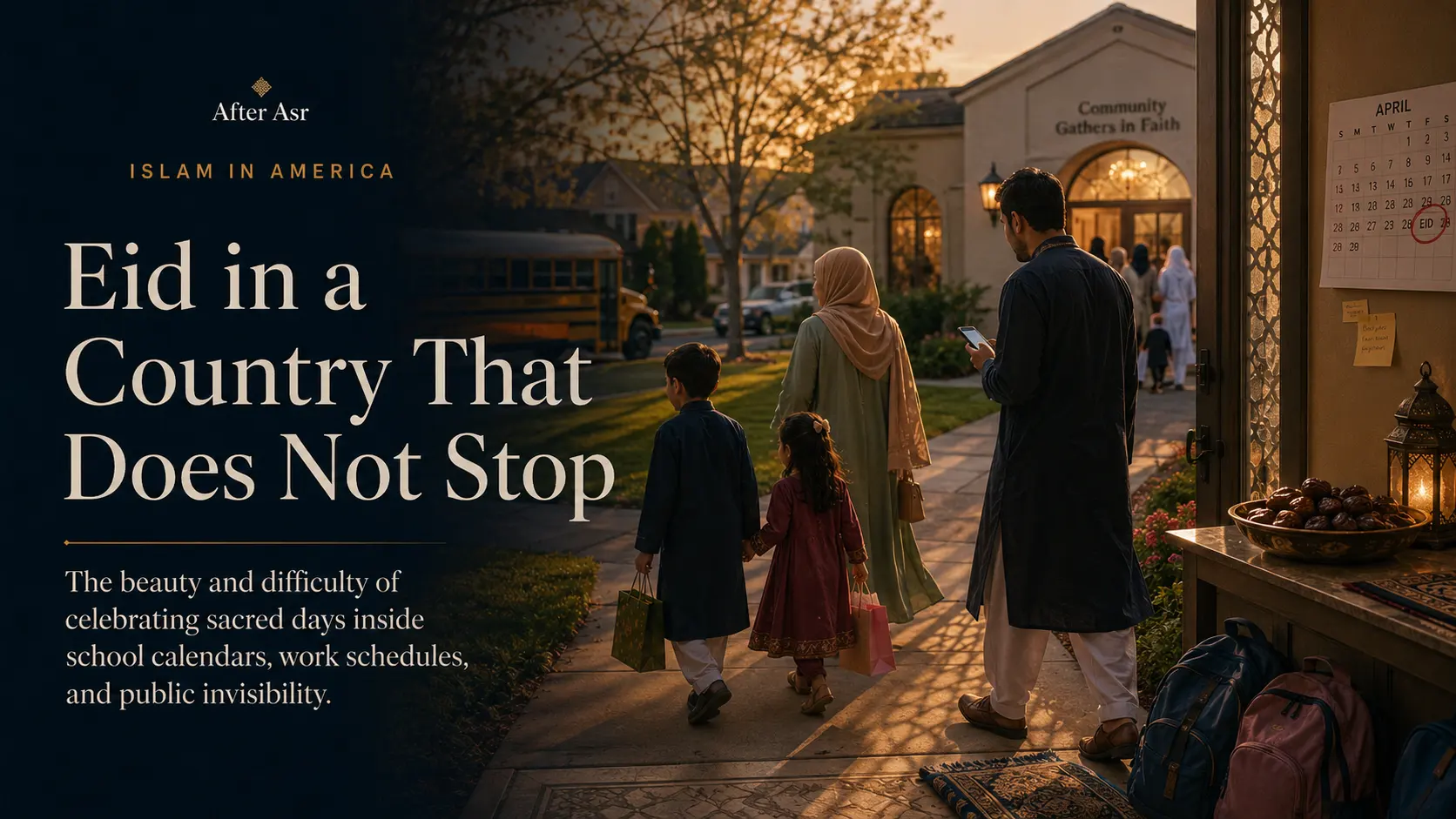
The beauty and difficulty of celebrating sacred days inside school calendars, work schedules, and public invisibility.
Eid morning in America often begins with negotiation.
A parent wakes children before sunrise, hoping excitement will move them faster than sleepiness. Clothes were ironed the night before, or meant to be. Someone cannot find a shoe. Someone’s henna smudged. Someone asks whether they really have to go back to school after prayer. A work email arrives before the family leaves home. A manager has approved the day off, or has not. A college student checks an exam schedule. A nurse finishes a night shift and drives straight to Eid prayer. A father takes a half day because the office could not spare him. A mother packs sweets for classmates who may or may not understand why this day matters.
Outside, the country continues.
The school bus comes. Traffic builds. Offices open. Grocery stores run sales unrelated to the sacred day. Morning news carries other concerns. Neighbors walk dogs. Coworkers schedule meetings. Teachers take attendance. The public calendar does not pause. For many Muslims, Eid arrives not into a society waiting to celebrate with them, but into a society that often has to be reminded that Eid exists at all.
This does not make Eid less beautiful.
In some ways, it makes the beauty more deliberate.
Muslims in America learn to carve sacred joy into ordinary time. They rent convention halls, school gyms, hotel ballrooms, parks, fairgrounds, mosques, and community centers. They request leave. They write emails to teachers. They cook late into the night. They buy gifts between work shifts. They decorate homes even when no store aisle announces the season. They teach children that Eid is theirs, even if the wider world does not stop for it.
Eid in America is a celebration, but also a test of memory, confidence, planning, and belonging. It asks whether Muslims will honor sacred time even when public time ignores it. It asks whether families can make joy visible without turning it into imitation. It asks whether schools and workplaces will recognize that Muslim religious life is not an occasional diversity note, but part of the lives of millions of people. It asks whether Muslim communities can build Eid with beauty, dignity, and mercy for those who might otherwise be forgotten.
Sacred time in a secular rhythm
American public life has its own calendar.
It knows federal holidays, school breaks, tax deadlines, shopping seasons, sports seasons, summer vacations, winter holidays, national observances, and the long machinery of work and school. Some religious holidays are built into this rhythm because of Christian history and cultural dominance. Others appear only when communities advocate for them.
For Muslims, this means sacred time often has to be defended as real.
Ramadan may be visible in some workplaces and schools, but Eid is harder. Ramadan lasts a month and offers many opportunities for explanation. Eid comes suddenly to those who are not paying attention. It is based on the Islamic calendar. It may depend on moon sighting. Its exact date may not be settled far in advance in every community. It does not always align with weekends. It can fall on exam days, payroll deadlines, school picture day, project presentations, hospital shifts, military duties, retail schedules, and mandatory trainings.
This creates a quiet pressure. Muslims must decide how much to ask for. A day off? A half day? An excused absence? A postponed exam? A schedule adjustment? A substitute teacher? A shift swap? A remote work day? Some ask confidently. Some hesitate. Some fear being seen as difficult. Some have asked before and been dismissed. Some do not ask at all because they cannot afford unpaid leave.
The issue is not only logistics. It is dignity.
A sacred day should not feel like an inconvenience one apologizes for. Muslims should not have to explain every year from the beginning, as though Eid is a surprise to be justified. At the same time, Muslims living in a non-Muslim majority society must plan, communicate, and advocate with wisdom. Institutions may not know unless taught. Policies may not change unless requested. Calendars may not include Eid unless communities build the relationships and systems that make recognition possible.
Sacred time in America requires both patience and insistence.
Patience because not every institution understands immediately.
Insistence because sacred days are not optional decorations in Muslim life.
The child who goes back to school after Eid prayer
One of the most tender images of Eid in America is the child dressed beautifully for prayer, then returning to school before lunch.
The child may have new clothes, a small gift, maybe candy in a bag, maybe the smell of perfume still on their sleeve. At Eid prayer, they saw crowds of Muslims, heard takbir, hugged friends, ate sweets, and felt, for a moment, that the whole world was Muslim. Then they are dropped off at school where math class continues, lunch periods proceed, and classmates ask, “Why are you dressed like that?”
This can shape a child’s sense of religious belonging.
If Eid is treated as something squeezed into the margins, children may internalize that Muslim joy is secondary. If parents are too exhausted or constrained to make the day feel special, children may compare Eid unfavorably to holidays that dominate public life for weeks. If teachers ignore the day, children may feel invisible. If classmates mock or misunderstand, Eid can become a source of embarrassment rather than joy.
But if families and communities are intentional, Eid can become deeply meaningful even within those constraints.
A child can learn that sacred joy does not depend on public approval. They can learn that Muslims celebrate because Allah gave them reason to celebrate. They can learn to explain Eid with confidence. They can bring sweets to school, not as an apology, but as hospitality. They can have the whole day off when possible. They can see parents take the day seriously enough to plan for it. They can experience Eid prayer as a community event, not a rushed obligation before returning to normal life.
Schools can help. Teachers can mark Eid on classroom calendars. Administrators can excuse absences without suspicion. Districts can avoid scheduling major exams on Eid where Muslim populations are significant. Counselors can support students who fasted Ramadan and need transition. Libraries can include books about Eid. These gestures are not favors. They are part of recognizing the students who are already there.
A Muslim child should not have to choose between academic responsibility and sacred joy. With planning, respect, and community advocacy, they should be able to have both.
Workplaces and the hidden cost of celebration
For many adults, Eid is not a day off. It is a day managed.
Some work in hospitals, hotels, restaurants, factories, call centers, airports, warehouses, retail stores, military units, schools, police departments, laboratories, offices, and small businesses where absence is difficult. Some can request leave months in advance. Others have unpredictable schedules. Some are new employees afraid to ask. Some are hourly workers who lose income if they take the day. Some are managers whose absence affects others. Some are self-employed and cannot afford to close. Some are the only Muslim in the workplace and carry the awkwardness of explaining Eid every year.
Eid becomes beautiful, but expensive in ways not always visible.
A person may attend prayer, then go straight to work in Eid clothes. A nurse may celebrate with coworkers during a short break. A delivery driver may listen to takbir between stops. A hotel worker may miss the family meal. A student employee may choose between wages and worship. A parent may take children to prayer, then return to a full inbox and a meeting they could not move.
This can create grief. Not dramatic grief, but the small ache of sacred days passing under ordinary pressure.
Muslim communities should remember workers on Eid. Not everyone has the same flexibility. A family with salaried jobs and paid leave experiences Eid differently from a family dependent on hourly wages. A physician who can arrange coverage experiences Eid differently from a single mother working retail. A business owner who closes for Eid may lose revenue, but may also have more control than an employee who cannot ask.
Mosques can help by offering multiple Eid prayers where appropriate, communicating dates as early as possible, providing letters for employers, and advocating for religious accommodations. Families can help by not judging those who arrive late, leave early, or cannot attend every gathering. Employers can help by treating Eid leave as normal religious observance, not special pleading.
Eid should be a day of mercy. That mercy should include those whose work does not stop.
The beauty of making Eid from scratch
In Muslim-majority societies, Eid may be carried by the public atmosphere. Schools close. Markets prepare. Streets shift. Families gather across neighborhoods. Children see the day reflected outside the home.
In America, many families make Eid from scratch.
They decorate homes. Order balloons. Bake cookies. Buy gifts. Prepare clothes. Send classroom notes. Request leave. Coordinate prayer locations. Pack snacks. Organize community meals. Call relatives overseas. Create Eid traditions that did not exist in their own childhoods, or adapt traditions from countries their children have never seen.
This work can be exhausting, but it is also creative.
American Muslims are building an Eid culture shaped by many inheritances. Black Muslim families, immigrant families, converts, interracial families, rural Muslims, suburban communities, city mosques, campus groups, and small-town prayer circles all contribute. Eid may include biryani, bean pie, barbecue, sambusas, cupcakes, kabsa, donuts, tacos, sheer khurma, fried fish, halal burgers, maamoul, jollof, pancakes, or whatever a family can manage before prayer.
Some families wear traditional clothing. Some wear suits and dresses. Some children wear matching outfits. Some converts wear the nicest clothes they own and wonder if they look “Muslim enough.” Some families host large gatherings. Some eat takeout. Some spend the day visiting. Some spend it resting after Ramadan. Some make Eid gifts. Some keep it simple because money is tight.
There is no single American Muslim Eid style. That is part of its beauty.
The challenge is to make Eid meaningful without turning it into consumer performance. Muslim families sometimes feel pressure to compete with the scale of dominant holidays. More gifts, more décor, more photos, more outfits, more elaborate parties. A little beauty is good. Children should feel joy. Homes can be decorated. Gifts can be given. But Eid should not become a festival of anxiety where parents feel they have failed unless the day looks perfect.
Eid joy does not require luxury.
It requires remembrance, gratitude, prayer, generosity, family, and love.
The rented hall and the temporary city
Eid prayer in America often takes place in spaces not designed for Eid.
School gyms. Convention centers. Hotel ballrooms. Parks. Fairgrounds. University halls. Community centers. Masjid parking lots. Rented churches. Soccer fields. Multipurpose rooms. In these places, Muslim communities build a temporary sacred city for a morning.
Volunteers arrive early. Prayer rows are marked. Sound systems are tested. Signs are taped to doors. Sisters organize one entrance. Brothers direct parking. Youth hand out water. Children run in clothes they will stain before noon. Vendors set up tables. Someone realizes the microphone batteries are dead. Someone forgot the donation box. Someone’s grandmother needs a chair. Someone is already asking when the khutbah will start.
Then the takbir rises.
For a few minutes, the rented hall becomes something else. Muslims who may be scattered across suburbs, campuses, workplaces, and small towns gather shoulder to shoulder. Converts see the scale of their new family. Children see Muslims filling a public space. Elders see the community they prayed would survive. Parents feel the relief of not being alone.
The temporary nature of these spaces is part of their tenderness. The gym will become a gym again. The ballroom will host another event. The park will return to joggers and dogs. But for that morning, the space held sujood, tears, greetings, and sacred joy.
The rented hall also reveals how much labor Eid requires. Many people experience the beauty without seeing the planning. Contracts, deposits, insurance, parking, security, setup, cleanup, volunteer coordination, prayer permits, accessibility, weather plans, and crowd management all sit behind the moment. Eid depends on organizers whose own celebration may be partly spent serving others.
Communities should honor them. Better yet, communities should help them.
A sacred day should not be carried by the same exhausted few every year.
Converts and Eid loneliness
Eid can be one of the loneliest days for converts.
The public prayer may be joyful. People may hug them, say Eid Mubarak, and offer sweets. But after prayer, families often go home to private plans. Parents, cousins, grandparents, cultural meals, childhood traditions, photos, and visits unfold in circles that may not naturally include the convert. The convert may drive home alone, call non-Muslim relatives who do not understand the day, or sit in an apartment after the most communal hour of the year has ended.
This loneliness is not always visible because Eid is loud.
The convert may smile at prayer. They may say they are fine. They may not want to impose. They may not know how to ask, “Where do I go now?” They may be grieving holidays they no longer observe while trying to love a holiday they have not yet learned how to celebrate. They may feel childish for wanting an invitation. They may wonder why the community that celebrated their shahadah did not remember their Eid.
Muslim communities should plan for this before Eid morning.
Convert care should include Eid care. Ask who has plans. Invite clearly. Do not assume someone else did. Create community lunches, open houses, smaller gatherings, or host-family systems. Explain Eid customs without overwhelming. Make space for converts to bring their own halal traditions. Remember single converts, older converts, convert parents, and converts whose families are hostile or confused.
Eid is not only a family holiday. It is an ummah holiday. If those without Muslim family are left alone, the community has misunderstood something.
The greeting “Eid Mubarak” should be followed, when possible, by “Come eat with us.”
Black Muslim Eid and the American foundation
Black Muslim communities have long shaped Eid in America.
Their Eid gatherings, masjid meals, family tables, community centers, prison Eid observances, neighborhood celebrations, and disciplined public presence are part of the American Muslim foundation. In many cities, Black Muslims made Eid visible long before some immigrant communities had established large institutions. Their celebrations often carried layers of worship, dignity, racial history, family repair, economic struggle, and neighborhood rootedness.
Any honest account of Eid in America must include this.
Too often, public images of Eid center immigrant aesthetics while overlooking Black Muslim traditions. This narrows the story. Eid in America is not only embroidered clothes, imported sweets, and large suburban prayer halls. It is also bean pies, fish dinners, community cookouts, storefront masjids, prison prayer spaces, children in bow ties and kufis, mothers organizing food, fathers returning to family through Islam, elders who remember when Muslim holidays were even less recognized, and communities that made Eid a declaration of dignity in a society that denied both Blackness and Islam.
For Black Muslim children, seeing their Eid traditions honored matters. For non-Black Muslim children, learning this history matters. It teaches that Islam in America did not begin with their parents’ arrival or their local suburban masjid. It teaches that Eid has been celebrated here under conditions of invisibility and struggle, and that today’s recognition was not created from nothing.
Eid should widen memory.
When Muslims gather for Eid, they are not only celebrating the end of Ramadan or the days of sacrifice. They are standing in a long American Muslim story, and Black Muslims are not at the edge of that story. They are among its foundations.
Eid in prison
There are Muslims who celebrate Eid behind bars.
For them, Eid may mean a special prayer if approved, a chaplain visit, a modified meal, a small group of brothers or sisters saying takbir in a controlled space, a letter from family, or nothing more than the private knowledge that the day is sacred. Some may have entered Islam in prison. Some may be returning to worship after years away. Some may feel Eid as both mercy and grief.
Prison Eid is rarely visible to the broader community, but it is part of Islam in America.
It forces a serious question: do we remember Muslims whose celebration cannot look like ours? Do mosques include incarcerated Muslims in Eid du’a? Do communities support prison chaplaincy? Do families with incarcerated relatives receive care without shame? Do we believe that sacred days reach prison cells too?
Eid is not only for the socially comfortable. It belongs to the believer who is free and the believer who is confined, the believer in a crowded prayer hall and the believer reciting quietly behind a door that locks from the outside.
Prison chaplains and volunteers who help make Eid possible inside correctional facilities perform quiet work of great significance. They help preserve the dignity of Muslims whom society often forgets. They remind us that joy, repentance, and worship are not limited to those whose lives look publicly respectable.
When we say “Eid Mubarak,” our hearts should be wide enough to include those who cannot gather with us.
Eid and the family wound
Eid is joyful, but it can also reveal family wounds.
A divorced parent may spend part of Eid without their children. A widow may feel the absence of the person who once led the morning. A convert may miss non-Muslim relatives. An immigrant may ache for parents buried overseas. A refugee may remember an Eid before war. A family conflict may make gatherings tense. A young adult estranged from parents may not know where to go. A child whose parents argue may associate Eid with stress. A single person may feel invisible among family-centered celebrations.
Sacred days intensify longing.
Communities often speak of Eid as if everyone is happy in the same way. This can make those who are grieving feel even more alone. We should preserve joy without denying sorrow. Islam allows the heart to hold both. A person may attend Eid prayer, smile, hug others, and still carry grief. A family may set a beautiful table with one chair emotionally empty. A mother may dress children and cry in the bathroom. A student may post Eid photos and feel lonely after the camera closes.
A mature Eid culture makes room for the wounded.
Invite the widowed. Include divorced parents. Check on single adults. Remember converts. Visit elders. Call those far away. Make space for someone who cannot host. Do not ask painful questions casually: “When are you getting married?” “Where are your children?” “Why did you come alone?” “Why are you not with your family?” Such questions may be ordinary to the speaker and heavy to the listener.
Eid should be a day when mercy increases, not when social pressure becomes decorated.
Public recognition and its limits
In some American cities and school districts, Eid recognition has grown.
Schools may close. Officials may issue greetings. Public calendars may list Eid. Universities may provide accommodations. Workplaces may acknowledge Muslim employees. Libraries may host Eid story times. Local governments may include Muslim communities in civic observances.
These are meaningful developments. They tell Muslim children that their sacred days are not invisible. They reduce the burden on families. They help institutions plan. They normalize Muslim presence in American public life.
But public recognition has limits.
A city proclamation does not make Eid spiritually alive. A school closure does not teach children gratitude. A corporate Eid graphic does not replace prayer. A public greeting does not ensure converts have somewhere to eat. Recognition can be helpful, but it can also become shallow if Muslims measure success only by whether institutions name them.
The deeper question is whether Muslims are celebrating Eid as worship.
Public recognition should support sacred life, not replace it. If schools close for Eid, families should still make the day meaningful. If employers offer leave, Muslims should use it to pray, visit, rest, give, and reconnect. If officials attend Eid events, communities should welcome with dignity but not turn the day into a performance for public approval.
Recognition matters because Muslims live in society. But Eid belongs to Allah before it belongs on a civic calendar.
That order must remain clear.
The moon, uncertainty, and communal patience
Eid in America often comes with the familiar question: when is Eid?
Moon sighting, calculations, global announcements, local committees, national organizations, differing fiqh positions, time zones, community habits, and family traditions can all shape the answer. Some communities know in advance. Others wait until the night before. Families plan around uncertainty. Schools and employers ask for dates. Parents try to request leave. Students wonder whether an exam will conflict. Converts are confused. Children ask why their friends are celebrating on a different day.
The moon can become a test of adab.
Differences over Eid dates are not new. But in America, where Muslims are already trying to secure recognition from schools and workplaces, the uncertainty can feel especially difficult. Some become frustrated. Some mock other communities. Some accuse others of being careless or rigid. Some families split attendance between two Eid prayers. Some children receive mixed messages.
Communities need both knowledge and patience.
Scholars and leaders should teach the principles behind their community’s practice clearly before Ramadan ends. Mosques should communicate timelines early. Families should explain to children that Muslims sometimes differ in how they determine the start of Eid, and that difference should not destroy love. Employers and schools can be told that Eid may fall within a likely range. Communities can provide letters explaining the uncertainty.
The moon should call Muslims to humility, not contempt.
No one should let a disagreement over the date erase the purpose of the day.
Eid al-Fitr and the discipline of joy
Eid al-Fitr comes after Ramadan, after fasting, night prayer, Qur’an, hunger, fatigue, charity, repentance, and the hope of forgiveness.
It is not merely a party because fasting is over. It is a celebration of Allah’s mercy. The believer rejoices not because discipline has ended, but because Allah allowed the discipline to happen. The day begins with zakat al-fitr, bathing, dressing well, eating before prayer, takbir, gathering, listening, greeting, visiting, and gratitude.
In America, Eid al-Fitr can become logistically crowded. Families are tired. Ramadan may have ended late the night before. Communities scramble to confirm prayer times. Children are excited. Parents are exhausted. Work and school pressures remain. The spiritual transition from Ramadan to Eid can be abrupt.
This makes intentionality important.
Eid should not feel like a collapse after Ramadan. It should feel like the flowering of Ramadan. The Qur’an recited in the month should echo in the day. The hunger should create gratitude. The charity should soften the table. The night prayers should make the morning feel earned, not by our deeds alone, but by Allah’s generosity.
Families can preserve this meaning with small practices. Make takbir audible in the home. Give zakat al-fitr on time. Eat something sweet before prayer. Dress with dignity. Speak about what Ramadan taught. Visit someone lonely. Avoid turning the day into only photos and food. Let children feel joy, but also teach them why joy is being given.
Eid al-Fitr is sacred happiness after obedience.
That is different from ordinary celebration.
Eid al-Adha and sacrifice in a consumer society
Eid al-Adha carries another kind of meaning.
It is tied to Ibrahim, peace be upon him, to sacrifice, obedience, trust, Hajj, and the willingness to place Allah above what the heart clings to most. In America, Eid al-Adha can be harder for some families to feel because it may not follow a month-long communal buildup like Ramadan. Work and school may be in full force. Many Muslims are not performing Hajj. The sacrifice may be arranged online or through a butcher, distant from the household’s direct experience.
Yet Eid al-Adha may be especially needed in American life.
It interrupts a society that often treats comfort, family preference, consumption, and personal desire as ultimate. It reminds Muslims that love must submit to Allah. It teaches that worship may require giving up what is precious. It connects Muslims in America to the pilgrims in Makkah and to the global ummah. It calls families to feed others, remember the poor, and speak of prophetic obedience.
Muslim families should work to make Eid al-Adha visible and meaningful. Teach children the story of Ibrahim and Ismail, peace be upon them. Explain sacrifice with reverence. Arrange qurbani where possible. Share meat. Visit family. Attend prayer. Make the day distinct, even if the country does not notice it.
The difficulty of celebrating Eid al-Adha in America should not make it smaller. If anything, its message becomes sharper. In a culture of self-fulfillment, Muslims gather to remember surrender.
That is not a small thing.
Eid and the poor
Eid should not become a day only for those who can afford joy.
New clothes, gifts, meals, travel, decorations, and events can create pressure. Some families struggle quietly. A parent may not be able to buy outfits. A child may hear classmates talk about gifts and feel embarrassed. A convert may not have money for celebration. A refugee family may be newly arrived. A single mother may be choosing between bills and Eid treats. An unemployed father may avoid gatherings because he cannot bring anything.
Communities must protect dignity here.
Zakat al-fitr before Eid al-Fitr is one mechanism of mercy, ensuring that those in need can share in the day. But communities can also organize Eid gift drives, clothing exchanges, grocery support, free community meals, transportation assistance, and discreet financial help. Mosques should avoid making Eid events too expensive. Families should not turn children’s Eid into public comparison. Gift-giving is beautiful, but competition is not.
The poor should not be remembered only as recipients. They are part of the community. They should be welcomed at the table without being made visible as needy. A family receiving help may also be a family full of dua, wisdom, service, and dignity.
Eid joy becomes more complete when it is shared.
A community that celebrates lavishly while its own members feel ashamed by poverty has misunderstood the day.
The role of women in making Eid happen
Much of Eid is carried by women.
Clothes bought, altered, washed, and prepared. Food planned. Children dressed. Gifts wrapped. Henna arranged. Family visits coordinated. Guests hosted. Homes cleaned. Community meals organized. Convert sisters invited. Elderly relatives called. Photos taken. Sweets packed for school. Emotional atmosphere managed. Traditions preserved.
This labor can be loving, but it can also become exhausting and invisible.
A mother may spend Eid morning making everyone else’s joy possible while barely experiencing the day herself. A sister may volunteer at Eid prayer and miss half the khutbah. Women may cook for large gatherings and then clean while men sit. Young women may help with children all day without rest. Widows, single women, and divorced women may be expected to serve while their own loneliness is overlooked.
Muslim families and communities should ask whether Eid joy is being distributed fairly.
Men should help prepare, serve, clean, and plan. Fathers should know children’s clothing needs. Brothers should assist guests. Youth should clean after events. Communities should create volunteer systems that do not repeatedly burden the same women. Families should let mothers rest. Women should be able to attend Eid prayer with dignity, hear the khutbah, greet friends, and experience joy as worshippers, not only as organizers.
Eid should not depend on women disappearing into service.
Service is blessed, but so is receiving joy.
Eid in small towns and rural places
For Muslims in small towns and rural areas, Eid can look very different.
There may be no large prayer hall, no nearby masjid, no halal bakery, no Muslim neighbors, no school recognition, and no extended family. A family may drive hours for Eid prayer. A convert may celebrate alone. A few Muslims may gather in someone’s home. A student may join an online Eid program. A family may make the day special with limited resources and a long road ahead.
This quiet Eid matters.
Not all sacred joy is crowded. A family of four praying together in a small town is part of the American Muslim story. A convert eating Eid breakfast alone but remembering Allah is part of it. A group of Muslims renting a small community room for the first time is part of it. A truck driver breaking from work to call family and say Eid Mubarak is part of it.
Large communities should remember rural and isolated Muslims. Livestream reminders, regional Eid gatherings, travel support, convert networks, online companionship, and intentional outreach can help. But we should also honor the sincerity that grows in hidden places. When Eid is not socially reinforced, choosing to mark it can become an act of deep faith.
A sacred day does not need a crowd to be known by Allah.
Teaching Eid as inheritance
Children do not automatically understand Eid.
They must be taught. Not only the rules, but the feeling. Not only the date, but the meaning. Not only the excitement, but the gratitude. If parents and communities do not teach Eid intentionally, children may measure it against louder public holidays and find it lacking.
Teaching Eid as inheritance means making it spiritually and emotionally real.
Tell children why Eid al-Fitr follows Ramadan. Tell them why Eid al-Adha remembers sacrifice. Let them hear takbir. Let them help prepare. Give them roles, not only gifts. Teach them to greet elders. Let them take sweets to neighbors. Explain zakat al-fitr. Visit someone lonely. Share food. Make the home look different. Take the day off when possible. If not possible, mark the morning or evening with care.
Do not make Eid only about consumption. Children may enjoy gifts, but they should also experience worship, family, generosity, and community. The goal is not to outdo other holidays. The goal is to let Muslim children feel that Allah has given them days of joy worth loving.
An inherited Eid becomes stronger when children know both its beauty and its reason.
From invisibility to rootedness
Eid in America remains unevenly visible.
In some places, it is recognized by schools, city halls, and workplaces. In others, it remains unknown. Some Muslim children see classmates acknowledge it. Others are asked if Eid is “like Christmas.” Some employees receive cheerful greetings. Others must explain why they need time off. Some communities pray in large public spaces. Others gather quietly.
This unevenness can be frustrating, but it also reveals the stage of American Muslim life.
Muslims are no longer simply asking whether they can celebrate. They are asking how to build recognition without losing meaning, how to make institutions responsive, how to teach children confidence, how to include converts and isolated Muslims, how to honor diverse Eid traditions, and how to celebrate sacred days in a country whose public calendar is still learning to see them.
Rootedness does not mean the country fully stops.
It means Muslims know how to honor what Allah has given them whether or not the country stops. It means they advocate where needed, plan where possible, and celebrate with dignity regardless. It means Eid becomes part of American public life without becoming spiritually flattened by public recognition. It means Muslim families and institutions become organized enough to make sacred joy sustainable.
A community that waits for the wider society to validate Eid before loving it has placed love in the wrong hands.
We should seek recognition, but not depend on it.
The country keeps moving, and still we gather
There is a moment on Eid morning when the tension becomes clear.
Outside, America continues. Emails, buses, traffic, meetings, school bells, appointments, errands, deadlines, and ordinary noise. Inside the prayer space, Muslims say takbir. Allahu akbar, Allahu akbar. Allah is greater. Greater than the schedule. Greater than the invisibility. Greater than the awkward leave request. Greater than the school calendar. Greater than the exhaustion. Greater than the feeling of being forgotten.
The country does not stop.
But the believer stops.
Stands.
Listens.
Prays.
Greets.
Gives.
Remembers.
This is the quiet power of Eid in America. Muslims are not waiting for perfect conditions to celebrate Allah’s mercy. They are building joy inside imperfect conditions. They are teaching children that sacred time is real even when the public calendar is slow to recognize it. They are inviting converts to tables. They are driving long distances. They are requesting leave. They are renting halls. They are feeding the poor. They are calling relatives overseas. They are making homes beautiful. They are carrying grief and joy together. They are saying Eid Mubarak in a country still learning what that means.
Eid in America may always require effort. Perhaps that effort is part of its formation.
It teaches Muslims not to let sacred days become passive. It teaches families to plan for joy. It teaches communities to widen belonging. It teaches institutions to recognize Muslim life. It teaches children that Islam is not hidden in the private corners of life, but walks into schools, workplaces, neighborhoods, and public halls with dignity.
And it teaches the believer that when Allah gives a day of joy, the world does not have to understand it fully for the heart to receive it.
The sacred day comes.
The country keeps moving.
Still, Muslims gather.
Still, the takbir rises.
Still, children smile in new clothes.
Still, someone alone is invited.
Still, the poor are remembered.
Still, the believer says alhamdulillah.
That is Eid in a country that does not stop: difficult, beautiful, unfinished, and full of a joy that does not need permission to be real.