A look at rural and small-town Muslim experiences
The nearest mosque is forty-five minutes away. Dr. Rashid makes the drive every Friday for Jumu’ah, leaving his clinic in rural Montana early enough to pray and return before afternoon appointments. During the week, he prays alone in his office between seeing patients. His children, the only Muslim kids in their school, have learned to explain Ramadan to curious classmates and politely decline pepperoni pizza at birthday parties. When Eid comes, there’s no community celebration, just a family gathering in their living room and video calls to relatives in bigger cities who have actual Eid festivals to attend.
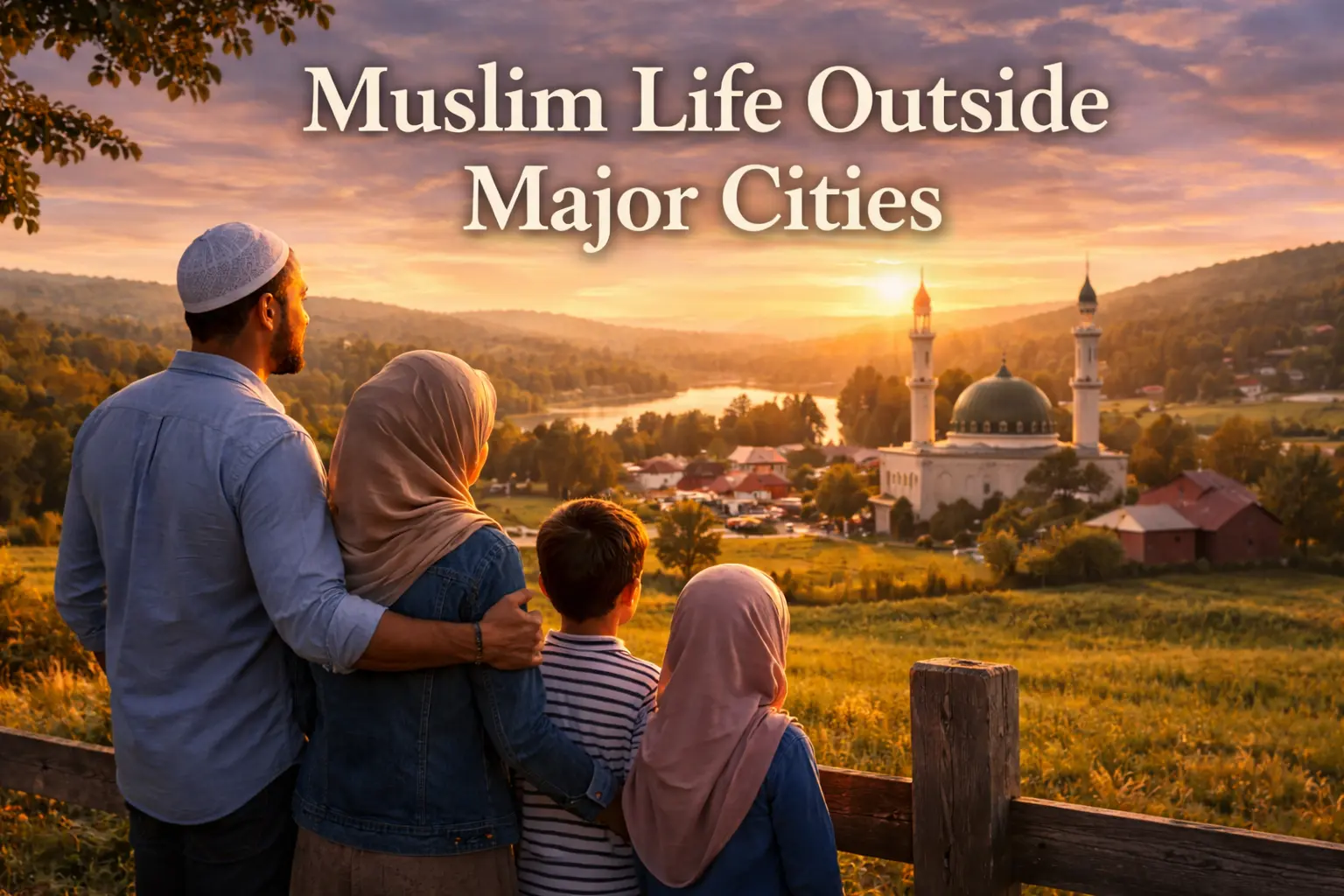
This is Muslim life outside major cities. No halal restaurants on every corner. No Islamic schools with waiting lists. No choice between multiple mosques offering different styles of worship. No assumption that anyone you meet has ever knowingly encountered a Muslim before. It’s a reality for hundreds of thousands of American Muslims who live in small towns, rural areas, and mid-sized cities across the country, far from the established Muslim enclaves of New York, Los Angeles, or Detroit.
These Muslims are doctors and engineers recruited to underserved areas, immigrants who found work in meatpacking plants or factories, converts who never left their hometowns, refugees resettled by agencies trying to distribute populations beyond overwhelmed urban areas, military families stationed at bases in the middle of nowhere. They are raising children, building careers, and practicing their faith in places where being Muslim means being conspicuously different.
Their experience challenges assumptions about Muslim American life. The narratives that dominate discussions of Islam in America are largely urban stories, Dearborn’s Arab American community, New York’s diverse Muslim population, California’s established institutions. But Muslim life in small-town Iowa or rural North Carolina looks nothing like that. It requires different strategies, creates different challenges, and offers different gifts. Understanding these experiences means grappling with what it takes to maintain faith when you’re isolated, how Muslim identity shifts when you’re always the only one, and what community means when your nearest co-religionist is an hour’s drive away.
The Geography of Isolation
In major cities, Muslims can take for granted a certain critical mass. There are enough Muslims that institutions emerge naturally, mosques and Islamic schools and halal grocery stores. There are enough Muslims that you’re likely to encounter others at work, at the gym, in the neighborhood. Being Muslim is just one identity among many in a diverse urban landscape.
Outside cities, this evaporates. A small town might have one Muslim family, or three, or a dozen. Even mid-sized cities of 50,000 or 100,000 people might have only a few hundred Muslims total, not enough to support more than a basic mosque and certainly not enough for multiple institutions serving different cultural or theological preferences.
This scarcity shapes everything. The nearest halal butcher might be two hours away, requiring monthly trips to stock up and a freezer full of meat. Zabihah becomes a complicated question when your choices are limited to whatever you can find or ordering online and hoping the shipment arrives still frozen. Some rural Muslims become vegetarian by default or stretch definitions of what constitutes “people of the book” to justify meat from their local supermarket.
Finding a Muslim spouse becomes nearly impossible without looking beyond your immediate area. Young Muslims in small towns either marry non-Muslims, move to cities where there’s actually a Muslim community, or navigate long-distance relationships and online matchmaking with more intensity than their urban counterparts. Parents worry their children will drift from Islam simply because there’s no one to marry who shares their faith.
Even basic religious education requires creativity. There’s no weekend Islamic school, so parents teach their children themselves using online resources and YouTube videos. There’s no community of Muslim kids for their children to befriend, so they drive hours to regional gatherings a few times a year, hoping those brief connections will sustain their children’s sense of Muslim identity.
The isolation is both physical and social. You can’t just drop by the mosque to see familiar faces. You can’t attend a lecture by a visiting scholar or join a regular halaqa. You can’t complain to another Muslim parent about your teenager’s struggles or ask someone’s advice about balancing work and prayer. The informal networks and casual encounters that create community in cities simply don’t exist.
Visibility and Vulnerability
In a city, a woman in hijab blends into the crowd. In a town of 5,000 people, she’s immediately recognizable. Everyone knows exactly where the Muslim family lives, where they shop, where their kids go to school. There’s no anonymity, no blending in, no choice about whether to be visibly Muslim.
This hypervisibility cuts both ways. On one hand, it creates vulnerability. When national news features terrorism or international conflicts, rural Muslims brace themselves. They know their neighbors are watching them differently, reading their reactions, wondering about their loyalties. Hate crimes in small towns can be particularly terrifying because there’s nowhere to hide and often limited law enforcement resources to investigate or prevent them.
After 9/11, some rural Muslims faced direct hostility. Mosques in small towns were vandalized. Muslim-owned businesses were boycotted. Children were bullied at school. But the isolation also meant there was no large Muslim community to provide support, no civil rights organizations with local chapters, no network of mosques to coordinate response. Families had to navigate threats largely on their own.
But hypervisibility also creates opportunities for relationship-building impossible in anonymous urban environments. In a small town, people actually get to know you. You’re not just “a Muslim” but Ahmed the pharmacist who sponsored the Little League team, or Fatima the teacher whose students love her, or the Khalil family who always brings dessert to the church potluck even though they don’t eat pork.
These personal relationships can be protective. When someone proposed an anti-Sharia law in a state legislature, small-town Muslims found that their neighbors defended them, not because those neighbors understood Islamic jurisprudence but because they knew the Muslim families in their community and couldn’t imagine them as threatening. When a mosque in rural Tennessee faced opposition, church congregations rallied to support it because the pastor had developed friendships with the Muslim community.
The personal nature of small-town life means Muslims often become educators by necessity, explaining their faith constantly but to people who are genuinely curious rather than hostile. The questions can be exhausting and sometimes offensive in their ignorance, but they also represent real opportunities to challenge stereotypes and build understanding.
Improvised Community
Without established institutions, rural Muslims create community from scratch. A dozen families meeting in a rented space becomes their mosque. Someone’s living room becomes the Sunday school. The WhatsApp group becomes the main communication channel for everything from arranging carpools to sharing news of a death in the community.
These improvised communities are intimate in ways that large urban mosques often aren’t. Everyone knows everyone. When someone is struggling, the whole community knows and mobilizes. When there’s a wedding or a baby or a funeral, everyone comes. There are no strangers, no anonymity, no opportunity to attend Friday prayer without talking to anyone.
But small size also means limited resources and heavy burdens on individuals. Without professional imams, community members take turns leading prayers and giving khutbahs, often without formal training. Without dedicated youth programs, parents organize activities themselves. Without established governance structures, decision-making can become personal and contentious in ways that formal procedures might prevent.
The cultural diversity that’s a strength in urban mosques becomes a challenge in small communities. When your entire Muslim community is fifteen families, you might have Arabs, South Asians, Africans, and white American converts all trying to pray together. Do you recite the call to prayer in the Turkish style or the Egyptian? Do you celebrate Eid according to moon sighting or calculation? Do women pray in the same room as men or separately? Every decision requires negotiation because there aren’t enough people to split into separate communities along cultural or theological lines.
This forced integration across cultures and perspectives can be enriching. Children grow up with a more universal Islam, less tied to ethnic tradition. Adults learn to distinguish between what’s Islamic and what’s cultural. The community becomes a microcosm of the ummah’s diversity rather than a replica of a specific homeland.
But it can also be exhausting. Compromises must be made constantly. No one gets to practice Islam exactly the way they prefer because accommodation is necessary for the community to function at all. The small size means personality conflicts can fracture the entire community. When two families stop speaking to each other, it affects everyone.
The Convert Experience
Small-town and rural Muslims include a higher percentage of converts than urban communities. These are often white Americans who found Islam through reading, relationships, or searching for spiritual meaning. They converted in places where there was no Muslim community to welcome them, learning to pray from YouTube and reading translated Quran on their own.
For these converts, isolation is particularly acute. They may be estranged from family who view their conversion as betrayal. They have no cultural connection to Muslim-majority countries and no inherited Islamic practice. They’re trying to learn everything from scratch with minimal guidance.
Some rural mosques welcome converts warmly, grateful for anyone willing to join their small community. But immigrant Muslims sometimes view converts with suspicion or treat them as perpetual outsiders who need constant correction. The cultural barriers can be as significant as theological learning, trying to figure out not just how to pray but how to navigate social dynamics in communities organized around ethnic identity.
At the same time, converts in small towns sometimes build bridges that immigrant Muslims cannot. They speak the local language and culture fluently. They have networks in the broader community. They can explain Islam in terms that make sense to other Americans. Some of the most effective Muslim community organizers in rural areas are converts who understand both Muslim and non-Muslim perspectives.
The children of converts face unique challenges. They’re Muslim but don’t look like what people expect Muslims to look like. They don’t speak Urdu or Arabic. They don’t have extended family reinforcing Islamic practice. They’re navigating Muslim identity without the ethnic and cultural frameworks that support other Muslim kids.
Economic Realities
Muslims in rural areas often have different economic profiles than urban Muslims. Many are professionals recruited specifically because of labor shortages, doctors and engineers whose skills are in high demand in underserved areas. They may earn good incomes and enjoy comfortable lifestyles, but their professional success doesn’t insulate them from social isolation.
Others are working-class Muslims employed in agriculture, food processing, or manufacturing. Somali refugees work in meatpacking plants in Nebraska and Minnesota. Arab immigrants run convenience stores in small Southern towns. These Muslims face economic precarity alongside cultural isolation, working long hours for modest wages while trying to maintain faith and raise children in places with few resources.
The economic diversity within small Muslim communities creates its own dynamics. The doctor and the meatpacking worker pray side by side, but their daily realities differ drastically. The mosque may struggle to collect enough donations to cover rent when half the community is barely getting by. Zakat distribution becomes complicated when you personally know everyone who might need it.
Some rural Muslims appreciate the lower cost of living and slower pace of life. They can buy houses, raise children with yards and safety, and build lives that would be financially impossible in expensive coastal cities. Others feel trapped, wanting to move to areas with larger Muslim communities but unable to afford it or unwilling to sacrifice good jobs.
Raising the Next Generation
Parents raising Muslim children in small towns face an acute version of the challenge all American Muslim parents navigate: how to transmit faith to children growing up in a non-Muslim society. But without weekend Islamic school, without Muslim peers, without any reinforcement outside the home, the task becomes even more daunting.
Some families homeschool or send their children to Islamic boarding schools in other states, sacrificing daily family life to ensure religious education. Others enroll their kids in public school and try to provide Islamic education at home, often feeling inadequate to the task.
Children growing up as the only Muslim in their school often face intense pressure to assimilate. They’re asked invasive questions about their faith and sometimes subjected to bullying. They see their peers drinking, dating, and attending dances, activities prohibited in many Muslim families. Without Muslim friends who share their restrictions, they can feel isolated and resentful.
Yet some children raised in small-town Muslim families develop strong, articulate faith precisely because they must constantly explain and defend it. They can’t be Muslim passively. They have to choose it consciously and understand it well enough to answer questions. They become bridges between communities, equally comfortable in Muslim and non-Muslim spaces.
Parents worry constantly about whether their children will stay Muslim. Without community reinforcement, without potential Muslim spouses nearby, without the cultural immersion that urban Muslim enclaves provide, the pull toward assimilation is strong. Some families eventually relocate to cities just so their teenagers can have Muslim peers.
Others decide to stay and trust that the faith they’ve modeled at home will be enough. They hope that the close family bonds created by isolation, the intimate relationship with Islam developed through individual study, and the strength built through being different will sustain their children’s Muslim identity even without community.
Interfaith as Necessity
In cities, Muslims can build parallel institutions and minimize interaction with non-Muslims if they choose. In small towns, interfaith engagement is unavoidable. Your neighbors are Christian or secular. Your children’s friends are not Muslim. The community events you attend are organized by churches. You either engage across religious lines or you have no community at all.
This necessity often leads to deep interfaith relationships. Muslim families attend church potlucks and community festivals. They join volunteer organizations and serve on school boards. They build genuine friendships with people of other faiths, learning about Christianity and secularism not as abstract concepts but through real relationships.
These relationships can be profoundly enriching. Small-town Muslims often report feeling welcomed by Christian neighbors, supported by churches during difficult times, and defended by non-Muslim friends when they face discrimination. The interfaith engagement that urban Muslims pursue intentionally happens organically in small towns.
But it also creates tensions. How much participation in Christian-dominated spaces is acceptable? Should Muslim children attend vacation Bible school with their friends? Should families put up lights in December to fit in with neighborhood traditions, even if they don’t celebrate Christmas? The lines between cultural participation and religious compromise become blurred.
Some small-town Muslims worry that deep interfaith engagement, especially for children, will weaken Islamic identity. Others argue that confident interfaith relationships actually strengthen faith by requiring Muslims to know what they believe and why. The debate continues, but the reality remains: in small towns, isolation from non-Muslims isn’t an option.
The Question of Belonging
Do Muslims in small-town America feel they belong? The answer is complicated. Many report feeling deeply integrated into their communities in ways that urban Muslims might not. They know their neighbors. They contribute to local institutions. They’re recognized as valued community members.
But they also feel the limitations of that belonging. They’re welcomed as individuals but their faith remains foreign. They’re included in community life but Islamic practice remains marginal. They belong conditionally, as long as they’re not too Muslim, too visible, too demanding of accommodation.
Some rural Muslims describe a kind of double isolation: isolated from other Muslims, but also never quite fully part of the non-Muslim community either. They’re neither fish nor fowl, too American for Muslim immigrants visiting from overseas, too Muslim for their small-town neighbors.
Yet others find profound belonging precisely in this in-between space. They create hybrid identities that are authentically both Muslim and rural American. They learn to code-switch seamlessly. They build lives that honor both their faith and their geographic community. They refuse to choose between being Muslim and being small-town American because they are fully both.
The Future of Rural Islam
Muslim presence in rural and small-town America is likely to grow. As urban areas become more expensive and crowded, some Muslim families are deliberately choosing smaller communities. As second and third-generation Muslims become more established, some are returning to or staying in the small towns where they grew up. As refugee resettlement continues, agencies are increasingly placing families in mid-sized cities rather than overwhelming established urban enclaves.
This growth may eventually create enough critical mass for more robust institutions. Small mosques might expand. Islamic schools might emerge. Halal options might increase. The isolation that defines rural Muslim life today might ease.
But it may also preserve something valuable that urban Muslim communities sometimes lose: the necessity of building genuine relationships across difference, the intimacy of small communities, the conscious choice to be Muslim that comes from not having faith passively reinforced by ethnic enclaves.
Muslim life outside major cities is not easier or harder than urban Muslim life, just different. It requires different skills, offers different challenges, and creates different opportunities. The Muslims who choose it or find themselves in it are writing a distinct chapter in the American Muslim story, one that deserves recognition and respect.
They are proof that Islam in America is not just an urban phenomenon or an immigrant enclave story. It’s a faith being lived in small towns and rural areas across the country, in communities of ten families and individual households, in mosques that meet in rented spaces and living rooms, by people who are building Islamic life from scratch in places where most Americans have never knowingly met a Muslim.
They are isolated but not alone, visible but determined, few in number but strong in faith. And they are as much a part of American Islam as the established communities in major cities, writing their own story of what it means to be Muslim in America, one small town at a time.