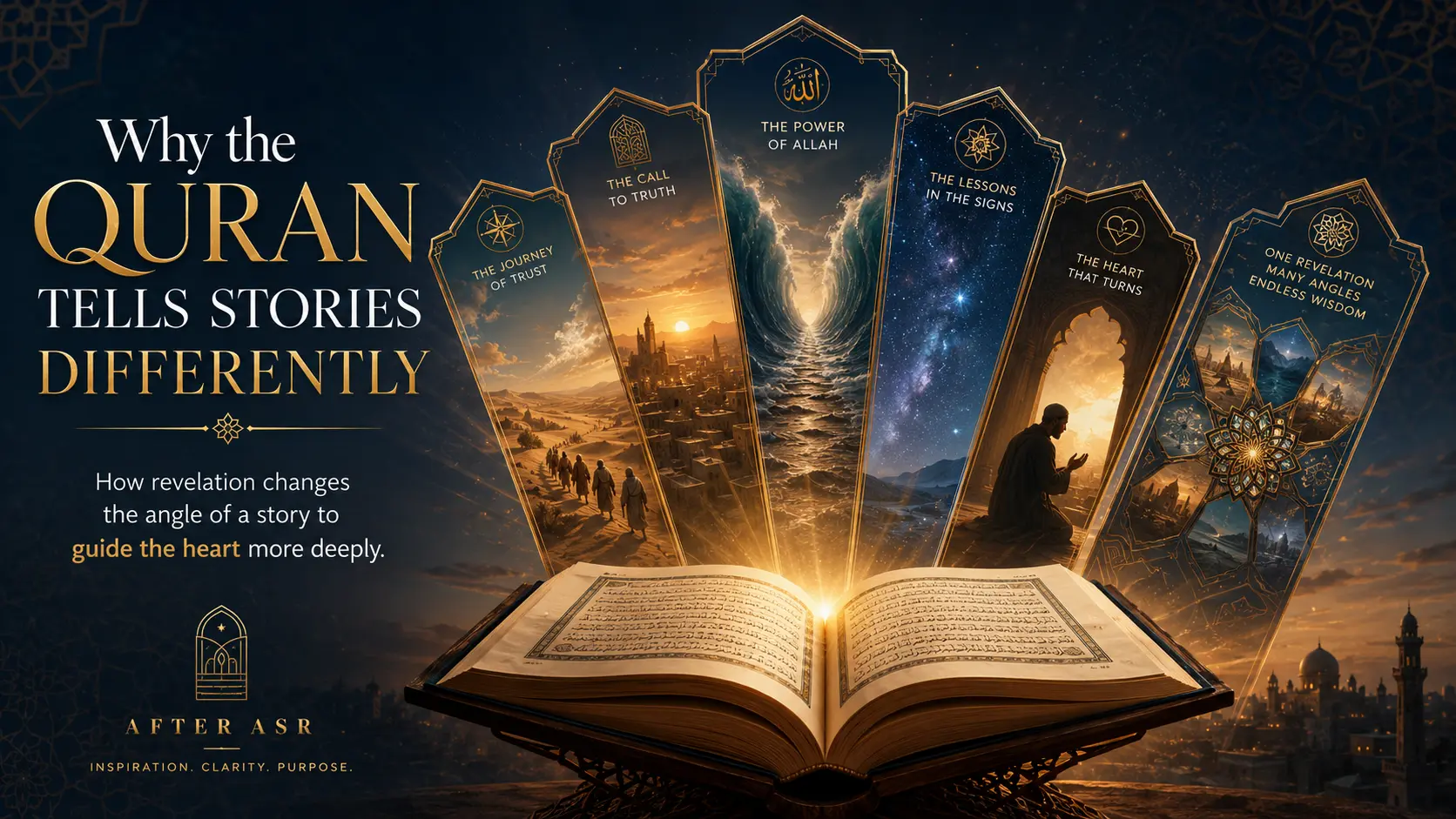
How revelation changes the angle of a story to guide the heart more deeply.
The Quran tells stories in a way that can surprise readers who expect narrative to function like modern biography, history, or literature. A familiar prophet may appear in one surah with one set of details, then appear elsewhere with a different emphasis. A moment may be brief in one passage and expanded in another. A conversation may be highlighted in one place and omitted in another. A story may begin without background, end without the kind of closure modern readers expect, or return later with a new emotional and moral center.
This is not inconsistency. It is not carelessness. It is not a lack of narrative structure. The Quran is doing something different from ordinary storytelling. It is not simply recording events so the reader can reconstruct the past. It is revealing guidance through the past. It tells stories in the way guidance requires, not in the way curiosity demands.
This distinction is essential. A history book often asks, “What happened, in what order, and with what details?” The Quran asks deeper questions: What does this event reveal about Allah? What does it reveal about human beings? What warning does this community need? What comfort does this believer need? What disease of the heart is being exposed? What truth is being made unforgettable?
The Quran changes the angle of a story because human beings need more than one angle of guidance.
The Quran Is Not Storytelling for Entertainment
The Quran’s stories are beautiful, but they are not included for entertainment. They are not meant to satisfy curiosity, decorate religious imagination, or provide dramatic material detached from worship and accountability. They are signs, warnings, consolations, proofs, and reminders. They are part of revelation’s work of forming the human being.
This is why the Quran often leaves out details that a modern reader may expect. We may want names, dates, locations, physical descriptions, political background, extended dialogue, or chronological transitions. Sometimes the Quran gives details. Sometimes it does not. The absence is meaningful. Revelation does not include every detail that human curiosity might seek, because not every detail is necessary for guidance.
A story in the Quran is not measured by how much information it provides, but by how effectively it directs the reader toward Allah. If a detail serves guidance, it appears. If it does not, it may be left aside. This teaches the reader to approach Quranic stories differently. The goal is not to ask, “Why was I not told everything?” The better question is, “Why was I told this part?”
Different Surahs Have Different Purposes
A Quranic story changes depending on the surah in which it appears. Every surah has its own themes, rhythm, atmosphere, and spiritual force. When a story enters that surah, it serves the surah’s purpose. This is one reason the same prophet can be presented differently across the Quran.
The story of Musa, peace be upon him, for example, may be used to show Allah’s rescue of the oppressed, the arrogance of Pharaoh, the courage required to speak truth, the weakness and fear of a prophet entrusted with mission, the stubbornness of people after deliverance, or the certainty that worldly power cannot defeat divine command. Each telling is true, but each telling draws the reader’s attention to a different moral center.
This is not repetition in the weak sense. It is layered instruction. The Quran does not flatten a prophet’s life into one lesson. It allows the same life to speak to many conditions. The frightened believer may need Musa’s fear and reliance. The oppressed may need the collapse of Pharaoh. The arrogant may need the warning of power destroyed. The caller to truth may need the patience of a messenger facing rejection.
The story changes because the need changes.
The Quran Tells Stories by Moral Emphasis
Modern storytelling often treats plot as the central concern. Quranic storytelling often treats moral emphasis as central. The question is not always, “What happens next?” but “What are you meant to notice?”
Sometimes the Quran slows down at a moment of decision. Sometimes it highlights a single sentence. Sometimes it passes quickly over years of events to focus on one confrontation, one prayer, one act of patience, or one response to truth. The pacing is guided by meaning.
Consider how the Quran may focus on a prophet’s dua rather than the long years that led to it. This teaches the reader that the supplication itself matters. It reveals the prophet’s dependence upon Allah. It gives believers words, posture, and hope. In another place, the same prophet’s conflict with his people may be highlighted, because the lesson there is patience under rejection or the danger of collective arrogance.
The Quran is not indifferent to events. It is selective with divine wisdom. It tells the part of the story that serves the guidance being given at that moment.
The Same Story Can Console and Warn
One of the remarkable features of Quranic storytelling is that the same story can comfort one reader and warn another. This depends on where the reader stands morally and spiritually.
The story of Nuh, peace be upon him, can console someone who has been patient for a long time without seeing results. It tells them that calling to truth may be difficult, that rejection is not proof of failure, and that Allah sees perseverance. But the same story can warn someone who mocks reminders, dismisses sincere advice, and assumes that delay means safety.
The story of Yusuf, peace be upon him, can console the betrayed, the imprisoned, the falsely accused, and the patient. But it can also warn those consumed by envy, those who use power unjustly, and those who forget that Allah can raise someone they tried to bury.
The story of Pharaoh can comfort the oppressed by showing that tyranny is not permanent. It can also warn anyone who uses power arrogantly, even in smaller forms. Pharaoh is not only a historical ruler. He becomes a mirror of what happens when power refuses humility.
This is why Quranic stories do not belong to the past alone. They keep locating the reader in the present.
Details Change Because the Lesson Changes
When a Quranic story appears in multiple places, the selected details may differ because the lesson differs. The reader is not meant to force every passage into the same emotional experience. Each passage must be allowed to teach what it came to teach.
A passage may mention fear because the lesson is reliance. Another may mention public confrontation because the lesson is courage. Another may mention rescue because the lesson is Allah’s support. Another may mention rejection because the lesson is patience. Another may mention punishment because the lesson is accountability.
This is similar to how a wise teacher may tell the same real event differently depending on what a student needs. If teaching courage, the teacher emphasizes the moment of fear. If teaching gratitude, the teacher emphasizes the moment of rescue. If teaching humility, the teacher emphasizes the failure that came from pride. The story is the same, but the teaching angle changes.
The Quran does this with divine precision. It does not merely repeat stories. It reorients the reader to receive a particular form of guidance.
The Quran Does Not Feed Curiosity for Its Own Sake
Human curiosity is not evil, but it can become spiritually distracting. A person may want to know every detail of a story while avoiding the moral demand that has already been made clear. They may ask about names, places, numbers, and timelines, not because those details would increase obedience, but because details feel safer than transformation.
The Quran often refuses to satisfy this kind of curiosity. It gives enough to guide, not always enough to entertain speculation. This is itself a form of discipline. It teaches the reader that revelation is not under the command of our curiosity. We are not approaching the Quran as consumers demanding complete narrative background. We are approaching the speech of Allah as servants seeking guidance.
When the Quran does not tell us something, that absence may be instructive. It may be directing us away from what does not benefit and toward what does. The unanswered detail asks the reader to pay attention to the revealed lesson instead of inventing a distraction around what was left unrevealed.
The Quran Makes the Past Present
The Quran does not tell stories as dead history. It makes the past present. Earlier nations, prophets, tyrants, believers, families, and communities are brought before the reader as living lessons. Their choices become warnings. Their prayers become models. Their arrogance becomes recognizable. Their patience becomes companionship.
This is why the Quran may tell a story in a way that feels immediate rather than distant. It is not always concerned with creating historical distance. It often removes distance. The reader is not allowed to say, “That was them, long ago.” The Quran brings the question closer: What about you? What are you doing with guidance? Where is your arrogance? Where is your patience? Where is your trust? Where is your gratitude? Where are you repeating the same error with different clothing?
This is one reason Quranic storytelling can feel so powerful. It does not leave the reader as a spectator. It turns the reader into someone being addressed.
Prophetic Stories Are Not Hero Worship
The Quran honors the prophets, peace be upon them, but it does not present their stories as shallow hero worship. It does not turn them into distant figures admired only for greatness. It shows their worship, patience, dua, struggle, reliance, grief, courage, and obedience. Their greatness lies in servanthood to Allah.
This matters because people often admire religious figures in a way that avoids imitation. Admiration can become a substitute for transformation. A person may love the story of Yusuf without practicing patience, love the story of Musa without standing against falsehood, love the story of Ibrahim without questioning inherited idols, love the story of Maryam without honoring dignity under trial.
The Quran’s storytelling does not allow admiration to remain passive. It presents the prophets as signs of what surrender looks like under real conditions. They are not merely characters in sacred history. They are models of how the human being lives when Allah is the center.
The Villains Are Also Mirrors
Quranic stories do not only give us righteous models. They also show us dangerous patterns. Pharaoh, Qarun, arrogant elites, mocking communities, envious brothers, hypocrites, and rejecters of messengers are not included so that readers can feel superior to them. They are included so readers can recognize the diseases that destroy human beings.
This is uncomfortable because it is easier to locate ourselves among the righteous figures in a story. We imagine ourselves with Musa, not with Pharaoh’s arrogance. With Yusuf, not with the envy of his brothers. With the believers, not with the people who mocked reminders. Yet the Quran’s moral force requires us to examine the possibility that some part of the disease exists in us.
A person may never be Pharaoh, but they may have a small Pharaoh in the way they handle authority. They may never be Qarun, but they may have Qarun’s pride when they attribute every blessing to themselves. They may never openly reject a prophet, but they may reject reminders that threaten their comfort.
The Quran tells these stories differently because each telling exposes a different disease.
Some Stories Are Brief Because Brevity Can Strike Harder
Not every Quranic story is long. Some are strikingly brief. A moment appears, a warning is given, a response is shown, and the passage moves on. This brevity can be powerful. It does not allow the reader to become lost in narrative detail. It delivers the moral force directly.
A short account may function like a flash of lightning. It reveals the landscape for a moment, enough for the reader to see danger. The brevity itself becomes part of the message. Human life is brief. The moment of decision may be brief. The distance between arrogance and consequence may be brief. The opportunity to repent may be brief.
Longer stories invite extended contemplation. Brief stories deliver sharp recognition. The Quran uses both.
The Story of Yusuf Is Different for a Reason
One of the most notable exceptions to the Quran’s usual storytelling pattern is Surah Yusuf, where the story of Yusuf, peace be upon him, is told in a more continuous narrative form. This difference is not accidental. It shows that the Quran can tell a story continuously when that serves the divine purpose.
Surah Yusuf carries a distinctive emotional and spiritual arc: dream, envy, separation, temptation, imprisonment, patience, rise, recognition, forgiveness, and reunion. Its continuity allows the reader to see Allah’s wisdom unfolding through events that, at first, appear painful or confusing. The story teaches that Allah’s plan may be hidden within betrayal, delay, injustice, and loss.
The fact that Surah Yusuf is told differently helps us understand the larger principle. The Quran is not incapable of continuous storytelling. It chooses the form that best serves guidance. Sometimes that means a full narrative arc. Sometimes it means a single scene. Sometimes it means returning to the same event across different surahs with different emphasis.
The form follows the guidance.
Quranic Storytelling Trains Reflection
Because the Quran tells stories differently, the reader must reflect differently. The reader cannot simply consume the story once and assume the lesson has been exhausted. They must ask why this version appears here, why this detail is mentioned now, why this dialogue is preserved, why this ending is chosen, and how the surrounding verses shape the meaning.
This trains the believer to read with attention. It slows down the habit of assuming familiarity. A person may think, “I know the story of Musa,” but the Quran keeps showing them another angle. A person may think, “I know what happened to Yusuf,” but the surah keeps revealing more about patience, beauty, restraint, forgiveness, and divine planning. A person may think, “I know Pharaoh was arrogant,” but each passage asks whether arrogance is still alive in new forms.
The Quran does not let sacred stories become stale. It renews them by changing the angle of address.
Stories Are Tailored to Human States
Human beings approach the Quran in different conditions. One reader is afraid. Another is grieving. Another is proud. Another is confused. Another is newly repentant. Another is oppressed. Another is comfortable and heedless. Another is seeking courage. Another is tempted by despair. The Quran’s varied storytelling meets these different states.
A story told one way may reach the grieving heart. Told another way, it may awaken the heedless. Told another way, it may instruct the caller to truth. Told another way, it may expose the tyrant. The variety is part of the mercy of revelation. The Quran is not a one-dimensional address to one kind of person in one kind of situation. It speaks across human conditions.
This is why a believer may return to a familiar story years later and feel as if it has become new. The story did not change. The reader’s condition changed. The Quran’s different tellings allow guidance to meet the reader again at a new place in life.
The Quran’s Stories Are Theological
Quranic stories are not only moral. They are theological. They teach who Allah is. They show His knowledge, mercy, justice, power, wisdom, nearness, patience, and ability to bring life from situations that appear closed. They show that Allah hears the dua of the distressed, exposes the arrogance of the powerful, rescues whom He wills, delays with wisdom, and fulfills His promise.
This is perhaps the most important point. The central character in Quranic storytelling is not the human being. It is not even the prophet in isolation. The ultimate focus is Allah. Human beings act, choose, resist, repent, oppress, believe, and endure. But the story reveals the Lord who governs, guides, tests, forgives, and judges.
When the Quran tells stories differently, it often reveals a different aspect of Allah’s relationship with creation. In one passage, we see Allah as the One who rescues. In another, the One who warns. In another, the One who knows what is hidden. In another, the One who opens a way where none seemed possible. In another, the One who holds wrongdoers accountable after long delay.
The stories teach us how to know Allah.
The Reader Must Not Flatten the Stories
One danger in reading Quranic stories is flattening them into simple moral slogans. “Be patient like Yusuf.” “Be brave like Musa.” “Trust like Ibrahim.” These statements may be true, but if they are left too simple, they can reduce the depth of revelation.
Yusuf’s patience was not passive waiting. It included resisting temptation, enduring injustice, remaining faithful in prison, serving with excellence, interpreting dreams, and forgiving when power came to him. Musa’s courage was not the absence of fear. It was obedience despite fear. Ibrahim’s trust was not vague optimism. It was surrender that challenged idolatry, family expectation, and worldly security.
The Quran tells stories differently so that we do not trap them in one slogan. Each return complicates and deepens our understanding. The prophets are not cardboard examples. Their lives are signs filled with layers of guidance.
Different Tellings Protect the Story From Ownership
When a story is told in only one way, people may feel they have mastered it. They know the plot, the lesson, and the conclusion. But the Quran’s varied storytelling prevents this kind of ownership. It keeps the reader humble. It reminds us that revelation has more to give than we have already received.
A familiar story may suddenly confront us from a different direction. A passage we once read as comfort may later become warning. A passage we once read as history may later become personal. A detail we once passed over may later explain our own struggle with envy, fear, pride, patience, or repentance.
This is part of the Quran’s living guidance. It does not change in truth, but it continues to address the changing human being. Different tellings make that ongoing address possible.
Conclusion
The Quran tells stories differently because its purpose is guidance, not mere narration. It changes emphasis, pacing, detail, and angle because different hearts, moments, surahs, and lessons require different forms of address. The same story may console the oppressed, warn the arrogant, instruct the believer, expose the hypocrite, strengthen the caller to truth, and reveal something of Allah’s mercy, wisdom, justice, and power.
This variety is not a problem to be solved. It is a mercy to be received. The Quran does not give stories as static material from the past. It gives them as living signs. It tells us what we need to know, when we need to know it, in the form that best serves remembrance, reflection, and return.
The reader who expects the Quran to behave like a modern history book may become confused by its storytelling. But the reader who understands that revelation is guiding the heart will begin to see the wisdom in its form. Details appear with purpose. Silences teach restraint. Repetition deepens recognition. Variation opens new doors.
The Quran tells stories differently because human beings need to be guided differently.
And because the truth of a story is not exhausted by telling it once.