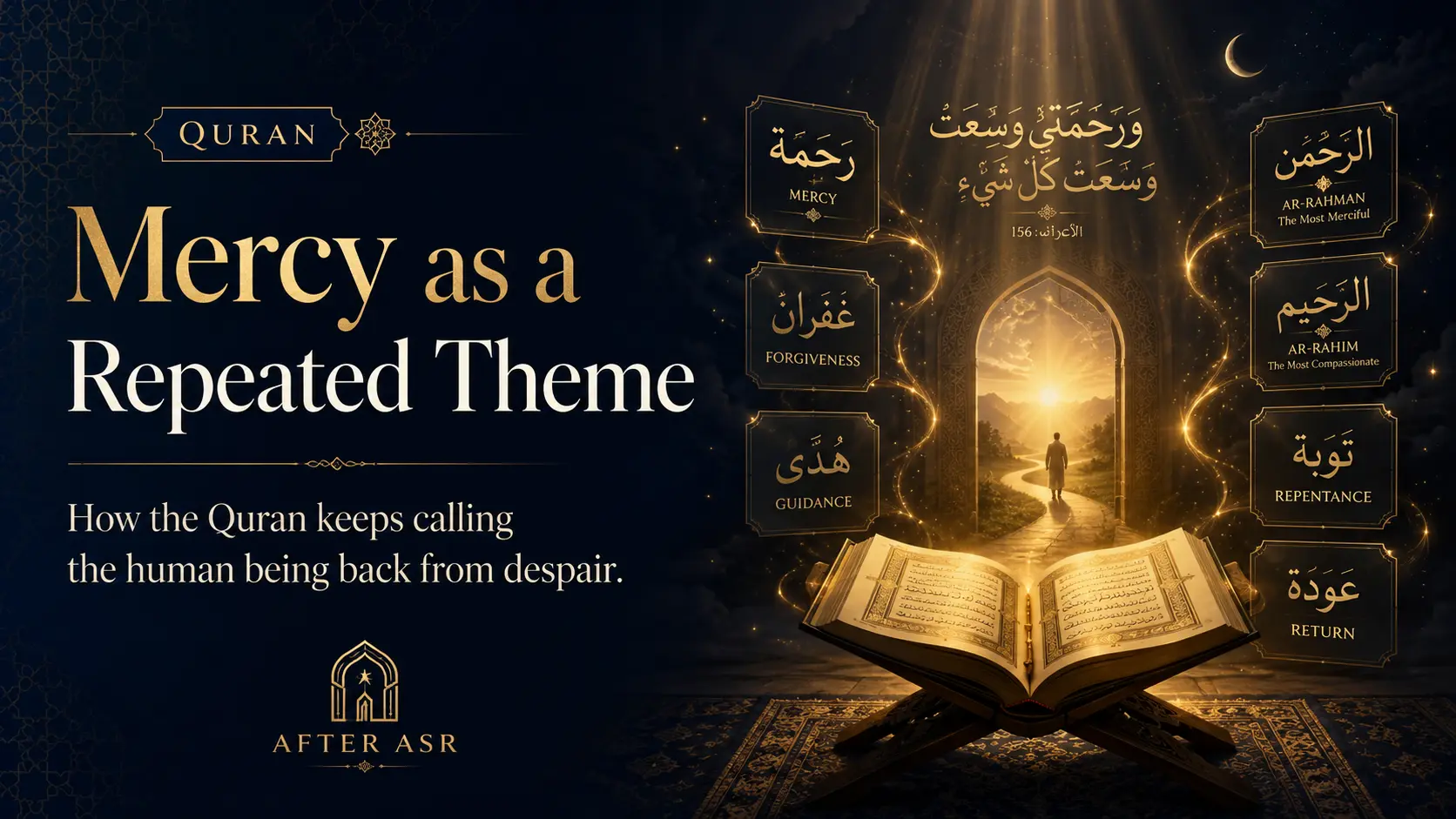
How the Quran keeps calling the human being back from despair.
The Quran repeatedly returns to mercy because the human being repeatedly needs it. We forget, fall, harden, exaggerate our own strength, underestimate our weakness, and then sometimes despair when we finally see ourselves clearly. The Quran knows this about us. It does not present the human being as a creature who simply needs information, nor as a soul that can be repaired by law alone. It speaks to a being who is accountable, but also fragile; responsible, but easily overwhelmed; honored, but prone to ruin; capable of obedience, but always in need of Allah’s mercy.
Mercy in the Quran is not a soft decorative theme placed beside more serious matters. It is central to how revelation introduces Allah, how it explains creation, how it calls sinners back, how it describes the mission of the Prophet Muhammad, peace and blessings be upon him, and how it keeps accountability from becoming despair. The Quran warns with force, but it does not leave the reader trapped under warning. It commands, but it also opens the door of return. It exposes human failure, but not to humiliate the servant into hopelessness. It exposes in order to heal, correct, awaken, and bring the servant back to the One whose mercy is greater than the servant’s sin.
To understand mercy as a repeated theme in the Quran, we must first resist reducing it to mere gentleness. Mercy is not indulgence. It is not the removal of all boundaries. It is not the denial of justice. It is not Allah overlooking truth in order to make human beings comfortable. Quranic mercy is far richer than that. It is the mercy that creates, guides, warns, forgives, disciplines, provides, delays punishment, accepts repentance, sends messengers, reveals scripture, and promises reward far beyond what human effort could deserve.
The Quran Begins With Mercy
The believer’s relationship with the Quran is framed by mercy from the beginning. Before many Muslims recite a surah, they say, “In the name of Allah, the Most Merciful, the Especially Merciful.” These words are not ornamental. They establish the atmosphere in which revelation is received. The Quran does not begin by presenting Allah as distant, indifferent, or eager to punish. It begins by naming Him through mercy.
This matters because many people carry distorted images of religious life. Some imagine faith as nothing but fear. Others imagine Allah’s commands as restrictions without tenderness. Others, wounded by harsh human behavior, struggle to believe that divine authority can be merciful. The Quran corrects these distortions at the very entrance. The Lord who commands is the Lord who is merciful. The Lord who judges is the Lord who forgives. The Lord who warns is the Lord who sent guidance so that human beings would not be left to destroy themselves in ignorance.
The repetition of divine mercy in the Quran trains the believer to approach Allah with seriousness and hope together. Fear alone can crush the heart. Hope alone, when detached from responsibility, can make it careless. The Quran forms a believer who trembles before accountability while still trusting that the door of Allah’s mercy is wider than the doorway of human shame.
Mercy Is Built Into Creation
The Quran does not present mercy only as forgiveness after sin. Mercy appears before the human being ever asks for it. Existence itself is mercy. Life is mercy. Provision is mercy. The body, the mind, the earth, rain, food, family, language, sleep, beauty, and the order of creation are all signs that the human being lives inside dependence before any illusion of independence can form.
This is important because people often notice mercy only after crisis. When a person is rescued, healed, forgiven, or relieved, they may recognize mercy. But the Quran teaches a wider vision. Every ordinary blessing is already mercy. The fact that the heart beats without command, that the earth produces, that night gives rest, that the sun rises, that one can speak, learn, repent, and begin again, all of this is mercy surrounding the human being before the human being becomes grateful.
Such mercy does not erase accountability. In fact, it deepens it. The more a person recognizes how much has been given, the more gratitude becomes necessary. Ingratitude in the Quran is not merely bad manners. It is a failure to read reality correctly. The ungrateful person lives from mercy while acting as though they are self-made. They receive constantly while acknowledging little. Quranic mercy therefore calls for gratitude, not entitlement.
Revelation Itself Is Mercy
The Quran is mercy because guidance is mercy. A human being left only to desire, speculation, social pressure, inherited custom, and personal opinion would be lost. People can be intelligent and still spiritually blind. They can build civilizations and still worship falsehood. They can master technology and still fail to master anger, greed, lust, arrogance, envy, and despair. Revelation comes as mercy because it tells the human being what they could not safely determine on their own.
This is why the Quran’s commands should not be understood as arbitrary burdens. They are part of divine care. Allah does not need human worship. Human beings need worship because without it they become disordered. Allah does not benefit from human honesty. Human beings need honesty because lying corrupts the soul and society. Allah does not require charity because of poverty in Himself. Human beings need charity because wealth, if not disciplined, can become an idol.
Even warnings are mercy. A warning before destruction is not cruelty. It is an opening. The Quran warns of arrogance, heedlessness, injustice, and the Hereafter because human beings are capable of walking toward ruin while calling it success. A culture may praise what destroys the soul. Friends may normalize what distances a person from Allah. The ego may justify what revelation exposes. In that condition, warning is not the opposite of mercy. It is one of mercy’s forms.
The Prophet ﷺ as Mercy
The Quran’s teaching on mercy is not only conceptual. It is embodied in the mission of the Prophet Muhammad, peace and blessings be upon him. His prophethood was not a private spiritual event detached from the world. He was sent to recite revelation, teach, purify, judge with justice, endure harm, forgive when forgiveness was better, show patience with weakness, and establish a community shaped by worship and moral responsibility.
To speak about Quranic mercy while ignoring the Prophet’s character is to miss how revelation became visible in human life. The Prophet, peace and blessings be upon him, was not merciful because he lacked seriousness. He carried the most serious message. He warned, corrected, commanded, and stood firmly upon truth. Yet his firmness was not cruelty, and his mercy was not weakness. He showed that divine guidance can be carried with patience, tenderness, courage, and moral clarity.
This balance is desperately needed. Some people in religious spaces mistake harshness for strength. Others mistake permissiveness for compassion. The Prophetic model corrects both. Mercy does not require abandoning truth, and truth does not require abandoning mercy. The Quranic message, lived through the Prophet, peace and blessings be upon him, teaches that the heart most submitted to Allah is not cold toward creation.
Mercy and Repentance
One of the most repeated expressions of mercy in the Quran is the invitation to repent. The human being sins. This is not treated as surprising. What becomes spiritually dangerous is not only sin itself, but the refusal to return after sin. Shame can become a wall. Pride can become a wall. Despair can become a wall. Habit can become a wall. The Quran breaks these walls by repeatedly calling the servant back to Allah.
Repentance in the Quran is not a public performance of guilt. It is a return. It requires honesty, regret, stopping the wrong, resolving to change, and restoring rights when other people have been harmed. But it is also an act of hope. No one repents sincerely unless they believe that Allah’s mercy is real. Despair says, “I am too ruined to return.” Arrogance says, “I do not need to return.” Repentance says, “I have sinned, but my Lord is greater than my sin.”
This repeated call to repentance protects the believer from two opposite disasters: becoming casual with sin or becoming hopeless because of sin. The Quran does not allow sin to be normalized. It also does not allow sin to become a reason for abandoning Allah. The sinner is neither flattered nor discarded. They are called back.
Mercy Does Not Mean Lack of Accountability
Because mercy is so central in the Quran, it can be misunderstood. Some people speak of Allah’s mercy as though it cancels moral responsibility. They treat mercy as a guarantee that choices have no serious consequences. This is not Quranic mercy. The Quran joins mercy with justice, forgiveness with truth, and hope with accountability.
A parent who never corrects a child is not necessarily merciful. A doctor who never warns a patient about danger is not merciful. A judge who ignores the rights of victims is not merciful. In the same way, a vision of divine mercy that erases accountability is not mercy. It is sentimentality. The Quran’s mercy is wiser and more truthful. It opens the door of return before judgment, but it does not declare that rebellion and obedience are the same.
This is especially important when harm involves other people. A person cannot invoke mercy to avoid returning stolen wealth, apologizing for abuse, correcting false speech, or facing consequences for oppression. Allah’s mercy is vast, but it is not a shield for injustice. The one who seeks mercy must also become willing to stop being a source of harm. Mercy received should become mercy practiced.
Mercy for the Broken
The Quran speaks to people in strength, but also to people in brokenness. Human beings do not only sin out of arrogance. They also collapse under grief, loneliness, fear, regret, poverty, rejection, illness, and exhaustion. The Quran returns to mercy because life repeatedly places people in conditions where they may feel abandoned.
Quranic mercy teaches that Allah knows what people cannot explain. He knows the hidden wound behind a public smile, the anxiety beneath a composed face, the regret a person cannot put into words, and the weakness they themselves do not fully understand. This does not remove responsibility, but it places responsibility under divine knowledge rather than human cruelty. People often judge from fragments. Allah knows the whole.
This matters because some religious language can become unbearably harsh when it forgets human fragility. The Quran does not forget. It knows the servant who is trying and failing, returning and slipping, hoping and fearing, carrying burdens no one else sees. Its repeated mercy keeps the door open for such a person. It tells them not to confuse their weakness with Allah’s absence.
Mercy in the Delay of Punishment
Another expression of mercy in the Quran is delay. Human beings often interpret delay wrongly. When wrongdoing is not immediately punished, some take it as proof that they are safe. When injustice continues, some imagine that Allah is unaware. The Quran corrects both errors. Delay is not neglect. Sometimes it is mercy, sometimes a test, sometimes an opening for repentance, and sometimes part of a wisdom human beings cannot see.
For the sinner, delay is an opportunity. Every day before death is a day in which return is possible. The fact that a person was not seized at the moment of disobedience should not make them arrogant. It should make them ashamed and grateful. Allah’s mercy gives space for repentance, but that space is not guaranteed forever.
For the oppressed, delay can be painful. It may feel like silence. But the Quran insists that Allah is not unaware of what wrongdoers do. The delay of judgment is not the absence of judgment. This is where mercy and justice meet in ways human beings may struggle to grasp. Allah gives time, but time does not erase truth. The record remains. The door of repentance remains open until it closes.
Mercy and the Hereafter
The Quran’s descriptions of the Hereafter include fearsome accountability, but they also include magnificent mercy. Paradise itself is mercy. Forgiveness is mercy. The multiplication of good deeds is mercy. The acceptance of repentance is mercy. The fact that Allah rewards limited, imperfect human obedience with lasting joy is mercy beyond calculation.
No one earns Paradise in a crude transactional sense, as though finite deeds could purchase infinite reward independently of Allah’s grace. The believer acts, strives, obeys, sacrifices, and repents, but always remains in need of mercy. This need does not reduce the value of deeds. It places them correctly. Deeds are necessary, but they are not a reason for arrogance. The righteous person still depends on Allah. The worshiper still depends on Allah. The scholar, martyr, parent, student, worker, and caller to good all depend on Allah.
This understanding protects the believer from spiritual vanity. A person who understands mercy does not look down on others because they pray more, know more, or appear more disciplined. They know that guidance itself is mercy, consistency is mercy, repentance is mercy, and acceptance is mercy. The closer a person comes to Allah, the more they realize how much they need Him.
Mercy as a Social Ethic
The Quran’s repeated mercy is not meant to remain only as a private feeling between the servant and Allah. It should shape how Muslims treat one another. Those who seek mercy from Allah must become people of mercy toward creation. This does not mean approving of wrong, abandoning standards, or refusing correction. It means that correction itself should be guided by wisdom, proportion, and concern for the person’s return to Allah.
A community that speaks often of mercy but humiliates sinners, crushes the weak, ignores converts, shames the ignorant, mocks the struggling, and abandons the wounded has not fully understood Quranic mercy. Religious seriousness should not make people less humane. If knowledge makes a person cruel, something has gone wrong in how that knowledge entered the heart.
Mercy must appear in family life, teaching, leadership, disagreement, da’wah, and correction. Parents need mercy with children. Teachers need mercy with students. Scholars and speakers need mercy with ordinary Muslims. Communities need mercy with those who are learning, returning, grieving, or carrying complicated histories. Again, mercy does not mean chaos. It means people are guided as human beings, not handled as problems.
Mercy and the Limits of Human Judgment
The Quran’s repeated emphasis on Allah’s mercy should make human beings cautious in how they judge others. People are responsible for outward conduct, and communities do need moral clarity. But no human being sees the full inward reality of another soul. We do not know the whole history of a person’s wounds, efforts, ignorance, private repentance, hidden good deeds, or final state before Allah.
This does not mean all judgment disappears. Islam has moral categories, legal responsibilities, and communal obligations. But the believer should avoid speaking as though they possess divine knowledge of another person’s ultimate worth. Harsh certainty about people’s final standing can become a disease of the tongue. The Quran teaches accountability, but it also reminds us that Allah’s mercy reaches places human judgment cannot.
A Muslim who understands mercy should be careful with despairing language. They should not make people feel that return is impossible. They should not speak about sinners as though they are beyond Allah. They should not turn religion into a locked room when Allah has kept the door of repentance open. The task is to call people back, not to enjoy imagining them excluded.
Mercy Repeated Because Forgetfulness Repeats
The Quran repeats mercy because human forgetfulness repeats. A person may believe in Allah’s mercy in principle, then forget it after sin. They may believe in it for others, but not for themselves. They may believe in it during ease, then doubt it during hardship. They may believe in it when young, then lose sight of it after years of regret. They may believe in it intellectually, but not emotionally.
Repetition heals this. Again and again, the Quran names Allah as merciful, forgiving, accepting of repentance, kind, gentle, and generous. It does not say this once and leave the servant to remember alone. It surrounds the believer with reminders because despair is persistent. Shame is persistent. Shaytan’s whisper is persistent. The ego’s excuses are persistent. The Quran’s mercy returns because the forces that push the human being away from Allah also return.
There is deep wisdom in this repetition. A person may pass by a verse of mercy many times without feeling it. Then one day, after a failure, a loss, or a moment of desperate honesty, the same verse becomes a lifeline. The words did not change. The heart became ready to receive them.
Mercy Should Not Make Us Passive
Receiving mercy should not make a believer passive. It should make them move. The one who knows Allah is merciful should repent more quickly, not delay repentance. They should worship with love, not treat worship as meaningless. They should forgive where forgiveness is appropriate, repair what they have broken, give because they have been given to, and show patience because Allah has been patient with them.
Quranic mercy produces action. It does not leave the person sitting comfortably inside religious language while continuing the same harm. A person who keeps invoking mercy but refuses to change has not understood the gift being offered. Mercy is not an invitation to remain diseased. It is the opening through which healing begins.
This is why the most hopeful Quranic passages can also be the most demanding. To be told that return is possible removes excuses. The sinner can no longer say, “There is no way back.” There is a way back. That means the next step matters. Mercy gives hope, and hope creates responsibility.
Conclusion
Mercy is repeated throughout the Quran because it is one of the deepest truths the human being must know about Allah and one of the easiest truths to forget. The Quran does not present mercy as weakness, sentimentality, or the cancellation of justice. It presents mercy as divine care in its fullest reality: creation, provision, guidance, warning, forgiveness, repentance, patience, reward, and the sending of the Prophet Muhammad, peace and blessings be upon him, as a mercy.
The believer needs this mercy at every stage. Before obedience, they need mercy to be guided. During obedience, they need mercy to remain sincere. After obedience, they need mercy for acceptance. Before sin, they need mercy for protection. After sin, they need mercy for repentance. In hardship, they need mercy for endurance. In ease, they need mercy for gratitude. At death, in the grave, and on the Day of Judgment, they need mercy more than they have ever understood.
The Quran repeats mercy because Allah knows the servant. He knows how often we fall, how quickly we forget, how easily we despair, and how desperately we need to be called back. The repetition is not excess. It is rescue.
A person should never use mercy as an excuse to remain far from Allah. But neither should they let shame convince them that Allah has closed the door.
The Quran keeps opening that door in verse after verse, name after name, story after story, reminder after reminder.
Mercy is not a small theme in the Quran.
It is the atmosphere in which the servant learns to return.