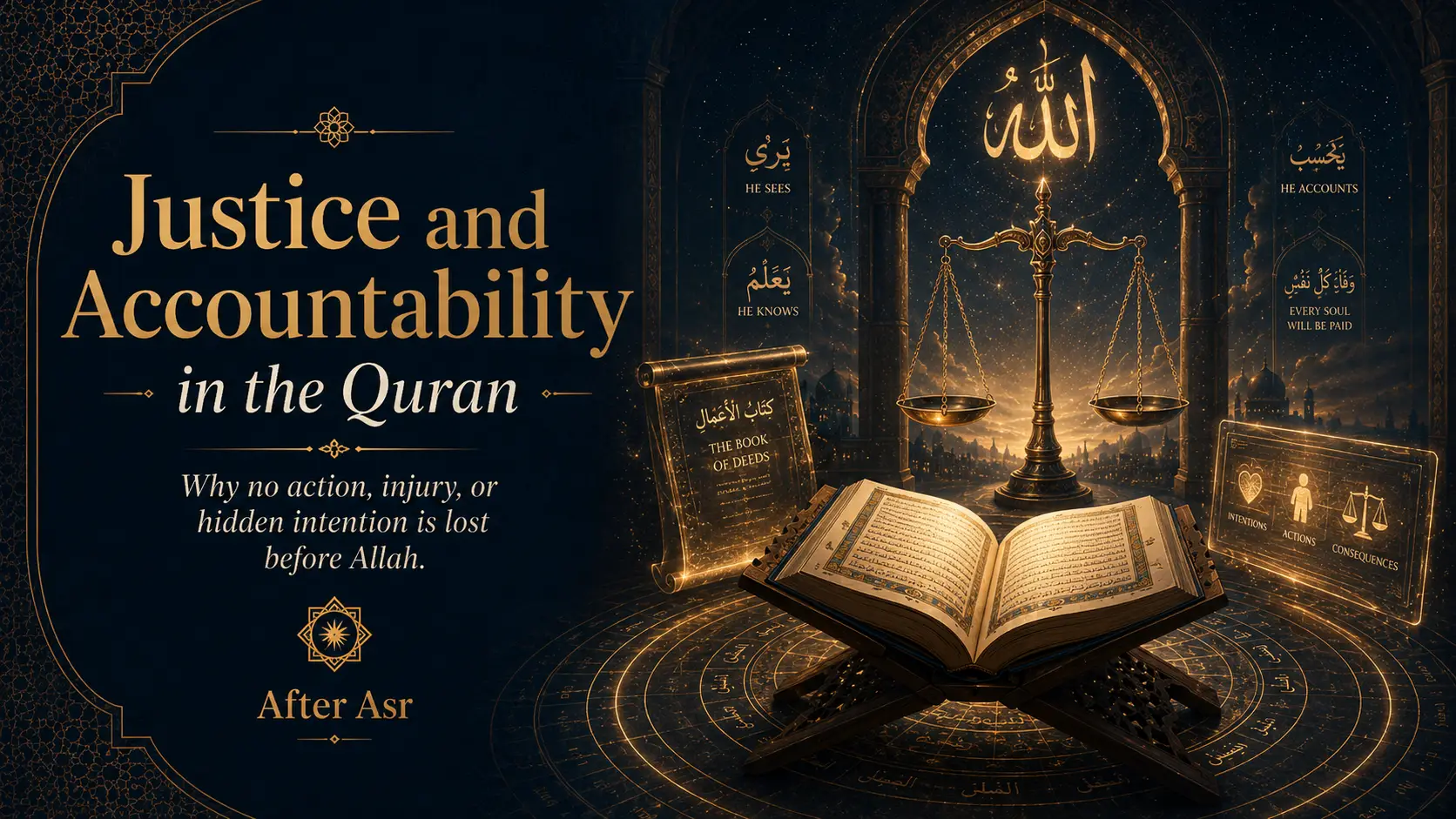
Why no action, injury, or hidden intention is lost before Allah.
Justice in the Quran is not a decorative moral value. It is not a public slogan, a political preference, or a virtue invoked only when convenient. Justice is woven into the Quran’s view of Allah, creation, human responsibility, social life, and the Hereafter. To read the Quran seriously is to encounter a moral universe in which nothing is random, no soul is meaningless, no oppression is invisible, and no human being escapes accountability merely because they were powerful, popular, private, or persuasive.
The Quran teaches that Allah is never unjust. This truth is foundational. It means that reality itself is not morally chaotic, even when human life appears deeply unfair. People may lie and be believed. They may steal and be praised. They may oppress and be protected. They may harm others quietly, leaving wounds that no court ever records. At the same time, others may do good without recognition, endure hardship without applause, forgive without being thanked, and remain sincere while being misunderstood. If this world were the final measure, justice would appear incomplete. The Quran insists that this world is not the final measure.
Accountability is therefore not a threat added to religion to frighten people into obedience. It is the completion of justice. It is the promise that truth does not disappear simply because people bury it. It is the announcement that every human being lives under divine knowledge, and that every deed, intention, harm, restraint, mercy, betrayal, and repentance matters before Allah.
Justice Begins With Allah
The Quranic understanding of justice begins with Allah Himself. Allah commands justice because He is perfectly just. He prohibits oppression because oppression is a violation of the order He has established. He holds people accountable because human life is morally serious. This means justice is not invented by society and then projected onto religion. Justice comes from the Lord who created the human being, knows the human being, and will judge the human being.
This matters because human definitions of justice are often unstable. People tend to demand justice when they are wronged and resist it when they are guilty. Families redefine justice to protect their own. Nations redefine justice to defend their interests. Political groups redefine justice to punish enemies and excuse allies. Individuals redefine justice around their desires, fears, wounds, and ambitions. The Quran challenges this instability by grounding justice in Allah rather than in convenience.
When justice is tied to Allah, it cannot be reduced to revenge, tribal loyalty, public image, or majority opinion. It must answer to something higher than human appetite. The believer is not free to treat justice as a tool to use against others while escaping its demands personally. The Quran calls the human being to a justice that begins before the self, before the family, before the tribe, and before the nation. It is justice under the gaze of Allah.
Accountability Gives Justice Its Horizon
In this life, accountability is often partial. Some wrongs are exposed. Others remain hidden. Some victims are believed. Others are dismissed. Some criminals are punished. Others die honored. Some acts of goodness become famous. Others are known only to Allah. The Quran does not deny this worldly incompleteness. Instead, it places it inside a larger horizon: the Day of Judgment.
The Day of Judgment is the moment when moral reality becomes impossible to evade. It is not merely a courtroom image for individual sins. It is the unveiling of life as it truly was. Public performances fall away. Excuses lose their power. The hidden becomes known. The small becomes weighty. The forgotten returns. The human being sees that life was not being lived in emptiness, but in record, witness, and meaning.
This belief transforms how a Muslim understands both patience and fear. For the wronged, it means that injustice is not final even when worldly systems fail. For the wrongdoer, it means that concealment is not safety. For the sincere, it means that hidden goodness is not wasted. For the arrogant, it means that power was never immunity. Accountability gives justice its full horizon because Allah’s knowledge is complete, His judgment is perfect, and His court cannot be manipulated.
No One Is Above Judgment
The Quran repeatedly warns against the illusion of exception. Human beings often imagine that accountability belongs to other people. The corrupt ruler assumes consequences are for the weak. The wealthy exploiter assumes wealth can purchase protection. The respected religious person assumes public honor can hide private failure. The ordinary sinner assumes delay means escape. The wounded person assumes their pain justifies any cruelty they commit in return.
The Quran breaks these illusions. No title, lineage, office, wealth, beauty, intelligence, tribe, or reputation places a person beyond Allah’s judgment. The human being may enjoy temporary concealment, but concealment is not exemption. A person may avoid criticism, but they have not avoided knowledge. They may avoid punishment, but they have not avoided return.
This is one reason Quranic accountability is so morally powerful. It democratizes the human condition. The king and the laborer, the scholar and the student, the parent and the child, the employer and the employee, the famous and the forgotten all stand as servants before Allah. Their worldly ranks may differ, but their dependence is the same. Their records may differ, but their return is the same. The Quran does not allow human beings to confuse social elevation with spiritual safety.
Justice Must Be Practiced Against the Self
It is easy to love justice as an idea. It is harder to accept justice when it exposes us. The Quranic call to justice is not limited to opposing oppression elsewhere. It includes truthfulness against one’s own ego. A person cannot claim to stand for justice while lying to protect their image, manipulating facts to win arguments, denying harm they caused, or demanding accountability only from people they dislike.
The self is often the first place where justice is betrayed. We excuse our intentions while judging others by outcomes. We minimize our harsh words while remembering every word spoken against us. We demand patience from others while refusing to show it ourselves. We interpret our anger as principle and another person’s anger as character failure. We seek mercy when guilty and strictness when wronged.
The Quran’s moral discipline forces the believer to become suspicious of this double standard. Justice requires a person to ask not only, “Who harmed me?” but also, “Whom have I harmed?” Not only, “Who owes me an apology?” but “What apology am I avoiding?” Not only, “What rights were taken from me?” but “What rights have I neglected?” A Quranic sense of justice begins when the believer allows revelation to judge the self before using it to judge the world.
Justice in Speech
The Quran gives serious attention to speech because speech is one of the most common places where justice is violated. A person may never physically harm another human being, yet destroy reputations, spread suspicion, mock the vulnerable, distort testimony, inflame conflict, or hide truth when speech is required. Words can become instruments of oppression.
Accountability over speech is especially difficult because people often treat words as temporary. They say something in anger, joke with cruelty, pass along a rumor, exaggerate a story, or make a claim without knowledge, then move on as if nothing happened. But the person wounded by those words may carry them for years. A community harmed by false speech may fracture. A family may break. A reputation may never recover.
The Quran teaches that speech must answer to truth, fairness, and accountability. To speak justly means refusing false witness, refusing slander, refusing mockery, refusing selective truth, and refusing the manipulation of language to make wrongdoing sound acceptable. It also means speaking when silence becomes complicity. Justice is not always loud, but it cannot be permanently mute in the face of clear wrongdoing.
Justice in Wealth and Power
The Quran repeatedly addresses wealth because wealth gives human beings both opportunity and danger. Wealth can feed, shelter, educate, heal, support, and uplift. It can also corrupt, distract, exploit, and harden the heart. The moral question is not only whether a person has wealth, but how wealth was gained, how it was used, and what it did to the soul.
Accountability in wealth begins with recognizing that provision is from Allah. A person may work, plan, study, risk, and build, but none of these remove dependence upon the One who grants ability, opportunity, health, and outcome. Wealth is therefore not pure possession. It is trust. The wealthy person is accountable for honesty in earning, fairness in trade, generosity toward those in need, and humility before the Provider.
Power functions similarly. A person with authority over others carries a heavier moral burden. Parents, employers, leaders, teachers, officials, scholars, and community figures all possess forms of power that can be used justly or unjustly. The Quranic worldview does not treat authority as self-justifying. Authority is tested by how it handles those who cannot easily resist it. The true measure of power is not how confidently it commands, but how faithfully it answers to Allah.
The Oppressed Are Not Invisible
One of the most profound elements of Quranic justice is its attention to the oppressed. Human societies often notice suffering selectively. Some victims are easy to sympathize with because they resemble us, benefit us, or fit our preferred narratives. Others are ignored because they are poor, foreign, inconvenient, politically costly, socially disliked, or unable to speak in ways the powerful recognize.
The Quran does not allow moral concern to be limited by convenience. Oppression is not made acceptable because the victim is weak. It is not made acceptable because the oppressor has status. It is not made acceptable because people have grown used to it. Allah knows what human beings conceal, what societies normalize, and what victims are unable to prove.
This knowledge should terrify the oppressor and comfort the oppressed. The one who harms others quietly should not mistake their privacy for safety. The one whose pain is unseen should not mistake human neglect for divine neglect. There are tears no historian records, wounds no institution acknowledges, and injustices no public narrative admits. The Quran teaches that Allah is not unaware of any of it.
Justice Is Not the Same as Cruelty
Because justice involves accountability, people sometimes confuse it with harshness. The Quranic view is more balanced. Justice is not cruelty, vengeance, humiliation, or the pleasure of seeing others fall. Justice is the restoration of right order under Allah. It must be joined with truth, wisdom, mercy, proportion, and fear of exceeding limits.
This distinction matters because human beings can become unjust even while demanding justice. A person wronged by another may begin with a legitimate grievance, then move into exaggeration, slander, revenge, or dehumanization. A community may respond to harm with such uncontrolled anger that it commits new harms. A leader may use the language of accountability to crush criticism. A religious person may use moral correction to satisfy personal harshness.
The Quran disciplines both the wrongdoer and the one responding to wrongdoing. It does not ask believers to ignore injustice. It also does not permit them to become unjust in the name of opposing injustice. The believer must hate oppression without loving cruelty. They must seek accountability without losing taqwa. They must remember that even righteous anger requires guidance.
Mercy Does Not Cancel Accountability
The Quran speaks constantly of Allah’s mercy, forgiveness, and acceptance of repentance. This mercy is not a minor theme. It is central to how believers survive their own failures and return to Allah after sin. But mercy in the Quran is not permission to treat wrongdoing lightly. Mercy does not cancel accountability. It gives the sinner a path back before accountability arrives in its final form.
This distinction is crucial. A person who has sinned should never despair of Allah’s mercy. Despair itself can become a form of misunderstanding Allah. Yet hope in mercy must not become a strategy for continuing harm. Repentance is not merely feeling bad. It involves stopping the wrong, regretting it sincerely, resolving not to return to it, and restoring rights where rights have been violated.
When harm involves other people, accountability becomes more serious. A person cannot simply claim private spirituality while leaving damage unrepaired. Stolen wealth must be returned. False accusations must be corrected. Betrayed trust must be acknowledged. Abuse cannot be hidden under the language of forgiveness. The rights of people are not erased by religious vocabulary. The Quranic path of mercy is real, but it is not cheap.
The Weight of Hidden Intentions
Justice in the Quran reaches deeper than visible action. Human beings judge mostly by what appears. Allah knows what is concealed. This gives Quranic accountability a depth no human system can match. Two people may perform the same outward act while standing in very different realities before Allah. One gives charity sincerely, another for reputation. One speaks truth to protect the vulnerable, another to humiliate an enemy. One remains silent out of wisdom, another out of cowardice. One apologizes sincerely, another to regain control.
The knowledge that Allah sees intentions should make the believer both careful and hopeful. Careful, because public goodness is not enough if the heart is diseased by arrogance, showing off, envy, or manipulation. Hopeful, because sincere acts unknown to people are not lost. A small deed done purely for Allah may outweigh a public act polluted by ego.
This inward accountability is one of the Quran’s great moral interventions. It prevents religion from becoming mere performance. It tells the believer that Allah is not fooled by the image others admire. It also tells the believer that Allah knows the sincerity others fail to notice. Human judgment is limited. Divine judgment is complete.
Patience Is Not Passivity
The Quran often praises patience, but patience should not be misunderstood as passive acceptance of injustice. Sabr is not surrender to oppression as though oppression itself were acceptable. It is steadfastness in obedience to Allah during difficulty. Sometimes patience means enduring what cannot be changed without losing faith. Sometimes it means restraining the self from sinful retaliation. Sometimes it means continuing the work of justice when results are delayed. Sometimes it means speaking the truth with discipline rather than rage.
A person can be patient and still seek their rights. A community can be patient and still oppose oppression. A believer can trust Allah’s final judgment and still work for justice in this world. The Quran does not create a false choice between spiritual reliance and moral action. It teaches that both must be governed by Allah.
This matters because oppressors often prefer a distorted version of patience. They want the wronged to be quiet, forgiving, and religiously obedient in a way that protects the oppressor from accountability. The Quranic vision does not serve that agenda. It calls the wronged to dignity, restraint, and trust in Allah, but it does not sanctify abuse or require victims to pretend that harm is righteousness.
Social Justice Begins With Moral Truth
The Quran addresses society, but it does not reduce justice to external systems alone. Laws matter. Institutions matter. Courts matter. Economic arrangements matter. Public norms matter. Yet all of these are shaped by human beings whose hearts may be truthful or corrupt. A society cannot be just if its people are committed to lying, greed, arrogance, tribalism, and the worship of power.
For this reason, Quranic justice begins with moral truth. It reforms the person and the society together. It commands fairness in testimony, honesty in trade, care for the poor, protection of orphans, fulfillment of contracts, respect for family rights, restraint in conflict, and accountability for rulers and communities. But it also addresses envy, pride, hypocrisy, heedlessness, and the diseases that make injustice attractive.
Modern discussions of justice sometimes focus heavily on structures, while personal morality is treated as secondary. Other discussions focus heavily on personal morality, while structures of harm are ignored. The Quran gives neither reduction. It knows that unjust hearts build unjust systems, and unjust systems train hearts toward further corruption. Revelation addresses both.
Accountability Should Make Us Humble
The believer’s awareness of accountability should not produce arrogance. It should produce humility. A person who believes in the Day of Judgment should be careful about claiming purity for themselves. They should fear their own record before obsessing over the records of others. They should correct wrongdoing where needed, but without imagining that they stand outside the need for mercy.
This humility is essential for anyone who speaks about justice. The moment a person begins to enjoy condemning others more than they fear Allah for themselves, their moral clarity is in danger. The Quran warns, but it also turns the warning back upon the reader. It does not allow the believer to become a spectator watching other people fail. It makes every reader a participant in the drama of accountability.
The question is not only whether unjust people will answer to Allah. They will. The question is also whether we have been just in our own homes, workplaces, communities, speech, spending, desires, and private lives. The Day of Judgment is not only a doctrine about tyrants and criminals. It is a reality for every soul.
The Promise That Nothing Is Lost
For all its warnings, Quranic accountability also carries immense comfort. Nothing done for Allah is lost. No sincere restraint is wasted. No private act of worship disappears. No tear of repentance is meaningless. No pain endured with faith is overlooked. No injustice suffered patiently under Allah’s gaze is forgotten. The same divine knowledge that exposes the oppressor also preserves the hidden good of the believer.
This is especially important in a world obsessed with visibility. People often feel that if their work is not recognized, it has no value. If their pain is not acknowledged, it has no meaning. If their sacrifice is not praised, it has disappeared. The Quran frees the believer from this tyranny of visibility. Allah sees what people do not see. Allah knows what people misread. Allah preserves what people forget.
A believer may live and die unknown to the world while being known in the heavens. This is not poetic exaggeration. It is a core part of the Quranic worldview. The scale of Allah is not the scale of the crowd.
Conclusion
Justice and accountability in the Quran are inseparable. Justice tells us that life has moral order. Accountability tells us that this moral order will be completed. Together, they form a worldview in which the human being cannot treat action as meaningless, power as permission, privacy as escape, or delay as denial.
The Quran teaches that Allah is never unjust, that human beings are responsible, that oppression is seen, that intentions matter, that mercy remains open, and that the Day of Judgment will reveal what this world concealed. This belief should make the oppressor afraid, the wronged patient, the sinner hopeful, the powerful humble, the sincere comforted, and the believer serious about every trust.
To live under Quranic accountability is not to live in despair. It is to live awake. It is to know that every choice moves toward Allah, that every right matters, that every hidden thing is known, and that every soul will meet the truth of what it sent forward.
The Quran does not allow us to imagine a universe where injustice wins forever.
It tells us that Allah sees.
It tells us that Allah knows.
It tells us that Allah judges with perfect justice.
And it tells us, before that Day arrives, to become people who fear being unjust more than we fear being exposed.