
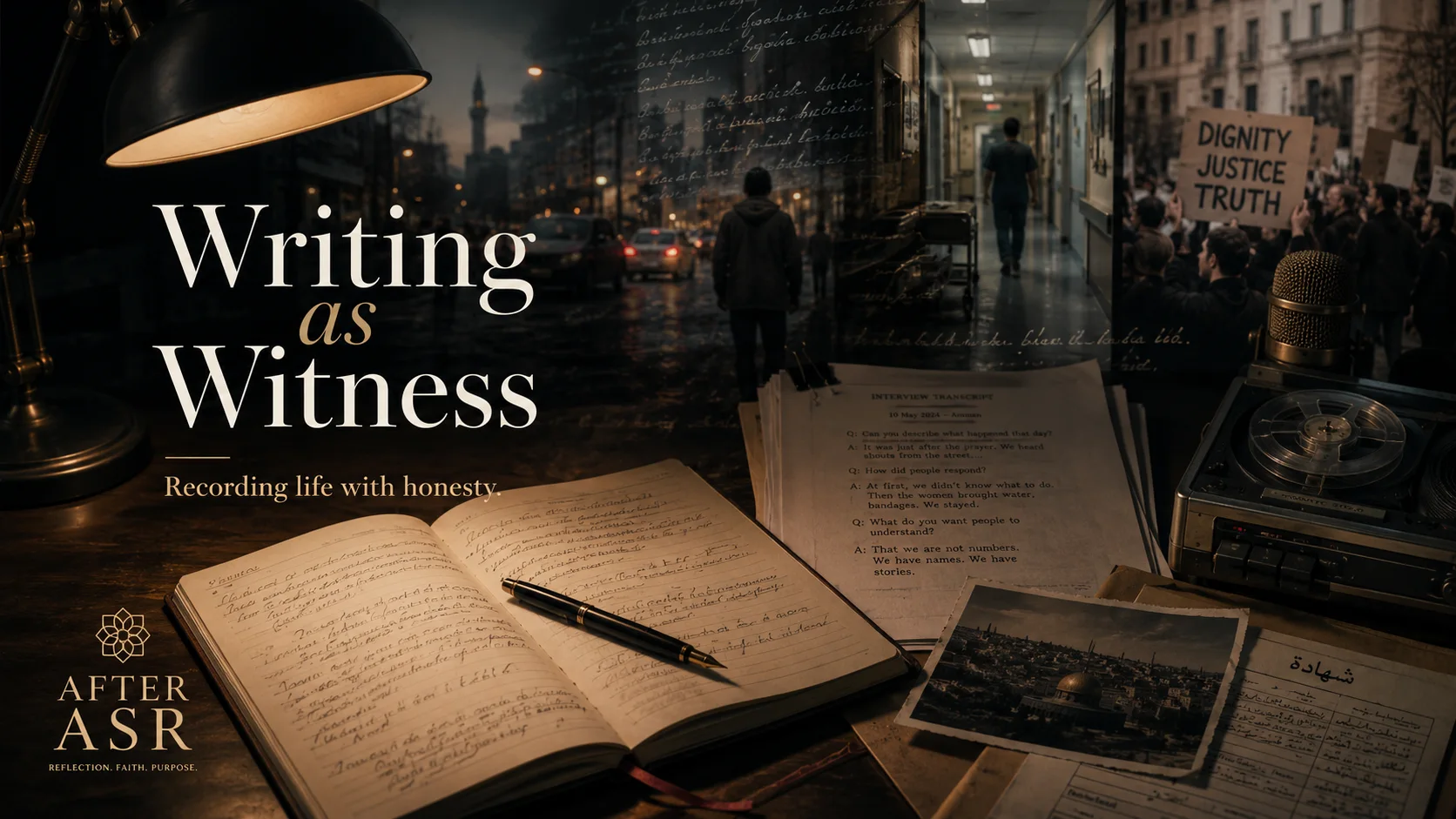
Recording life with honesty.
A writer does not have to stand at the center of history to bear witness.
They may be sitting in a hospital waiting room, noticing how families learn to speak softly around fear. They may be recording the memory of a grandmother whose village no longer exists as she knew it. They may be reporting from a courtroom, a protest, a famine, a floodplain, or a city block where eviction notices have appeared on too many doors at once. They may be writing about their own life with enough honesty to refuse the flattering version. They may be trying to preserve the name of something people around them have been trained not to see.
Witness begins with attention.
Not performance. Not proximity to suffering as a form of status. Not the rushed conversion of pain into prose. Attention. The disciplined act of noticing what is there, what is being hidden, what is being normalized, what may later be denied, and what deserves to be remembered because human beings passed through it.
Writing as witness matters because life is constantly at risk of being misdescribed.
Power misdescribes. Distance misdescribes. Nostalgia misdescribes. Ideology misdescribes. Even love can misdescribe when it becomes unwilling to name harm. The writer who bears witness does not claim perfect neutrality or total comprehension. They accept a more demanding task: to record as honestly as they can, with enough precision that the reader encounters reality rather than the writer’s self-importance.
This kind of writing has many forms. Testimony. Memoir. Reporting. Documentary prose. Oral history. Poetry. Fiction shaped by historical consciousness. A diary kept during upheaval. A letter from prison. A community archive. A personal essay that refuses to turn suffering into ornament. Their methods differ. Their authority differs. Their relation to fact differs. But they share a moral impulse: this happened, or this is happening, and it should not be allowed to vanish under silence, abstraction, or convenient distortion.
Witness writing does not guarantee justice. Records can be ignored. Testimony can be disbelieved. Books can be censored, buried, or praised without being heeded. Yet the absence of witness leaves injustice more comfortable. It permits the powerful to narrate events uncontested. It allows ordinary life, especially the life of those outside prestige and institutional memory, to disappear before anyone thinks to preserve it.
To write as witness is to refuse that disappearance.
Witness Is More Than Observation
Seeing something is not the same as bearing witness to it.
A passerby may observe a man being humiliated at a checkout counter and feel uncomfortable. A witness carries the scene inward, recognizes its significance, and if called upon, names what occurred without embellishment or evasion. In writing, the distinction is similar. Witness does not mean simply having been near an event. It means accepting responsibility for how one represents it.
This responsibility is visible in formal testimony archives. The USC Shoah Foundation describes its Visual History Archive, now the largest collection of genocide witness testimony in the world, as an effort to preserve and share survivor and witness voices so that future generations may encounter them directly. Yale’s Fortunoff Video Archive likewise holds thousands of Holocaust survivor and witness testimonies, preserving not only facts about events but the voices, pauses, emotional textures, and personal memories through which history becomes humanly graspable.
The importance of such archives lies partly in evidence, but not only there. They also resist a second death: the reduction of lives to numbers, categories, or footnotes. A statistic may tell us how many were deported. Testimony tells us who was holding whose hand at the train station, who hid bread, who stopped speaking after liberation, who remembered a song, who still could not explain why they survived when others did not.
Witness writing often moves between the factual and the intimate. Its task is not merely to confirm that suffering occurred. It is to preserve the human reality of that suffering against the forces that would make it abstract.
Why Societies Need Witnesses
Every society produces official stories about itself.
It remembers certain achievements vividly and certain failures selectively. It commemorates some victims and neglects others. It teaches some histories in schools and leaves others to families, activists, religious communities, and local memory. This is not always conspiratorial. Collective memory is inevitably selective. No society can narrate everything.
But selective memory becomes dangerous when it protects comfort at the expense of truth.
Witness writing disrupts that protection. It says: there is another account. There was another experience. The policy you call reform was lived by someone as dispossession. The war you summarize through strategy was lived by someone as the disappearance of a father. The economic downturn you chart in percentages was lived by a child noticing that dinner had become quieter.
UNESCO’s work on oral histories and audiovisual heritage emphasizes that community archives preserve not only records of the past, but forms of lived memory that deepen understanding across cultures and generations. Its recent documentation of family archives and oral histories in AlUla, Saudi Arabia, underscores how recording ordinary lives helps protect experiences that might otherwise be lost outside formal institutions.
The writer as witness participates in this larger preservation. They may not be building an archive in the institutional sense, but they are resisting erasure. They are placing life into language before indifference, death, or deliberate distortion can remove it from view.
This matters especially for communities whose experiences have been neglected, stereotyped, or filtered through outsiders. To witness one’s own world honestly is not provincial. It is one of the ways literature corrects the imbalance of who gets to define reality.
Honesty Is Not the Same as Exposure
Writing as witness is often praised for its courage in “telling all.” But honesty should not be confused with indiscriminate disclosure.
Not everything one knows is one’s right to publish. Not every wound becomes public property because a writer has observed it. A grieving person’s face, a child’s confusion, a family’s private shame, a victim’s vulnerable testimony, and a community’s intimate rituals require care. Witness is not extraction.
Journalism ethics has wrestled extensively with this problem. Scholarship on “citizen witnessing” and crisis imagery warns that the impulse to show suffering can conflict with the dignity of those being shown, particularly in digital environments where images circulate beyond context and beyond the control of the people depicted. More recent work on portrayals of death and suffering likewise stresses that the duty to bear witness must be balanced against the duty not to sensationalize or instrumentalize pain.
Writers face a parallel duty. They must ask:
- Am I recording this because it deserves remembrance, or because pain gives my work emotional force?
- Have I preserved the person’s dignity, or turned them into material?
- Does the detail clarify reality, or merely intensify the scene?
- Who pays the cost of my candor?
Honesty sometimes requires naming what others prefer hidden. It may require writing about abuse, state violence, communal hypocrisy, exploitation, or spiritual injury. Silence can protect the wrong people. But honesty also requires restraint. It refuses to confuse detail with truthfulness. A scene can be explicit and still false in spirit. Another can be restrained and devastatingly accurate.
Witness writing is not strongest when it reveals the most. It is strongest when it reveals what matters.
The Witness Must Resist Self-Centering
A strange temptation accompanies writing about difficult realities: the writer can begin to make their own witnessing the main event.
They were there. They saw it. They dared to tell it. Their courage becomes the story. The suffering they record becomes the background against which their sensitivity shines.
This distortion is subtle because it often hides inside sincere feeling. A writer may be deeply moved by what they witness and still overoccupy the frame. A journalist may write about a devastated community but devote too much attention to their own shock. A memoirist may recount another person’s pain primarily as a turning point in the memoirist’s self-understanding. A poet may aestheticize the wound until the wound serves the poem more than the person.
Writing as witness requires humility. The writer is not absent, but they are not always central. Their position matters because it shapes what they could see and what they could not. Their limitations should be acknowledged. Their presence may be ethically relevant. But witness writing should resist the conversion of attention into vanity.
The point is not, “Look what I endured by seeing this.”
The point is, “Look carefully at what happened.”
That distinction protects the work from becoming morally inverted.
Testimony Is Powerful, and Memory Is Fragile
Witness writing often relies on memory. This gives it force and vulnerability at once.
Memory is not a perfect recording device. Contemporary cognitive science continues to emphasize that eyewitness memory can be contaminated by stress, suggestion, repeated retelling, and flawed collection procedures. At the same time, researchers caution against the simplistic conclusion that eyewitness memory is merely useless; under careful conditions and when gathered early, it can remain critically valuable.
This matters for literary and documentary witness. The fact that memory is reconstructive does not make testimony meaningless. Nor does the moral seriousness of testimony make every remembered detail infallible. A mature culture must be able to hold both truths.
A survivor may misremember the exact date of an event and still convey, with piercing accuracy, the terror of living through it. A writer may recall the emotional atmosphere of childhood with greater confidence than the order of every scene. An oral history may preserve community memory while requiring corroboration for certain factual claims. These distinctions do not degrade witness. They dignify it by treating it seriously rather than sentimentally.
The honest writer does not pretend memory is a transcript. They may signal uncertainty. They may distinguish what they saw from what they later learned. They may write, “I remember,” rather than “It was exactly so,” when memory demands that humility.
Witness becomes more trustworthy, not less, when it admits the edges of its knowledge.
The Ordinary Also Requires Witness
When people hear the word witness, they often imagine catastrophe: genocide, war, imprisonment, displacement, disaster. These are central forms of witness writing, and rightly so. But ordinary life also requires recording.
A society is not made only of crises. It is made of how people speak at dinner, how a mother folds school uniforms, how men gather outside a convenience store after night prayer, how a neighborhood changes when rents rise, how elderly immigrants preserve phrases their grandchildren half understand, how a young convert feels in the first Ramadan when everything is new and no family tradition yet surrounds them.
These details may seem small. They are not.
Ordinary life vanishes with astonishing speed. The common speech of one generation becomes quaint in the next. A local shop closes, and with it disappears a social world no census counted. A community’s humor changes. A prayer room becomes a mosque. A mosque becomes an institution. The early improvisations fade unless someone writes them down.
Witnessing ordinary life is not lesser than witnessing crisis. It serves a different function. It preserves texture. It tells future readers not only what happened, but what it felt like to be alive in a particular place before the world moved on.
UNESCO’s oral heritage work has long emphasized the preservation of intangible cultural expressions and spoken memory, recognizing that communities transmit history, values, and identity through forms that may never enter formal print culture unless deliberately recorded.
The writer who records the ordinary may be preserving a civilization in miniature.
Witness Against Sanitized Language
One of the writer’s responsibilities is to resist words that make harm easier to accept.
Institutions often describe life-altering events in bloodless language. People are “displaced,” “processed,” “separated,” “terminated,” “collateral,” “noncompliant,” “housing insecure.” Some of these terms have legitimate technical uses. But they can also create distance between action and consequence.
Witness writing returns the human being to the sentence.
Instead of “families were displaced,” it may show a woman sleeping in her car beside plastic bags containing what could be saved. Instead of “civilian infrastructure was affected,” it may describe a boy studying under a stairwell because the school is gone. Instead of “workers were laid off,” it may show someone rehearsing how to explain the news at home without alarming their children.
This is not sentimental excess. It is linguistic repair.
The witness writer knows that euphemism can be an accomplice to indifference. They do not exaggerate. They make visible what abstraction has concealed.
Writing Can Preserve What Denial Will Later Attack
Some events are denied almost as soon as they occur. Others are gradually minimized over time. Witness records become crucial in both circumstances.
Testimonies, diaries, photographs, letters, and literary works created near the time of atrocity or upheaval can later stand against revisionism. They may not settle every historical question by themselves, but they make denial harder. They prove that someone saw, someone remembered, someone cared enough to record.
The USC Shoah Foundation’s stated mission to preserve testimonies for future generations reflects precisely this concern. As living witnesses to the Holocaust pass away, archived testimony remains a defense against ignorance, distortion, and denial.
Writing as witness shares that urgency. It is not always clear which details future generations will need. A diarist during war may not know which ordinary observation will later help historians understand civilian life. A reporter covering a protest may not know that one conversation will reveal the moral atmosphere of a movement better than the day’s headline. A community essayist may not know that their description of a disappearing neighborhood will become a record of loss no official planning document captured.
Witness writes partly for the present. It also writes against future amnesia.
The Witness Does Not Own the Story
To witness another life is not to possess it.
A writer may be entrusted with someone’s account, but the account does not become the writer’s property in a moral sense. Testimony creates obligations. Consent matters. Context matters. Attribution matters. The writer should not rearrange another person’s suffering into a cleaner narrative simply because art prefers shape.
This is difficult. Writing requires structure. Events rarely arrive with literary pacing. People speak messily. Memory circles. Lives resist neat endings. The temptation to tidy is strong.
But witness writing must be careful with resolution. Not every story closes. Not every injustice produces redemption. Not every survivor wants to be made into an emblem of resilience. Not every death carries a lesson acceptable to those who loved the person. To impose uplift where there is only devastation may comfort readers at the expense of truth.
Honesty sometimes means refusing the ending that would make the piece more satisfying.
Fiction Can Witness, but Differently
Witness writing is often associated with nonfiction, and for good reason. Testimony, reportage, memoir, and documentary prose make claims about actual events. Their credibility depends on factual integrity.
Yet fiction can also bear witness, provided we are precise about what kind of witness it offers.
A novel may not testify to specific events in the evidentiary sense. But it can witness to conditions of life, social patterns, moral climates, and psychological realities that conventional records fail to convey. Scholarship on fiction and testimony, especially in relation to Holocaust and trauma studies, continues to examine this difficult boundary: fiction can approach testimonial truth while also raising serious questions about invention, authority, and corroboration.
A novel about occupation may create composite characters, yet reveal the texture of waiting at checkpoints, the distortions of daily routine under surveillance, the way children learn political vocabulary before they are old enough to understand it. A fictional account of factory work may bear witness to exhaustion, hierarchy, and bodily strain even if no single character corresponds to a historical individual.
The danger is real. Fiction can falsely claim the authority of witness. It can aestheticize suffering or overwrite lived testimony. But fiction can also refuse the false neatness of public narratives and carry truths that are experiential rather than documentary.
The key is honesty about genre. Fiction should not be mistaken for proof. Nonfiction should not borrow fiction’s freedoms while pretending otherwise. Each form has power. Each has limits.
The Writer Must Notice Their Own Blindness
No witness sees everything.
A reporter arrives with a deadline, a background, a language, a set of questions, and often a degree of institutional distance. A memoirist is inside the story but limited by self-knowledge. A poet may feel the truth of an event but not its full context. A scholar may know the archive and miss the trembling life around it.
Honest witness writing therefore includes self-suspicion. It asks:
- What did I not understand at the time?
- Who was not speaking to me?
- What assumptions shaped my attention?
- What detail did I treat as incidental because it did not fit my frame?
- What would someone else present at the same scene say I missed?
This is not paralysis. It is rigor.
A writer who pretends omniscience becomes less trustworthy. A writer who acknowledges perspective may become more so. The task is not to erase the self from the page. That is impossible. The task is to make one’s position legible enough that the reader can understand the conditions of the witnessing.
The strongest witness writing often carries both conviction and humility: this matters, this happened, this is what I saw, this is what I came to understand, and this is where my knowledge ends.
Muslim Traditions Know the Weight of Testimony
For Muslim readers, the moral seriousness of witness is deeply familiar.
The Qur’an repeatedly speaks about testimony, justice, and the obligation not to conceal what one knows. Believers are commanded to stand firmly for justice as witnesses for God, even against themselves, parents, or close relatives. Elsewhere, the Qur’an warns against concealing testimony. These verses concern legal and moral truthfulness, not literary craft, but they establish a profound principle: witness is an ethical trust, not a casual possession. (quran.com) (quran.com)
A Muslim approach to writing as witness can draw from that seriousness. It should resist falsehood even when falsehood protects our side. It should resist exaggeration even when exaggeration strengthens a cause we support. It should refuse to exploit the vulnerable, because witness without mercy becomes another form of violation. It should also refuse cowardly silence when truth needs record.
There are times when writing becomes a form of amanah, a trust. The writer has seen something, learned something, been told something, or lived something that should not be surrendered to oblivion. They must decide how to carry it faithfully.
Not every experience must be published. But when one chooses to write as witness, the ethical demand is high.
The Cost of Bearing Witness
Witnessing is not emotionally neutral.
Journalists covering war, human rights abuses, and catastrophe can experience moral distress, helplessness, and trauma. Recent discussions of modern journalism increasingly acknowledge that repeatedly documenting suffering has psychological consequences, especially when reporters are expected to remain composed while confronting human devastation.
Writers outside journalism may experience related burdens. Oral historians listening to traumatic testimony. Essayists revisiting family harm. Memoirists reconstructing abuse. Poets carrying images they cannot set down. Witness writing can become a form of secondary exposure to pain, or a return to one’s own.
This cost does not make the work noble automatically. Suffering while writing does not sanctify the writing. But acknowledging the cost helps resist romanticism. Bearing witness is not glamorous. It can be exhausting, ethically fraught, and lonely. It may leave the writer wondering whether words are enough.
They are not enough. But they are not nothing.
Words may not stop the harm. They can prevent the harm from being narrated solely by those who caused it.
What Honest Witness Leaves Behind
Writing as witness rarely resolves what it records.
A testimony does not undo the crime. A memoir does not restore childhood. A report does not by itself change policy. A poem does not resurrect the dead. The writer works under the shadow of insufficiency.
Yet insufficiency is not futility.
A truthful account may reach someone who had been taught not to believe. It may give language to another person’s unspoken experience. It may enter an archive and serve historians decades later. It may preserve dignity where the public record offered only statistics. It may make denial less comfortable. It may help a community remember itself. It may stand as a quiet rebuke to the idea that only the powerful deserve to narrate the world.
Witness writing says: a life was here. A harm occurred. A tenderness existed. A contradiction mattered. A person resisted. A community mourned. Someone saw enough to write, and wrote carefully enough that forgetting would not have the final word.
That is not everything.
But it is a serious human act.