What moves and what remains.
A sentence crossing from one language into another never arrives untouched.
It may keep its meaning. It may preserve its image, its argument, its tenderness, even its force. A reader who cannot access the original may still be shaken by it, comforted by it, altered by it. Translation makes this possible. It opens rooms that would otherwise remain closed. It lets a Persian poem speak to a reader in Detroit, a Japanese novel unsettle someone in Marrakesh, a Bengali story accompany a student in London, an Arabic memoir enter the life of someone who has never heard the language spoken aloud.
Translation is one of literature’s great acts of hospitality.
But hospitality is not replication. Something changes at the threshold.
A joke may explain itself too slowly in the new language. A rhyme may vanish. A single verb carrying tenderness, hierarchy, and cultural memory may be rendered by an English word that communicates the action but not the atmosphere. A phrase that sounds ordinary in one language may sound ceremonial in another. A sentence built to unfold with suspense may become stiff if its grammar is followed too closely, or too casual if it is remade for ease.
The translated work is not a counterfeit. It is not a failure because it differs. Yet neither is it the original wearing new clothes. It is a second life, dependent on the first and newly vulnerable in its own way.
To think seriously about translation is to think about loss without despair. It is to ask what can move between languages, what resists passage, and what the act of carrying itself reveals about the value of words.
Translation Is Not Duplication
Many readers first imagine translation as substitution. This word becomes that word. This sentence becomes that sentence. The translator’s task, in this view, is to replace one linguistic surface with another while leaving the contents undisturbed.
Literary translation quickly breaks that illusion.
Languages do not divide the world in identical ways. They differ in grammar, rhythm, metaphor, register, politeness, humor, and what they leave unsaid. Even when two words appear to match in a dictionary, they may live differently within their respective languages. A word can carry class associations, scriptural echoes, childhood intimacy, bureaucratic coldness, or comic exaggeration that cannot be transferred through a one-word exchange.
Translation studies often describe a tension between fidelity, the attempt to preserve the source text’s meaning, and transparency, the attempt to make the translation read naturally in the receiving language. Both matter. A translation that is scrupulously literal may become unreadable. A translation that flows beautifully may smooth away the strangeness and structure that made the original itself. (research.ncl.ac.uk)
This is why translation is not clerical labor. It is judgment.
The translator must decide what the reader most needs to receive. Is the sentence’s precision more important than its ease? Does the image need to remain foreign, or should it be gently contextualized? Should the pun be replaced with another pun, explained in a note, or surrendered? Should the rhythm of the original guide the English sentence even if the result sounds unusual? Should a cultural term remain visible rather than being flattened into a partial equivalent?
There is no single answer because no text asks the same thing. A legal document, a children’s story, a lyric poem, a novel, a sermon, and a sacred text do not place identical burdens on the translator. Translation begins in language, but it becomes an ethics of attention. The translator is always asking: What must not be casually lost?
What Moves
Much can move.
Plot moves. A betrayal, a homecoming, a mother waiting at a window, a boy lying to spare his father’s pride, a woman realizing that the life admired by others has left her spiritually empty. These can cross languages with astonishing force. Human beings do not require identical idioms to recognize jealousy, shame, longing, courage, or regret.
Images move. A candle guttering in an empty room. Rain on a tin roof. Hands stained with ink. A road disappearing into dust. Even when the image’s cultural setting is unfamiliar, its sensory life can reach the reader.
Moral tension moves. A character must choose between loyalty and truth. A government speaks in euphemism while families bury the consequences. A person who has suffered begins to mistake bitterness for strength. These patterns travel because they belong not only to one language, but to human action.
Tone can move, though rarely without effort. A good translator can preserve reserve, urgency, austerity, tenderness, irony, or dread. The tone may not be identical, but it can be ethically equivalent. It can teach the new reader how to approach the work.
Even silence can move. A paragraph may end without explaining itself. A character may answer indirectly. A poem may leave a final image open. The translator who respects such restraint allows the translated work to keep its shadows.
This is translation’s miracle. It proves that literature is not imprisoned inside the exact language of its birth. Meaning has a mobility of its own. A reader far from the original setting can still be pierced by the scene, troubled by the question, moved to reread a page because something in it has become personal.
Without translation, most of world literature would remain local to those born into its languages. With translation, the world’s libraries become more porous.
What Does Not Move Intact
Yet something is always altered.
Sound is among the first casualties. Poetry makes this especially clear. A poem’s meaning may reside not only in what the words denote, but in their music, the rhythm of syllables, the recurrence of consonants, the suspension before a rhyme, the way a vowel opens or darkens the line. Poetry scholars and translators have long noted that rhythm, sound, linguistic impact, and cultural-historical texture cannot simply be transferred intact from one language to another. (exchanges.uiowa.edu)
A translator may create new music, but it will not be the same music.
Wordplay also resists travel. A pun depends on an accident of language. A proverb may carry centuries of use in six words. A children’s rhyme may rely on nonsense sounds beloved precisely because they belong to childhood memory, not adult analysis. To translate these literally can be deadening. To reinvent them can be bold, but boldness changes the work.
Syntax can carry meaning too. Some languages comfortably delay the verb, creating suspense by grammar alone. Others shift emphasis through word order with a fluidity English cannot reproduce without sounding theatrical. A poet may use formal address in one sentence and intimate address in the next, signaling emotional movement that English, with its single “you,” may struggle to show without explanation.
Historical resonance is even harder. A word may echo scripture, empire, folk song, regional dialect, nationalist propaganda, or a mother’s lullaby. To speakers of the original language, the echo may arrive instantly. In translation, it may require a footnote, and a footnote can inform the intellect without recreating the sensation of recognition.
This is not a defect in translation. It is a truth about language.
Words are not empty containers transporting detachable content. They are shaped by histories of use. They belong to voices, regions, rituals, schools, jokes, insults, and prayers. When a work is translated, its meaning may cross. Its entire linguistic weather cannot.
The Honest Translator Does Not Pretend There Is No Loss
There is a sentimental way of praising translation that speaks only of bridges, access, and unity. These are real. But translation should not be honored by denying the cost of what it does.
A faithful translation does not eliminate loss. It manages loss responsibly.
Every translation chooses its sacrifices. A poem may preserve imagery at the expense of meter. Another may preserve rhythm while loosening literal precision. A novel may keep foreign terms visible to preserve cultural texture, risking distance for some readers. Another may translate more aggressively into familiar idiom, gaining immediacy while losing some strangeness. The best choice depends on the work, the audience, and the translator’s understanding of what is essential.
This is why two translations of the same book can feel strikingly different while both remain serious. One may be lean and literal. Another lush and interpretive. One may keep the reader aware that the story comes from elsewhere. Another may pull the reader quickly into emotional intimacy. Translation is not merely a pass-fail examination of accuracy. It is an argument about what the original most urgently needs to become in another language.
That argument should be visible enough to respect. Translators’ notes, prefaces, and introductions matter because they acknowledge the choices behind the page. They remind us that fluency is not invisibility. Someone has labored to make the encounter possible.
A culture that treats translation as transparent service risks devaluing both the translator and the original. It wants access without noticing mediation. But mediation is not shameful. It is the very substance of the work.
Sometimes Loss Reveals Value
Loss is not only lamentable. It can also teach.
When a translated line feels beautiful, then we later learn that the original contains an additional play of sound or meaning we did not receive, the knowledge need not invalidate our experience. It can deepen reverence. It reminds us that the work is larger than the version we encountered.
Translation sometimes makes readers aware of the irreducible dignity of the original language. A person who loves Rilke in English may begin to wonder about German. A reader moved by Mahmoud Darwish in translation may become newly conscious that Arabic cadence and wordplay lie behind the lines like a second light. A Muslim who reads Qur’anic translations may be drawn toward the Arabic not because the translation failed entirely, but because it succeeded enough to reveal that there is more.
Many English-language Qur’an editions are explicitly presented as an interpretation of the meanings, a phrasing that reflects a longstanding Muslim caution: translation can communicate meaning, but it does not replace the Arabic Qur’an itself. This distinction is not a rejection of translation. It is an acknowledgment of what sacred language, recitation, rhetorical structure, and interpretive depth mean in Islam. (darussalamstore.com)
The same principle, in a non-sacred and different register, applies to literature. A translation can be genuinely powerful without being exhaustive. It can bring us near without erasing distance. It can offer access without pretending to abolition of difference.
There is humility in this. A translated work says, in effect: here is something real, carried as faithfully as possible, but the source remains more than what has arrived.
Translation Is Also Creation
If translation only lost, it would be a melancholy enterprise. But translation also makes.
It makes a new work in a new language. Not an independent work, not a replacement, but a literary form with its own cadence, its own relation to readers, its own capacity to endure. Generations may meet a book first through translation and carry phrases from that translation as part of their own intellectual or emotional formation.
A translated sentence can become unforgettable in the receiving language. It may not sound exactly like the original. It may even reveal an aspect of the work that becomes newly visible through the angle of another tongue. Languages do not merely subtract from one another. They illuminate differently.
This is why translation has often been described less as copying than as re-creation or interpretation. The translator does not simply transport meaning. They read the work with extraordinary intensity, decide what its life depends upon, and then build a corresponding experience under altered conditions. The process requires humility before the source and artistry within the target language.
A literal translation may preserve the bones of a sentence but not its pulse. A great translation finds some form of pulse again.
There is a moral beauty in that. The translator accepts that perfect transfer is impossible and still refuses despair. They work within limitation, not as an excuse for carelessness, but as the condition that makes care necessary.
The Bilingual Reader Knows the Ache
Those who live between languages often understand translation’s grief most intimately.
A child whose parents speak one language at home and another outside it knows that not every joke survives school. A migrant may find that the word used for a beloved food, ritual, or family relation becomes strangely flat when explained to colleagues. A bilingual adult may struggle to translate a parent’s tenderness because the tone of the phrase matters more than its dictionary meaning. Even a familiar expression of affection can sound too formal, too childish, or too sentimental once moved into another language.
This is not only a literary problem. It is a life problem.
People translate themselves constantly. They translate customs for institutions, family expectations for friends, grief for therapists, faith for strangers, humor for those who do not know the reference, anger into a tone deemed acceptable. Much is communicated. Something remains lodged in the original.
That remainder can ache.
A person may feel misunderstood not because others have refused to listen, but because there was no clean equivalent available. The sentence crossed. The world behind it did not.
Literary translation gives form to this experience. It reveals that the inability to say everything in another language is not a personal failure. It is part of what languages are. Each carries its own archive of intimacy. Each teaches the mouth different ways to approach shame, reverence, longing, and joy.
To translate is to honor the desire to be understood while respecting the fact that full transfer is rare.
Culture Does Not Cross as Decoration
Some translations fail not because the words are wrong, but because the cultural life of the text has been thinned out.
A wedding becomes a party. An elder becomes an old person. A religious greeting becomes hello. A market vendor’s dialect becomes generic colloquial speech. A gesture of deference becomes politeness. Each choice may make the sentence more accessible. Taken together, such choices can strip the work of its world.
This is especially dangerous when translating literature from cultures already treated as exotic or marginal. There is pressure to make the work smooth for dominant-language readers, to reduce friction, to explain everything that might seem strange, or to normalize details that would otherwise challenge the reader’s sense of what ordinary life looks like.
But strangeness is not always an obstacle. Sometimes it is part of the reader’s education.
A responsible translation need not preserve every unfamiliar term. It also need not domesticate the work until it feels written from nowhere. The translator must decide when clarity serves the text and when excessive ease betrays it. The receiving reader has responsibilities too. They may need to tolerate not knowing immediately. They may need to infer from context. They may need to accept that literature from elsewhere does not exist solely to reassure them.
Translation offers access. It should not always offer comfort.
Poetry Makes the Problem Visible
All literary translation involves negotiation, but poetry dramatizes it.
A poem may be built from compression. Every word bears more than its literal meaning. Sound and sense work together. A repeated consonant may echo rain, breath, bells, marching, or hesitation. A short line may feel abrupt in one language and gracelessly bare in another. A metaphor that seems startling but natural in the source language may sound overwrought in translation, or become disappointingly plain if explained.
Poetry’s density means that translation must often decide which qualities to privilege. No version can perfectly preserve meaning, music, brevity, etymological echo, emotional tone, and cultural resonance at once. A 2012 Oxford-published discussion of translating difficult poetry argued that translation occupies an “in-between” space that is neither the source nor the target language fully, but a creative field formed by their encounter. (academic.oup.com)
That in-between space is not a defect. It is where translated poetry lives.
A reader may fall in love with a translated poem and later discover that another translator rendered it entirely differently. This can feel unsettling at first. Which version is right? Often, the answer is that each has approached a different center of the poem. One hears its intellectual structure. Another hears its sensual movement. Another restores its harshness. Another its restraint.
The existence of multiple translations is not proof that translation fails. It is proof that some works are abundant enough to demand repeated carrying.
Translation Resists Linguistic Isolation
Without translation, readers risk mistaking their language’s literature for literature itself.
Translation widens the sense of what a novel can be, what an essay can do, how time can move in a story, what kinds of silence can be meaningful, how memory can be structured, how a character may speak indirectly without being evasive. It confronts readers with formal and moral possibilities that their own literary tradition may not emphasize in the same way.
This is not only beneficial for readers. It also renews literature within the receiving language. Translated works alter taste. They introduce new pacing, images, themes, structures, and expectations. Writers read beyond their linguistic borders and return changed. Literary history is full of such crossings.
Translation prevents provincialism from masquerading as universality.
A reader who lives only inside one language may come to assume that its idioms are natural, its narrative patterns neutral, its emotional registers complete. Translation quietly disproves this. It shows that human experience exceeds any single grammar.
Something is lost in translation, yes. But something provincial is lost too, and that loss can be a gift.
Sacred Texts and the Ethics of Nearness
For Muslim readers, translation carries a special seriousness when the text in question is the Qur’an.
The Qur’an is recited, memorized, and worshipfully engaged in Arabic. Its sound, structure, rhetorical power, and linguistic depths are inseparable from the original revelation in Muslim belief. At the same time, translations have played an essential role in helping non-Arabic-speaking Muslims and interested readers approach its meanings. This dual reality requires both gratitude and caution.
A translation of the Qur’an can teach, clarify, invite reflection, and open the path to further study. It can change a life. Many Muslims first encounter Qur’anic meaning deeply through a translation, especially during conversion or early learning. That encounter should not be belittled.
Yet the translation should not be mistaken for the whole. Differences among English Qur’an translations reflect not only style, but interpretive judgment. Scholars and translators may choose different renderings where Arabic terms carry layered meanings or where the verse’s relationship to exegetical tradition affects how it is best conveyed. Studies of Qur’anic translation continue to note that misunderstanding or over-narrow rendering of particular Arabic words can produce significant interpretive differences in English. (tpls.academypublication.com)
This is why a mature Muslim reading practice often compares translations, consults tafsir, and, where possible, returns toward the Arabic. Translation is not despised. It is placed within a larger ethic of nearness.
The Qur’an teaches perhaps the sharpest version of translation’s paradox: language can carry guidance across the world, and still the original remains incomparable.
The Translator’s Quiet Authority
Because readers often do not know the source language, they place enormous trust in translators. The translator chooses the temperature of the sentence. They decide whether a character sounds formal or plainspoken, whether a narrator seems austere or warm, whether a line lands with force or softens at the edge.
This authority is quiet because it is often invisible. Many readers remember the author and forget the translator, even when the author’s presence in their life has been made possible entirely through another person’s craft. That invisibility can distort how we understand literature. It hides the collaborative nature of translated reading.
A book in translation is a meeting of at least two literary intelligences. Sometimes more, if editors, scholars, and consultants shape the work. The author created the original. The translator creates the conditions of encounter for new readers.
Respecting translation means naming that labor. It means reading the translator’s name, noticing when a new translation appears, understanding that different translations are not redundant, and recognizing that the way a foreign book enters our language is itself a cultural event.
To translate badly is to misrepresent. To translate beautifully is to practice a form of stewardship.
Loss Is Not the Opposite of Preservation
The fear of loss can lead some readers to undervalue translation altogether. If the original cannot be carried perfectly, why read the translation? If poetry’s music shifts, why trust it? If sacred language exceeds equivalence, why approach through another tongue?
Because imperfect nearness is often better than total absence.
A reader who cannot access the original but reads a careful translation has received something real. They have not received everything. No honest translator would claim otherwise. But literature does not become worthless the moment it arrives altered. Human relationships themselves often proceed through partial understanding, and yet they remain meaningful. We spend our lives trying to know one another across differences of experience no language can fully solve.
Translation belongs to that same hopeful realism.
It preserves by transforming. It accepts that what enters another language will bear marks of the crossing. It does not keep the text sealed in purity. It lets the text risk new readers.
This risk is beautiful. A work that remains untranslated may remain intact within its language, but inaccessible to many who could have loved it. A work that is translated becomes vulnerable to misreading, yes, but also open to unexpected devotion. It may find a second home. It may change the literature of the language that receives it. It may lead readers back toward the source.
Loss and preservation are not always opposites. Sometimes preservation requires a form of loss. A seed disappears into soil to make another life possible. Translation does not reproduce the tree. It carries something capable of growing elsewhere.
What Remains
What remains after translation?
Not everything. Enough, sometimes, to matter profoundly.
The plot remains, though its pacing may shift. The image remains, though its cultural aura may thin or change. The ache remains, though the sentence produces it differently. The moral question remains, though the path toward it bends. The voice remains, not exactly, but recognizably enough that readers can fall in love, argue, grieve, and return.
And sometimes what remains is longing itself. The translated book creates a desire for the language beyond it. It leaves the reader grateful and unsatisfied, which may be one of translation’s highest achievements. It grants access without abolishing wonder.
To read in translation is to accept a gift with seams visible. It is to know that another person has carried words toward us, not across empty space, but across the dense terrain of grammar, history, music, memory, and culture. It is to receive what could move, and to honor what could not move whole.
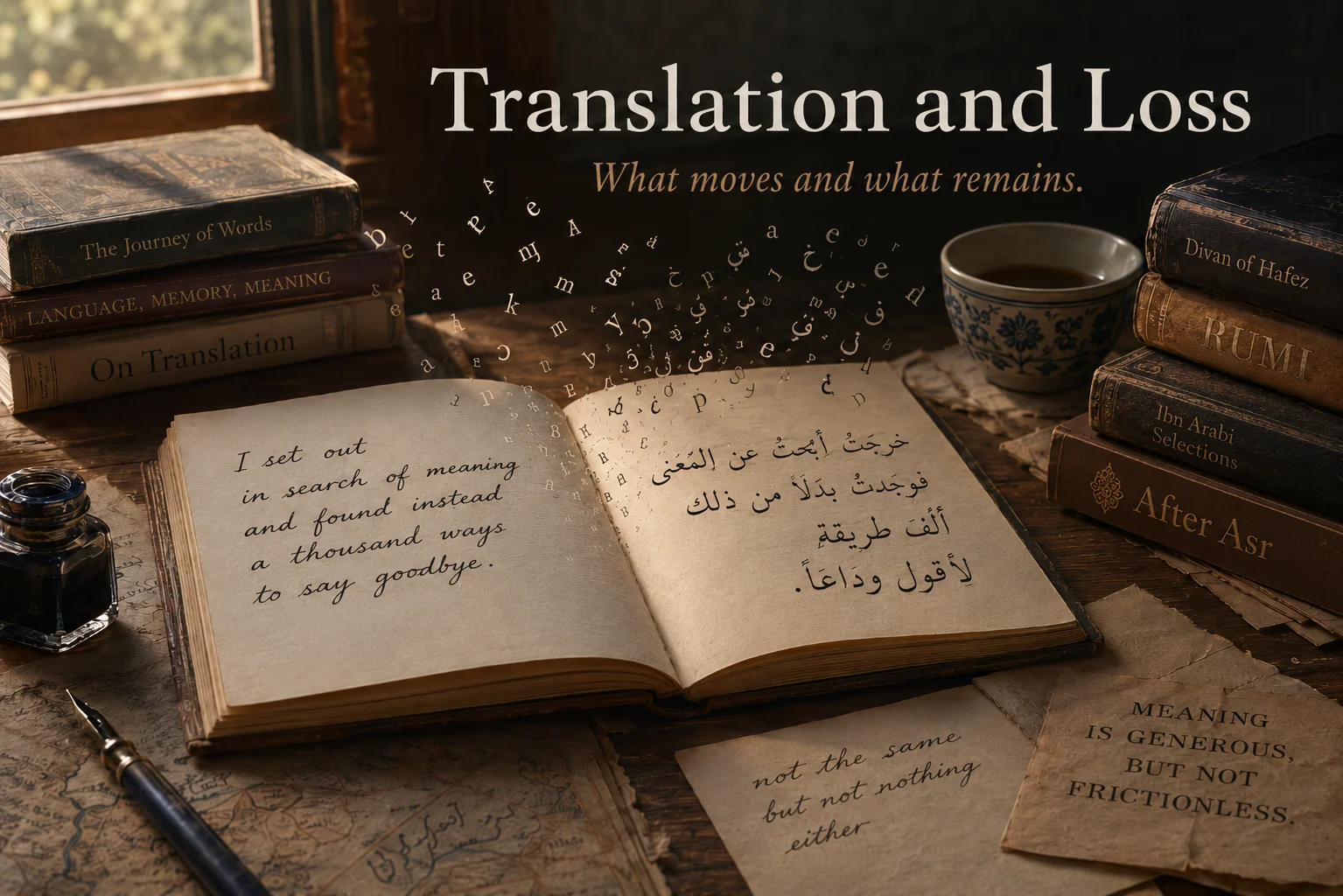
Translation teaches a lesson literature repeatedly needs: meaning is generous, but not frictionless. Words can travel far, but they do not travel without history. Understanding is possible, but it should never become arrogant.
Something is lost.
Something arrives.
And sometimes, because of the journey, we learn to value both more deeply.