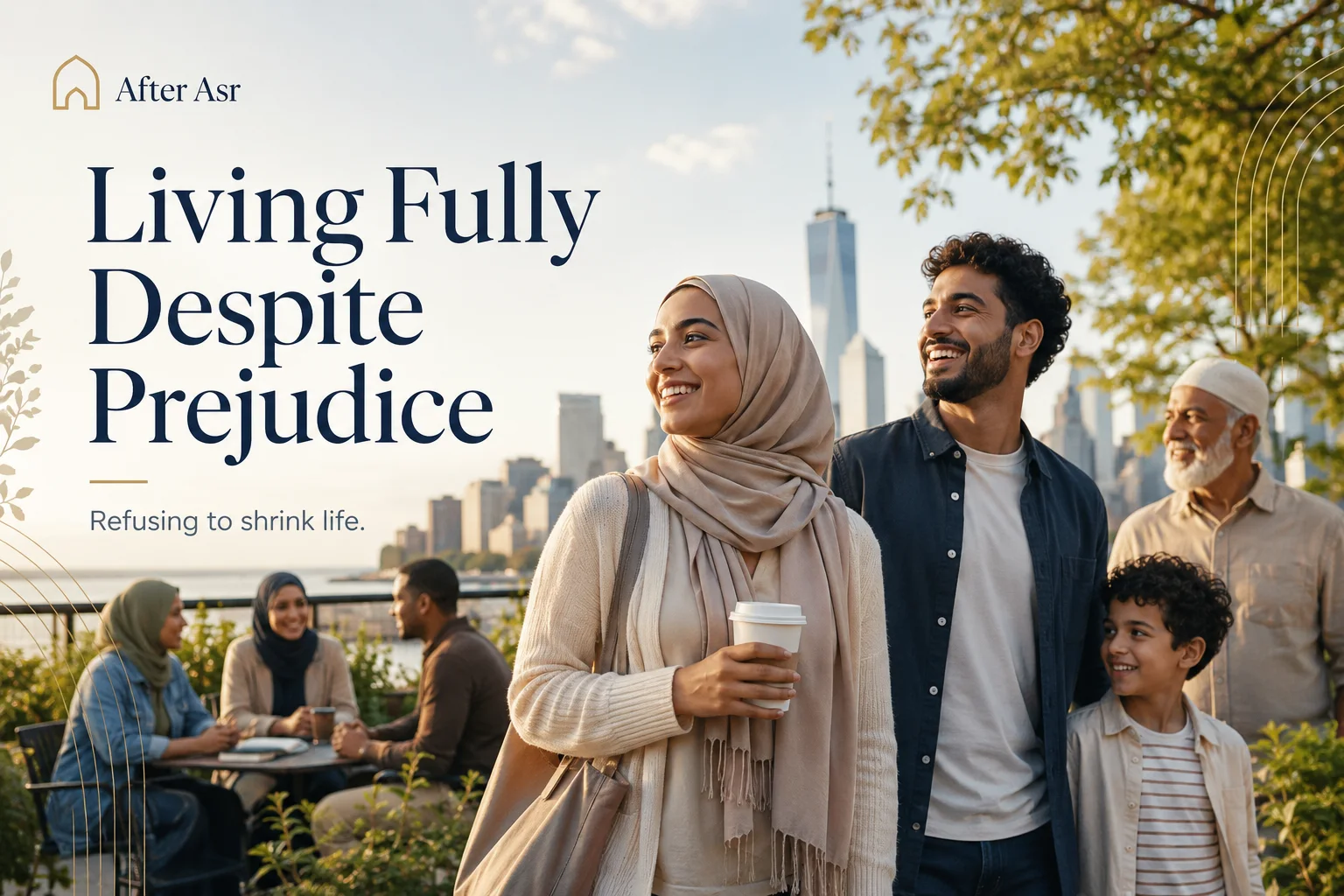
Refusing to shrink life.
Prejudice has an appetite.
It does not only want to insult.
It wants to reduce.
It wants people to think smaller, move more cautiously, speak less freely, dream more modestly, and enter rooms already apologizing for the discomfort their presence might cause. It wants a Muslim woman to wonder whether wearing hijab will make the day harder. It wants a Muslim man to calculate whether speaking firmly will be misread. It wants a student to hesitate before joining a campus discussion, a parent to worry before sending a child to school, a professional to wonder whether visible faith will quietly cost them opportunity.
Prejudice rarely admits this ambition aloud. It does not say, “Shrink your life for us.” It simply creates enough friction that shrinking begins to feel practical.
Avoid that place.
Do not say that.
Maybe wait to apply.
Do not wear that today.
Keep the prayer private.
Let the comment pass.
Do not make yourself too visible.
Do not expect too much.
Some caution is wisdom. People have a right to protect themselves. No one should be shamed for navigating a difficult world carefully.
But there is a line.
A person can adapt to reality without allowing prejudice to define the size of their life.
That line matters.
Because surviving bias is not the same as living beyond its terms.
Prejudice Wants to Become a Boundary
Every prejudice eventually tries to draw a border around the person it targets.
It says: this is as far as you can go.
This is how visible you can be.
This is how ambitious you may become.
This is how much discomfort others will tolerate from your full humanity.
For Muslims, that border can appear in countless forms. It can be social, professional, political, spiritual, and emotional. A community may be welcome to serve quietly but treated as suspect when it advocates publicly. A Muslim employee may be accepted as competent but less readily imagined as leadership. A visibly Muslim person may feel safe enough in some settings but not enough to relax.
The most damaging part is that the border can begin moving inward. A person starts enforcing it upon themselves before anyone else has to.
They lower the dream before it is challenged.
They avoid the conversation before it becomes difficult.
They mute the part of themselves they think the world will reject.
They confuse anticipation with fact.
This is how prejudice gains territory without needing to win every encounter.
It convinces people to pre-limit themselves.
Living fully requires noticing when a boundary was built by fear and asking whether it deserves obedience.
Fullness Is Not Recklessness
Refusing to shrink life does not mean ignoring danger.
A Muslim who chooses a different route after harassment is not surrendering. A woman who takes safety precautions when traveling is not capitulating. A family that thinks carefully about a hostile environment is not failing to be bold. Wisdom belongs in any life.
Fullness is not recklessness.
It is not the demand that people expose themselves needlessly to prove courage. It is not a romantic insistence that vulnerability should always be public. It is not telling Muslims to walk into unsafe rooms with a smile and call that dignity.
Fullness is the refusal to let prejudice become the sole decision-maker.
A person may choose caution in one moment and expansion in another. They may decline a confrontation today and speak publicly tomorrow. They may leave one workplace and build something of their own. They may change how they move through a space without changing what they believe about their worth.
The central question is not:
Am I afraid?
Many courageous people are afraid.
The central question is:
Is fear making every decision for me?
The Right to Ordinary Ambition
Muslims do not need to justify wanting full lives.
They are allowed to want advancement, beauty, leisure, influence, recognition, romance, scholarship, creativity, financial stability, leadership, travel, ownership, rest, and joy. They are allowed to care about their careers, neighborhoods, public institutions, and children’s futures. They are allowed to build businesses, write books, enter politics, make art, host gatherings, become excellent at things unrelated to explaining Islamophobia.
This may sound obvious.
It is not always treated as obvious.
Communities living under prejudice are often pulled into reactive life. So much energy goes toward responding, correcting, defending, documenting, and surviving that expansive desires can begin to feel indulgent. The person becomes known through what they endure rather than what they seek.
But Muslims are not only subjects of prejudice.
They are makers of worlds.
A life narrowed entirely into response is still being organized by the thing it opposes.
Living fully means insisting that ambition is not betrayal of seriousness. Joy is not denial. Beauty is not distraction. Building is not avoidance. A community can resist prejudice and still plan weddings, open cafés, publish essays, renovate homes, pursue graduate degrees, teach children calligraphy, argue about movies, plant gardens, and laugh at things that have nothing to do with survival.
There is no dignity in allowing hostility to occupy every room of the soul.
Public Life Should Not Require Self-Erasure
One of the quiet tests of belonging is whether a person can enter public life without sanding themselves down first.
Can a Muslim candidate run for office without being endlessly asked about foreign conflicts before being asked about local policy?
Can a woman in hijab be seen as a full professional rather than as a religious issue at work?
Can a student talk about chemistry, architecture, literature, or labor law without becoming an unofficial spokesperson on Muslim identity?
Can a Muslim family open a business without its faith becoming a curiosity before its work is judged?
Living fully requires entering the public square with one’s humanity intact.
Not because every space will receive that humanity well. Some will not. But because the alternative is self-erasure disguised as strategy.
There is a difference between courtesy and self-diminishment. A Muslim may speak thoughtfully, adapt to context, and practice tact. These are mature virtues. But they need not perform an edited version of themselves designed to reassure those who have not earned that accommodation.
A public life based on constant self-editing is not full participation.
It is managed exposure.
Refusing to Make Bias the Center of Identity
Prejudice can become central even when it is resisted.
A person wakes up angry at Islamophobia, works against Islamophobia, reads about Islamophobia, explains Islamophobia, and goes to sleep exhausted by Islamophobia. Their concern is justified. Their labor may be necessary. But if every part of Muslim life becomes organized around hostility, prejudice has achieved a second victory.
It has moved from the outside world into the architecture of attention.
This does not mean ignoring injustice. It means refusing to let injustice monopolize identity. A Muslim may care deeply about anti-Muslim bias while also being a cook, mechanic, teacher, gamer, scholar, uncle, poet, runner, gardener, organizer, husband, daughter, and friend. They may carry political commitments and private silliness at the same time.
No community should be forced to choose between seriousness and wholeness.
Living fully means making room for selves that prejudice never accounted for.
The hateful imagination often knows only caricatures. A full life disproves it not by performing for it, but by existing beyond its categories.
Joy Is Not a Retreat From Reality
Joy is sometimes treated as suspicious in communities under pressure.
How can you celebrate when things are still difficult?
How can you enjoy yourself when people are suffering?
How can you make beautiful things when ugly things persist?
These questions often come from love. People do not want to trivialize harm. But joy is not trivialization.
Joy is one way human beings refuse total occupation by sorrow.
A dinner after a long week.
A child laughing while learning to make wudu.
Friends lingering after prayer.
A successful project finally complete.
A ridiculous family group chat.
A road trip with snacks packed badly.
A new coat, a new job, a new book, a new apartment, a new baby.
These are not interruptions of moral seriousness. They are among the reasons moral seriousness matters.
Prejudice often wants life to feel permanently embattled. Joy denies it that atmosphere. It says: you may cause pain, but you do not receive exclusive rights to my attention.
A people capable of joy remain difficult to reduce.
The Body Should Not Live Only in Defense
Bias affects the body.
Shoulders tighten.
Voices are measured.
Routes are reconsidered.
Eyes scan rooms.
Phone screens carry another ugly headline.
Sleep becomes lighter after threats or public controversy.
In such conditions, rest can feel almost rebellious.
Not rest as escape from responsibility, but rest as reclamation of a body that has been kept too alert. The body is not merely an alarm system. It is also made for stillness, friendship, worship, movement, food, affection, and renewal.
Living fully means refusing to treat exhaustion as the natural price of Muslim public presence.
Communities need safety plans. They also need picnic blankets.
They need legal advocacy. They also need games in the park.
They need documentation. They also need sleep.
There are struggles that require endurance. Endurance without restoration becomes depletion.
A life of permanent bracing is not the only honorable response to prejudice.
Children Need More Than Warnings
Parents facing bias often feel obligated to prepare children carefully.
They teach them how to respond to a cruel comment.
They explain that not everyone understands Islam.
They warn them to ask for help if someone makes them feel unsafe.
They tell them not to be ashamed.
All of this matters.
But children also need more than preparation for harm. They need permission to imagine wide futures.
They need to see adults who are not only careful, but also confident. Adults who build, celebrate, host, create, and pursue. Adults who answer prejudice when necessary but do not organize family life solely around it. Adults who model that being Muslim is not a burden to be managed, but a life to be inhabited with gratitude and ambition.
A child who hears only, “Be careful,” may learn caution.
A child who also hears, “You belong here, and you have things to build,” learns possibility.
Living fully is intergenerational work.
It passes down more than survival skills. It passes down scale.
Excellence Should Not Be a Plea for Acceptance
Muslims often respond to prejudice by excelling.
They study harder, work longer, lead well, serve generously, and aim to become undeniable. Excellence can be beautiful. It can arise from faith, discipline, family sacrifice, and personal aspiration.
But excellence becomes burdensome when it is performed as a defense strategy.
If a Muslim feels they must be twice as accomplished to receive ordinary trust, prejudice has already warped the meaning of achievement. If success is pursued mainly to reassure others that Muslims are not what stereotypes claim, then ambition becomes tied to exhaustion.
Living fully means reclaiming excellence from appeasement.
Be excellent because craft matters.
Because service matters.
Because God loves ihsan.
Because your gifts deserve development.
Because your family worked hard for you.
Because the world benefits from good work.
Not because your humanity is on probation.
A full life does not audition for dignity.
It starts from it.
Refusing the Assigned Role
Prejudice assigns roles.
The apologetic Muslim.
The angry Muslim.
The moderate Muslim.
The oppressed Muslim woman.
The suspicious Muslim man.
The grateful immigrant.
The exceptional professional.
The community spokesperson.
Living fully means refusing to spend one’s life trapped in roles written by others.
A Muslim woman may be observant and funny, ambitious and tender, politically sharp and deeply private. A Muslim man may be gentle, artistic, anxious, brilliant, ordinary, nurturing, soft-spoken, or hilariously unserious. A Muslim elder may carry tradition and curiosity at once. A convert may belong without becoming a permanent novelty. A child may be devout without being made prematurely responsible for public understanding.
People are more varied than the roles prejudice offers them.
A full life insists on that variation.
It says: I will not accept a reduced script merely because you have rehearsed it often.
There Is Power in Taking Up Space Calmly
Not every refusal to shrink is dramatic.
Sometimes it is simply presence.
A student wearing hijab on the first day in a new environment.
A Muslim professional asking for a prayer accommodation without apologizing for the request.
A family opening their curtains after neighbors made them feel watched.
A writer placing Muslim characters into fiction without translating every reference.
A business owner naming a shop unapologetically.
A worshipper praying where prayer is allowed without behaving as though they have committed an offense.
These acts may not trend. They do not always announce themselves as resistance. Yet they matter because they normalize a truth prejudice tries to contest:
Muslims are here.
Muslim life is ordinary.
Muslim belonging is not conditional.
Taking up space calmly can be more transformative than making a spectacle of courage. It rewrites atmosphere through repetition. It allows the body to learn a new lesson: I do not have to disappear.
Do Not Let Hostility Choose Your Desires
Prejudice shapes life most deeply when it begins deciding what people want.
A person stops wanting public leadership because scrutiny seems inevitable.
Stops wanting to write because response may be hostile.
Stops wanting to travel because airports feel tiring.
Stops wanting to host because neighbors may judge.
Stops wanting to be visible because visibility draws attention.
Some decisions may be practical and entirely valid. Not every desire must be pursued. Not every stage of life calls for public exposure. But it is worth asking, honestly:
Did I stop wanting this, or did I get tired of wanting it under pressure?
That question can reopen possibilities.
Not every reclaimed desire will be acted upon. But reclaiming the right to desire expansively is itself meaningful. Prejudice wants to reduce imagination before it reduces action. A person who keeps imagining remains less containable.
Fullness Includes Care for Others, but Not Self-Abandonment
Muslim communities are often generous under pressure. They organize drives, support victims, educate neighbors, defend civil liberties, comfort children, and respond to crisis after crisis.
This service is honorable.
But service should not require self-abandonment.
A person cannot always be the translator, organizer, educator, donor, spokesperson, and emotional anchor. Communities need sustainable structures, shared burdens, and permission for individuals to rest. Otherwise, those most committed to protecting others become consumed by the work of protection.
Living fully means allowing oneself to receive care, not only provide it.
To say:
I matter even when I am not useful.
I am worthy even when I am not performing.
I may step back and still belong.
Prejudice already treats people instrumentally, as symbols or problems. Communities should not reproduce that logic internally by valuing members only for what they can endure or contribute.
A Life Bigger Than Reaction
There is an important difference between responding to prejudice and being organized by it.
Response is necessary.
Organization is dangerous.
A community may respond to a discriminatory policy through advocacy. It need not let policy become the only story it tells about itself. A Muslim artist may make work about Islamophobia. They need not make only that work. A journalist may report on discrimination. They need not imagine Muslim life only through harm.
Living fully means preserving genres of existence untouched by the oppressor’s imagination.
Romance.
Comedy.
Architecture.
Cuisine.
Sports.
Prayer.
Craft.
Parenting.
Friendship.
Silence.
Wonder.
These are not luxuries added after justice arrives.
They are parts of the life justice is meant to protect.
Prejudice Is Loud, but It Is Not Sovereign
Hostility can feel large because it repeats itself publicly. It dominates timelines, comment sections, hearings, headlines, and conversations. It can seem more powerful than quiet acts of dignity.
But loudness is not sovereignty.
A hateful narrative may spread quickly. A family still gathers for dinner.
A discriminatory comment may sting. A Muslim still graduates, marries, creates, teaches, builds.
A political moment may be ugly. A child still learns a dua from a grandparent.
A stranger may misread a hijab. The woman wearing it still knows why she chose it.
Prejudice affects life. It does not own all of life.
This distinction is essential. Without it, the person targeted begins measuring reality only by what harms them. That is understandable in moments of acute pain. It cannot become the permanent method of seeing.
A full life insists that beauty remains real even when ugliness is present.
Living Fully Is Not a Public Relations Strategy
Muslim joy, excellence, family life, creativity, and civic participation should never be reduced to “good representation” for outsiders.
Muslims do not marry beautifully to defeat stereotypes.
They do not produce art as a rebuttal to suspicion.
They do not raise children with tenderness to prove a point.
They do not laugh, travel, study, dress well, host guests, or fall in love as a media campaign.
These things may incidentally challenge prejudice, but their first value is not educational.
Their first value is that they are life.
Prejudice already looks at Muslims and asks, “What do you represent?”
Living fully replies, “I am not here primarily to represent. I am here to live.”
The Courage of Delight
Delight may be one of the most underrated responses to a hostile world.
To delight in one’s faith.
To delight in community.
To delight in children growing into themselves.
To delight in a well-made meal, a well-written page, a street after rain, a conversation that stretches past midnight.
Delight does not mean forgetting pain. It means pain has not destroyed perception. It means the self remains responsive to goodness.
A bitter world benefits when people lose the ability to delight. They become easier to manipulate, easier to exhaust, easier to trap in reaction. Delight restores independence. It says: my emotional life is not wholly available for your crisis-making.
There is courage in remaining capable of pleasure after being given reasons for dread.
Building Is a Declaration
One of the clearest ways to refuse shrinking is to build.
Build families.
Build institutions.
Build businesses.
Build schools.
Build publications.
Build friendships.
Build scholarship.
Build neighborhood ties.
Build art that does not ask permission to exist.
Building assumes a future. It is difficult to build seriously while secretly believing prejudice has already decided everything. Construction requires a kind of hope expressed through labor.
Every school opened, every article published, every organization strengthened, every young person mentored, every community space improved says something simple:
We intend to remain.
We intend to contribute.
We intend to live beyond your fear of us.
A full life is not always loud. Sometimes it looks like a budget meeting, a lesson plan, a garden plot, a manuscript draft, a repaired roof, a family calendar.
These humble acts are powerful because they presume continuity.
Fullness Includes Refusal
To live fully is not to say yes to everything.
It includes refusal.
Refusing to debate one’s humanity.
Refusing bad-faith invitations.
Refusing shame.
Refusing narratives that cast Muslims as permanent guests in their own society.
Refusing to sacrifice peace for every argument.
Refusing to make external approval the measure of success.
A full life needs doors that close.
Boundaries create the conditions for expansive living. Without them, prejudice can intrude endlessly, claiming attention, energy, and emotional space. Refusal protects what should be cultivated rather than constantly defended.
There is strength in knowing what not to give.
Conclusion
Prejudice will attempt to reduce life.
It will suggest caution until caution becomes confinement. It will provoke self-editing, overexplaining, smaller dreams, quieter voices, and the gradual belief that living visibly or expansively is too costly. It will try to make Muslims orient their lives around its discomfort.
The answer is not denial. Harm is real. Caution is sometimes necessary. Rest is needed. Protection matters.
But life must remain larger than prejudice.
Living fully means pursuing ambition without apology, joy without guilt, faith without embarrassment, public presence without constant self-erasure, and rest without shame. It means responding to hostility when needed, but refusing to let hostility become the central author of one’s identity. It means giving children more than warnings. It means building a future while others insist on suspicion. It means keeping delight alive.
Prejudice says: make yourself smaller.
A full life answers:
No.
Not recklessly.
Not carelessly.
Not without wisdom.
But clearly.
I will not shrink the life God gave me to fit the fear someone else learned.