
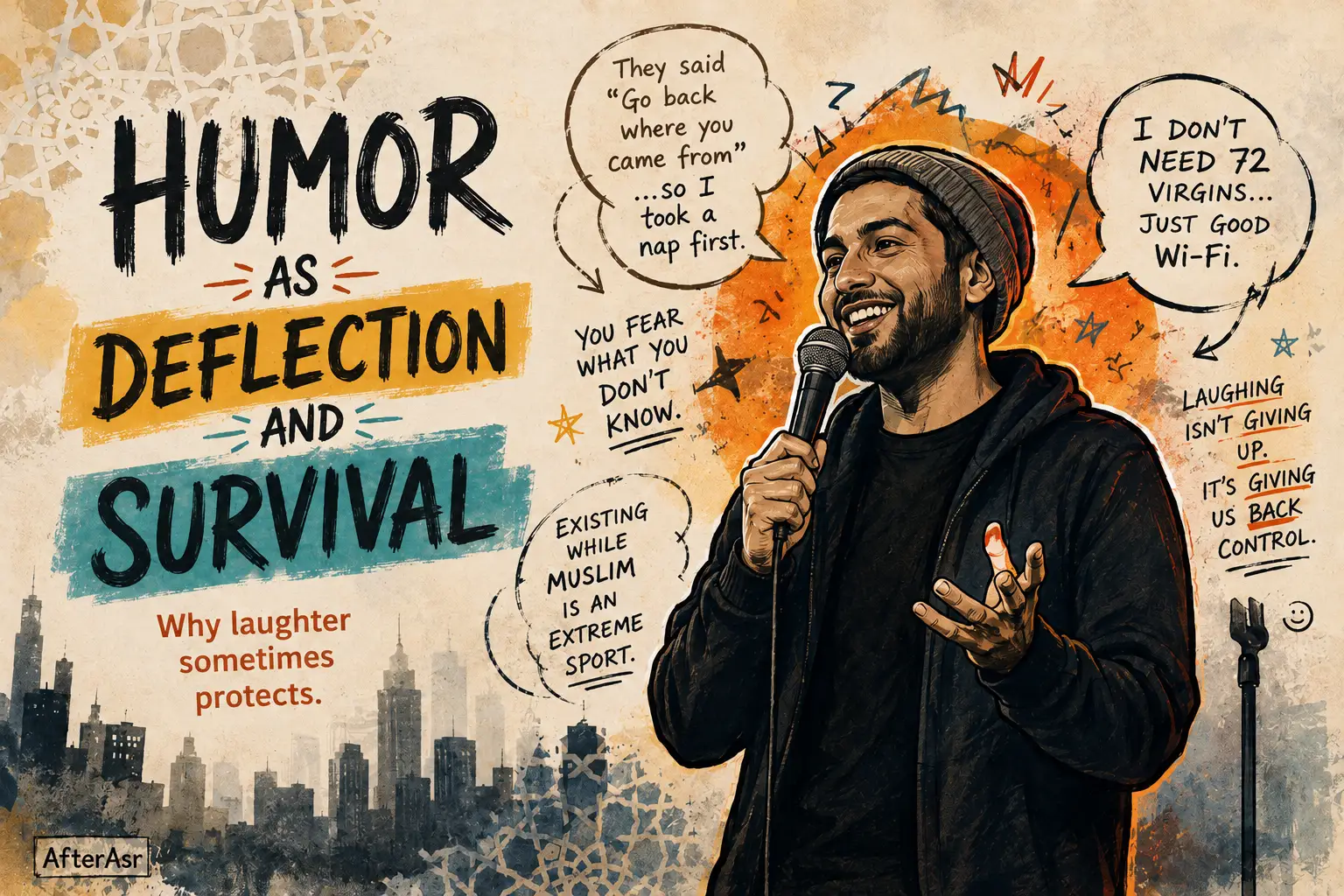
Why laughter sometimes protects.
There are moments when a joke is not an escape from seriousness.
It is how seriousness becomes bearable.
A Muslim hears the same tired airport joke for the hundredth time and answers with one sharper than the original. A woman in hijab replies to an invasive question with a line so quick the room laughs before it realizes what was exposed. A comedian walks onto a stage and turns years of suspicion, stereotyping, and public absurdity into a set that leaves an audience laughing at the prejudice rather than with it.
Humor can deflect.
It can disarm.
It can survive.
For communities living under bias, laughter is not always lightness. Sometimes it is a form of control reclaimed in a situation designed to make someone feel small. It can interrupt the script. It can expose how ridiculous a stereotype sounds when pushed one inch further. It can make a hostile assumption wobble under the weight of its own stupidity.
But humor is not simple. It can protect, and it can conceal pain. It can build solidarity, and it can pressure people to pretend they are not hurt. It can challenge Islamophobia, and it can also be demanded from Muslims as proof that they are easygoing enough to tolerate it.
Laughter is powerful.
That does not mean it is painless.
The Joke That Arrives Before the Person
Muslims often encounter humor before they encounter understanding.
The joke about bombs.
The joke about airport security.
The joke about “72 virgins.”
The joke about being “randomly selected.”
The joke delivered with a grin and followed by, “Come on, you know I’m kidding.”
These jokes are rarely original. Their repetition is part of their function. They tell Muslims that the stereotype is socially available, ready to be reached for in casual conversation, even among people who may not think of themselves as prejudiced.
Humor gives bias cover. A person can test a stereotype, enjoy the reaction, and retreat behind harmless intent if challenged. The joke becomes a shield for the speaker.
But humor can also become a shield for the target.
A Muslim who laughs back, exaggerates the absurdity, or redirects the moment with wit may regain some control over an interaction that otherwise placed them on the defensive. The laughter changes who appears awkward. It moves the discomfort off the Muslim person and back onto the assumption.
That is one reason humor has played such an important role in Muslim public life, especially in the post-9/11 era. Scholars examining American Muslim comedy have noted how performers use humor to challenge anti-Muslim stereotypes, reverse the gaze, and transform familiar tropes into objects of critique rather than passive injury.
Humor Can Say What Politeness Cannot
Some truths are difficult to deliver in a straight line.
A direct accusation may make people defensive.
A lecture may cause them to disengage.
A carefully worded correction may be ignored.
A joke can slip through.
When a comedian says that Islamophobes should “do their research” before spreading myths, the laughter creates an opening for facts. When a performer exaggerates the logic of suspicion until it becomes visibly ridiculous, the audience is invited to recognize the absurdity without first being told that they are morally failing. Humor lowers one guard while raising another kind of awareness.
This is not because jokes are automatically persuasive. They are not. But comedy can make a rigid narrative less stable. It can show that the stereotype is not inevitable, only repeated.
Recent work on humor and adversity suggests that humor can help people reframe stressful situations, preserve positive emotion, and cope with pressure, though its effects depend heavily on context and style.
In public discourse, that reframing matters. Humor can turn “Muslims are always being watched” into “the surveillance state has become so absurd it no longer knows what it is looking for.” It can turn a stereotype inside out until its logic is visible. It can make fear look foolish.
And once fear looks foolish, it loses some of its authority.
Laughter as a Way of Refusing Humiliation
Humiliation aims to fix someone in place.
It says: you are the object here.
You are the one being discussed.
You are the one who must absorb the room’s comfort.
Humor can refuse that arrangement.
A witty response does not erase the insult. But it can deny the insult total control over the moment. It allows the targeted person to speak from somewhere other than wounded silence. It turns passivity into authorship.
This is especially visible in stand-up, where Muslim comedians have often taken themes imposed on them by public prejudice and reworked them into material they control. Rather than waiting to be misrepresented, they narrate the misrepresentation themselves, exposing its patterns and turning audiences toward a more complicated reality.
That matters because dignity is not only preserved through solemn defense.
Sometimes dignity is preserved through timing.
A pause.
A raised eyebrow.
A joke that says: I see what you are doing, and I refuse to shrink beneath it.
Deflection Is Not Cowardice
Humor is sometimes dismissed as avoidance. If something hurts, why not say plainly that it hurts? If a remark is offensive, why answer playfully instead of confronting it?
The answer is that not every situation allows the same kind of response.
A Muslim teenager may joke back because challenging a group of classmates directly feels socially dangerous. A worker may respond lightly to a biased comment because they cannot risk an escalating conflict with a supervisor. A traveler may make a quip because anger at an airport does not feel safe. A friend may turn a painful moment into humor because they are tired and do not want to explain yet again.
Deflection can be survival.
It can protect energy. It can exit a moment without surrendering entirely to it. It can create distance between the person and the insult until they are ready to decide what to do with it.
Psychological research on humor as coping suggests that humor can help regulate stress and alter one’s relationship to difficult experiences, although it is not universally beneficial and should not be romanticized as a cure for distress.
A joke may not resolve the wound.
It may simply help someone carry it through the next five minutes.
That still counts.
The Private Joke Within the Community
Not all humor is directed outward.
Some of the most sustaining laughter happens among Muslims themselves, in spaces where explanation is not required. Jokes about Ramadan sleep schedules. Mosque parking chaos. Aunties asking invasive questions at weddings. The shared exhaustion of being summoned into public debate every time a headline appears. The strange creativity required to navigate airports, classrooms, family expectations, and group chats.
This kind of humor does more than entertain. It builds intimacy.
It says: you are not alone in finding this absurd.
You do not have to translate the setup.
We already understand.
Communal humor can turn pressure into shared recognition. It does not deny difficulty. It makes difficulty less isolating.
That distinction matters. A joke made by someone outside a community may flatten a people into a stereotype. A joke made within the community may reveal complexity, affection, and survival. The same subject can feel entirely different depending on who is speaking, who is being invited to laugh, and whether the humor punches down or gathers people together.
Humor Is Also a Cultural Counter-Narrative
Islamophobia often depends on narrow representations of Muslims: solemn, angry, rigid, threatening, joyless, perpetually offended.
Humor disrupts that image.
The Muslim comedian, satirist, writer, or ordinary friend who is funny in public refuses a stereotype without delivering a formal rebuttal. Their humor does not “prove” Muslim humanity. Humanity does not require proof. But it does complicate an image built from flattening.
Muslim comedy has often worked in precisely this space, making room for irony, self-awareness, family comedy, political satire, and social critique in environments where Muslim identities were too often reduced to security or conflict.
This matters because public imagination is shaped not only by what people fear, but by what they can picture. If Muslims appear only in serious contexts of crisis, then comedy restores a missing register of life.
It says: we are not only symbols in your debate.
We are also people who notice how ridiculous the debate has become.
The Risk of Being Expected to Laugh
Humor becomes less protective when it becomes compulsory.
A Muslim may joke about stereotypes on their own terms. That does not mean others now have permission to keep using those stereotypes casually. A comedian may turn a painful experience into a brilliant routine. That does not mean ordinary Muslims owe the public a charming response to hostility. A friend may laugh off an awkward remark once. That does not mean the remark did no harm.
Sometimes laughter is interpreted too conveniently by those who caused the discomfort.
They think:
They laughed, so it was fine.
They joked back, so they are not bothered.
They are funny about it, so this issue cannot be serious.
But humor can coexist with pain. It often does.
Research on humor and coping repeatedly emphasizes that humor is one strategy among many, not evidence that the underlying stressor has disappeared.
A laugh is not always consent.
A witty reply is not always comfort.
A good joke does not absolve a bad environment.
Self-Deprecation Can Become a Trap
There is a difference between playful self-awareness and shrinking oneself for acceptance.
Muslims may use self-deprecating humor to navigate awkwardness, preempt stereotypes, or make a room feel easier. Sometimes this is generous. Sometimes it is artful. Sometimes it is genuinely funny.
But repeated self-deprecation can also become a social bargain:
I will make the joke first, so you do not make it worse.
I will mock the part of myself you might mock, so you will like me.
I will prove I am not sensitive by laughing at what tires me.
This bargain can be costly.
It teaches the room that the stereotype is available, provided it is handled with enough charm. It can also teach the person making the joke to keep converting discomfort into entertainment, even when they would rather not.
The line is not always obvious. Humor is deeply personal. What feels liberating to one person may feel exhausting to another. But the question is worth asking:
Am I laughing freely, or am I managing someone else’s comfort?
Satire Lets People Aim Upward
Humor is most powerful when it does not simply absorb hostility, but redirects scrutiny toward the systems producing it.
Satire can mock the politician who claims a halal grocery aisle signals civilizational collapse. It can expose media panic over a Muslim family living an ordinary life. It can exaggerate the logic of surveillance until the absurdity becomes undeniable. It can puncture the self-seriousness of public fear.
This is one reason Muslim humor has often gravitated toward political and cultural satire. It is not only coping. It is criticism with a sharper edge. It invites audiences to laugh at power, not at the vulnerable.
Satire does not replace reporting, organizing, or legal advocacy. But it can weaken the emotional spell of prejudice. Bigotry often depends on being treated as sober realism. Humor can reveal how theatrical, repetitive, and intellectually lazy it is.
Sometimes laughter is what happens when fear loses its costume of seriousness.
Humor Gives Back Complexity
Prejudice prefers one-dimensional people.
It wants Muslims to be either threatening or pitiable, angry or oppressed, foreign or exceptional. Humor refuses those narrow roles because humor requires perspective. It shows observation, contradiction, timing, and an awareness of the absurd.
A funny person cannot easily be reduced to a symbol.
Not because funny people are more human than anyone else, but because humor reveals a mind at work. It shows someone interpreting the world rather than merely being interpreted by it.
This is why humor can feel especially freeing for groups subjected to caricature. It restores subjecthood. The person is no longer only the object of a story. They become the narrator.
And narration is power.
Laughter Can Coexist With Seriousness
There is a mistaken belief that humor weakens moral seriousness.
It does not have to.
Some of the sharpest criticism arrives through comedy precisely because laughter loosens defensiveness. A joke can carry grief. A punchline can deliver indictment. A light tone can expose something heavy without minimizing it.
That complexity is familiar to communities who have lived through pressure. They know how to laugh at the thing that still hurts. They know that a joke made after a long day is not always frivolous. Sometimes it is what keeps the day from winning.
Humor does not cancel seriousness.
It can make seriousness survivable.
Not Every Wound Should Be Turned Into Material
Still, there must be room not to laugh.
No person or community owes humor about its pain. Some experiences are too raw. Some moments deserve silence, tears, anger, or formal dignity. Some jokes arrive too soon. Some attempts at levity feel like avoidance rather than relief.
Survival has many forms.
One person jokes.
Another speaks plainly.
Another walks away.
Another refuses to perform resilience at all.
All may be valid.
The danger comes when humor is treated as the superior response, the “healthy” response, or the more palatable response for audiences uncomfortable with Muslim anger or grief.
A society that welcomes Muslims only when they are funny is not welcoming Muslims fully.
It is selecting the emotions it finds easiest to tolerate.
The Difference Between Laughing With and Laughing At
This distinction remains essential.
Humor that protects does not flatten Muslims into a joke.
It does not turn religious identity into a prop for others’ amusement.
It does not ask Muslims to endure humiliation with a smile.
Protective humor creates agency. Harmful humor removes it.
To laugh with Muslims is to share recognition, irony, humanity, and perhaps critique. To laugh at Muslims is to reinforce distance while pretending no injury was intended.
The same room may contain both kinds of laughter. The same joke may be read differently depending on history, power, and trust.
That is why humor cannot be judged only by whether people laughed.
We also have to ask who had to carry the joke after it ended.
Conclusion
Humor does not end Islamophobia.
It does not replace policy, education, solidarity, or honest confrontation. It cannot make discrimination harmless. It should never be required from those experiencing pain.
But humor can protect.
It can create distance from humiliation. It can expose the stupidity of stereotypes. It can preserve dignity in hostile rooms. It can build community, release tension, and remind people that those cast as symbols are still fully capable of irony, delight, and authorship.
Laughter is sometimes misread as lightness.
For those living under suspicion, it may be something sturdier.
A shield.
A signal.
A refusal.
Not everything that is serious must sound solemn.
Sometimes the joke is how a person keeps their softness from being crushed.