
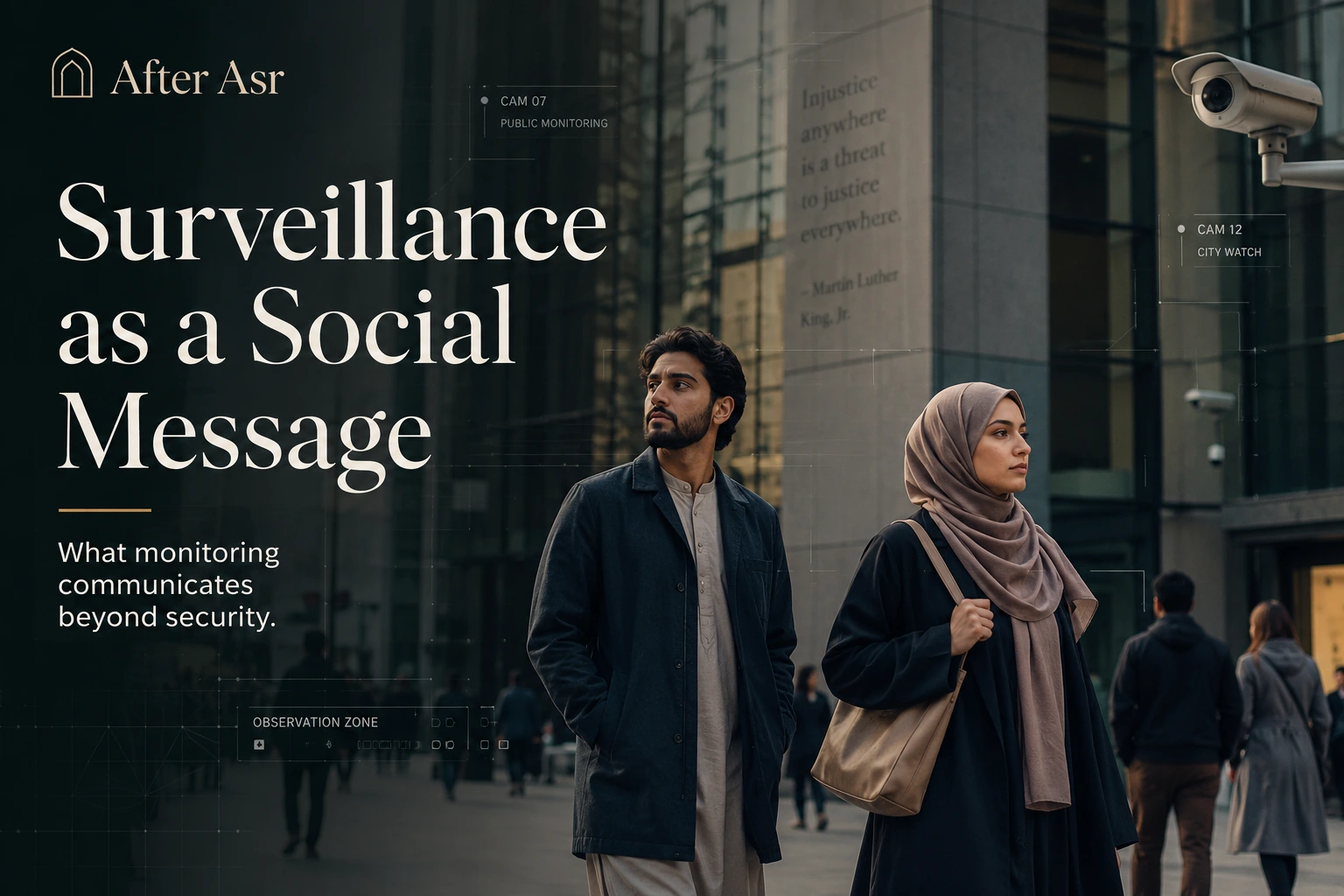
What monitoring communicates beyond security.
Surveillance is often defended in the language of prevention.
It is described as a tool.
A precaution.
A way to identify risk before harm occurs.
A difficult but necessary feature of modern security.
Sometimes that is true. Governments do have a duty to investigate credible threats. Law enforcement agencies may need to gather information, follow evidence, and act before danger becomes violence. A serious discussion of surveillance should not pretend that all monitoring is illegitimate by definition.
But surveillance does more than collect information.
It communicates.
It tells people who is being watched, who is considered worth watching, what kinds of behavior appear suspicious, and which communities are expected to live with heightened scrutiny as a condition of public life.
For Muslims in Western societies, especially in the decades shaped by the “War on Terror,” surveillance has often functioned not only as a security practice, but as a social message:
You are not merely citizens. You are potential subjects of concern.
That message can shape a community long after a specific investigation ends.
Surveillance Has an Audience
Surveillance is rarely private in its effects, even when its methods are hidden.
People talk.
Patterns become visible.
Stories circulate.
A mosque learns that someone was questioned.
A student association hears that another group was monitored.
A community leader is visited at home.
A traveler is repeatedly stopped.
A religious institution begins wondering who in the room may be reporting conversations elsewhere.
The point is not that every rumor is accurate. The point is that surveillance, once experienced or reasonably suspected, changes social behavior.
A 2021 study of Arab and Black American Muslims found that surveillance shaped not only research access, but also respondents’ self-perceptions, political attitudes, and civic engagement. The author described surveillance as a political mechanism that socializes Muslims into a particular relationship with the state. (cambridge.org)
That is what makes surveillance more than a technical instrument. It becomes part of the environment people move through.
A camera may be mounted in one place. Its message travels farther.
The Difference Between Investigation and Atmosphere
An investigation is supposed to be specific.
It follows facts.
It concerns a person, network, or activity linked to concrete evidence.
It is limited by law, purpose, and oversight.
An atmosphere of surveillance is different.
It emerges when an entire community comes to feel that ordinary religious, political, or social life may attract scrutiny. The line between behavior and identity begins to blur. Attendance at a mosque, participation in a student group, charitable involvement, or political advocacy may no longer feel fully ordinary. People begin to wonder how these actions are being interpreted by institutions they cannot see.
This atmosphere has been documented in research on Muslim communities in both the United States and Canada. A 2023 study based on 95 interviews with Muslim community leaders in five Canadian cities found that intelligence surveillance was experienced not simply as targeted investigation, but as widespread monitoring that transformed mosques into spaces of suspicion, encouraged informant dynamics, and led people to self-regulate their behavior. (journals.sagepub.com)
When surveillance becomes atmospheric, security no longer acts only on alleged threats.
It begins acting on community life itself.
Monitoring Sends a Message About Belonging
Every society tells people who fully belongs and who remains conditional.
Sometimes that message comes through law.
Sometimes through culture.
Sometimes through who receives the benefit of the doubt.
Surveillance can participate in that messaging.
If mosques, Muslim student associations, Muslim charities, or Muslim neighborhoods receive forms of attention that comparable institutions do not, the broader signal is difficult to miss. The issue is not merely whether one agency believes it has legal authority. The social message is that Muslim communal life is unusually legible as a security concern.
That perception can alter how Muslims understand their place in society. A house of worship becomes not only a site of prayer, but a site one wonders about. A political meeting becomes not only civic participation, but an activity one evaluates for possible future consequence. A community leader becomes not only a representative, but someone who must assess whether contact with officials is outreach, investigation, or both.
Surveillance tells a community that it is visible in a particular way.
Not admired.
Not simply included.
Monitored.
When Religious Life Becomes Interpreted
One of the most damaging consequences of anti-Muslim surveillance is the way it can make ordinary religious practice appear suspicious.
Prayer is not simply prayer.
Charity is not simply charity.
Mosque attendance is not simply worship.
Religious study is not simply learning.
Political concern is not simply citizenship.
Researchers examining Canadian Muslim experiences with intelligence agencies reported that interviewees described Muslim youth being asked questions about whether people appeared to be “praying excessively,” illustrating how ordinary religious behavior could be interpreted through assumptions about radicalization. The study argued that such practices coded Muslim bodies and Muslim spaces as potential threats. (journals.sagepub.com)
That is a profound shift.
A society may officially affirm religious freedom while operationally treating certain expressions of religion as especially worthy of scrutiny. The contradiction is felt immediately by the people living inside it.
If public policy says, “You are free to worship,” but surveillance practice seems to ask, “How much are you worshipping, and with whom?” the reassurance begins to ring hollow.
The Chilling Effect Is Part of the Harm
Surveillance need not produce an arrest to produce consequences.
It can produce silence.
A person avoids a political event.
A student leaves a group chat.
A donor hesitates before contributing to a cause.
A community member stops attending mosque as often.
A speaker edits a sermon.
A researcher struggles to gain trust.
A young person learns that caution is safer than openness.
This is often called a chilling effect: the way monitoring, or fear of monitoring, discourages lawful expression, association, and participation.
Research on American Muslim communities after 9/11 has repeatedly examined these effects. A 2021 political science study found that surveillance influenced civic engagement and political attitudes among respondents, while legal and social analyses of post-9/11 monitoring have described reduced mosque attendance, self-censorship, and hesitancy around community participation. (cambridge.org) (mjlr.org)
The harm is not only that people feel watched.
The harm is that they begin organizing their lives around that feeling.
A Community Can Begin Watching Itself
Surveillance does not always remain external. It can be internalized.
People begin wondering what is safe to say. They caution one another. They worry about newcomers. They avoid disagreement in public spaces. They become careful about what is discussed in mosques, on campuses, at fundraisers, and in community forums.
This does not happen because Muslims are naturally secretive or fearful. It happens because surveillance changes the conditions of trust.
The 2023 Canadian study found that state-led anti-Muslim surveillance produced internal forms of community surveillance, where individuals began self-regulating their own behavior. (journals.sagepub.com)
That finding is important. Surveillance can reproduce itself socially. Once people believe they may be monitored, they may begin narrowing one another’s speech in anticipation of scrutiny.
A community that once debated openly may become more guarded.
A young person who once asked questions freely may become quieter.
A religious leader may feel pressure to avoid topics that could be misunderstood.
Monitoring does not merely observe community life.
It can reshape it.
Trust Becomes Fragile
Security agencies often say they want community trust. That trust matters. Communities are more likely to report genuine threats, cooperate with authorities, and participate constructively in public safety when they believe institutions act fairly.
But trust is difficult to build when outreach and monitoring blur together.
If Muslims experience officials as simultaneously asking for partnership and treating them as a population requiring special watchfulness, the relationship becomes unstable. Community members may wonder whether a meeting is dialogue or intelligence gathering. They may hesitate before sharing concerns. They may see engagement not as a civic bridge, but as exposure.
That tension has surfaced repeatedly in criticism of countering violent extremism programs and other prevention initiatives aimed heavily at Muslim communities. Civil liberties groups have argued that programs framed as engagement or prevention can foster distrust and chill rights when they operate through community monitoring rather than individualized suspicion. (aclu-il.org) (aclum.org)
A community cannot be asked to trust institutions while also being trained to suspect that ordinary interaction with those institutions may carry hidden consequences.
Trust requires clarity.
The Message Reaches Beyond Those Directly Watched
One reason surveillance is socially powerful is that it affects people who may never be personally contacted by authorities.
A young Muslim hears that someone at the mosque was questioned.
A parent learns that a community leader received an unexpected visit.
A student hears about another student group being monitored.
A family watches public revelations about broad surveillance programs.
They may never be questioned themselves. Yet the message arrives.
This is how surveillance becomes collective. It does not need to touch every person directly in order to shape the behavior of many. The possibility is enough.
The PBS reporting on post-9/11 surveillance of Muslim Americans described a generation living under distrust and fear, with mosque-goers becoming skeptical of unfamiliar people in spaces that had once felt safer and more communal. (pbs.org)
The social message of surveillance spreads through community memory.
People remember not only what happened to them, but what happened around them.
“Security” Can Become Too Broad a Justification
Because security is important, it can be difficult to challenge practices introduced in its name. Few people want to appear indifferent to danger. That moral pressure can make surveillance harder to question, even when its scope expands beyond reasonable bounds.
A practice may begin as a response to a defined concern, then broaden into generalized monitoring. A category of risk may stretch until it includes lawful religious expression, political activism, social networks, or entire institutions. A community may be told that discomfort is simply the cost of safety.
But security is not made stronger by abandoning proportionality.
A policy that treats entire communities as possible reservoirs of extremism may erode civil liberties, damage cooperation, and reinforce the very alienation it claims to prevent. The Government Accountability Office has repeatedly urged federal agencies to improve evaluation and oversight of countering violent extremism efforts, reflecting broader concerns about whether such programs are effective, well-defined, and properly assessed. (gao.gov)
The question is not whether security matters.
It does.
The question is whether the language of security is being used to normalize broad suspicion.
Surveillance Defines What Counts as Normal
Every surveillance regime operates with assumptions. It must decide what is ordinary and what deserves attention.
Those decisions are never purely technical.
If a mosque fundraiser is treated as ordinary philanthropy, one message is sent.
If it is treated as an event requiring special concern, another message is sent.
If a Muslim student organization is understood as a normal campus group, one civic norm is affirmed.
If it is treated as inherently worthy of closer attention, another norm is being built.
Surveillance creates categories. It separates the unremarkable from the questionable.
When Muslims repeatedly find themselves on the questionable side of that line, the impact extends beyond any one policy. It affects how public institutions imagine Muslim life, and how Muslims imagine themselves within those institutions.
The message is not merely, “We are looking for danger.”
It can become, “Your community is where danger is expected to emerge.”
The Problem With Suspicionless Monitoring
The clearest line should be this: evidence matters.
Monitoring based on individualized, legally grounded suspicion is one thing. Monitoring entire communities because of religion, ethnicity, geography, or associational life is another.
This distinction has been central to legal challenges and civil rights advocacy around post-9/11 surveillance. Cases and settlements involving NYPD monitoring of Muslim communities turned precisely on the danger of religiously targeted, suspicionless surveillance that swept in mosques, businesses, student groups, and daily community life rather than responding to particularized evidence of wrongdoing. (brennancenter.org) (theguardian.com)
The social meaning of that distinction is enormous.
When a person is investigated because of credible facts, they may object, but the investigation is at least tied to conduct. When a community is watched because it is Muslim, the message is about identity.
The difference between those two approaches is the difference between security and stigma.
Surveillance Can Normalize Public Suspicion
State behavior shapes social behavior.
When institutions treat a community as unusually suspect, the broader public may take cues from that treatment. Media narratives, workplace assumptions, school interactions, and neighborhood attitudes can all be influenced by what the state appears to consider risky.
Surveillance can therefore reinforce Islamophobia even beyond its operational reach. It gives public suspicion a bureaucratic foundation. A private prejudice can point to public policy and say, “See, there must be a reason.”
This is one reason scholars describe surveillance not only as a reaction to racialization, but as a process that helps produce it. The 2023 study of Canadian Muslim experiences argued that anti-Muslim surveillance tactics reinforce broader racial logics that cast Muslims as a categorical threat. (journals.sagepub.com)
Monitoring does not simply follow suspicion.
It can teach suspicion.
Accountability Is Part of Security
If surveillance communicates social meaning, then oversight is not a side issue. It is part of how a democratic society tells communities whether they are respected.
Clear standards matter.
Independent review matters.
Transparent legal boundaries matter.
Mechanisms for complaint matter.
Public correction matters when programs overreach.
Accountability does not weaken legitimate security work. It helps distinguish legitimate security from habits of institutional fear. Without oversight, “prevention” can become a broad permission slip. With oversight, agencies are more likely to act within evidence, proportionality, and law.
The reforms that followed public scrutiny of the NYPD’s Muslim surveillance program reflected this concern, including stronger limits on investigations involving political and religious activity and greater oversight of intelligence practices. (newyorker.com)
The message of accountability is equally important:
No community should have to surrender ordinary dignity in exchange for public safety.
What Fair Security Would Communicate
A fair security posture would communicate something different.
It would say:
Threats are investigated based on evidence, not identity.
Religious practice is not a proxy for danger.
Political dissent is not radicalization by default.
Communities are partners in public life, not populations to be quietly managed.
Oversight is not hostility to law enforcement, but a safeguard against error and abuse.
This does not ask institutions to be naive. It asks them to be precise.
Precision is not merely a technical virtue. It is a civic one. It protects the innocent from being absorbed into categories they did not create. It prevents security from becoming a language through which prejudice acquires official form.
Conclusion
Surveillance is never only about what it finds.
It is also about what it says.
When Muslims experience monitoring as broad, identity-linked, or embedded in ordinary communal spaces, the social message can be profound. It tells them that their worship, associations, politics, and presence are being interpreted through a lens of possible threat. It alters trust. It produces self-censorship. It changes how mosques feel, how activism feels, how public participation feels.
A society committed to security should care about that.
Because safety is not only the absence of attack. It is also the presence of rights, trust, and ordinary civic ease. Surveillance that undermines those things may protect less than it claims, and damage more than it admits.
Monitoring can be justified.
But when monitoring teaches a community that it is perpetually suspect, it has become more than a security practice.
It has become a social message.
About the Author
Samira Nasser covers civic belonging, social perception, and the quieter ways prejudice shapes ordinary life, with a focus on Muslim communities in public institutions and culture.