
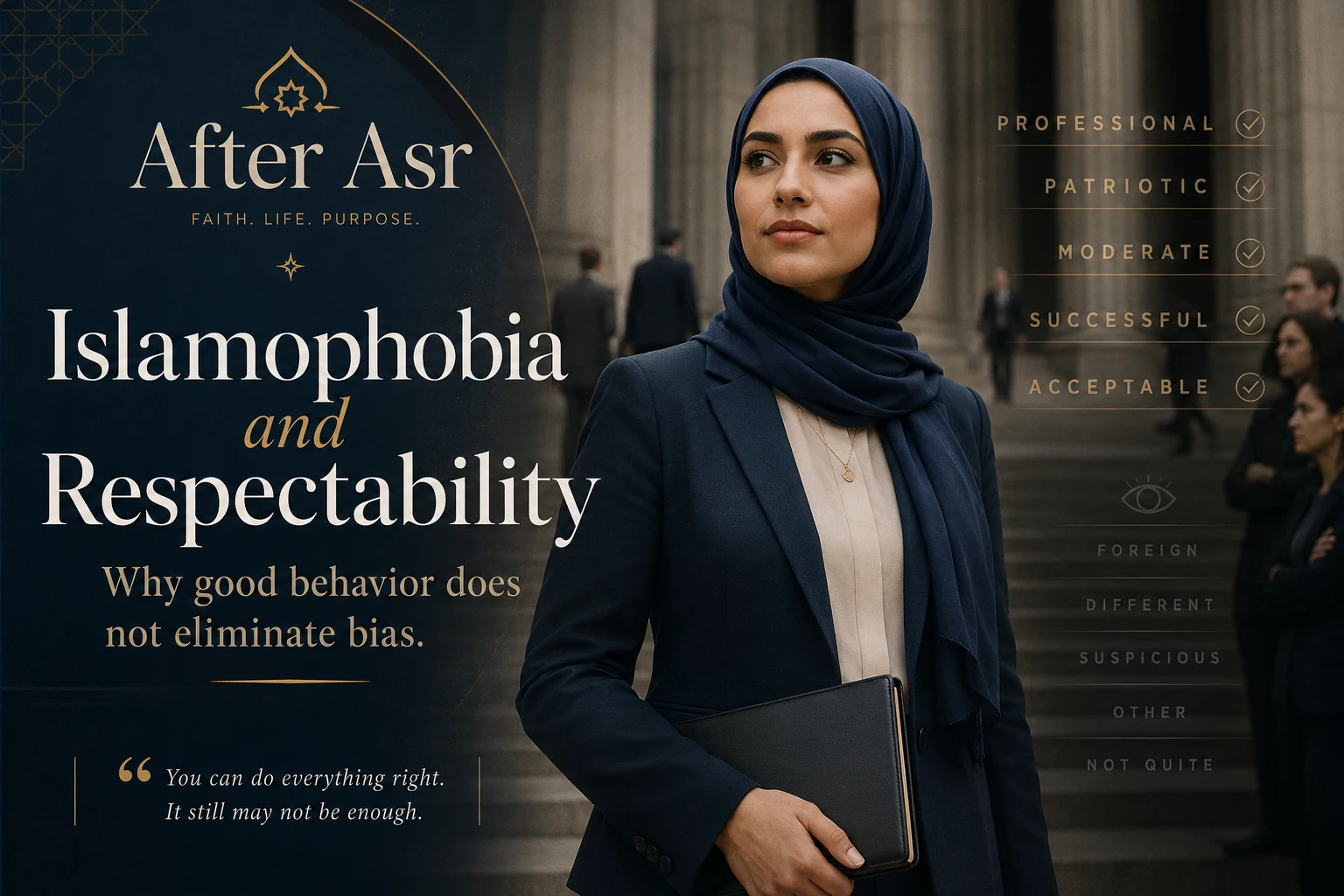
Why good behavior does not eliminate bias.
There is a promise quietly offered to many Muslims in public life:
Be kind enough.
Be successful enough.
Be patriotic enough.
Be articulate enough.
Be moderate enough.
Be visibly harmless enough.
Then, perhaps, suspicion will ease.
This promise is rarely stated so directly. It appears instead through praise. The Muslim professional who is “so well-spoken.” The athlete admired for being disciplined but not “political.” The neighbor who is “not like what you see on television.” The public figure celebrated for being respectable, calm, grateful, and carefully nonthreatening.
Good behavior matters. Character matters. Courtesy matters. Civic responsibility matters. Muslims, like anyone else, may rightly value dignity, excellence, discipline, and moral conduct.
But these virtues should not be confused with a bargain.
Islamophobia is not defeated by individual Muslims performing acceptability. Prejudice does not disappear simply because its targets are gracious. A society that requires Muslims to be exceptional before treating them fairly has not overcome bias. It has merely made acceptance conditional.
The Appeal of Respectability
Respectability has obvious appeal, especially for communities living under scrutiny.
When a group is routinely associated with danger, backwardness, disloyalty, or social disruption, it is understandable that some of its members respond by emphasizing stability, achievement, professionalism, family values, patriotism, and public service. These are not false qualities. Muslim communities often embody them genuinely.
Respectability can also be strategic. It may open doors, reduce immediate friction, protect institutions, reassure neighbors, and create opportunities for civic participation. Scholars studying Muslim minority life have noted that Muslim leaders and organizations sometimes adopt respectability politics as a way to contest Islamophobia and secure recognition in environments where their belonging is treated as uncertain. (cambridge.org)
There is nothing inherently shameful about wanting to be seen as responsible or honorable. The problem begins when public fairness is made dependent on that performance.
If Muslims must constantly demonstrate that they are orderly, productive, grateful, calm, and culturally familiar before they are treated as ordinary citizens, then respectability has become a gatekeeping demand.
The “Good Muslim” Problem
One of the most influential critiques of post-9/11 discourse came from scholar Mahmood Mamdani, who argued that public narratives increasingly divided Muslims into “good” and “bad” categories. The issue, he suggested, was not merely distinguishing peaceful people from violent actors. It was the broader cultural habit of sorting Muslims according to whether they reassured dominant society. (nau.edu)
The “good Muslim” is often imagined as:
- personally successful
- publicly grateful
- culturally legible
- quiet about discrimination
- eager to condemn other Muslims
- religious, but not too visibly so
- politically engaged, but not in ways that cause discomfort
The “bad Muslim,” by contrast, may be anyone who appears too angry, too foreign, too religious, too critical, too unapologetic, or too unwilling to perform reassurance on demand.
This is not a fair moral distinction. It is a comfort distinction.
A Muslim may be law-abiding, compassionate, devoted to family, deeply civic-minded, and still be considered threatening if they refuse to mute their faith, critique public injustice, or present themselves in forms already approved by the majority.
Respectability becomes a narrow path when approval depends less on ethics than on non-disruption.
Good Conduct Is Not a Shield Against Prejudice
The basic premise of respectability is that exemplary conduct can soften bias. Sometimes, at the level of individual relationships, it may. Personal familiarity can challenge stereotypes. Encounters matter. Information that counters perceptions of Muslims as foreign, threatening, or disloyal has been shown to modestly improve attitudes in experimental settings. (cambridge.org)
But modest improvement is not the same as elimination of prejudice.
Bias often survives direct contradiction. A person may admire one Muslim coworker while retaining negative views of Muslims generally. An employer may value professionalism in theory and still respond negatively to visible signs of Muslim identity. A public audience may celebrate Muslim excellence while treating Muslim political demands with suspicion.
Field experiments on hiring discrimination have found that Muslim applicants can face disadvantages even when qualifications are held constant. A cross-national European study found discrimination against Muslim job applicants in multiple countries, and U.S.-based research has similarly reported lower employer response rates to résumés signaling Muslim affiliation. (tandfonline.com) (time.com)
Those findings matter because they expose the weakness of the respectability bargain. A résumé already represents competence, effort, and social conformity. Yet the signal of Muslim identity can still change how it is received.
The problem is not insufficient excellence.
The problem is bias.
The Moving Standard of Acceptability
Respectability offers no fixed finish line.
A Muslim who becomes highly educated may still be viewed with suspicion if they speak forcefully about foreign policy. A Muslim woman praised for career success may be treated differently if she wears hijab. A Muslim athlete admired for discipline may be criticized if they visibly express faith in a public setting. A Muslim organization applauded for charitable work may be distrusted if it criticizes discrimination too bluntly.
Recent scholarship on respectability in Muslim minority contexts emphasizes that these expectations are unstable and reactive. Respectability politics may help communities navigate hostile environments, but it often fails to deliver full, unconditional citizenship because the terms of acceptance remain controlled by others. (cambridge.org)
This instability is central.
A minority cannot finally satisfy a demand that keeps changing. If every act of visibility, dissent, or discomfort can reopen the question of acceptability, then respectability is not a path into equal belonging. It is a probationary status.
Praise Can Carry a Threat
Respectability often arrives through compliments, which makes its pressure harder to see.
“You represent Muslims so well.”
“You are such a good example.”
“You make people see Islam differently.”
“If more Muslims were like you, there would be less prejudice.”
These statements may be intended as encouragement. Yet they place a heavy burden on the individual receiving them.
The Muslim person is praised not merely for being admirable, but for correcting the public image of a group. Their goodness becomes representational labor. Their success is treated as a rebuttal to stereotypes they did not create. Their conduct is quietly connected to the reputational fate of others.
That kind of praise can feel less like recognition and more like assignment.
It suggests that Muslims must earn fairness collectively through exceptional behavior, rather than receive it as a matter of justice.
Respectability Can Reward Silence
One of the most troubling features of respectability is that it may reward Muslims for minimizing the very prejudice they experience.
A Muslim who speaks calmly about civic engagement may be welcomed. A Muslim who speaks sharply about surveillance, media distortion, or anti-Muslim racism may be described as divisive. An organization that focuses on interfaith harmony may be celebrated. An organization that names structural Islamophobia directly may be treated as confrontational.
A 2026 study of Muslim elites in Norway examined how some organizations pursued a “positive approach” that downplayed Islamophobia in order to remain trusted partners within mainstream institutions. The study presents this not as simple failure, but as a strategic response to unequal conditions. Still, it highlights the danger: respectability can create incentives to soften truth in exchange for access. (tandfonline.com)
This is how bias reshapes speech without issuing a formal ban.
Muslims may remain present, but only if they speak in ways that do not unsettle those already comfortable. Their inclusion becomes conditioned on emotional manageability.
That is not the same as genuine belonging.
“Successful Muslims” Do Not Disprove Islamophobia
Another common misconception is that visible Muslim achievement disproves the existence of anti-Muslim bias.
A Muslim wins elected office.
A Muslim becomes a judge.
A Muslim physician leads a hospital.
A Muslim business owner thrives.
A Muslim artist receives public acclaim.
These achievements matter. They deserve celebration. They expand public imagination and challenge stereotypes. But they do not erase the larger structure of prejudice.
Public opinion research continues to show that Muslims face unusually high levels of expressed prejudice relative to other religious and ethnic groups studied, even while Muslim Americans are deeply embedded in civic, professional, and cultural life. A 2024 University of Maryland Critical Issues Poll, reported by Brookings, found that public prejudice toward Muslims remained higher than toward other groups measured, and that Muslims were viewed less favorably in terms of their perceived contributions to American society. (brookings.edu)
Success stories can coexist with discrimination. They often do.
The existence of exceptional individuals does not tell us whether ordinary Muslims are treated fairly. In fact, societies with entrenched prejudice often celebrate select minority figures precisely because they can be framed as exceptions.
The praise of a few should not be used to deny the burdens placed on many.
Respectability Makes the Vulnerable More Vulnerable
Respectability standards often privilege those who already possess social advantages.
A wealthy, educated, English-speaking Muslim professional may be easier for majority society to accept than a working-class immigrant, a visibly poor family, a politically angry student, a Black Muslim, a refugee, or someone whose religious practice is more outwardly unfamiliar. In this way, respectability can reproduce internal hierarchies even while seeking external acceptance.
Scholars examining Muslim respectability politics describe it as shaped by class, gender, race, and embodied presentation. The demand to appear acceptable does not fall equally on all Muslims, nor does everyone have equal access to the traits that dominant institutions reward. (cambridge.org)
This matters because prejudice is often most severe toward those least able or least willing to perform society’s preferred image of Muslim normalcy.
If the public can respect only Muslims who are polished, deferential, credentialed, and familiar, then it has not learned to respect Muslims. It has learned to reward resemblance.
There Is No Moral Failure in Being Ordinary
Respectability politics often pressures minorities to become inspirational.
The Muslim who is merely average may feel insufficient. The student who struggles academically, the worker who is impatient, the parent who is exhausted, the young person who makes mistakes, the community leader who speaks imperfectly, each may feel that their ordinary humanity risks reflecting poorly on Muslims as a whole.
That is an unfair burden.
Muslims should not have to be remarkable to deserve dignity. They should not have to be overachievers to receive the benefit of the doubt. They should not have to respond to insult with immaculate grace before their pain is recognized. They should not have to embody an idealized version of citizenship in order to avoid being treated as suspect.
Equality means the right to be ordinary.
It includes the right to be flawed without turning those flaws into evidence against a religion.
Goodness Matters, But Not as a Defense Strategy
None of this means goodness is meaningless.
Muslims may pursue excellence because faith encourages it, because communities need it, because service matters, because discipline and kindness matter. Moral conduct is valuable even when no audience is watching. Civility is not invalid simply because respectability politics can misuse it.
The distinction is crucial.
Good behavior is a virtue.
Performing goodness as proof of deserving rights is a trap.
A Muslim should be free to be gracious without that graciousness becoming compulsory. Free to be professional without professionalism being interpreted as a rebuttal to prejudice. Free to contribute without contribution being demanded as payment for belonging.
Dignity should not operate on a merit system.
When Bias Rewrites the Meaning of Behavior
Prejudice has a remarkable ability to reinterpret whatever Muslims do.
If Muslims protest injustice, they are called angry.
If they remain quiet, they are accused of hiding their views.
If they assimilate, they are praised as exceptions.
If they maintain visible religious practice, they are accused of refusing integration.
If they succeed, their achievement is treated as evidence that discrimination cannot be serious.
If they struggle, their hardship is attributed to culture or belief.
This is why respectability cannot solve Islamophobia. The problem is not a lack of correct Muslim behavior. The problem is a framework that reads Muslim behavior through suspicion.
As long as that framework remains intact, every action can be interpreted in service of the bias already present.
The Demand to Reassure Is Itself Revealing
A society that repeatedly asks Muslims to reassure it reveals something about itself.
It reveals that Muslim belonging is not yet assumed. It reveals that trust is unevenly distributed. It reveals that some citizens are allowed to be complex, while others are asked to remain comforting.
This can appear in subtle civic expectations. Muslims are encouraged to demonstrate loyalty, condemn violence, showcase patriotism, highlight charitable work, and produce public symbols of harmlessness. Yet survey data and social research continue to show that suspicions about Muslim loyalty and social contribution have persisted in American public opinion for years, even as Muslim Americans participate extensively in national life. (gallup.com) (brookings.edu)
The demand for reassurance is not neutral. It grows from the assumption that reassurance is owed.
That assumption deserves scrutiny.
A Fairer Standard
A fair society would still value integrity, service, kindness, and responsibility. But it would not selectively require those traits from Muslims as conditions of acceptance.
It would not measure Muslim worth by how effectively Muslims relieve non-Muslim anxiety.
It would not praise “good Muslims” in ways that leave unnamed “bad Muslims” looming in the background.
It would not use Muslim achievement to dismiss Muslim testimony about discrimination.
It would not treat political quietness as moral maturity.
It would not confuse comfort with fairness.
A fairer standard would recognize that people deserve rights before they perform reassurance. It would understand that an ordinary Muslim citizen should not need to become exemplary before being trusted. It would insist that prejudice be examined at its source rather than managed through endless self-presentation by those it harms.
Conclusion
Respectability can help individuals navigate a biased world. It can open certain doors, soften certain encounters, and serve as a tactic of survival. It may even arise from sincere moral commitments rather than social pressure.
But respectability cannot eliminate Islamophobia.
It cannot guarantee fairness. It cannot force institutions to abandon suspicion. It cannot ensure that public praise becomes equal treatment. It cannot make prejudice disappear by offering enough examples of admirable Muslims.
Good behavior matters. But it is not proof that a people deserve dignity.
They already do.
The real test of a society is not whether it can admire the most reassuring Muslims. It is whether it can treat Muslims fairly when they are ordinary, outspoken, visibly religious, imperfect, inconvenient, or unwilling to audition for acceptance.
Respect is not justice when it must first be earned through performance.
About the Author
Samira Nasser covers civic belonging, social perception, and the quieter ways prejudice shapes ordinary life, with a focus on Muslim communities in public institutions and culture.