
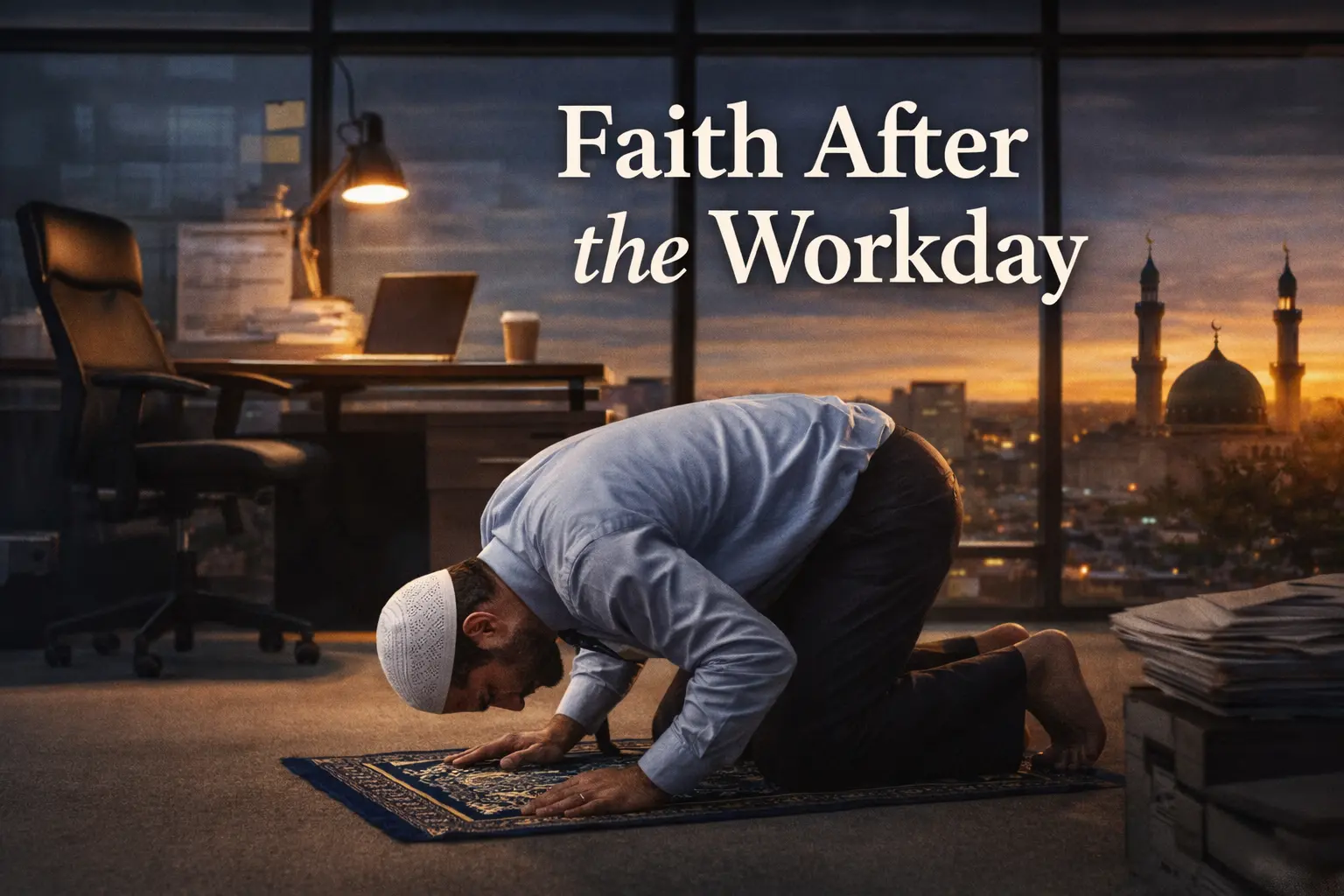
How American Muslims balance worship, work, and modern schedules
The alarm goes off at 5:30 AM, well before dawn. Sarah, a nurse in Chicago, performs wudu in the dim bathroom light, careful not to wake her husband, and spreads her prayer rug facing east. She has twenty minutes before she needs to start getting ready for her shift. Fajr cannot wait.
Across the country in Los Angeles, Ahmed closes his laptop at the tech startup where he works. It’s 1:47 PM, and Dhuhr came in at 12:43. He’s already missed the ideal window, but he finds an empty conference room, locks the door, and prays quickly before his next meeting at 2:00. His coworker saw him walk in with his prayer rug and asked no questions. After three years at the company, this has become routine.
In Houston, Fatima drives home from her teaching job, her mind racing through the evening ahead. Asr at 5:32, dinner prep, kids’ homework, maybe squeeze in a workout, Maghrib at 7:48, baths and bedtime routine, Isha at 9:11. She’ll be lucky if she gets to pray any of them on time, let alone with the focus and presence they deserve. Some days, faith feels less like a spiritual practice and more like an item on an impossible to-do list.
This is the reality for millions of American Muslims: the constant negotiation between the rhythms of faith and the demands of a society that runs on a different clock entirely. Islam calls for five daily prayers at specific times. America calls for nine-to-five jobs, back-to-back meetings, overtime, and hustle. Finding space for worship in a workday designed without it requires creativity, persistence, and sometimes painful compromise.
The Prayer Puzzle
The five daily prayers are non-negotiable in Islam, obligatory acts that structure a believer’s entire day around remembrance of Allah. But American work culture was not designed to accommodate them. There are no built-in prayer breaks, no designated prayer rooms in most workplaces, no cultural understanding that an employee might need to step away five times a day for worship.
Muslim Americans have developed countless strategies to make it work. Some wake up early enough to pray Fajr before the morning rush, treating it as a spiritual anchor for the day ahead. Others combine prayers when necessary, praying Dhuhr and Asr together during a lunch break, or Maghrib and Isha after returning home from work. Scholars differ on the permissibility of this practice outside of travel, but for many working Muslims, it’s become a practical necessity.
Prayer rooms at work remain rare, though large companies in diverse cities increasingly provide them. More often, Muslims pray in bathroom stalls, parked cars, empty offices, stairwells, or storage closets. A survey rug that folds into a small pouch becomes essential gear. Apps that calculate precise prayer times based on location replace the muezzin’s call. The experience is solitary, rushed, and far from the communal ideal of praying in congregation at the mosque.
Some Muslims have the privilege of workplace flexibility. Remote workers can pray at home between video calls. Those with understanding bosses can block off fifteen-minute windows on their calendars marked “unavailable.” Doctors and nurses develop the skill of speed-praying between patients. Teachers pray during lunch or prep periods. But many others, particularly those in customer-facing roles, hourly positions, or demanding corporate environments, struggle to find even five minutes of private space.
The psychological weight of this struggle is real. There’s the stress of watching prayer times approach while stuck in a meeting. The guilt of delaying prayers or rushing through them without presence. The anxiety of explaining religious needs to supervisors who might not understand or approve. The exhaustion of constantly calculating and recalculating schedules. For some, the difficulty of maintaining prayer at work leads to gradually abandoning the practice altogether, a slipping away that happens not from lack of faith but from sheer logistical overwhelm.
Ramadan in the Office
If daily prayers require constant accommodation, Ramadan demands an entire month of it. Fasting from dawn to sunset while maintaining full work productivity is challenging enough. Add in the disrupted sleep from waking before dawn for suhoor and staying up for tarawih prayers at night, and Ramadan becomes a test of physical endurance as much as spiritual devotion.
American workplaces rarely acknowledge Ramadan. There are no reduced hours for fasting employees, no exemptions from lunch meetings or office celebrations involving food. Muslim workers learn to navigate the awkwardness of declining birthday cake, sitting at lunch tables without eating, and explaining repeatedly why they’re not drinking water on a hot afternoon.
Some have it easier than others. White-collar workers might discreetly schedule important meetings earlier in the day when energy is higher, or work from home when fasting becomes particularly difficult. But blue-collar workers, those in physically demanding jobs, or anyone whose role requires constant customer interaction often have no such flexibility. Construction workers fast in the summer heat. Uber drivers go twelve-hour shifts without food or water. Cashiers stand on their feet all day, watching customers buy and consume food they cannot touch.
The greatest tension comes in the final hours before iftar. In Muslim-majority countries, work slows down in the late afternoon, shops close early, and everyone rushes home to break fast with family. In America, 6:00 PM is the middle of the workday for many people. Evening meetings, work events, and late shifts mean some Muslims break their fast alone in their cars or at their desks, eating dates from Tupperware containers instead of gathered around a table with loved ones.
Yet Ramadan at work also creates unexpected moments of community and visibility. Muslim coworkers share iftar together in office kitchens. Non-Muslim colleagues ask genuine questions about the practice and sometimes express admiration for the discipline it requires. Companies slowly learn to avoid scheduling major events during Ramadan or at least to provide non-alcoholic options and vegetarian meals that fasting Muslims can eat after sunset.
The Friday Dilemma
Jumu’ah, the Friday congregational prayer, occupies a special place in Islamic practice. For men, attendance is generally considered obligatory. For women, it’s recommended. The prayer occurs in the early afternoon, precisely when most Americans are in the middle of their workday.
Some Muslim professionals have arranged their schedules around Jumu’ah. They take long lunches on Fridays, work from home and drive to the mosque midday, or negotiate part-time or flexible schedules that allow them to leave the office. In cities with large Muslim populations, mosques offer multiple Jumu’ah services to accommodate different work schedules, some as early as 12:15 PM, others as late as 2:00 PM.
But for many, attending Jumu’ah weekly is simply impossible. Hourly workers can’t leave in the middle of a shift. Teachers can’t abandon their classrooms. Doctors can’t walk out of surgery. The Muslim medical student rotations, the lawyer in a demanding firm, the retail worker whose schedule changes every week often go months or even years attending Jumu’ah only occasionally, if at all.
This creates a particular kind of spiritual loss. Jumu’ah is meant to be a weekly gathering of the community, a moment to hear the khutbah, reconnect with fellow Muslims, and reset spiritually before the week continues. Missing it repeatedly means missing not just a prayer but a vital connection to the larger ummah. Some Muslims compensate by attending weekend programs at the mosque or watching khutbahs online, but it’s not quite the same.
The challenge is especially acute for Muslim women, who already face barriers to mosque attendance in some communities. When Jumu’ah conflicts with work, and Friday is the one day the mosque is most accessible, missing it means missing the most vibrant weekly gathering of the community. Weekend programs often feel more family-oriented and less spiritually substantial than the main Friday service.
Beyond Prayer: The Other Pillars
Work-life balance affects more than just salah. Zakat requires careful calculation of wealth and timely distribution, but tax season and financial planning take precedence in most American schedules. Hajj, which must be performed at a specific time of year, requires either significant vacation time saved up or a sympathetic employer willing to grant extended leave. For hourly workers or those without paid time off, the financial cost of lost wages makes Hajj even more prohibitively expensive.
Even daily acts of worship face obstacles. Reading Quran regularly requires time and focus that feel impossible to find between work, family obligations, and basic self-care. Attending Islamic classes or study circles means sacrificing evening hours already stretched thin. Volunteering at the mosque or participating in community service happens only when work schedules allow, which often they don’t.
The pressure to be constantly productive in American culture makes rest feel like laziness and worship feel like an inefficient use of time. The “grind” mentality, the hustle culture that valorizes overwork and treats self-care as selfish, leaves little room for spiritual practices that don’t produce measurable outcomes. Even Muslims who recognize this as antithetical to Islamic values struggle to resist it when their livelihoods depend on meeting those cultural expectations.
Finding Balance, Redefining Success
Yet despite these challenges, American Muslims continue to practice their faith. They wake up before dawn. They find corners to pray in. They fast through long summer days. They figure it out, not perfectly, often not even well, but persistently.
Some have reimagined what faithful practice looks like in this context. They focus on quality over quantity, praying fewer prayers but with greater presence. They use commute time for dhikr and reflection. They create mini-communities at work, praying together in groups when possible. They extend grace to themselves for the prayers they miss and show up again the next day to try.
Others are pushing for systemic change, advocating for workplace accommodations, educating employers about religious needs, and supporting legislation that protects religious practice. Muslim entrepreneurs are building companies with prayer rooms and flexible schedules built in from the start. Muslim employees at large corporations are forming resource groups that create space for faith within institutional structures.
The conversation is also shifting around what constitutes success. Is the Muslim who attends every Jumu’ah but neglects their family truly more faithful than the one who misses Friday prayer to coach their child’s soccer team? Is the person who wakes for Tahajjud every night but treats their coworkers harshly living Islam more fully than the one who prays only the obligatory prayers but shows up with kindness and integrity? Faith after the workday might mean recognizing that the work itself, done with excellence and ethics, can be an act of worship too.
American Muslim scholars and thinkers are grappling with these questions, developing frameworks for faithful living in contexts the classical scholars never imagined. The conversation is ongoing, evolving, and necessary. Because American Muslims aren’t going anywhere. They’re here, building careers, raising families, contributing to society, and trying to maintain their relationship with Allah in the midst of it all.
The Spiritual Commute
Perhaps the most quintessentially American Muslim practice is the spiritual commute, those moments in the car between work and home when the day hasn’t ended but hasn’t yet transitioned into evening responsibilities. Some Muslims use this time to listen to Quran recitation or Islamic lectures. Others sit in the masjid parking lot for a few minutes of stillness before heading home. Still others simply drive in silence, the highway a space between worlds where they can exhale the work persona and prepare to be present for family.
These liminal moments might be where American Islam is most honestly lived. Not in the pristine practice of an ideal schedule, but in the messy reality of trying to remember Allah while stuck in traffic. Not in the grand gestures of pilgrimage and fasting, but in the small persistent choices to pray even when it’s inconvenient, to maintain integrity even when it costs something, to keep faith alive even when the schedule doesn’t accommodate it.
Faith after the workday is faith in the margins, carved out and held onto despite everything working against it. It is faith that looks nothing like the textbooks describe and everything like resilience. It is imperfect, exhausting, and ongoing. And for American Muslims, it is simply what faith looks like here.
So Sarah finishes her shift at the hospital and prays Maghrib in the break room before driving home. Ahmed sets a phone reminder for Isha because he knows he’ll get absorbed in bedtime stories and forget. Fatima gives herself permission to combine prayers tonight because she’s exhausted and Allah is merciful.
They are doing their best. And in a culture that was not built for their worship, perhaps that’s enough.