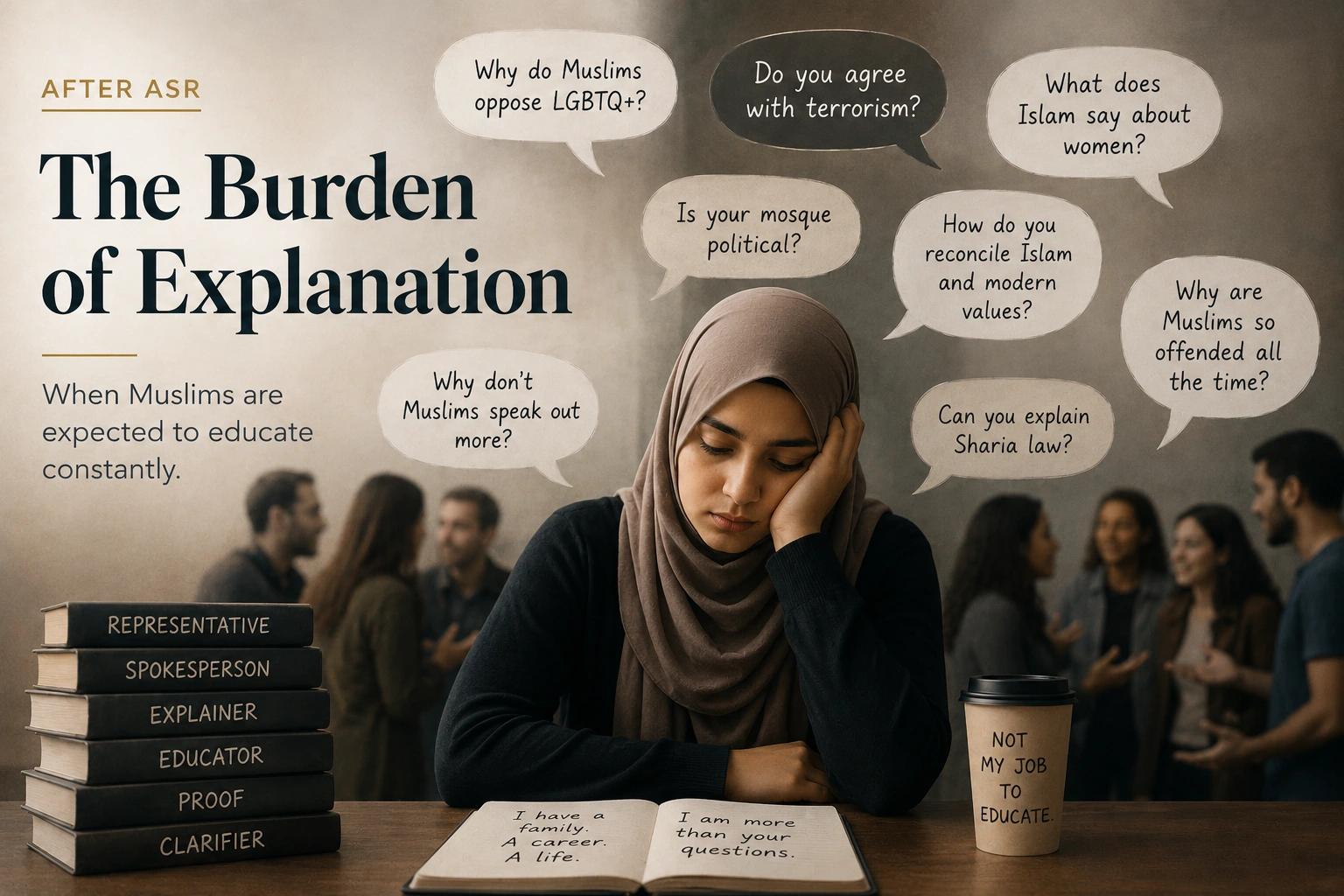
When Muslims are expected to educate constantly.
There is a difference between being willing to explain and being expected to explain.
Many Muslims are generous with questions. They speak about Ramadan to coworkers, answer classmates’ questions about prayer, clarify misconceptions about hijab, discuss what halal means, and sometimes welcome difficult conversations about faith, politics, and public life.
But generosity becomes burdensome when it is assumed.
When every public controversy involving Muslims creates a private assignment for ordinary Muslims, something has shifted. A person is no longer simply a colleague, student, neighbor, customer, or friend. They become an interpreter of Islam, a representative of Muslim communities, a fact-checker of stereotypes, and, at times, a defendant in a case they did not create.
This is the burden of explanation.
It is the quiet expectation that Muslims should be endlessly available to clarify themselves to others.
The Question Beneath the Question
Some questions are sincere.
“What is Eid?”
“Why do Muslims fast?”
“How do you make time for prayer during the workday?”
These can open real connection. They can reflect interest rather than suspicion.
But other questions carry a different weight.
“Why don’t Muslims condemn terrorism?”
“What does Islam say about women, really?”
“Do you agree with what happened over there?”
“Is your mosque political?”
“Why are Muslims so offended all the time?”
These questions are rarely just requests for information. They arrive already shaped by broader narratives. The Muslim person is not simply being asked what they know. They are being asked to address a concern that has already attached itself to their identity.
That is why the same question can feel very different depending on timing, tone, and pattern.
After a violent event, a Muslim employee may walk into work knowing someone will eventually bring it up. A Muslim student may see the news before class and feel dread, not only because of the event itself, but because they expect to be looked at, asked, or silently associated with it. Scholars of Islamophobia have long criticized this expectation, particularly the recurring demand that Muslims publicly condemn violence they did not commit in order to prove moral innocence.
The burden is not always in the words. Sometimes it begins before anyone speaks.
Becoming the Room’s Unofficial Muslim
In many environments, a Muslim person may be the only visibly Muslim person present. That position can turn ordinary conversation into representational labor.
A workplace discussion about world events drifts toward the Middle East, and eyes turn toward the Muslim colleague. A classroom debate touches on religion, and the Muslim student is asked to “give the Islamic perspective.” A friend hears a controversial claim online and brings it to the one Muslim they know for correction. A journalist needs a quote about a public issue and seeks out “the Muslim voice,” as though one person can speak for a global, internally diverse religious community.
The moment may be well-intentioned. But it still places a person under pressure to answer on behalf of many.
This kind of added representational labor resembles what researchers in other contexts call a minority tax: the extra, often uncompensated burden placed on underrepresented people to educate, represent, reassure, and support institutional diversity beyond their ordinary roles. The term is most developed in academic and professional research, but the underlying dynamic is recognizable far beyond those settings.
For Muslims, the tax often includes being expected to serve as a living explanatory footnote to Islam itself.
Curiosity Becomes Exhausting When It Is Constant
No single question may feel unreasonable. The exhaustion comes from accumulation.
A Muslim woman may answer questions about hijab at school, then again at work, then again in a social setting, then again in a doctor’s office, then again from a stranger who insists they are “just curious.” A convert may spend years explaining why they became Muslim, as though their faith requires a permanent press conference. A Muslim parent may repeatedly clarify food, holidays, prayer, or names to institutions that have had years to learn but still expect families to start from the beginning.
The questions are often framed as harmless because each one is new to the person asking.
They are not new to the person answering.
This asymmetry matters. One person experiences a moment of curiosity. The other experiences the hundredth repetition of a role they did not volunteer to occupy.
Over time, even respectful questions can begin to feel like small withdrawals from the same account.
The Demand to Condemn
Perhaps the clearest example of the burden of explanation is the demand that Muslims condemn acts of violence committed by other Muslims.
For decades, Muslim organizations, scholars, leaders, and ordinary individuals have repeatedly denounced terrorism and attacks on civilians. Yet the public question returns with remarkable persistence: Why don’t Muslims speak out? Todd Green’s 2023 article in the Journal of Muslim Philanthropy & Civil Society argues that repeated calls for Muslims to condemn terrorism can reinforce the assumption that Muslims are presumptively implicated until they publicly distance themselves.
The issue is not whether Muslims should speak against injustice. Many do, from moral conviction and religious principle.
The issue is the unequal expectation.
Christians are not routinely asked to condemn every violent Christian extremist before being treated as decent neighbors. White Americans are not expected to explain every white supremacist attack. Men are not collectively summoned to defend themselves after every act of male violence. Yet Muslims are often treated as if silence itself is suspicious.
In this frame, condemnation is not heard as moral speech. It is demanded as evidence of innocence.
That is a very different thing.
Explaining Against a Moving Target
Another feature of this burden is that the explanation is rarely final.
A Muslim may clarify that terrorism is condemned in Islam. Then someone asks about a verse they saw online. The verse is contextualized. Then someone asks about a government in a Muslim-majority country. That distinction is explained. Then someone asks about women. Then about Sharia. Then about extremism. Then about “integration.” The conversation keeps moving, often without acknowledging that the Muslim person has already answered in good faith.
The target shifts because the underlying suspicion has not actually been resolved. It has simply changed shape.
This makes some explanatory encounters feel less like dialogue and more like a series of tests. The Muslim speaker must continue demonstrating reasonableness, modernity, peaceability, and competence. The other person retains the right to keep escalating the syllabus.
A sincere learner eventually absorbs information.
A suspicious listener keeps requiring more proof.
Education Is Valuable. Compulsory Education Is Something Else.
It would be wrong to say Muslims should never explain Islam to others. Muslim communities have always taught, hosted, welcomed questions, built interfaith relationships, and corrected falsehoods. Education matters. It can reduce ignorance, soften fear, and build civic trust.
But there is a difference between chosen education and compulsory explanation.
Chosen education is intentional. It may happen in a mosque open house, a community event, a classroom invited for that purpose, a workplace panel, a thoughtful friendship, or an article written for public understanding. It is shaped by consent and context.
Compulsory explanation is reactive. It appears unexpectedly. It often interrupts ordinary life. It assumes access to someone’s time and emotional energy. It may emerge after a headline, a stereotype, a rude comment, or a poorly informed challenge.
One is a form of generosity.
The other can become extraction.
The Emotional Work of Staying Gracious
The burden of explanation is not merely intellectual. It is emotional.
Muslims often have to decide how honest to be, how patient to sound, whether to correct a false claim immediately, whether a question deserves an answer, whether refusing will be interpreted negatively, whether anger will be used as proof of the stereotype under discussion.
This self-management is labor.
A student may answer calmly even when embarrassed in front of peers. A coworker may gently correct an offensive assumption to avoid making the room tense. A Muslim woman may explain hijab for the fifth time that week and still smile because she does not want the asker to feel ashamed. A parent may patiently educate a school administrator who should already know how to handle a basic religious accommodation.
The Muslim person is not only providing information. They are managing the emotions of the person receiving it.
Researchers studying minority tax and emotional tax describe similar burdens among underrepresented people in workplaces and institutions: the additional effort of navigating bias, educating others, and preserving relationships while doing so.
That labor may be invisible to everyone except the person performing it.
The Risk of Saying “I Don’t Want to Explain”
Declining to educate should be a normal option. It often does not feel like one.
A Muslim who says, “I’d rather not discuss that right now,” may worry they seem evasive. A woman who declines to explain hijab may worry she has made Muslims appear unfriendly. A student who says, “I’m not the right person to speak for all Muslims,” may worry they seem unhelpful. A coworker who refuses to discuss a breaking-news event may worry their silence will be misread.
This is one of the clearest signs that explanation has become burden. When refusing it feels socially risky, the exchange is no longer entirely voluntary.
The expectation of accessibility becomes part of the pressure.
Muslims may be told that dialogue is the solution to prejudice, but dialogue cannot be healthy when one side is constantly summoned and the other side arrives unprepared.
Resources Exist. Muslims Should Not Be the Only Resource.
The modern information environment makes this burden more difficult to justify.
There are books, articles, mosques, educational organizations, public lectures, university resources, introductory guides, and Muslim scholars who have already addressed the most common questions at length. Someone who wants to understand Ramadan, hijab, prayer, terrorism, Islamic law, or basic Muslim beliefs has more access to reliable explanation than at almost any previous point in history.
That does not make personal conversation unnecessary. But it does mean personal access should not be treated as the first and only route to education.
In workplace and organizational settings, inclusion researchers increasingly emphasize that marginalized people should not bear sole responsibility for teaching colleagues what institutions and individuals could learn through existing resources and shared accountability.
A thoughtful question sounds different when it follows some effort.
“I read a little about this and wanted to understand your perspective, if you feel like sharing,” is not the same as, “Explain your religion to me.”
One recognizes the Muslim person as a conversation partner.
The other treats them as a search engine.
The Pressure Is Heavier in Moments of Crisis
The burden of explanation intensifies when geopolitical violence, terrorism, war, or anti-Muslim controversy dominates the news. During such periods, Muslims may experience not only grief or fear about events themselves, but also anticipatory stress about the social demands that follow.
A Muslim student may wonder whether class discussion will become uncomfortable. A Muslim employee may brace for a comment in the break room. A Muslim public figure may be expected to release a statement before others are asked what they think. A Muslim organization may understand that silence will be interpreted publicly even when many comparable organizations are allowed private grief, uncertainty, or restraint.
Recent research on Muslim American college students emphasizes that many have come of age in a post-9/11 environment marked by surveillance, discrimination, and repeated stigmatization, shaping how they experience campus life and public scrutiny.
The burden of explanation is part of that broader atmosphere. It tells Muslims that public events may become personal assignments.
Explaining Can Also Distort Muslim Identity
When Muslims are asked to explain Islam mainly in response to controversy, the subjects themselves begin to narrow. Islam becomes publicly associated with whichever topics non-Muslims repeatedly demand clarification about.
Terrorism.
Women.
Violence.
Foreignness.
Law.
Security.
Loyalty.
These are not the only questions about Islam. They are not even the questions that define most Muslims’ daily religious lives. Muslims may spend more time thinking about prayer, mercy, family, spiritual discipline, work, community, grief, forgiveness, charity, or God than about the subjects they are constantly asked to address.
But the burden of explanation can trap Muslims inside other people’s concerns.
They are asked to explain Islam according to the fears surrounding it, not according to the fullness of the faith itself.
That is a quieter kind of distortion.
What Better Curiosity Looks Like
A society should not retreat from conversation. Better curiosity is possible.
It begins with self-awareness.
Is this the right moment?
Is this person close enough to me for this question?
Am I asking because I want to learn, or because I want them to relieve my discomfort?
Could I find a basic answer myself first?
Am I asking one person to speak for millions?
Would I ask this in the same way if the subject were another faith or group?
Have I given them a genuine option not to answer?
Good questions leave room for consent. They do not corner. They do not demand real-time correction. They do not make Muslims responsible for fixing every falsehood they encounter.
And when a Muslim does choose to answer, that willingness should be received as generosity, not entitlement.
Let Muslims Be Off Duty
Perhaps the simplest correction is this: Muslims should be allowed to be off duty.
They should be able to attend class without teaching a seminar on Islam. Work without fielding questions after every news cycle. Wear hijab without explaining womanhood. Fast without turning lunch into an educational panel. Decline a question without being treated as defensive. Exist publicly without being converted into a resource.
This does not mean shutting down dialogue.
It means restoring proportion.
A Muslim person may sometimes be a teacher, advocate, spokesperson, or guide. But they are not always those things. They are also tired, busy, distracted, grieving, laughing, late to a meeting, trying to buy groceries, or simply uninterested in carrying the conversation that someone else has decided to begin.
Ordinariness should include the right not to explain oneself on demand.
Conclusion
The burden of explanation is one of the quieter ways Islamophobia shapes daily life. It does not always appear as hostility. Sometimes it appears as expectation: that Muslims will answer, clarify, reassure, translate, condemn, contextualize, and educate whenever others feel uncertain.
Some questions are sincere. Some conversations are meaningful. Many Muslims choose to explain their faith with patience and care.
But choice matters.
When explanation becomes compulsory, repetitive, and unequally assigned, it stops being simple dialogue. It becomes labor. It asks Muslims to manage not only misconceptions about Islam, but also the discomfort of those who hold them.
A healthier public culture would still ask questions. It would simply stop assuming that Muslims owe an answer every time curiosity, fear, or confusion appears.
Education is valuable.
Entitlement to someone else’s explanation is not.