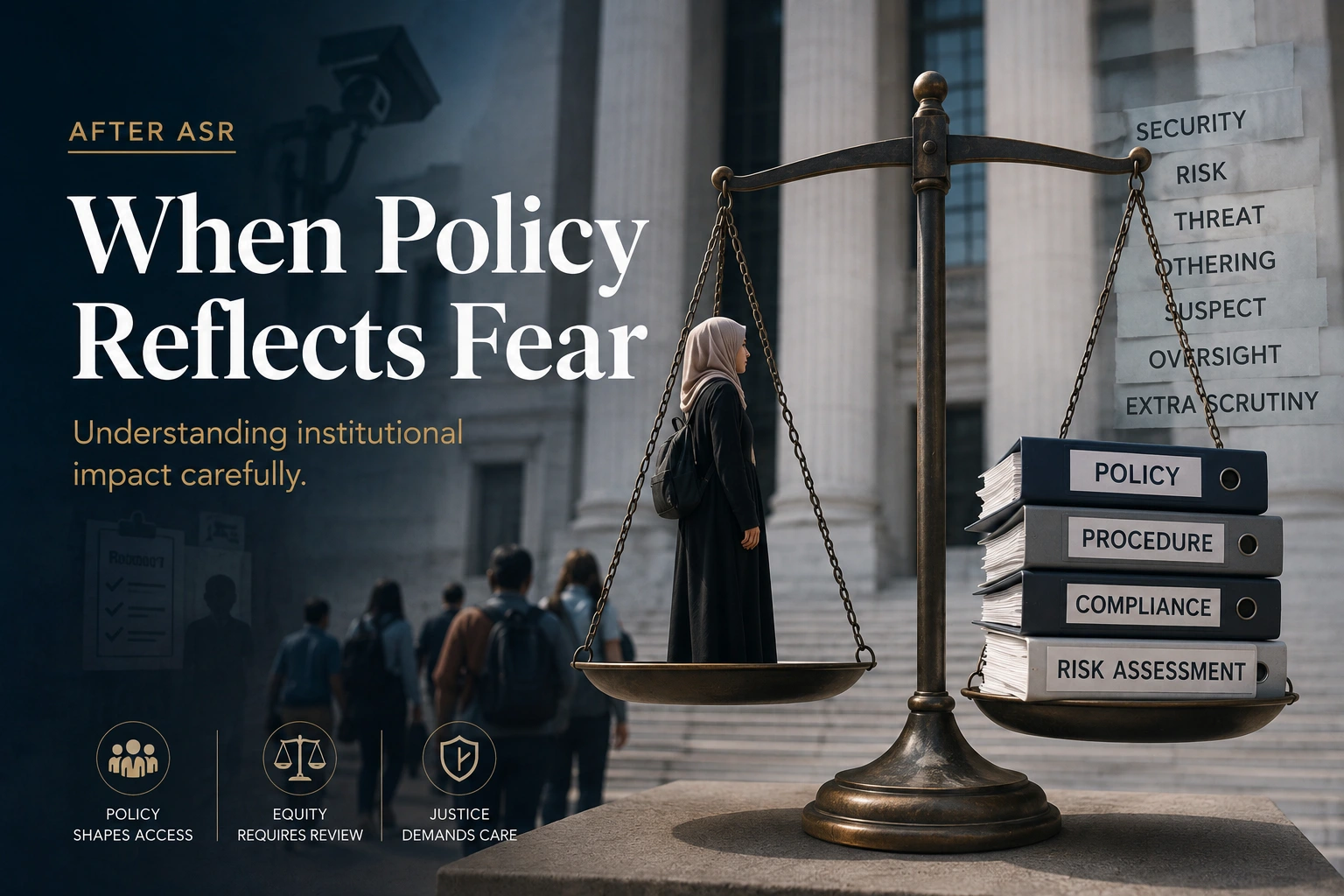
Understanding institutional impact carefully.
Fear does not remain private forever.
When it becomes widespread enough, repeated enough, and politically useful enough, it can begin to shape institutions. It enters procedures, training manuals, security systems, school rules, workplace decisions, border inspections, and funding priorities. It may no longer sound emotional. It may sound administrative.
That is part of what makes it powerful.
A prejudiced comment can be challenged in public. A policy often arrives with forms, justifications, and official language. It presents itself as rational, standardized, and necessary. Yet policies are made by people, in particular climates, under particular pressures. They can reflect the anxieties of their moment, even when they do not name those anxieties directly.
In discussions of Islamophobia, this distinction matters. The concern is not that every security measure, accommodation rule, or institutional decision involving Muslims is discriminatory. It is not. Institutions have real responsibilities. Governments face real threats. Employers and schools have practical limits.
The question is more careful than that:
When does a legitimate institutional concern become shaped by generalized suspicion toward Muslims?
Policy Is Not Automatically Neutral
Policies often appear impersonal. They are written in broad terms, applied through procedures, and defended as consistent. This can create the impression that they are naturally fair simply because they do not mention a particular group.
But neutrality in wording does not guarantee neutrality in impact.
A rule can avoid saying “Muslim” while predictably burdening Muslims. A dress policy can affect hijab-wearing women. A grooming policy can affect Muslim men who keep beards for religious reasons. A rigid scheduling system can make prayer or Eid observance difficult. A security procedure can disproportionately subject visibly Muslim travelers, or those perceived to be Muslim, to additional scrutiny.
Federal employment guidance recognizes precisely this issue. The Equal Employment Opportunity Commission explains that religious accommodation may require exceptions to otherwise general workplace requirements, and that employer discomfort or coworker reactions are not enough, by themselves, to deny accommodation. The agency has also issued guidance addressing discrimination affecting Muslims, Arabs, South Asians, and Sikhs in employment settings.
The principle is simple but important: a rule is not fully understood by reading its language alone. It must also be examined through the burdens it creates.
The Institutionalization of Suspicion
Islamophobia becomes more consequential when it no longer depends on individual hostility.
A single person may distrust Muslims. An institution can operationalize distrust.
That operationalization may be explicit, but it is often subtler. It can appear through:
- extra review
- unusual documentation requests
- disproportionate monitoring
- delayed approvals
- heightened inspection
- restrictive interpretations of religious accommodation
- risk models that treat Muslim-associated indicators as more suspicious
Not every instance of heightened review is discriminatory. But the pattern deserves scrutiny when Muslims, or those perceived to be Muslim, repeatedly encounter institutional doubt that others do not.
This concern has surfaced in public oversight of transportation and border systems. In 2022, the Government Accountability Office reviewed whether TSA passenger screening practices could result in discrimination and recommended stronger assessment and complaint tracking. In 2023, GAO reviewed Customs and Border Protection traveler inspections, noting that travelers and stakeholder organizations had raised concerns about potential discrimination based on race, religion, or other characteristics, even as the agency maintained procedures intended to prevent such discrimination.
That tension is instructive. Institutions may have formal safeguards and still require continued examination of how people experience their systems.
Fear Often Expands the Definition of Risk
Policy shaped by fear tends to widen the category of what counts as suspicious.
Instead of focusing narrowly on behavior linked to an actual threat, institutions can begin treating identity-adjacent markers as meaningful signals: travel patterns, language, clothing, religious practice, charitable giving, political speech, or association with particular regions of the world.
The official language may remain careful. The lived experience can feel much broader.
A Muslim traveler does not necessarily know why they were selected for additional questioning. A Muslim student does not always know why their activism is being interpreted with unusual alarm. A Muslim employee may not know whether a denial of accommodation was truly operationally necessary or simply shaped by discomfort. Ambiguity itself becomes burdensome.
This is why responsible institutional review matters. It is not enough to say that a policy was created for safety. It is also necessary to ask whether it is evidence-based, proportionate, consistently applied, and subject to meaningful oversight.
Fear prefers expansion.
Justice requires limits.
The Difference Between Protection and Projection
Governments and institutions do have a duty to protect people. Security measures are not inherently discriminatory. Neither are school conduct policies, workplace dress codes, or border inspections. The existence of a rule is not the problem.
The problem arises when the rule begins reflecting projection rather than evidence.
Protection responds to a concrete concern.
Projection assigns danger in advance.
Protection is specific, reviewable, and accountable.
Projection is broad, difficult to challenge, and often defended by asking people to trust the institution’s judgment without being allowed to examine its assumptions.
This distinction helps avoid two equally poor conclusions: that all institutional scrutiny of Muslims is Islamophobic, or that no policy can be Islamophobic unless its authors openly declare anti-Muslim intent.
Neither is true. Institutional bias often appears in the space between those extremes.
The Burden of Proving Ordinary Life
One of the most exhausting effects of fear-shaped policy is that it can require Muslims to prove that ordinary life is ordinary.
A head covering must be explained.
A prayer break must be justified.
A charitable donation may invite suspicion.
A trip abroad may become an occasion for intensified questioning.
A campus organization may find its politics interpreted through national security assumptions before being treated as ordinary student advocacy.
These burdens are not always dramatic. Often, they are procedural. Yet repeated procedure teaches a lesson: some people are presumed uncomplicated participants in public life, while others are treated as exceptions requiring review.
That is an institutional effect of Islamophobia and it turns belonging into paperwork.
Institutions Can Also Correct Fear
Policy does not only transmit bias but it can also confront it.
The same institutional power that burdens communities can be used to protect them when agencies recognize the problem and act with clarity. In September 2023, federal agencies clarified that certain forms of Islamophobic discrimination can fall within Title VI protections against discrimination based on shared ancestry or ethnic characteristics in federally funded programs. In December 2024, the White House released the first U.S. National Strategy to Counter Islamophobia and Anti-Arab Hate, describing a whole-of-government effort to address bias, discrimination, and threats affecting Muslim and Arab Americans.
These developments matter because they show that institutions are not fixed in one direction. They can reproduce fear, but they can also name and restrain it. They can create burdens, but they can also build protections, complaint processes, training, and clearer standards.
Policy is not inherently hostile.
It is also consequential.
Why “Careful” Matters
The subtitle of this discussion matters: understanding institutional impact carefully.
Carefulness protects against exaggeration. It prevents us from labeling every disappointing decision as Islamophobia. Institutions sometimes deny requests for legitimate reasons. Security investigations can be warranted. Schools and employers must make real operational judgments. Public policy involves tradeoffs.
But carefulness also protects against denial.
If Muslim communities repeatedly describe certain systems as uniquely burdensome, if oversight bodies recommend better tracking of possible discrimination, if civil rights agencies continue issuing guidance on religious accommodation and anti-Muslim bias, then the issue should not be dismissed as oversensitivity.
A serious analysis neither inflates nor minimizes. It asks what the evidence shows, what patterns emerge, and whether institutional systems are producing unequal effects that deserve correction.
Policy Can Outlast the Fear That Created It
One of the most important things to understand about institutions is that rules often survive the moment that produced them.
A policy introduced during a period of heightened anxiety can remain long after public attention has moved elsewhere. A procedure created as an emergency response can become routine. A form of scrutiny once justified as temporary can harden into culture.
This is why policies require periodic review. Institutions must ask whether rules still serve their stated purpose, whether they have generated unintended disparities, and whether safeguards are working as designed.
Fear is often reactive. Policy is durable.
That durability raises the stakes.
The Human Meaning of Institutional Impact
Policy language can feel abstract. Its impact is not.
A Muslim woman denied a job because a dress expectation is treated as more important than religious accommodation experiences policy personally. A traveler subjected to repeated additional screening experiences institutional suspicion personally. A student whose complaint of Islamophobic harassment is poorly handled experiences administrative failure personally. Civil rights agencies have repeatedly made clear that religious discrimination can arise in employment, education, public accommodations, and federally funded programs.
This is why institutional bias cannot be waved away as mere bureaucracy. Bureaucracy is one of the ways society distributes dignity, delay, inconvenience, scrutiny, and access.
Policies are lived through bodies.
What Fair Policy Requires
A fair institution does not assume that every concern about discrimination is valid. Nor does it assume that every policy is justified because it was written in neutral language.
It examines.
Fair policy asks:
- What problem is this rule trying to solve?
- What evidence supports it?
- Who bears the burden?
- Is that burden necessary and proportionate?
- Is the rule applied consistently?
- Can affected people challenge it meaningfully?
- Are complaints tracked and reviewed?
- Are accommodations considered in good faith?
- Has the institution mistaken familiarity with one cultural norm for neutrality itself?
These questions are not anti-security, anti-order, or anti-institutional. They are what make institutions worthy of trust.
Conclusion
Fear becomes especially powerful when it stops sounding like fear and starts sounding like procedure.
That is why Islamophobia must be examined not only in speech and sentiment, but also in systems. A policy can be written without hatred and still reflect suspicion. A rule can appear neutral and still burden Muslims unequally. An institution can pursue legitimate goals and still require correction when its methods drift beyond evidence or proportion.
Understanding this carefully means rejecting simple answers. Not every policy affecting Muslims is discriminatory. Not every institutional concern is prejudice. But neither should Muslims be asked to ignore the ways that fear can settle into rules, routines, and official habits.
The test of a fair institution is not whether it claims neutrality.
It is whether its neutrality can withstand examination.
About the Author
Samira Nasser covers civic belonging, social perception, and the quieter ways prejudice shapes ordinary life, with a focus on Muslim communities in public institutions and culture.