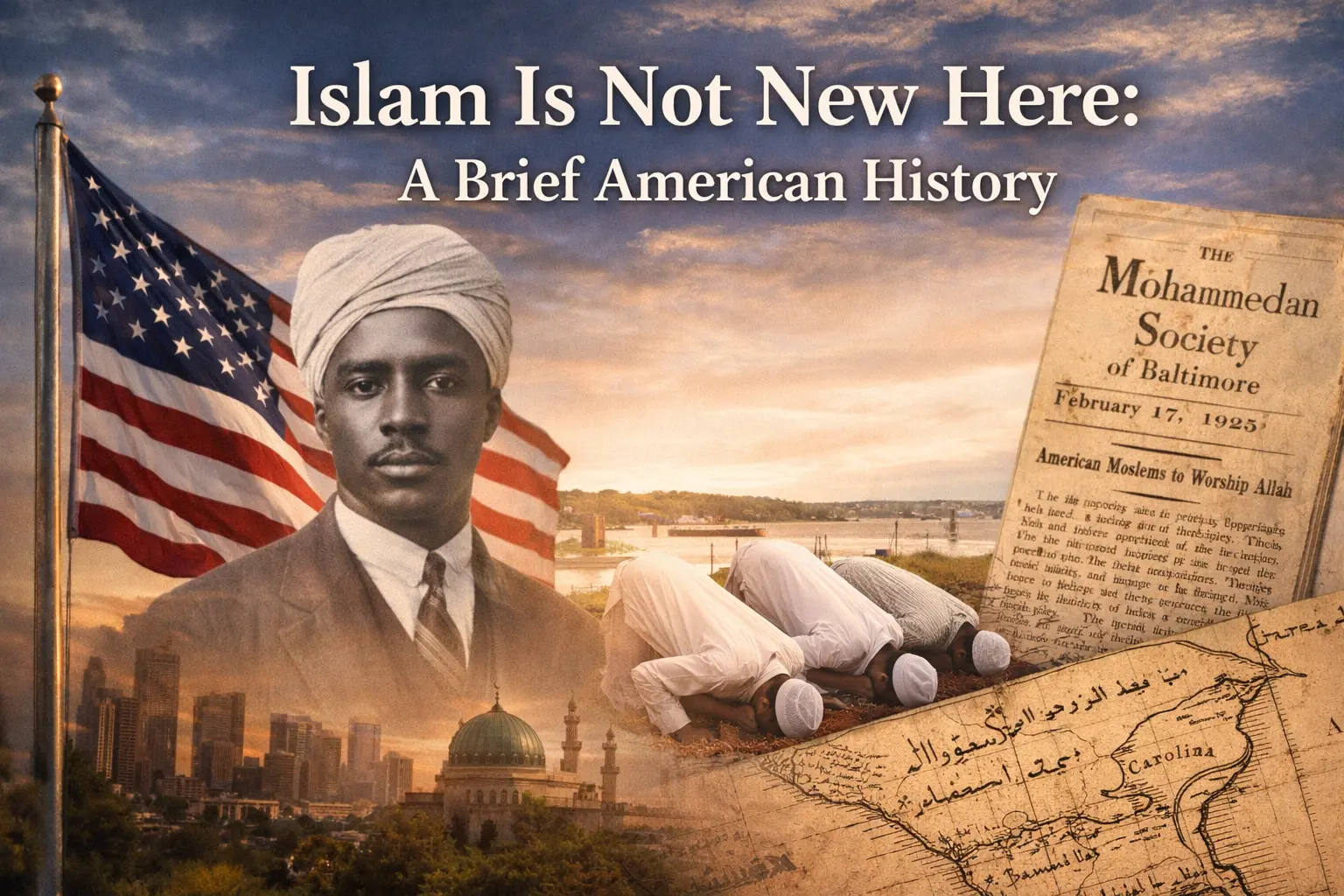
When conversations about Muslims in America arise, they often begin with immigration waves of the 20th century or the post-9/11 era. But this framing erases centuries of history. Islam in America is not a recent arrival or a foreign transplant. It is woven into the very fabric of this nation, present since before the country’s founding, carried in the hearts of enslaved Africans, built into the economic foundations of the South, and sustained through generations of struggle, adaptation, and faith.
To understand Muslims in America today, we must first acknowledge a simple truth: Islam is not new here. It has been here all along.
The First Muslims: Enslaved and Faithful
The first Muslims to arrive on American shores came in chains. Historians estimate that between 15 and 30 percent of the enslaved Africans brought to the Americas were Muslim, carrying with them centuries-old Islamic traditions from West African empires like Mali, Songhai, and Kanem-Bornu. These were not simply practitioners of folk religion but members of sophisticated Islamic societies with rich scholarly traditions, established legal systems, and networks of Islamic education.
Many of these Muslims were literate in Arabic, educated in Islamic jurisprudence, and deeply committed to their faith. Omar ibn Said, enslaved in North Carolina, wrote his autobiography in Arabic and maintained his Islamic practice even in bondage. Ayuba Suleiman Diallo, also known as Job ben Solomon, was a learned merchant and scholar who was eventually freed and returned to Africa. Bilali Muhammad, enslaved on Sapelo Island in Georgia, left behind a handwritten manuscript in Arabic detailing Islamic law. These men and countless unnamed others performed their prayers in secret, fasted during Ramadan when possible, and held onto their faith in the face of systematic attempts to strip them of their identity.
The erasure of this Islamic heritage was deliberate. Enslavers recognized that Islam, with its emphasis on human dignity, literacy, and submission only to Allah, posed a threat to the system of chattel slavery. Muslims were forced to convert to Christianity, punished for practicing their faith, and separated from others who shared their beliefs. Within a few generations, most traces of Islamic practice had been suppressed, though echoes remained in language, naming traditions, and cultural practices throughout the African American community.
Yet even as organized Islamic practice was crushed under slavery’s weight, the spiritual legacy persisted. The hunger for dignity, the resistance to subjugation, and the belief in a higher justice that cannot be taken away all carried forward. When African Americans would later rediscover Islam in the 20th century, it would feel less like conversion and more like homecoming.
Immigration and Institution Building
The next major chapter of Muslim American history began in the late 19th century with immigration from the Middle East, South Asia, and Eastern Europe. These early immigrants, primarily from Syria, Lebanon, and Palestine, arrived seeking economic opportunity and escape from Ottoman rule. They were largely working class, peddlers and laborers who settled in the industrial centers and farming regions of the Midwest and Great Plains.
These early Muslim immigrants faced the challenge of maintaining their faith in a country with no mosques, no halal meat, and no organized Muslim community. They gathered in homes for prayer, created burial societies to ensure proper Islamic funerals, and worked to pass their faith to children who were quickly becoming American. The first purpose-built mosque in America was established in Cedar Rapids, Iowa in 1934, a testament to these communities’ determination to create lasting Islamic institutions.
The early 20th century also saw the emergence of distinctly American Islamic movements within the Black community. Noble Drew Ali founded the Moorish Science Temple in 1913, teaching that African Americans were of Moorish descent and offering an alternative to the Christianity of their oppressors. While not orthodox Islam, it represented a reclaiming of Islamic identity and laid groundwork for later movements.
The most significant of these was the Nation of Islam, founded in Detroit in 1930. Under the leadership of Elijah Muhammad, the Nation grew into a powerful force in Black America, preaching self-reliance, racial pride, and separation from white society. While its theology diverged significantly from mainstream Islam, denying Muhammad as the final prophet and teaching a racialized cosmology, the Nation introduced millions of African Americans to Islamic concepts, Arabic terminology, and the idea of Islam as a dignifying alternative to the Christianity associated with slavery and oppression.
The Transformation: Mid-Century to Today
The 1965 Immigration Act fundamentally changed Muslim America. By removing racist quotas that had favored European immigration, the law opened America’s doors to Muslims from across the globe. Doctors, engineers, and students arrived from Pakistan, India, Egypt, Iran, and beyond. These new immigrants were often highly educated professionals who built mosques, Islamic schools, and national organizations like the Islamic Society of North America (ISNA) and the Muslim Students Association (MSA).
This same period saw a theological revolution within Black American Islam. Malcolm X’s break from the Nation of Islam and his journey to Mecca in 1964 exposed him to orthodox Sunni Islam and the universalism of the ummah. His transformation, though cut short by assassination in 1965, planted seeds that would flower after his death. When Warith Deen Mohammed, son of Elijah Muhammad, took leadership of the Nation of Islam in 1975, he systematically moved the organization toward Sunni orthodoxy, renaming it several times before settling on the American Society of Muslims. Millions of Black Americans transitioned to mainstream Islam, creating one of the largest Muslim communities in America.
Not all followed this path. Minister Louis Farrakhan revived the original Nation of Islam theology in 1977, and the organization continues today with its distinctive teachings. Meanwhile, other Islamic movements took root: Sufi orders established zawiyahs and khanqahs, Shia communities built centers and observed Muharram, Salafi study circles emphasized return to scriptural sources, and progressives pushed for gender-inclusive and LGBTQ-affirming interpretations.
Crisis and Growth
The Iranian Revolution of 1979, the first Gulf War in 1991, and escalating conflicts in the Middle East gradually associated Muslims with geopolitical crisis in the American imagination. But nothing compared to the rupture of September 11, 2001. The attacks and their aftermath defined a generation of Muslim Americans who suddenly found themselves viewed with suspicion, subjected to surveillance, and called upon to constantly apologize for violence they had nothing to do with.
The post-9/11 era brought unprecedented challenges: hate crimes against Muslims and those perceived to be Muslim, discriminatory policies like the NYPD’s surveillance program and the FBI’s infiltration of mosques, immigration restrictions targeting Muslim-majority countries, and a cottage industry of Islamophobia that portrayed Islam as inherently violent and incompatible with American values.
Yet Muslim American communities responded with resilience and creativity. Civil rights organizations like the Council on American-Islamic Relations (CAIR) fought discrimination in courts. Muslim Americans ran for office and won, from city councils to Congress. Young Muslims built media platforms, comedy shows, and cultural productions that told their own stories. Interfaith organizing deepened, with Muslims joining coalitions fighting for social justice. The community that had been told to go home reminded America that they were already home.
A Living History
Today, Muslim Americans number between 3.5 and 5 million, representing extraordinary diversity. They are Black and white, Arab and Asian, immigrant and indigenous, conservative and progressive, Sunni and Shia and Sufi and everything in between. They are doctors and cab drivers, politicians and poets, activists and entrepreneurs. They have roots reaching back to before the country’s founding and fresh memories of arriving last year.
This diversity is a strength, even when it creates tension. The Syrian grandmother who immigrated in the 1950s and the Somali refugee who arrived in the 2000s are both Muslim Americans, but their experiences of America and Islam differ dramatically. The Black American Muslim whose family has been here for generations and the South Asian software engineer who just got her citizenship are both building Muslim American futures, but from different vantages.
What unites these disparate communities is not sameness but shared struggle and aspiration. All Muslim Americans navigate the challenge of maintaining faith in a secular society. All face the choice of assimilation or distinction. All must determine what to preserve, what to adapt, and what to create anew. And all are contributing to an ongoing story, a living history that continues to unfold.
Claiming Our Place
Understanding this history matters because it challenges the narrative that Muslims are strangers in America. We are not newcomers to be tolerated or threats to be monitored. We are foundational to the American story. We picked the cotton, laid the railroad ties, opened the corner stores, and staffed the hospitals. We fought in every American war from the Revolution to the present. We wrote Arabic manuscripts in antebellum Georgia and built mosques in prairie towns. We have been here from the beginning, and we will be here until the end.
Islam is not new here. It is as American as anything else, forged in the same fires, shaped by the same struggles, reaching for the same promises. The history of Muslims in America is American history. When we claim this history, we claim our rightful place in the American narrative, not as guests or outsiders, but as people who have always belonged.
This is our story. This is our home. And we have been here all along.