Why difference does not weaken faith
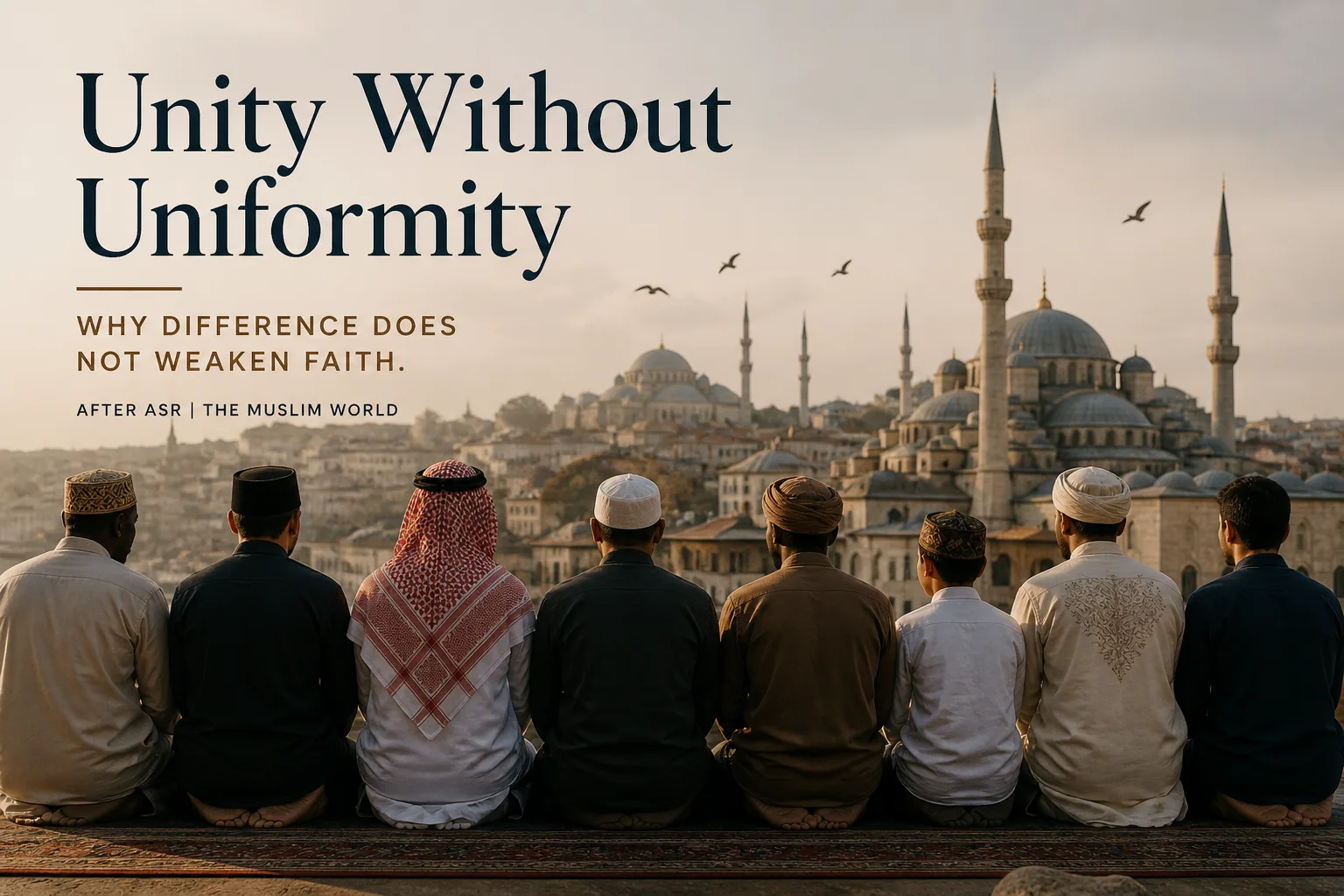
For much of its history, Islam developed across vast geographies without producing a single cultural or legal uniformity. From West Africa to Southeast Asia, Muslim societies differed in language, dress, governance, and even in certain details of religious practice. Yet these differences did not prevent the formation of a coherent and enduring religious civilization.
Today, however, many Muslim communities find themselves uneasy with internal diversity. Differences that were once managed through scholarship and tradition are now frequently interpreted as signs of fragmentation. In some cases, variation is treated not as a natural feature of a global faith, but as a problem to be corrected.
This shift reflects a deeper misunderstanding of what unity in Islam has historically meant.
A Tradition That Accommodated Difference
Classical Islamic scholarship did not operate on the assumption that all questions would yield a single, universally binding answer. Within the framework of Sunni Islam alone, multiple legal schools developed, each with its own methodologies, evidentiary standards, and interpretive principles. These schools did not emerge as deviations from a norm. They were the norm.
Disagreement among scholars, known as ikhtilaf, was not merely tolerated. It was recognized as an inevitable outcome of serious intellectual effort applied to complex questions. Differences in interpretation often reflected variations in available evidence, linguistic analysis, or contextual judgment.
Importantly, these disagreements did not fracture the religious community. A Muslim could follow one school of thought while recognizing the validity of another. Legal diversity existed alongside theological cohesion.
The Structure of Unity
To understand why this system functioned, it is necessary to distinguish between foundational and secondary matters. Core beliefs, such as the oneness of God, the prophethood of Muhammad, and the authority of revelation, were non-negotiable. They formed the basis of unity.
Beyond these foundations, however, there was space for variation. The precise positioning of the hands in prayer, the method of performing certain rituals, or the interpretation of specific legal questions were not treated as defining markers of inclusion or exclusion from the faith.
This distinction allowed the Muslim world to maintain both coherence and flexibility. Unity was anchored in shared principles, not in identical expressions.
When Difference Becomes a Source of Anxiety
The contemporary discomfort with difference is not entirely without cause. In a globalized and highly visible digital environment, disagreements are no longer confined to scholarly circles. They are amplified, simplified, and often stripped of context.
Social media has accelerated this process. Complex legal discussions are reduced to short statements, and positions that once required years of study are presented as self-evident truths. In such an environment, disagreement can appear more chaotic than it actually is.
At the same time, many communities lack access to the scholarly frameworks that historically managed difference. Without those frameworks, variation can feel destabilizing rather than structured.
The Risk of Enforced Uniformity
In response to this uncertainty, some attempt to resolve tension by insisting on a single correct approach in matters that historically allowed for multiple valid positions. While this may produce short-term clarity, it carries long-term risks.
First, it narrows the intellectual tradition. When only one interpretation is considered acceptable, the depth and adaptability of Islamic scholarship are diminished.
Second, it creates unnecessary divisions. Muslims who follow recognized scholarly positions may be viewed with suspicion simply because they differ in practice.
Third, it places a burden on individuals to conform in ways that are not required by the tradition itself. This can lead to disengagement rather than greater commitment.
Difference as a Sign of Intellectual Vitality
A tradition that produces no internal discussion is not necessarily strong. It may instead be stagnant. The presence of principled disagreement indicates that a body of thought is actively engaging with new circumstances, questions, and contexts.
Historically, Islamic scholarship demonstrated this vitality. Scholars debated, refined, and sometimes revised their positions in response to new evidence or changing conditions. This process did not weaken the faith. It sustained it.
Difference, when rooted in knowledge and sincerity, reflects a living tradition rather than a rigid system.
Reframing Unity in the Modern Context
If unity is redefined as complete uniformity, it becomes fragile. Any deviation, however minor, is perceived as a threat.
If unity is understood as shared commitment to core beliefs and principles, it becomes more resilient. Variation can exist without undermining cohesion.
This reframing does not mean that all differences are equally valid or that boundaries do not exist. It means that the tradition itself provides a framework for distinguishing between acceptable diversity and genuine error. That framework, however, requires scholarship, discipline, and intellectual humility.
Conclusion
The history of Islam does not support the idea that unity depends on uniformity. On the contrary, it suggests that a certain degree of difference is both inevitable and beneficial within a structured and principled system.
The challenge for contemporary Muslims is not to eliminate difference, but to understand it. This requires a return to the intellectual and ethical traditions that once allowed disagreement to exist without division.
Unity, in this sense, is not the absence of variation. It is the ability to remain connected despite it.