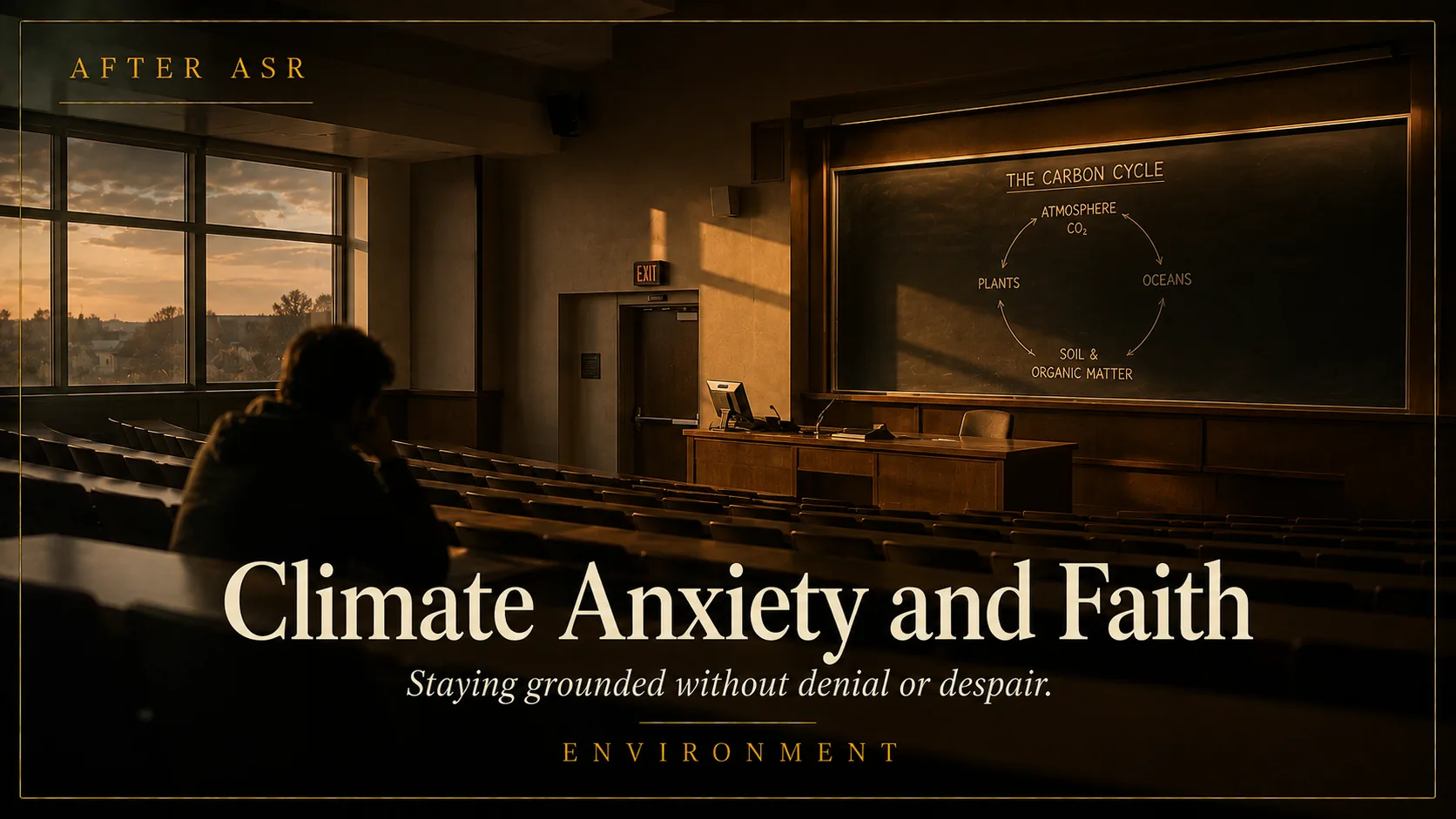
After a lecture on carbon cycles, a student waited for the room to empty.
Then she asked me whether it was wrong to want children.
She was not being theatrical. She had done the reading. She could cite the emissions curves better than some of my colleagues, and she had concluded, quietly and privately, that the future might be a place it was unkind to send someone.
I gave her an answer that day. I have spent the years since checking my work.
This essay is the long version of what I should have said.
The Condition Now Has a Name
Climate anxiety is real, measurable, and spreading. Large international surveys of young people find majorities reporting that worry about the planet’s future affects their daily functioning. Sleep, concentration, major life decisions. The respondents are not a fringe. They are median young adults across many countries, including this one.
I want to be careful here, because two mistakes are available.
The first is to pathologize the worry, as if grief over real losses were a disorder. It is not. A person disturbed by disturbing data is, in one sense, functioning correctly. The instruments and the feelings agree.
The second mistake is to let the worry claim authority it has not earned. Anxiety feels like knowledge. It is not knowledge. It is weather in the nervous system, and it forecasts poorly.
Between those two mistakes runs a narrow path. The tradition I practice and the science I trust both have things to say about walking it. That agreement is rare enough to be worth an essay.
What the Data Actually Says
Honesty first, because nothing in this essay works without it.
The warming is real and it is us. The instruments are unanimous, and I have spent my life learning to respect exactly that kind of unanimity. Ice cores, tide gauges, satellite records, thermometers in their tens of thousands. The signal is out of the noise.
Some losses are already purchased and cannot be returned. Species are gone. A certain amount of sea rise is in the mail regardless of what we do next.
And. The same body of science says the difference between our better and worse paths remains enormous, and remains open. Every tenth of a degree corresponds to harvests, coastlines, and lives. The window has narrowed. It has not closed.
Anyone who tells you the story is over, in either direction, has left the data and started preaching. I distrust the lullaby and the siren equally, and professionally. One says relax, the other says run, and neither verb has ever repaired anything.
The evidence does not counsel comfort. It also does not counsel surrender. It counsels work.
What Denial Actually Costs
Denial gets described as comfort. Having watched it up close, I would call it a payday loan. The relief is immediate. The interest is ruinous.
A farmer who denies the drought does not escape the drought. He escapes the planning that would have softened it. He plants the wrong crop in the wrong month, waters on the old schedule, and meets the same dry summer as his neighbor, unprepared.
Denial never cancels the storm. It only cancels the preparation.
There is also a quieter theological cost. To deny what the instruments plainly record is to declare the witness of creation inadmissible. But our tradition treats creation as a truthful sign, and treats the deliberate refusal of evident signs as a spiritual defect, not a neutral opinion.
A believer, of all people, should be able to look at a true measurement without flinching. We claim to be a people of reckoning. Reckonings begin with accurate books.
Despair Is a Second Form of Denial
Here is the observation that took me longest to reach. Despair and denial, which advertise themselves as opposites, are structurally the same act.
The denier says: nothing is happening, so nothing is required of me. The despairer says: everything is lost, so nothing is required of me. Different weather, same destination. Both have declared the outcome settled. Both have excused themselves from the ledger.
And both are making claims the evidence cannot support. The denier denies the present, which is measured. The despairer denies the future, which is not. Of the two, despair is arguably the larger overreach, because it claims certainty about the one thing no instrument has ever recorded: what has not happened yet.
Despair feels like realism. That is its disguise. It is a forecast issued without data, by an agency inside us that is frightened, tired, and unlicensed.
I do not say this coldly. I have hosted that agency. But I have learned to check its credentials.
What the Models Can and Cannot See
I build and read models for a living, so let me make the honest concession from inside the shop.
Models can project the physics. Give them an emissions path and they will return temperatures, rainfall shifts, and sea levels, with error bars that have earned their keep. Decades of hindcasting confirm it. The physics side of the house is in good order.
What the models cannot see is us.
Every projection is conditional. If humans do this, the climate does that. The models do not know whether a technology will fall in price by a factor of ten, as solar just did, embarrassing every forecast made about it. They do not know whether a religion will remember its own teachings, or a generation will change what it honors. Human turning, what our tradition calls tawbah, appears in no simulation.
I have sat in rooms where model output was mistaken for destiny by intelligent people. The modelers never make that mistake. They know where the conditionals are buried, because they buried them.
The scenarios are maps of consequence, not prophecies. The most important variable is left blank, on purpose, because it is not the modelers’ to fill.
It is ours.
The Quran Forbids the Counsel of Despair
Our tradition does not treat despair as a mood. It treats it as a theological error with a diagnosis attached.
Do not despair of the mercy of God, says Surah az-Zumar, in a verse addressed precisely to people who believe they have ruined things beyond repair. And in Surah al-Hijr, Ibrahim goes further: who despairs of the mercy of his Lord except those who are astray?
Note what despair claims. It claims to know that mercy has limits, and that we have found them, and that the door observed closing is closed forever. Those are three assertions about the unseen, made with no evidence, against explicit testimony.
The first generation heard that verse in az-Zumar as the widest door in the Book, and walked through it out of lives they had thought unforgivable. Whatever our century has broken, the door has handled heavier traffic.
This does not mean outcomes are guaranteed to be gentle. Mercy is not a weather report. It means the future belongs to God and not to our dread, and that acting as if ruin were certain is not humility.
It is a quiet form of claiming to know what only He knows.
You Were Not Assigned the Whole Sky
Much climate anxiety, examined closely, is a scope error. The sufferer has accepted responsibility for the planet, entire, and is failing at it daily, because no such job exists.
God does not burden a soul beyond its capacity. Surah al-Baqarah states it as a principle of the whole system. Obligation is indexed to ability. What you cannot reach, you were never assigned.
The atmosphere, entire, is not your assignment. Your kilowatt-hours are. Your representatives are reachable; the trajectory of Asian coal plants is not. Your street can be shaded with trees you will personally water. The Amazon cannot be defended from your kitchen, but your kitchen can be run like a place where nothing given is despised.
Even the Prophet, peace be upon him, was scoped. You are only a reminder, says Surah al-Ghashiyah; you are not a warden over them. If the best of creation was given edges to his assignment, our job descriptions certainly have them.
This is not shrinking from the fight. It is finding your actual position in it. Soldiers who try to hold the entire front hold nothing.
The despair of the overextended is not proof the battle is lost. It is proof they were standing in the wrong place.
Anxiety Is Information Without a Task
The psychology here is almost mechanical, and knowing the mechanism helps.
An alarm system exists to trigger action. See threat, do something, alarm resets. That loop is ancient and it works. What our era has built is unprecedented: a firehose of vivid, global, hourly threat information, delivered to people who are given nothing to do about it. The alarm triggers and triggers and never resets.
Chronic anxiety is what an unresettable alarm feels like from inside.
The feed is not wicked, but notice its economics. It profits from your alarm and offers no spade. Watching a glacier collapse in high definition, twelve times, is not vigilance. It is rehearsal of helplessness.
The laboratory version of this is old news. Give an animal a stressor it can act on, and it copes. Remove the lever, and it eventually stops trying even when the lever returns. The feed is a no-lever environment, by design.
The repair is not ignorance. It is closing the loop. Information should arrive, in a well-run soul as in a well-run lab, attached to a protocol: what does this change about what I do on Tuesday? If the answer is nothing, the twelfth viewing was not information. It was injury.
Choose a Watershed, Not a Feed
Here is the most practical sentence I know on this subject. Trade the planet for a place.
Pick the creek nearest your home, the canopy of your block, the energy bill of your masjid. Somewhere small enough to know and near enough to touch. Then let it become your assignment, the way a patient becomes a doctor’s assignment: specifically, by name.
Two things happen. First, you become effective. A person can actually change a stream bank, a roofline, a bylaw. Second, and more quietly, the anxiety begins to organize itself into competence. Fear of everything becomes work on something.
I have watched this transformation in students often enough to consider it reliable. The ones who adopted a marsh got steadier. The ones who adopted a feed got worse.
A note for the data-minded. Local monitoring is not sentimental busywork. Volunteer stream teams and backyard bloom logs feed real datasets, the kind ecologists publish from. Your creek can end up in the literature. Anxiety cannot.
The earth is not experienced in general. It is experienced as places. It is healed the same way, one jurisdiction of care at a time.
Tawakkul Ties the Camel First
A man asked the Prophet, peace be upon him, whether he should tie his camel or trust in God. The answer has organized sane religion ever since. Tie it, and trust.
Tawakkul is routinely mistaken for its imposter, fatalism. The fatalist skips the knot and calls his negligence trust. The Prophet’s instruction runs the other way. Effort first, fully, to the end of your rope. Then the outcome is handed over, genuinely, with both hands.
Notice what this does to anxiety. Anxiety lives in the gap between effort and outcome, pacing that corridor all night. Tawakkul closes the corridor. The effort is mine; the outcome was never mine. I do not have to carry what I cannot steer.
Applied here: insulate, plant, vote, organize, measure. Tie every knot you know how to tie. Then sleep. The night shift is covered, and not by you.
This is not resignation. Resignation drops the rope. Tawakkul pulls it to the last inch and then trusts the Hand that holds the rest.
The Practices Were Built for Pressure
It is worth noticing what the tradition hands a worried person. Not arguments first. Structure.
Five times a day, the feed is interrupted by something older than the feed. Wudu puts your hands in literal water. The prayer puts your forehead on the literal ground. Whatever else salat is, it is a scheduled return to the two elements the anxiety is about, held at the scale where they are still a mercy and not a headline.
When a matter distressed the Prophet, peace be upon him, his practice was recorded: he turned to prayer. Not after the crisis. Into it.
Surah ar-Ra’d states the mechanism without apology: in the remembrance of God do hearts find rest. I can report, as an empiricist, that the claim replicates in my own small laboratory of one.
Fasting belongs here too. A person who voluntarily meets a limit every Ramadan is training the exact muscle this century requires: wanting, and not reaching, and finding himself still whole at sunset.
The practices do not argue with dread. They outlast it.
Grief Is Permitted Here
Between denial and despair there is a third state, honorable and largely unclaimed. Grief.
Some of what is being lost will not return on any human timescale. There are glaciers with funerals now, marked with plaques. A scientist I admire wept, on record, describing bleached coral she had studied for thirty years. That weeping was not unprofessional. It was accurate.
Our tradition does not forbid such tears. The Prophet, peace be upon him, wept at real losses and said the eye weeps and the heart sorrows, and we say only what pleases our Lord. Sorrow, in his practice, coexisted with unbroken function.
The psychologists studying climate emotion keep finding the same shape. The people who name the grief function better than the people who suppress it. Weeping and working turn out to be compatible. The tradition did not wait for the studies.
Grief differs from despair in exactly this: grief mourns what is lost; despair forecloses what is not. One is honest accounting. The other is fraudulent bookkeeping about the future.
So mourn the glacier. Truly. Then plant something, because mourning that never returns to work has quietly become despair, and despair, we have established, is not permitted to us.
Small Acts Are Not Symbolic
The despairing objection arrives on schedule: your bike lane will not cool the Pacific. Correct, and beside the point, twice.
First, empirically. Behavior is contagious in ways we can now measure. Solar panels spread through neighborhoods like a benign rumor; one visible roof measurably raises the odds of the next. Movements are made of visible ordinary acts, and no one can compute in advance which act tips which neighbor. The despairer claims to know the cascade is impossible. No one knows that.
Second, theologically. Our acts are not priced by their planetary tonnage. Whoever does an atom’s weight of good will see it, says Surah az-Zalzalah, and the verse attaches no clause about market impact. The deed is weighed, not its press coverage.
The sapling hadith, which deserves and will get its own essay, makes the same point at the end of the world. Plant anyway. The instruction survives even the Hour.
Nothing done for God is symbolic. Symbols are for audiences. The One watching does not need them.
The Future Is a Field, Not a Forecast
I return to my student’s question, because she deserved better than a mood.
Every generation that ever had children had them in the face of credible endings. Plague generations. War generations. The parents of the last century raised families under a nuclear siren that could have meant twenty minutes’ notice. They were not naive. They were doing something older and sturdier than optimism.
They were treating the future as a field and not a forecast. A forecast is something you submit to. A field is something you work. Its yield is unknown from the road, and changes depending on who walks in with seed.
There is a photograph I have seen of a university campus in 1910. The great elms in it are saplings, held up by stakes. The people who staked them stood four years from a world war they could not see and eight from a pandemic they could not either. The shade arrived anyway, on schedule, for other people.
A child raised to keep trusts, on a street with shade her parents planted, is not a hostage sent to the future. She is help sent to it.
The question was never whether the future deserves our children. It is whether it will have them: people trained by faith to neither lie about the data nor kneel to it.
What I Should Have Told Her
I told her, that day, that things were uncertain. True and useless.
Here is the fuller answer, years late.
The measurements are real. Honor them.
The despair is not a measurement. Decline it.
Take a place, small and near, and answer for it.
Tie every camel you have. Then sleep.
Mourn what is lost. Plant what is not.
The future is unwritten because it is waiting for hands.
Yours were counted before you worried.
Begin.