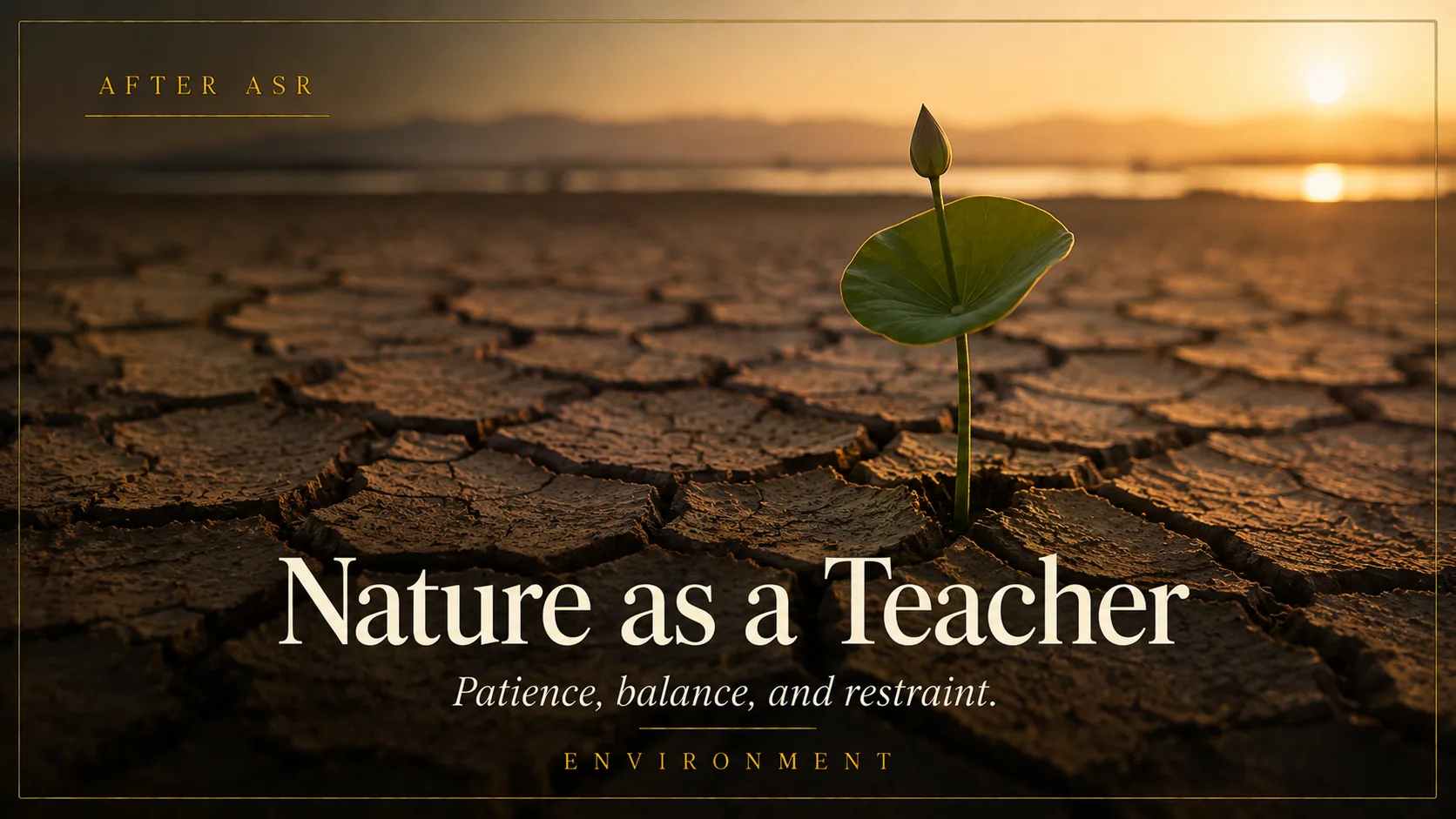
Some years ago, researchers germinated a lotus seed that had been waiting in a dry Chinese lakebed for more than a thousand years.
It sprouted.
The seed had outlasted dynasties. It had held its instructions intact through centuries of silence, asking for nothing, and when water finally arrived it simply resumed. No complaint is recorded.
I have spent most of my life in classrooms, on one side of the desk or the other. I know a teacher when I see one. That seed is a teacher. So is the field it slept under, and the rain that woke it.
The question is whether we are still enrolled.
The Classroom Has Been Open the Whole Time
The Quran does not merely permit the study of nature. It assigns it.
Do they not look at the camels, how they are created, asks Surah al-Ghashiyah. And at the sky, how it is raised. The verbs are imperatives of attention. Look. Consider. Travel through the earth and observe.
Notice what kind of homework this is. Not memorization. Fieldwork. The reader is sent outdoors, to standing animals and raised skies, and told that these are ayat. Signs. The same word used for the verses of the Book itself.
That pairing is the founding charter of this essay. One revelation is recited. The other is planted, weathered, and grazing. A person who reads only indoors is skipping half the syllabus.
I say this as a man of libraries. The libraries agree. Every science in them began as somebody staring at the other book. Astronomy was shepherds counting. Botany was medicine hunting herbs. Chemistry began, humblingly, in kitchens and kilns. The made world has always been the primer.
Repetition Is the Teaching Method
Any teacher will tell you the secret of the trade. Repetition. Nothing important is taught once.
The Quran repeats the sign of rain dozens of times. Water sent down, dead land quickened, your own raising likewise. Readers sometimes stumble at the recurrence, as if the Book were short of material. Teachers recognize the technique at once. The lesson returns because the student does.
Nature runs on the same pedagogy. Spring is not new information. It is the same lecture, delivered annually for longer than there have been ears to attend it. Every dawn rehearses the same argument about darkness. The tides state their case twice a day, patiently, to coastlines that never write it down.
What repetition builds is not novelty but depth. The fortieth spring you actually watch teaches what the first thirty-nine could not, because by then you have changed, and the lesson lands on different ground.
A sign repeated is a mercy. It means the Teacher expects us to miss it many times, and has planned accordingly.
A Seed Is a Lecture on Patience
Consider what a seed actually does. It condenses a whole organism’s instructions into a case smaller than a fingernail, then waits.
Not passively. A dormant seed monitors its situation with chemical precision. It measures moisture, temperature, sometimes even the smoke of passing fires. It declines to sprout in the wrong week. It would rather wait a decade than begin badly.
Some pines go further and seal their cones in resin, opening them only in the heat of a forest fire, timing their children’s start for the one week when the ground is cleared and lit. What looks like catastrophe is, on their calendar, commencement.
We call all this dormancy, which makes it sound like sleep. It is closer to discipline. The seed is the most patient object I know of, and its patience is not resignation. It is readiness with the engine off.
Every impatient project of my own has failed in the same way: begun in the wrong season because I could not stand to wait for the right one.
The lotus in that lakebed waited thirteen centuries. My record is about six days. The curriculum, clearly, has further to take me.
Nothing Important Here Moves at Our Speed
Hold two clocks in your mind for a moment.
The first is ours. Quarterly earnings, news cycles, two-day shipping. Its hand sweeps.
The second is the earth’s. Soil forms in centuries. A forest assembles itself over generations of trees, each generation preparing shade and fungus for the next. An aquifer fills on a schedule measured in ice ages. Its hand barely trembles.
In the White Mountains of California stand bristlecone pines nearly five thousand years old. They were already middle-aged when the pyramids went up. A tree that plans on that horizon builds slowly, wastes nothing, and holds its ground through everything a millennium can bring.
Nearly every environmental wound I can name comes from forcing the second clock to run on the first. We harvest forests on loan terms the forest never agreed to. We pump ten-thousand-year water into thirty-year mortgages.
Patience, in this light, is not a temperament. It is accuracy. The patient person is simply the one telling the truth about which clock the world runs on.
The impatient person is not faster. He is wrong.
The Balance Was Set Before We Arrived
Surah ar-Rahman opens with a cosmology in four moves. The Merciful. Taught the Quran. Created man. Taught him speech. Then, almost immediately: He raised the sky and set the mizan, the balance, that you not transgress in the balance.
Read that sequence slowly. The balance is presented as infrastructure, like the sky. It was raised and set before any human hand touched anything. Our job description with respect to it contains one verb: do not transgress.
The verse continues into commerce, weighing with justice, giving full measure. The same word serves the scales in the market and the scales in the atmosphere. I do not think that is an accident of vocabulary.
A person who shorts the balance anywhere has practiced shorting it everywhere.
Modern chemistry gives the market language teeth. The carbon in the air is weighed now, continuously, on instruments of great delicacy. We know the scale is tipping because we finally built scales fine enough to watch it tip.
The mizan is not ours to calibrate. It is ours to honor. The distinction is the whole lesson, and it is taught in the first page of that surah to anyone who reads it standing still.
Ecology Is the Mathematics of That Balance
Science found the mizan by counting.
The fur trade kept records, and in them ecologists noticed a rhythm: lynx and hare populations rising and falling in linked waves, decade after decade. Too many hares feed too many lynx. Too many lynx thin the hares. The system corrects, overshoots, corrects again.
Balance, it turns out, is not stillness. Nothing in a living system stands still. Balance is correction, applied continuously, from all directions at once. The marsh filters. The predator prunes. The fungus recycles. Every member of the assembly is also a regulator of it.
The corrections travel farther than anyone guessed. When wolves returned to Yellowstone, elk stopped loitering in the valley bottoms. Willows came back along the banks. Beavers came back for the willows, and their ponds followed. Rivers changed their behavior because a predator changed the mathematics.
This is worth absorbing, because we tend to picture harmony as a kind of freeze. The real thing is closer to a rider on a horse. Constant small adjustments. Perpetual attention.
Take the rider off and the picture does not hold its pose. It falls.
The Bee Was Given Its Syllabus Directly
Surah an-Nahl, the chapter named for the bee, says that your Lord inspired the bee: take homes in the mountains and the trees, then eat from all the fruits and follow the ways of your Lord made easy.
We have since learned what those ways involve. A returning forager dances on the comb, and the angle of her dance against gravity encodes the direction of flowers against the sun. Distance is in the duration. Other bees read the dance in the dark, by touch, and fly out correct.
I have read the papers on this and I still do not fully believe it, in the way one fails to believe a thing one knows to be true.
And note the economics of the flight. The bee takes nectar; the flower gets pollinated. The transaction enriches both parties and depletes neither. A whole industry, running for a hundred million years, with no waste stream.
We have yet to design one factory that meets the standard of that hive.
Surah an-Nahl calls what issues from the bee a drink of varying colors in which there is healing for people, and then closes the passage the way a teacher closes a lesson: in that is a sign for people who reflect. The bee is not merely admired. It is assigned.
Restraint Is Written into the Living World
Once you start looking for restraint in nature, you find it everywhere, engineered.
A tree in drought closes the pores of its leaves and simply does less for a while. A hibernating bear turns her metabolism down like a thermostat in an empty house. Desert annuals bloom briefly, set seed, and withdraw, declining to spend water on a summer they cannot afford.
Even predators, the supposed emblems of appetite, hunt to sufficiency and then stop. A lion at rest beside grazing zebras is an ordinary sight. The kill is indexed to hunger, not to opportunity.
The exceptions are instructive because they are rare enough to be famous.
Restraint in nature is not virtue. It is engineering. Systems that overdraw their budgets are removed from the ledger, and what remains is what learned to stop. We are watching the survivors of that examination.
An ecologist would say the budget enforces itself across generations. A believer would add that the Budgeter is generous, and keeps books. The two sentences describe one world.
It is a hard school. Its graduates are everything alive.
What Observation Can and Cannot Teach
I owe you the honest boundary of all this, because I have spent my life on the observing side of it.
Observation can show you the pattern. It can hand you the lynx cycles and the seed’s chemistry and the dance of the bee. It can demonstrate, with datasets, that patience and balance and restraint are not sentiments but structural requirements. Observation can do all of that.
It cannot enroll you.
No amount of watching obligates the watcher. Plenty of people have studied ecosystems all their lives and stripped them anyway, expertly. The pattern does not reach off the page and change a habit. Between the seeing and the doing there is a gap that no instrument crosses.
Revelation names the gap. The Quran shows the camel and the bee, then asks: will you not reflect, will you not be grateful? The questions are the bridge. Data becomes teaching only when the student consents to be taught.
Consent is the one thing nature cannot extract from us. It must be given.
An Orchard Cannot Be Crammed
I taught for enough years to know the difference between learning and cramming. The orchard knows it too.
You cannot compress a fruit tree’s education. The wood must thicken through its winters. Force it in a heated greenhouse and you get pale growth that snaps in the first honest wind. Growers have a word for plants raised too comfortably and too fast. Leggy. Tall, weak, and unprepared.
Students can be raised leggy too. So can institutions. So can souls.
I have watched accelerated cohorts of every kind, in classrooms and in gardens. The pattern holds across both. What is forced arrives early and fails early. What is formed arrives late and holds.
The slow version is not the inefficient version. The slow version is the one where the strength has time to arrive along with the size. An orchard is a seminar in exactly this, held annually, attendance free.
Anything real ripens. Anything that ripens has a season. Anything with a season will make you wait, and the waiting is not the obstacle to the sweetness. It is the manufacturing of it.
Winter Is Not a Failure of the System
Every year the temperate world shuts down, and every year it turns out to be on purpose.
The orchard drops its leaves and stands apparently dead. Underground, roots consolidate. Cold itself does work: many fruit trees count the chill hours and will not bloom without their full winter, and many seeds refuse to open until frost has cracked their coats.
Rest, in other words, is not the absence of production. It is a phase of it.
The Quran honors this rhythm in us. Surah an-Naba says the night was made a covering and sleep a rest, and the day for livelihood. Farmers honored it in their fields, resting ground in fallow years so it could bank fertility.
We are the first culture to attempt the removal of winter. Lit all night, open all hours, cropped every season. The early data on that experiment, in soils and in people, is not encouraging.
Sleep researchers and soil scientists have arrived, from opposite ends of the campus, at the same finding. Deprive a living system of its dormant phase and it does not become more productive. It becomes fragile, then sick, then quits.
The land keeps sabbath whether we join it or not.
The Desert Is the Advanced Course
If the forest teaches abundance managed, the desert teaches scarcity mastered. It is the honors seminar, and its students are magnificent.
The saguaro pleats like an accordion so it can swell with a single night’s rain and then live on the stored water for a year. The camel’s nose is a countercurrent condenser that reclaims moisture from its own breath. The kangaroo rat is so frugal it can live its whole life without drinking, extracting water from dry seed by pure metabolism.
None of these are austerity for its own sake. Desert life is not grim. A wet spring in the Sonoran is one of the most flamboyant displays on earth. The frugality funds the flowering.
That sentence deserves its own line, so let it have one.
The frugality funds the flowering.
Revelation came, more than once, to people who lived beside deserts. I do not press the point. I only note that the advanced course and the prophets kept close company.
We Are the Only Students Cutting Class
Here is the uncomfortable census. Every species alive sits inside the curriculum, obeying it by construction. One species audits.
We alone overdraw aquifers, and we alone write hydrology textbooks. We alone strip soils, and we alone radiocarbon-date the ruin. The capacity to break the pattern and the capacity to understand it arrived in the same creature, together.
The Quran would not find that surprising. The being who accepted the trust is the one capable of betraying it. Freedom is the whole difference. The bee follows its inspiration without option. We were handed ours with a choice attached.
This is why our species cannot be graded on instinct. We are graded on the elective. Surah al-Insan states our situation without decoration: We showed him the way, whether grateful or ungrateful. The bee was spared that sentence. It was also denied it.
Attendance, for us, is voluntary. That is our dignity and our indictment, and the two cannot be separated. Nothing else in the field has to decide whether to show up.
We do.
How to Enroll Again
Re-enrollment is undramatic, which is a mercy. No application, no tuition. The seminar meets wherever ground is uncovered.
Walk one route weekly, the same route, until it starts disclosing itself to you. Sameness is the instrument; only a repeated walk reveals change. Learn ten local species by name, because the named become visible and the visible become dear. Keep a small notebook of what the route is doing. Dates of first bloom. Water levels. Birds.
This sounds quaint. It is a discipline with a long record: most of ecology’s founding datasets are the notebooks of patient amateurs. Gilbert White watched one English parish for forty years and produced a book that has never gone out of print. He was not clever with instruments. He was faithful to a place.
Our tradition has a word for study that becomes reverence. Tafakkur. Reflection, in the Quran’s own assigned sense: the deliberate consideration of the made world until it points past itself.
Those who remember God standing, sitting, and lying down, says Surah Aal Imran, and reflect on the creation of the heavens and the earth, arrive at a sentence: Our Lord, You did not create this in vain.
That sentence is the diploma. It is issued one walk at a time.
The Oldest Curriculum
The lotus seed waited a thousand years for one cup of water.
It never once checked the time.
The syllabus it followed is still posted.
Patience, from the seeds. Balance, from the counted cycles. Restraint, from everything that survived.
The classroom door was never locked.
The Teacher of the bee is still teaching.
Take a seat outside.
Stay.