You have taken roughly twenty thousand breaths since this time yesterday.
You signed for none of them.
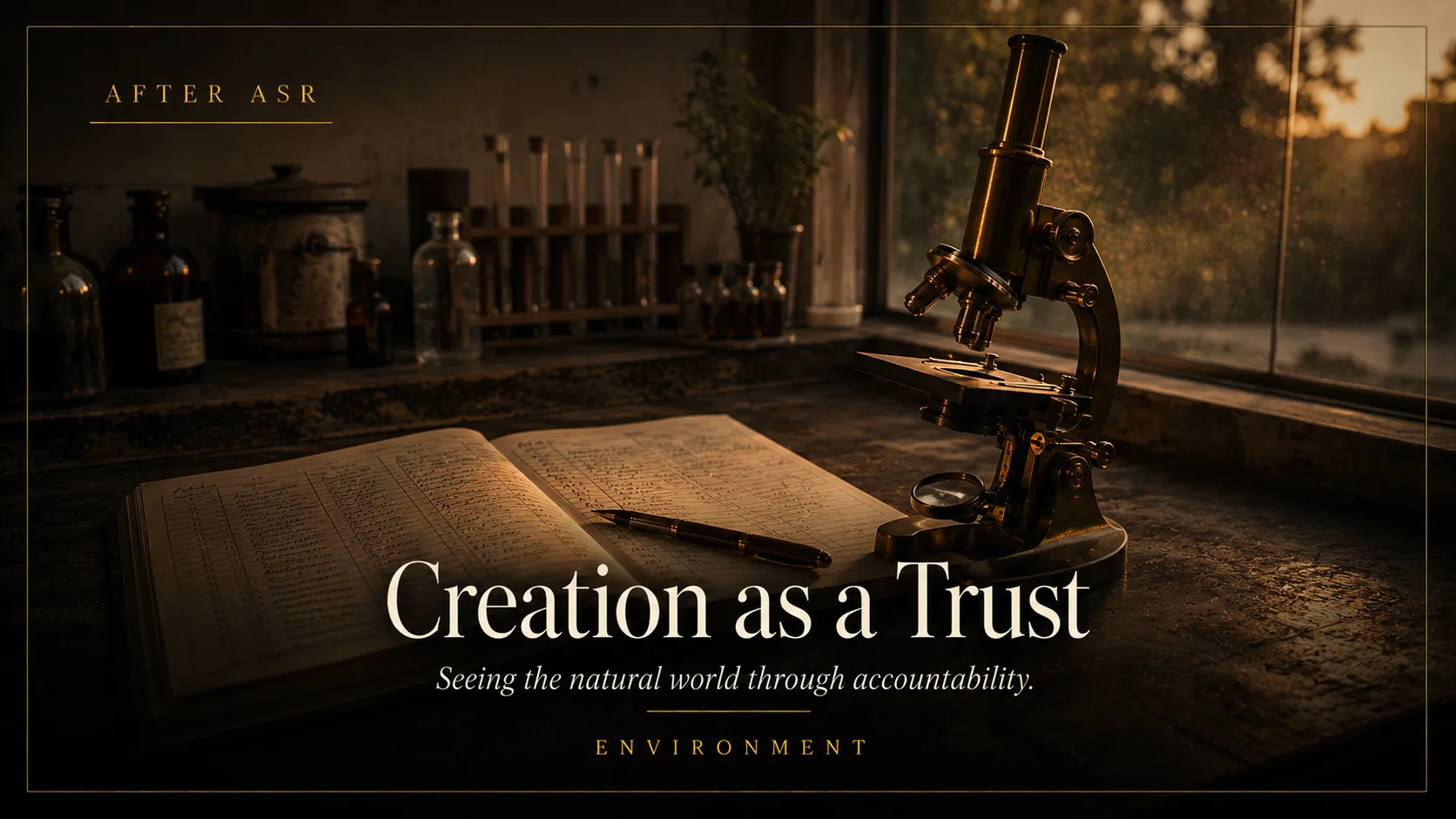
When I taught undergraduates, the department kept a sign-out sheet by the equipment room. Borrow a microscope, sign the sheet. Return it, and someone checked the lenses. That sheet taught more than some of my lectures did. What you touch, you answer for. What you damage, you report.
The world came to us with no sheet on the door. I have come to believe the signature was collected anyway.
Everything Here Was Handed to Us Running
Notice the strangest fact about the natural world. It was operational on arrival.
Nobody living remembers starting it. The atmosphere was already mixed to a composition that lets fires burn but not race, roughly a fifth oxygen, and it was holding that line before any chemist existed to check it. The water cycle was already lifting seawater, cleaning it of salt, and delivering it to continents. The soil was already digesting last year into next year.
We were born into a facility with every system on. No manual on the counter. No off switch on the wall.
Even the shielding was in place. Miles overhead, a faint layer of ozone, three molecules of oxygen instead of two, screens out the ultraviolet that would otherwise sterilize the continents. Nobody thanked it for the first few hundred thousand years of human history. It did not require thanks to keep working.
An engineer who inherits a running plant knows the first rule: understand a system before you lean on it. We leaned first. Much of the environmental story of the last two centuries is the story of adjustments made to machinery we had not yet read.
The estate was solvent when we took it over. That is worth saying plainly, and worth remembering at every audit that follows.
A Trust Has Three Parties
The word trust has a precise shape, older than any bank. Someone grants. Someone holds. Someone benefits. The whole arrangement exists because the holder is not the owner, and everyone involved knows it.
I use the analogy carefully, because analogies leak. But the Quran, read with this shape in mind, names all three parties without strain.
The Grantor is announced on nearly every page: to God belongs the dominion of the heavens and the earth. The holder is named in the offer of the amanah, the trust that the human being accepted. And the beneficiaries turn out to be a longer list than we usually recite. Every creature that drinks. Every generation that follows. The trustee himself, who is also permitted to eat from the orchard he keeps.
The Prophet, peace be upon him, confirmed the width of the beneficiary list in a sentence. No Muslim plants a tree, he said, and a person or a bird or an animal eats from it, except that it counts for him as charity. The bird is on the books. The charity clears whether or not the planter ever learns who drew on it.
A trustee who forgets which of the three roles is his has already begun the mismanagement. Most of our forgetting starts there.
Subjected to You Is a Liability Clause
Surah al-Jathiyah says that God subjected to us what is in the heavens and what is in the earth. Sakhkhara. Made it serviceable, set it to work for you.
Some read that verse as a deed of surrender, as if the planet were handed over for consumption. I think any student who ever worked in a laboratory knows better.
When the instruments were assigned to my bench, they became serviceable to me. They also became my problem. Every scratch traced back to my initials. Assignment transferred accountability, never title. The department did not stop owning the spectrometer just because I could touch it.
Subjection is the strongest argument for care, not against it. The verse puts the world under our hands. Nothing under your hands is ever, in the end, beneath your responsibility.
What serves you is filed under your name. That is not poetry. That is how every workshop on earth already runs.
Begin the Inventory with Air
A trustee’s first task is an inventory. Begin with the asset you are using this second.
The breathable atmosphere is thinner than it feels. Most of its mass sits within about ten miles of the ground. Scale the earth to an apple and the air is thinner than the skin. Everything that has ever breathed has breathed from that film.
Air is the only inheritance drawn on every minute of every life. There is no meter on it. No invoice has ever arrived for it. From an accounting standpoint, it is the most heavily used and least recorded asset in human history.
It is also a commons at the molecular level. The atmosphere mixes globally in about a year, which means the air over your street is on loan from everywhere, and everyone. No lung has a private supply. Whatever we put into the film, we put into each other.
Unrecorded is not the same as unwatched. The film keeps its own books, in parts per million, and we have learned to read them only recently. The numbers say the film is changing faster than anything alive has had time to adjust to.
Twenty thousand breaths a day. It seems a fair place for accountability to begin.
Water Arrives in Measure
Surah al-Mu’minun says that God sends down water from the sky in due measure and settles it in the earth. In measure. The phrase rewards a slow reading.
The planet’s water is a fixed stock, cycling. Nothing new is being delivered. The rain on your street has been ocean, glacier, cloud, and river beyond counting. The system does not create; it circulates, and it circulates with a regularity you can build civilizations on. People have.
Measure is the operative word. Not abundance. Not scarcity. Measure, which means an amount fitted to a purpose, which means an amount you can overdraw.
We have learned what the delivery is worth by trying to replicate it. Desalination plants can unsalt the sea, at great cost in energy and brine. The sky does it silently, at planetary scale, every day, and delivers by gravity. No invoice follows.
The aquifer surveys I read are, in their dry way, commentaries on that verse. Water settled in the earth over ten thousand years is being lifted out in decades. The measure is not being consulted.
A trust drawn faster than it refills has a name in every legal tradition. None of the names are kind.
Soil Is the Quietest Asset on the Books
I wrote recently about how slowly soil forms. Here I want to record what it is, because the inventory demands it.
A teaspoon of healthy soil holds more living organisms than there are people on earth. It is not dirt. It is tissue. It digests death into fertility, holds rain like a ledger holds deposits, and feeds essentially everything with a spine or a leaf.
And it is the least regarded entry in the whole trust. We name storms. We photograph rivers. Nobody frames a portrait of loam.
A good auditor learns to check the unglamorous accounts first, because that is where quiet losses hide. Soil is the unglamorous account of the biosphere. It is currently being spent, worldwide, faster than it forms.
Darwin, in his last years, set aside grander questions and wrote a whole book about earthworms. He measured how they swallow and refine the ground, burying old pavements inch by patient inch. His neighbors thought the subject beneath him. He had simply found the trust’s most diligent employees.
The trustee’s eye is proven not on the assets everyone watches, but on the ones nobody claps for.
The Sun Pays the Entire Payroll
Every trust has an income stream. This one has exactly one, and it arrives at the speed of light.
Nearly everything alive runs on sunlight, captured by leaves and passed along. The wheat is sunlight. The lamb that grazed the wheat is sunlight at one remove. The reader of this sentence is sunlight several transactions deep. Photosynthesis is the only significant deposit the estate receives, and it has cleared daily for something like three billion years.
Coal and oil are deposits too, but of a different kind. They are ancient sunlight, banked in the ground over hundreds of millions of years. Burning them is not income. It is drawing down principal, and the withdrawal slip shows in the air’s own bookkeeping.
I am not writing an energy policy here. I am reading a balance sheet aloud.
A household that lives on income can live indefinitely. A household that lives on principal is choosing a date for its own reckoning, whether or not it writes the date down.
The Animals Are Communities, Not Props
Surah al-An’am makes a statement that field biology keeps catching up to. There is no creature on the earth, nor bird flying on two wings, but that they are communities like you.
Communities. Umam. The same word the Quran uses for nations of people.
Spend unhurried time observing animals and the verse stops feeling figurative. Crows hold grudges and teach them to their young. Elephants return to the bones of their dead and stand with them. A beehive makes collective decisions by a process that resembles voting more than it resembles instinct.
I do not need to romanticize any of this, and I try not to. The claim is not that a heron is a person. The claim is that the trust we hold is inhabited, and the residents were called nations by the One who placed them.
A trustee who empties the estate of its residents has not managed the property. He has evicted the beneficiaries.
What Chemistry Cannot Tell You About Water
Here is the concession I keep having to make, in one field after another.
Chemistry can tell you nearly everything about water. Two hydrogens, one oxygen, bonded at an angle that makes ice float and life possible. It can explain why water climbs a redwood and why it holds a coastline’s warmth into winter. Chemistry can do all of that.
It cannot tell you what water is for.
Purpose does not precipitate out of any solution. You can boil the ocean down to its salts and find no instruction among them. The lab can describe the gift down to the last molecule and remain perfectly silent about the Giver, and about the thank-you note, and about the terms.
For the terms, you need revelation. Sent down in measure. Given as drink. Asked about later. Chemistry describes the asset. Only the Owner discloses the account it belongs to.
Both kinds of knowledge are knowledge. A trustee needs both hands.
Most of the Beneficiaries Are Not Born Yet
A trust, unlike a sale, runs forward in time. That is its entire point. The corpus is held so that someone downstream can draw from it.
Run the arithmetic gently. If humanity continues for even a few more centuries, then nearly everyone with a claim on this planet’s air and water has not yet been born. The current generation is a thin slice of the beneficiary class, holding the whole estate for a majority it will never meet.
Economists have a tool called discounting that quietly shrinks the future’s claims. It has its uses in finance. Applied to a trust, it is simply a way of favoring the beneficiary who happens to be in the room.
No honest trustee operates that way. The heirs who cannot yet speak are owed the same water table as the ones who can.
Islamic law grasped this early. A waqf, an endowment, holds an orchard or a well in perpetuity, its fruit dedicated to people its founder would never meet. Whole cities were watered for centuries on that instrument. Our tradition has practiced forward-running trusts for a thousand years. We are not being asked to invent anything.
I find this thought steadying rather than crushing. It tells me exactly whom I am working for. Most of them are quiet. All of them are coming.
The Audit Checks Condition, Not Sentiment
When a trustee’s term ends, the review asks one question above the rest. In what condition is the corpus?
Not: how did you feel about the corpus? Not: how eloquently did you describe it? The schedule of assets has no column for sentiment. It records acres, depths, populations, and concentrations, and it compares them against the day you took the keys.
This is uncomfortable, and I mean for it to be. Our environmental culture is rich in feeling and thin in condition. We produce more documentaries than watersheds in recovery.
Condition, happily, is checkable. That is its mercy. You can walk a stream and see whether the banks are holding. You can pull a well log and read the depth. A standard you can fail is also a standard you can meet, and know that you met.
The Quran’s picture of the Last Day is an accounting of exactly this kind. Deeds weighed. Records opened. An atom’s weight of good seen, an atom’s weight of harm seen. The scale in Surah az-Zalzalah is famously fine-grained.
I do not know the exchange rate between a repaired stream and a mercy shown to a child. I only know both are on the books, and that the books are kept better than mine.
Violations of a Trust Begin Quietly
No one embezzles a fortune on the first day. The classic violation begins with a small draw that nobody notices, repeated until it is a habit, then a structure, then a collapse.
Environmental loss follows the same curve. An aquifer declines by inches a year. A marsh is trimmed one permit at a time. The insect count falls so gradually that only a forty-year dataset can see the slope. Each individual draw is defensible. The sum is not.
This is why stewardship cannot rely on alarm. Alarms ring at thresholds, and by the threshold the account is already hollowed. What a trust requires is reconciliation, the boring monthly kind, where small discrepancies are caught while they are still small.
Reconciliation, in a life, looks like attention. The bill read. The meter checked. The habit weighed.
It also looks like honesty about drift. Nobody decides to waste. Waste accumulates in the unexamined corners of a routine, the way sediment accumulates in a slow bend of a river. The examined routine, like the dredged channel, stays navigable.
Quiet losses ask for quiet vigilance. There is no dramatic version of this. That is precisely why it works.
Gratitude Is an Inventory Practice
Surah Ibrahim states a limit I have tested and confirmed: if you try to count the favors of God, you will not be able to number them.
I have tried. On a slow walk I once attempted a strict census of what I was using, second by second. Borrowed air. Borrowed light. Borrowed gravity holding the walk together. The ledger ran away from me within a block, exactly as the verse predicted.
But the attempt changed the walk. That is the point of it.
Gratitude, practiced honestly, is an inventory of the trust. You cannot thank for what you have not noticed, so thanking forces noticing, and noticing is the beginning of care. The ungrateful eye sees a warehouse of free stock. The grateful eye sees an account, itemized, held in its name.
Shukr is often preached as good manners toward heaven. It is that. It is also the most rigorous audit a human being can perform, and the only one that ends in love.
Nobody Applied for This Position
A fair objection arrives at this point. I never asked to be a trustee. No one consulted me before loading a biosphere onto my account.
True. And it changes nothing, because that is how inheritance works everywhere.
The heir does not apply for the estate. The eldest child does not apply for the younger ones who become, in a hard year, her responsibility. The neighbor with the truck did not apply to be the one who can pull strangers from a flood. Capacity plus proximity has always been the world’s way of assigning duty, and consent has rarely been part of the paperwork.
There is even a comfort hidden in the unchosen role. What you did not appoint yourself to, you cannot be fired from by fashion or failure. The post is yours for the term of your breathing.
The amanah verse says as much. The trust was offered, and something in our nature took it up. We can dispute the wisdom of the acceptance. From inside the role, the dispute is academic.
The breath you are drawing right now is the signature, renewed.
Hold It the Way You Will Hand It Back
At the end of every semester, the instruments went back across the counter.
Someone turned each one under the light and checked the lenses.
I never once resented that inspection. It meant the tools had a keeper.
The world is on loan under the same policy.
Walk your ground tonight and look at it as the inspector will.
The air, the water, the quiet soil, the nations of animals.
All of it running. All of it entrusted.
Hold it the way you will hand it back.
Because you will.