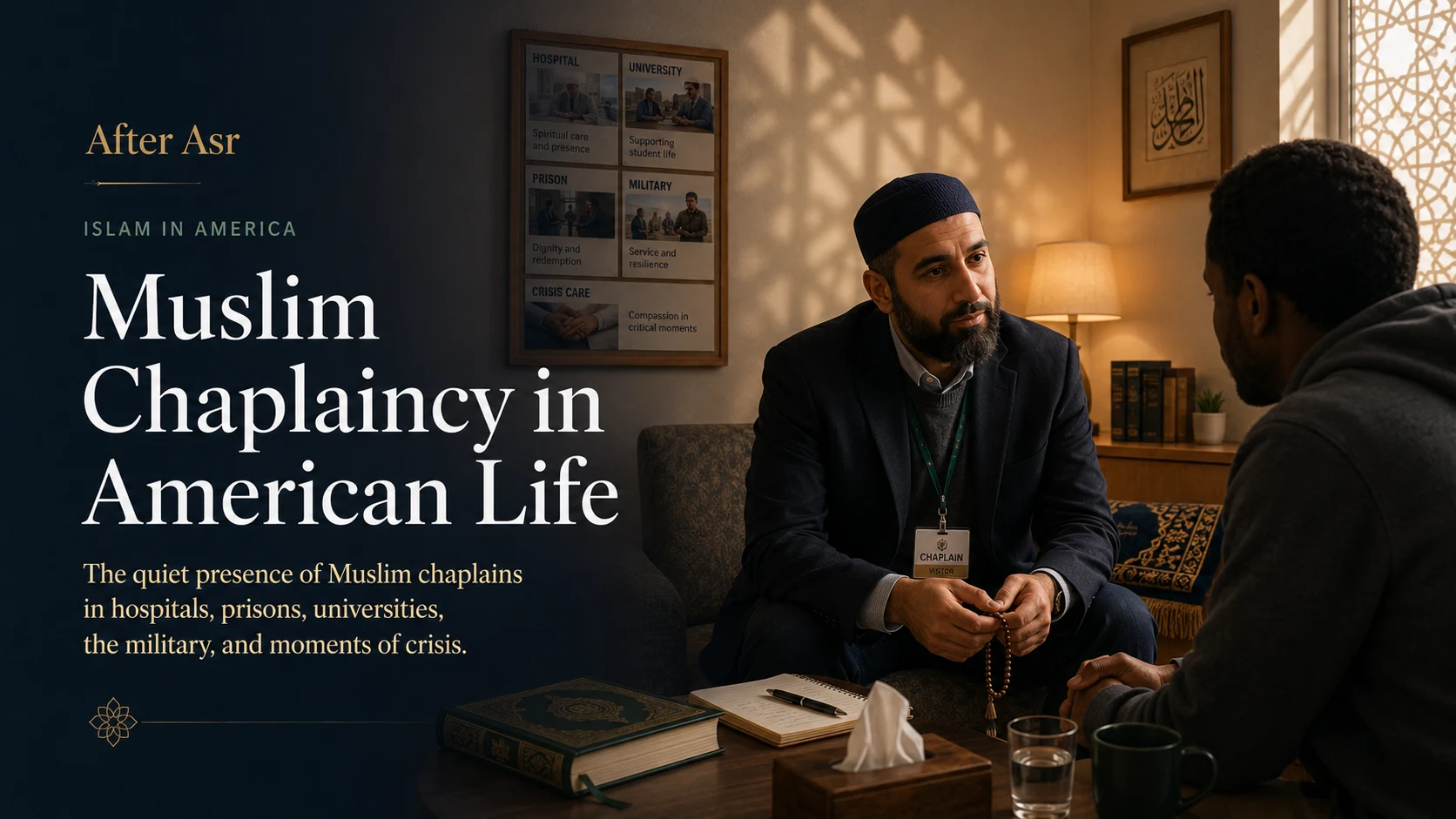
The quiet presence of Muslim chaplains in hospitals, prisons, universities, the military, and moments of crisis.
Much of Muslim chaplaincy happens in rooms where no one is taking pictures.
A hospital room after a diagnosis. A prison cell after a man begins to pray again. A university office where a student finally says they are not okay. A military base where a service member is trying to fast, deploy, grieve, and remain faithful. A family waiting room after an accident. A hospice bed where someone asks what to recite before death. A campus prayer room after news from overseas has left students shaken. A correctional facility classroom where men sit with Qur’ans, notebooks, and the complicated hope of return.
The chaplain enters quietly.
Not as the main speaker. Not as the public representative. Not as the fundraiser. Not as the person who solves everything. Often, the chaplain comes to sit, listen, remind, pray, clarify, comfort, advocate, and witness. The work is not always visible to the wider Muslim community, yet it has become one of the most important forms of Islamic presence in American life.
Muslim chaplaincy exists where human beings meet institutions at vulnerable moments: hospitals, prisons, universities, the military, detention centers, hospices, disaster sites, and spaces of public crisis. In these places, Muslims may be far from family, far from the masjid, far from certainty, or far from the social world that usually carries them. They may need someone who can understand both the language of Islam and the language of the institution.
A Muslim chaplain stands in that difficult space.
The role is not simply to provide religious services. It is to bring spiritual care into systems that can make people feel reduced to numbers, diagnoses, sentences, ranks, cases, or student IDs. It is to remind a person that before they are patient, prisoner, student, soldier, inmate, employee, or family member, they are a servant of Allah.
The chaplain as a bridge
Muslim chaplains often serve as bridges between worlds that do not naturally understand one another.
They explain prayer needs to hospital staff. They help universities understand Ramadan, Eid, grief, Islamophobia, and student crisis. They advocate for halal meals in prisons and military settings. They help Muslim families navigate end-of-life decisions in medical systems with unfamiliar language. They assist institutions in responding to Muslim deaths, trauma, discrimination, and public events. They also help Muslims understand institutional rules, limits, and processes.
This bridging work requires more than good intentions.
A chaplain must know enough Islam to guide responsibly. They must also understand the institution where they serve. Hospitals have protocols. Prisons have security rules. Universities have reporting obligations. The military has command structures. Chaplains must know when they can keep confidentiality and when they cannot. They must know how to refer someone to a scholar, therapist, attorney, social worker, imam, or emergency responder. They must know the difference between pastoral presence and overstepping their role.
The bridge is delicate because trust is delicate.
A Muslim in prison may not trust institutional representatives. A student may fear being reported or judged. A patient may be frightened by medical language. A military member may fear that asking for religious accommodation will be seen as weakness. A convert may not know whether the chaplain will understand their family situation. A woman seeking help may wonder whether her concerns will be believed.
The chaplain must be trustworthy in both directions. They cannot become merely the institution’s religious translator. Nor can they ignore the realities and responsibilities of the institution. They must serve Allah while serving human beings inside systems that are often complex, powerful, and imperfect.
That requires knowledge, humility, and courage.
Hospitals and the nearness of the unseen
Hospitals strip life down quickly.
A person who was busy with work, errands, family, bills, and plans may suddenly become a patient in a gown, waiting for test results. Families who were arguing over ordinary things may gather in a room where the only question is whether someone will survive. A mother watches a child breathe through machines. A son tries to help his father say the shahadah. A patient asks whether they can pray lying down. Someone wonders whether their illness is punishment. Someone else is angry at Allah but afraid to say it.
The hospital chaplain enters a space where the unseen feels near.
For Muslim patients and families, the chaplain may help with prayer, wudu, tayammum, qiblah direction, recitation, du’a, end-of-life guidance, grief, and conversations about hope, fear, and surrender. Sometimes the chaplain simply sits while a family cries. Sometimes they explain to medical staff why modesty matters, why certain dietary restrictions matter, why family may gather in large numbers, or why the timing of death rituals carries urgency.
Hospital chaplaincy requires tenderness because suffering often speaks in incomplete sentences.
People ask questions that are not only legal or theological. “Why is this happening?” may not be a request for a lecture on divine decree. It may be a cry from a frightened heart. “Is Allah angry with me?” may come from someone who needs mercy before explanation. “Can I still pray?” may carry shame, fear, and longing. “What do we do now?” may be both practical and spiritual.
A good Muslim chaplain does not rush to fill the room with answers. They listen for what kind of answer the moment requires. Sometimes a ruling is needed. Sometimes a reminder. Sometimes silence. Sometimes Qur’an. Sometimes the most Islamic act is to help a family breathe long enough to make the next decision.
The hospital teaches that chaplaincy is not abstract work. It is faith at the bedside.
Death, grief, and the Muslim family
Muslim chaplains are often called when death is close.
The family may need help reciting Qur’an, facing the qiblah, saying words of remembrance, understanding what to do after death, contacting the mosque, arranging ghusl and janazah, and navigating hospital release procedures. They may also need help managing disagreement: one relative wants every intervention, another believes it is time to let go, another is overwhelmed, another is not Muslim and does not understand the urgency.
Death in America often happens inside institutions, not homes. This means Muslim families may meet death through hospital policies, hospice systems, funeral home procedures, legal paperwork, and schedules that do not naturally align with Islamic burial practices. A chaplain can help translate these worlds.
But grief is not only procedural.
A Muslim family may need someone to remind them that crying is not weakness, that patience is not numbness, that du’a continues, that Allah is merciful, that the deceased is not abandoned, that the family can move through the required steps one at a time. A convert may have no Muslim relatives to help with funeral matters. A Muslim with non-Muslim family may fear that Islamic burial wishes will not be honored. A family may be divided by culture, language, or old wounds, and death brings everything to the surface.
The chaplain’s presence can steady the room.
Not by removing grief, but by giving it direction. Islam does not ask human beings not to mourn. It teaches them how to mourn before Allah. The chaplain helps hold that teaching when the family may be too shaken to hold it themselves.
Prison chaplaincy and the seriousness of return
Muslim chaplaincy in prisons carries a particular moral weight in American life.
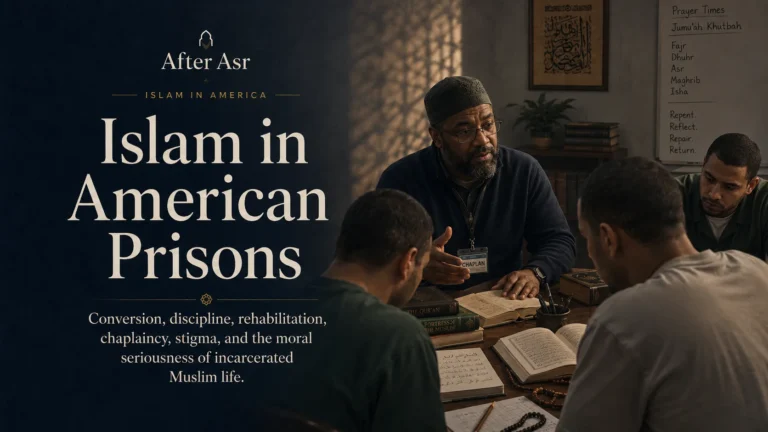
Prisons are places of confinement, punishment, despair, violence, discipline, and, for some, transformation. Many incarcerated Muslims encounter Islam inside prison, sometimes for the first time. Others return to Islam there after years away. Some were Muslim before incarceration and struggle to maintain practice under institutional restrictions. Some seek prayer, Qur’an, fasting, halal meals, Jumu’ah, religious texts, and a brotherhood that can help them survive spiritually.
The Muslim prison chaplain works in a place where hope must be handled carefully.
There are men and women who have done harm. There are also men and women who have been harmed by poverty, addiction, racism, abuse, mental illness, and systems that often fail long before sentencing. Islam does not erase accountability. It also does not erase the possibility of repentance. The prison chaplain must hold both realities: moral responsibility and divine mercy.
In prison, Islam can become a path of order. Prayer gives shape to time. Fasting trains restraint. Qur’an gives language to the soul. Brotherhood or sisterhood can replace destructive affiliations with spiritual companionship. Study can restore dignity to minds treated as disposable. The idea that Allah still sees, still knows, still forgives, still commands, can be life-saving.
Black Muslim history is especially important here. Islam in American prisons has been deeply shaped by Black Muslim struggle, leadership, da’wah, discipline, and the search for dignity under systems of racialized punishment. No serious conversation about prison chaplaincy can ignore that foundation. Many prison Muslim communities have carried religious seriousness under conditions where outside Muslims rarely looked closely.
The chaplain in prison is not only leading services. They are helping people imagine return: return to Allah, return to prayer, return to family if possible, return to society with accountability, return to the self as something more than a criminal record.
That work is quiet, difficult, and sacred.
The prison door does not open into belonging automatically
One of the hardest truths of prison chaplaincy is that religious growth inside does not guarantee support outside.
A person may pray consistently in prison, study Qur’an, fast Ramadan, and build discipline. Then release comes. The world outside is expensive, suspicious, fast, and unforgiving. Employment is difficult. Housing is difficult. Family relationships may be strained. Old environments may call. The local masjid may not know how to receive someone with a record. Brothers who prayed beside him inside are no longer there. The structure that helped him practice disappears.
The chaplain may prepare someone spiritually for release, but the wider community must decide whether it believes in repentance enough to build pathways home.
Reentry is not simple. Communities must be wise about safety, accountability, legal restrictions, and the rights of victims. But wisdom should not become abandonment. If Muslims believe that tawbah is real, then returning citizens need more than inspirational stories. They need mentorship, employment support, housing referrals, addiction recovery resources, family mediation, continued Islamic education, and masjids that know how to welcome without naivety.
Prison chaplains often see the gap between what Islam teaches about repentance and what communities are prepared to offer those repenting.
That gap should trouble us.
The person who learned to pray in a cell should not find every masjid door socially closed after release.
Universities and the young Muslim soul
On American campuses, Muslim chaplains often meet students at the intersection of confidence and confusion.
A student may come because they are struggling with doubt. Another because they are lonely. Another because family pressure feels unbearable. Another because they are in a relationship they know is not right. Another because they are grieving news from overseas. Another because they are exhausted by activism. Another because they cannot pray consistently. Another because they are a convert whose family does not understand. Another because Islam has become public identity, but private worship feels distant.
The campus chaplain’s office can become one of the few places where a Muslim student is allowed to be whole.
Not only a representative. Not only a minority. Not only an activist. Not only a high-achieving child of immigrants. Not only a convert story. Not only a hijabi symbol. Not only a student leader. A servant of Allah with fears, desires, questions, sins, hopes, and a future still forming.
Muslim chaplains on campuses do more than organize Jumu’ah. They teach classes, advise Muslim Student Associations, support converts, counsel students through crises, advocate for prayer spaces and halal food, help administrators understand Muslim needs, and respond when Islamophobia, war, death, or public tragedy shakes the student body.
They must also help students distinguish Islam from the pressure of campus ideologies. A university can be a place of learning, but it can also form moral assumptions that conflict with revelation. The chaplain must be able to engage difficult questions without panic and without surrender. They must help students think, worship, repent, and remain rooted.
A campus chaplain is not a substitute for parents, scholars, therapists, or local mosques. But in the life of a student far from home, they may be the person who keeps the door back to Allah visible.
Activism, grief, and campus crisis
Muslim students often turn to chaplains during public crises.
A war escalates. A hate crime happens. A student is harassed. A professor makes a careless remark. A campus protest becomes tense. A Muslim student dies. News from Palestine, Sudan, Kashmir, Syria, Yemen, China, or another wounded place leaves students grieving and furious. The MSA is expected to respond. Students are exhausted. Some want action. Some want prayer. Some want the university to issue a statement. Some cannot sleep. Some feel guilty for continuing classes while others suffer.
The chaplain enters a room of moral pain.
Their task is not to pacify students into silence. Nor is it to inflame them without guidance. It is to help grief remain connected to Allah, to help anger remain morally disciplined, to help activism remain truthful, to help students avoid despair, and to remind them that the ummah’s wounds are not carried by social media alone.
A chaplain may lead du’a, hold listening circles, advise student leaders, help draft requests to administration, connect students to counseling resources, and remind them to pray. They may also tell students to rest, eat, sleep, and not confuse constant exposure to suffering with service.
This is delicate work. Young Muslims need adults who take their grief seriously without letting grief consume them. They need religious language that does not minimize injustice. They need spiritual grounding that does not turn pain into performance.
The campus chaplain may be one of the few people able to say: yes, this matters; yes, you should care; yes, you must remain obedient to Allah while caring.
Military chaplaincy and moral complexity
Muslim chaplaincy in the military carries a unique complexity.
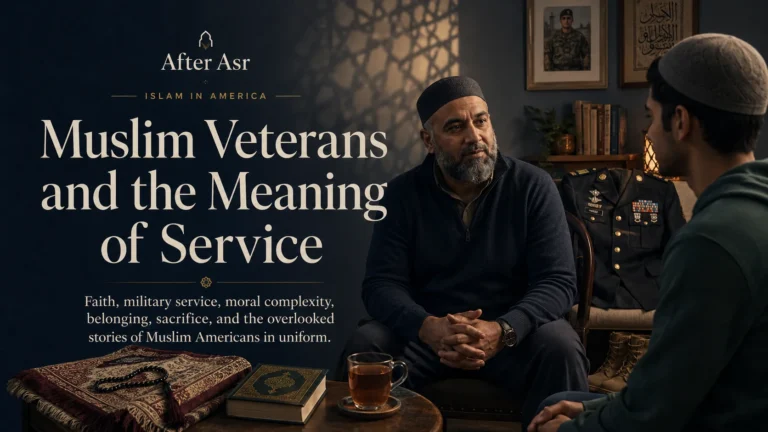
Muslim service members live within a structure of command, discipline, deployment, sacrifice, and moral questions that cannot be answered lightly. Some joined for opportunity, education, citizenship, family tradition, service, escape, or conviction. Some are born Muslims. Some are converts. Some are deeply practicing. Some are trying to find their way back to Allah. They may serve in environments where halal food, prayer time, Ramadan fasting, Jumu’ah, modesty, and religious identity require negotiation.
The Muslim military chaplain serves those Muslims while also serving in an institution tied to state power, war, and the possibility of violence. This requires moral seriousness. Simplistic praise is not enough. Simplistic condemnation is not enough. The lives of Muslim service members are real, and the ethical questions surrounding military service are real.
A chaplain may help a Muslim service member fast safely during training, pray while deployed, grieve a death, handle discrimination, seek accommodation, process moral injury, or speak with family. They may advise command on Muslim religious needs. They may support non-Muslim service members as well, because chaplaincy often serves the whole unit while remaining rooted in one’s own faith.
Muslim chaplains in the military also embody a public contradiction in the eyes of some: Muslim and American, religious and uniformed, pastoral and military. Their work requires clarity about ultimate allegiance. A Muslim chaplain’s first accountability is to Allah, even while operating within military structures.
For Muslim service members, having a chaplain who understands Islam can be a mercy. It can mean not having to explain everything from the beginning. It can mean prayer is taken seriously. It can mean Ramadan is not treated as a strange inconvenience. It can mean grief is met with Qur’an and du’a, not only protocol.
In morally complicated places, spiritual care may be even more necessary.
The chaplain and the non-Muslim institution
Muslim chaplains often work in institutions not shaped by Islamic assumptions.
Hospitals may understand spirituality through broad interfaith language. Universities may treat religion as identity, wellness, or diversity. Prisons may view religion through security concerns. The military may frame chaplaincy through readiness and morale. In each setting, Muslim chaplains must translate Islamic care without reducing it.
This is challenging.
A chaplain may need to explain that prayer is not only meditation, that fasting is not only self-discipline, that halal is not only preference, that modesty is not only culture, that Qur’an recitation is not only comfort, and that end-of-life practices are not only family custom. They must use language institutions can understand while preserving meanings institutions may not naturally share.
There is a temptation to soften Islam into generic spirituality. Sometimes broad language is useful. Mercy, presence, grief, hope, meaning, and compassion are real words. But a Muslim chaplain must not lose the specific center: Allah, revelation, the Prophet ﷺ, prayer, accountability, repentance, akhirah, and the sacred dignity of the human being as a servant of Allah.
The institution may welcome chaplaincy because it improves patient satisfaction, student wellbeing, rehabilitation, diversity, morale, or crisis response. These benefits may be real. But the chaplain must remember that spiritual care is not valuable only because it helps institutional goals. It is valuable because human beings belong to Allah, and they need guidance, mercy, and remembrance.
The chaplain works inside the institution, but must not be spiritually absorbed by it.
Confidentiality, trust, and the weight of listening
People tell chaplains things they may not tell anyone else.
A student admits they no longer believe. A patient says they are afraid to die. A prisoner confesses regret. A soldier speaks of nightmares. A woman reveals abuse. A parent says they are angry at Allah. A convert says they are thinking of leaving the community. A teenager says they cannot stop a private sin. An elder says they are lonely.
Listening to these things is a trust.
Chaplains must know how to carry confidentiality with seriousness. They must also know its limits. If someone is at risk of harming themselves or others, if abuse is disclosed, if institutional reporting rules apply, the chaplain may have obligations that must be explained clearly. Trust is not built by vague promises. It is built by honesty.
The weight of listening also affects the chaplain. Constant exposure to grief, trauma, regret, fear, and crisis can wear down the heart. Chaplains need supervision, peer support, spiritual renewal, and boundaries. They cannot be endlessly available without damage. They must protect their own prayer, family, health, and sincerity.
The Muslim community sometimes expects religious workers to carry everything because the work is “for Allah.” But the chaplain is also a servant of Allah, not a vessel without limits.
A burned-out chaplain may still appear calm in public while privately exhausted. Institutions and communities must support those who provide spiritual care.
Chaplaincy and the imam
Muslim chaplains and imams often overlap in public imagination, but their roles are not identical.
An imam may lead prayers, deliver khutbahs, teach, issue religious guidance, conduct marriages, oversee mosque life, and serve as a community authority. A chaplain often works within an institution, providing pastoral care, spiritual counseling, advocacy, crisis support, and religious accommodation in settings where Muslims may not have access to a masjid.
Some imams are excellent chaplains in practice. Some chaplains are also scholars or imams. But chaplaincy requires specific training: pastoral presence, institutional navigation, documentation, trauma awareness, interfaith literacy, confidentiality, crisis response, referral ethics, and often clinical pastoral education.
The distinction matters because communities may ask imams to do chaplaincy without support or training, and institutions may hire chaplains without ensuring adequate Islamic knowledge. Both create problems.
Muslims need religious leaders who understand pastoral care. They also need chaplains rooted in Islamic learning. The best future will include collaboration: imams, scholars, chaplains, therapists, social workers, teachers, and community organizers each knowing their roles and referring wisely.
A chaplain should not issue complex fatwas beyond their training. An imam should not be expected to handle every trauma case alone. A therapist should not replace spiritual guidance. A scholar should not dismiss pastoral realities. The community needs a network of care.
Human beings are complicated. Our support systems must be mature enough to reflect that.
Women in Muslim chaplaincy
Muslim women chaplains have become increasingly important in American life.
They serve in hospitals, universities, prisons, community organizations, and other settings where women, students, patients, converts, and families may need spiritual care from someone who understands both Islam and their lived experience. A female chaplain may be the person a Muslim woman trusts with questions about grief, abuse, menstruation, childbirth, marriage, divorce, sexuality, modesty, spiritual doubt, or loneliness. She may support female students navigating campus life, women patients facing medical vulnerability, incarcerated women seeking repentance, or convert women needing guidance after shahadah.
Women’s chaplaincy is not a concession to modernity. It is a recognition of need.
Muslim women have always taught, advised, transmitted knowledge, offered counsel, and carried spiritual care. In American institutions, formal chaplaincy gives structure and recognition to some of that work. It also places women in settings where male religious leaders may not have access or may not be the most appropriate source of care.
Communities should support women chaplains with seriousness. They need training, institutional respect, scholarly access, fair compensation, safety, and professional networks. They should not be expected to carry every women’s crisis simply because they are women. They should not be treated as secondary to male chaplains. They should not be reduced to “sisters’ issues” when their work may include theology, grief, ethics, education, and community leadership.
The presence of Muslim women chaplains strengthens the ummah because it expands the community’s capacity for care.
Chaplaincy and converts
Converts often encounter chaplains in moments of transition.
A student becomes Muslim on campus and needs someone to teach prayer. A patient converts in the hospital and wants to know what comes next. A prisoner accepts Islam and begins learning Qur’an. A service member finds Islam while stationed far from home. A person in crisis begins asking spiritual questions that lead toward shahadah.
The chaplain may be the first Muslim guide they know.
This is a tremendous responsibility. The convert needs clarity, gentleness, and follow-up. They should not be overwhelmed with every detail at once. They should not be treated as an inspirational story for institutional newsletters. They need prayer instruction, community connection, reliable resources, and, if possible, a local masjid or mentor who will continue care beyond the institution.
Chaplains can also protect converts from isolation. A campus chaplain may connect a new Muslim to the MSA and local mosque. A prison chaplain may help someone continue learning after release. A hospital chaplain may connect a patient to community support after discharge. A military chaplain may help a convert navigate religious accommodations.
Conversion inside an institution can be especially vulnerable because the person’s life may be unstable. The chaplain must take care not to create dependency, rush identity changes, or leave the person unsupported after the public moment.
A shahadah requires a pathway.
Chaplains often stand at the first step.
The chaplain in public tragedy
After tragedy, people often look for religious language.
A mass shooting. A natural disaster. A student death. A violent attack. A war escalation. A suicide. A hate crime. A public scandal. A community leader’s death. A local accident involving children. In these moments, chaplains may be called into spaces of collective shock.
The work is difficult because words can easily become too much or too little.
People need meaning, but not clichés. They need hope, but not denial. They need patience, but not emotional suppression. They need truth, but not harshness. They need space to grieve without having grief organized too quickly into statements and programs.
A Muslim chaplain may lead du’a, sit with families, advise institutions, help plan memorials, support students or staff, and remind Muslims of Allah’s mercy and the reality of the akhirah. They may also help non-Muslim colleagues understand Islamic mourning practices. In interfaith settings, they must speak with integrity, offering Muslim presence without diluting belief.
Public tragedy can tempt communities into performance. Statements, vigils, media requests, institutional optics, and social media can surround grief quickly. The chaplain must guard the human center. Who is hurting? Who needs to be accompanied? Who is alone? Who is unsafe? Who needs prayer? Who needs a referral? Who needs silence?
In crisis, the chaplain’s quietness may be their greatest gift.
The limits of chaplaincy
Chaplaincy is important, but it cannot carry everything.
A chaplain cannot replace a community. They cannot undo family neglect, institutional racism, poverty, mass incarceration, inadequate healthcare, campus loneliness, or military trauma by themselves. They cannot answer every legal question. They cannot be therapist, scholar, imam, social worker, attorney, case manager, and friend to everyone. They cannot make a prison just, a hospital gentle, a university morally coherent, or a military deployment simple.
Knowing the limits of chaplaincy protects both chaplain and community.
The chaplain is a crucial part of care, not the whole of care. Their work should connect to broader systems: mosques, families, scholars, counselors, reentry programs, student groups, medical ethics committees, legal aid, domestic violence organizations, disability support, and community networks. When a chaplain is isolated, their work becomes heavier and less sustainable.
Muslim communities should not outsource pastoral responsibility entirely to chaplains. Families still need to visit the sick. Mosques still need convert care. Communities still need prison outreach. Parents still need to support students. Boards still need to build safety systems. Imams still need pastoral training. Donors still need to fund care work.
The chaplain may stand at the bedside, in the prison, on campus, or on base. But the ummah must stand behind them.
Training, funding, and institutional maturity
If Muslim chaplaincy is to serve American Muslim life well, it needs investment.
Training matters. Islamic knowledge matters. Clinical pastoral education matters. Supervision matters. Emotional maturity matters. Cultural competence matters. Racial awareness matters. Convert sensitivity matters. Knowledge of trauma, grief, family systems, addiction, mental health, and institutional ethics matters. A chaplain who is sincere but untrained can still cause harm. A chaplain who is professionally trained but religiously shallow can also cause harm.
Funding matters too.
Many Muslim chaplaincy roles are underfunded, part-time, grant-dependent, or absent altogether. Universities may have chaplains for other faith communities while Muslim students rely on volunteers. Hospitals may have interfaith chaplains with limited Islamic literacy but no Muslim chaplain. Prisons may struggle to provide qualified Muslim spiritual care. Military chaplaincy requires long pipelines. Community chaplaincy is often supported by personal sacrifice rather than stable institutions.
American Muslims should fund chaplaincy as seriously as they fund buildings and events.
A chaplain may not draw crowds like a famous speaker. Their work may not produce visible metrics. But one student kept from despair, one patient comforted before death, one prisoner guided toward repentance, one family helped through grief, one service member supported in faith, one convert connected to community, these are not small outcomes.
Chaplaincy is a sign of institutional maturity. It means a community understands that Muslims need care not only in the masjid, but wherever life becomes fragile.
Muslim chaplains and interfaith spaces
Muslim chaplains often work alongside Christian, Jewish, Buddhist, Hindu, Sikh, humanist, and other chaplains.
This interfaith environment can be meaningful. It can teach mutual respect, practical cooperation, and shared concern for human suffering. In a hospital, a chaplain may not have the luxury of ideological distance from colleagues. Everyone is responding to grief, death, fear, and crisis. In universities, chaplains may work together to protect religious life in a secular institution. In prisons, chaplains of different faiths may advocate for religious access.
Cooperation can be good.
But Muslim chaplains must remain clear. Interfaith work should not require theological flattening. A Muslim chaplain can respect others without pretending all beliefs are the same. They can cooperate in care without diluting tawheed. They can participate in shared institutional work while maintaining Islamic boundaries around worship and belief.
This balance requires wisdom. It also models something important for American Muslims: public cooperation does not have to mean spiritual compromise. The chaplain can stand beside others in service while remaining firmly Muslim.
In moments of suffering, clarity and compassion are both needed. The Muslim chaplain’s presence can show that Islam teaches both.
The quiet da’wah of presence
Muslim chaplaincy can be a form of da’wah, though it should not be reduced to that.
A nurse sees a chaplain sit with a grieving family. A university administrator watches a Muslim chaplain calm frightened students. A prison officer observes men become more disciplined through prayer. A non-Muslim patient receives kindness from a Muslim chaplain when no one else is available. A colleague notices that Islamic spiritual care is not foreign, harsh, or abstract, but humane, grounded, and merciful.
This presence can soften assumptions.
But chaplaincy should not become performative da’wah. The person in crisis is not a project. A patient in pain does not need to be treated as an opportunity. A prisoner seeking counsel does not need to become a success story. A grieving family does not need publicity. The chaplain’s first duty in that moment is care.
If da’wah happens, it happens through sincerity, adab, and the beauty of Islam lived in service.
The quiet da’wah of chaplaincy is that it allows people to see Muslims at the bedside, in the prison, on campus, in uniform, in crisis, and in grief, not as abstractions, but as servants of Allah bringing mercy into difficult rooms.
The future of Muslim pastoral care
As Islam in America matures, chaplaincy will likely become more central, not less.
The community is growing more complex. Muslims are spread across campuses, hospitals, prisons, the military, workplaces, rural towns, suburbs, and institutions where the local mosque cannot reach every need directly. Families are navigating mental health struggles, aging, medical ethics, addiction, incarceration, grief, conversion, divorce, and loneliness. Young Muslims are asking difficult questions. Converts need structured care. Public crises continue. Institutions need Muslim voices trained in both faith and pastoral practice.
The old model, where the imam handles everything and volunteers fill the gaps, is not enough.
American Muslims need a broader ecology of care: imams, chaplains, scholars, therapists, social workers, teachers, mentors, community health workers, prison outreach teams, university advisors, hospital volunteers, and trained lay caregivers. Each has a role. Each needs boundaries. Each should serve the believer’s journey toward Allah.
Chaplaincy is one of the ways Muslim life becomes present where people actually suffer. Not only where people gather for worship, but where they receive diagnoses, serve sentences, question belief, deploy overseas, bury loved ones, and sit alone with fear.
A mature community will not wait for crisis to build this care.
The person beside the bed
Imagine a hospital room at night.
The machines hum. A family member is asleep in a chair. The patient is awake, afraid, and too tired for long conversation. The chaplain sits nearby. There is no speech to give. No public moment. No program. No audience. The chaplain asks softly whether the patient would like Qur’an recited. The patient nods. A few verses fill the room.
Nothing dramatic happens.
But something sacred is present.
Or imagine a prison classroom where a man asks whether Allah can forgive him. A campus office where a student says they no longer know how to pray. A military chapel where a service member breaks fast with water from a paper cup. A hospice room where a daughter asks what to say into her mother’s ear. A waiting room where a family needs someone to remind them to breathe and make du’a.
This is Muslim chaplaincy.
Not always visible. Not always celebrated. Not always understood. But deeply needed.
It is the quiet presence of Islam in the institutions where American life becomes vulnerable. It is the reminder that Allah is not absent from the hospital, the prison, the campus, the base, the crisis center, the funeral home, or the room where someone feels alone. It is the work of bringing mercy, knowledge, prayer, and steadiness into places that often reduce people to their circumstances.
The chaplain does not carry guidance alone. Guidance belongs to Allah.
But the chaplain may be the person Allah sends to sit beside someone when the world has become too heavy.
That is not glamorous work.
It is better than glamorous.
It is trust.