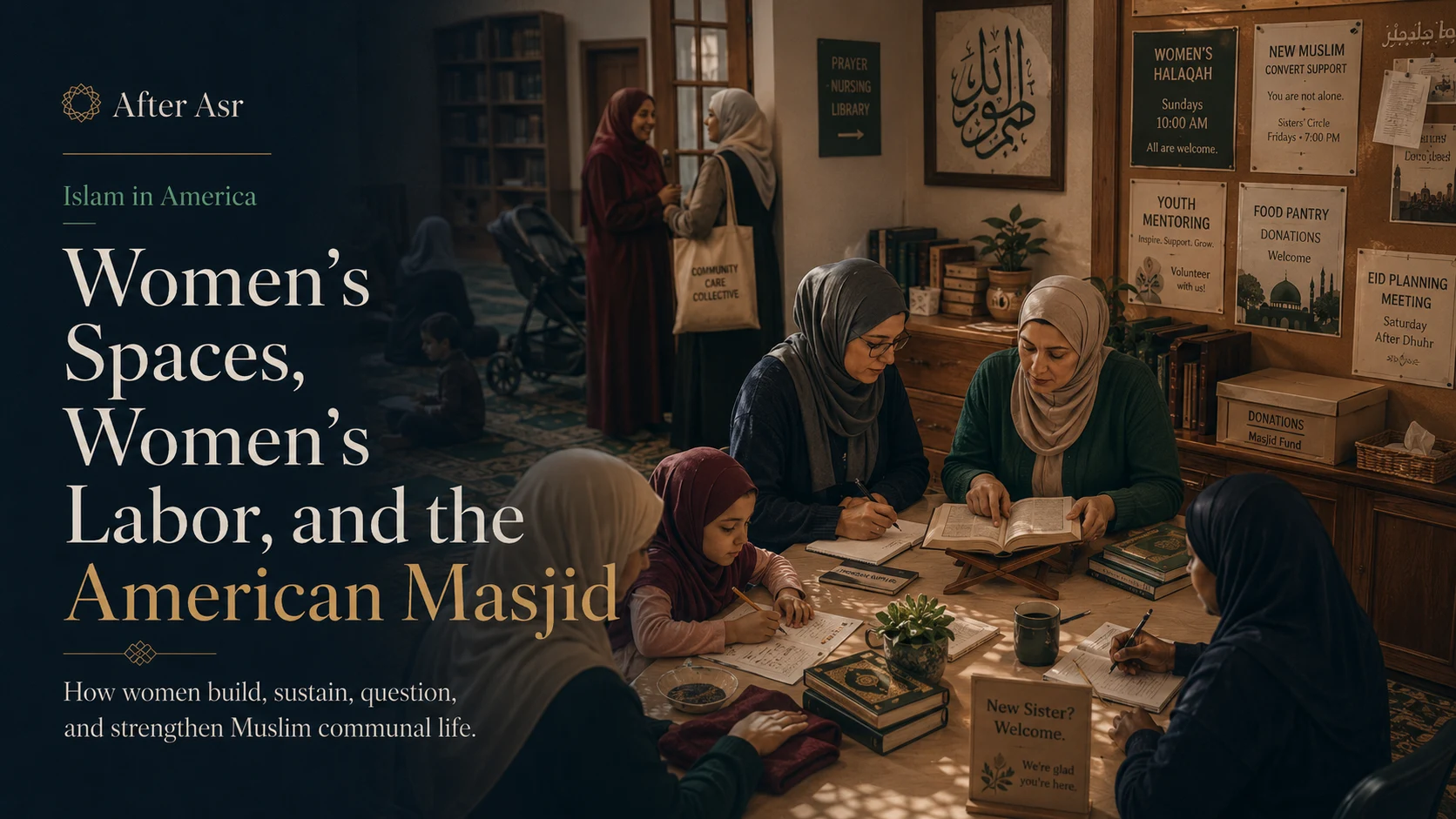
How women build, sustain, question, and strengthen Muslim communal life.
Every masjid has a life people see, and a life they depend on without always noticing.
The visible life may be the khutbah, the prayer rows, the Ramadan calendar, the fundraiser, the children’s program, the Eid crowd, the guest speaker, the community announcement. But behind much of that visible life are women whose labor shapes the emotional, educational, social, and spiritual architecture of the American masjid.
They teach children how to make wudu. They correct Qur’an recitation after class. They prepare food trays for iftar. They organize meal trains after childbirth, illness, and death. They welcome new sisters who do not know where to sit. They answer convert questions after everyone else has gone home. They manage group chats, remind parents about weekend school, decorate for Eid, clean kitchens, fold donated clothes, mentor teenagers, calm younger children, translate for elders, keep track of who is lonely, and notice who has stopped coming.
Some hold formal titles. Many do not.
Some are scholars, teachers, board members, chaplains, administrators, doctors, counselors, writers, and community leaders. Others are known simply as “sister,” “auntie,” “teacher,” “ummi,” “khala,” “baji,” “hajja,” or by a first name spoken with trust. Their work is often praised in general language, but not always supported in practical terms. They are called the backbone of the community, then sometimes given inadequate prayer space, limited decision-making power, little budget, and too much responsibility.
This contradiction is not unique to American Muslim life, but it is especially visible here because the masjid in America is asked to do so much. It is a prayer space, school, community center, counseling point, charity hub, youth space, convert support system, public representative, and family anchor. Women are present in all of that work, whether institutions fully acknowledge it or not.
A serious conversation about Islam in America must ask not only whether women are included in the masjid.
It must ask whether their worship is honored, their labor is protected, their knowledge is nourished, their concerns are believed, and their presence is treated as central to communal health.
More than a “women’s issue”
The condition of women’s spaces in a masjid is not only a women’s issue.
It is a measure of the whole community’s understanding of dignity. When women are physically marginalized, spiritually undernourished, or relied upon without voice, the entire institution is weakened. Boys learn from how their mothers and sisters are treated. Girls learn whether the masjid belongs to them. Converts learn what kind of family they have entered. Men learn, consciously or not, whether women’s service is valued or merely assumed.
A cramped women’s area is not just a facilities problem. Poor sound in the women’s section is not just an inconvenience. A lack of childcare is not merely a scheduling challenge. Women excluded from consultation while being expected to volunteer are not merely experiencing an administrative oversight. These things teach theology through architecture and habit.
They teach whether the community understands that women are worshippers before they are helpers.
This distinction matters. Muslim women are often approached in community life through what they provide: children, food, teaching, emotional care, social organization, fundraising support, hospitality, and volunteer labor. These contributions are real and honorable. But before any woman serves the community, she is a servant of Allah. She has a right to worship with dignity, learn seriously, ask questions, receive pastoral care, and belong without being useful first.
The masjid should not only ask, “What can sisters help with?”
It should ask, “What do sisters need in order to worship, learn, grow, serve, and flourish before Allah?”
That question changes everything.
The prayer space and the message it sends
A woman can tell, often within minutes, how a masjid has thought about women.
She can tell by the entrance. By the signage. By the sound system. By whether she can see or hear the imam clearly. By whether the space is clean. By whether the room is also storage. By whether mothers with children are treated with mercy. By whether there is a place to make wudu comfortably. By whether elderly women can access the space without stairs. By whether there are chairs. By whether the women’s area feels like part of the masjid or an afterthought.
No building is perfect. Many American masjids began in converted houses, office suites, church buildings, storefronts, warehouses, and rented halls. Communities often made do with limited money and awkward layouts. Some women’s spaces are imperfect because the building itself is difficult.
But women can usually tell the difference between limitation and neglect.
A small space can still be cared for. A temporary space can still be dignified. A converted building can still communicate love. Good sound, cleanliness, clear signage, safety, consultation, and responsiveness matter. When women repeatedly raise concerns and nothing changes, the issue is no longer architecture. It is priority.
The prayer space sends a message to girls. If they grow up watching women pray in distant, crowded, poorly maintained areas, they may internalize that the masjid is not fully theirs. If they see women’s spaces treated with care, they learn that their worship matters.
This is not about luxury. It is about reverence.
The house of Allah should not make half the community feel like visitors.
Women’s labor and the language of praise
Muslim communities often praise women’s labor beautifully.
“Sisters are the backbone of the community.”
“The mothers keep everything going.”
“We could not do this without the sisters.”
“Our aunties are amazing.”
These statements may be sincere. They may also become a way to admire women while continuing to overuse them.
Praise is not the same as support.
If women organize every meal but have no say in event planning, they are not supported. If women teach children but receive no curriculum, training, or classroom resources, they are not supported. If women handle convert care informally but receive no budget or institutional backing, they are not supported. If women are thanked after Ramadan but expected to carry the same exhausting load next year, they are not supported. If women clean up while men attend the lecture, the community has learned the wrong lesson about service.
The language of gratitude can become dangerous when it hides unequal labor.
American masjids need to examine who does what. Who cooks? Who cleans? Who teaches? Who plans? Who makes decisions? Who receives credit? Who is paid? Who is expected to volunteer? Who is called difficult when they ask for support? Who carries emotional labor after public programs end?
This is not about diminishing service. Serving for Allah is noble. Many women serve sincerely and with love. But sincere service should not be exploited. A community that depends on women’s labor should protect women from burnout, include them in planning, fund their work properly, and teach men and youth to share the load.
A meal served at the masjid should teach humility to everyone, not reinforce hidden hierarchy.
Teaching the children, carrying the future
Women are often among the primary teachers of Muslim children in American communities.
They teach Sunday school, Qur’an, Arabic letters, duas, seerah, adab, Ramadan lessons, craft activities, and the basics of Islamic identity. They teach in classrooms, living rooms, mosque libraries, online sessions, and kitchen tables. Many teach after full workweeks. Many teach while raising their own children. Many teach without adequate training, pay, supplies, or recognition.
Their work shapes the future.
A child may remember a sister who taught al-Fatihah with patience. A girl may remember a teacher who made Islam feel intelligent and gentle. A boy may remember an auntie who corrected him firmly but loved him. A convert child may remember the woman who explained Ramadan when no one else knew how. A teenager may remember a halaqah where a teacher answered a difficult question without panic.
Women’s teaching is not babysitting. It is religious formation.
Communities must treat it as such. Teachers need curriculum, training, classroom support, fair compensation where possible, background checks, policies, and spiritual nourishment. They need parents to respect them. They need boards to include them in educational planning. They need time to prepare. They need relief when burned out.
If a community says children are its future, then those who teach the children should not be treated as an afterthought.
Women have always been part of Islamic learning. American Muslim communities must stop acting as though women’s teaching is informal by nature. A sister teaching children may be carrying more of the community’s future than the person giving the most visible speech.
Women as students of knowledge
Women do not only teach. They must also be taught.
In some communities, women’s learning is limited to occasional reminders, parenting talks, marriage advice, or programs scheduled around everyone else’s priorities. Men may have regular access to scholars through prayer, informal gatherings, and board relationships, while women receive fewer opportunities for sustained study. Women may be expected to guide children and converts while not being invested in as serious students themselves.
This is a loss for the whole community.
Women need access to Qur’an, tafsir, hadith, fiqh, aqeedah, seerah, Arabic, spirituality, Islamic history, family law, financial ethics, professional ethics, and contemporary questions. They need spaces for beginners and advanced learners. They need female teachers and scholars, and where appropriate, respectful access to qualified male scholars. They need the ability to ask questions honestly about worship, marriage, divorce, menstruation, childbirth, sexuality, grief, abuse, parenting, aging, work, and public life.
A woman who studies seriously strengthens everyone around her. Her home is strengthened. Her children are strengthened. Her marriage may be strengthened. Her community work becomes more grounded. Her own worship deepens. Her ability to distinguish Islam from culture improves. Her confidence grows, not as performance, but as clarity before Allah.
Communities should not fear educated women. They should fear a community where women carry responsibilities without knowledge.
The masjid should be a place where women learn not only how to serve, but how to know Allah more deeply.
The convert sister and the need for real sisterhood
Convert women often reveal the difference between public welcome and actual belonging.
A woman says shahadah. Sisters embrace her. Someone gives her a scarf, a Qur’an, perhaps a prayer dress. People smile and say, “Welcome, sister.” Then the public moment ends. She may go home to a non-Muslim family. She may not know how to pray. She may not know what to wear, what to change first, or how to handle old friendships. She may have questions about hijab, family holidays, dating, marriage, halal food, menstruation, prayer, and loneliness. She may be overwhelmed by cultural expectations from Muslim women who assume she understands what they inherited.
Convert sisters need more than a welcome hug.
They need mentors. Prayer support. Beginner classes. Invitations to meals. Eid plans. Protection from predatory marriage proposals. Help navigating non-Muslim relatives. Patient teaching around modesty that does not reduce them to clothing. Friendship that lasts after the first week. Access to women who can answer intimate questions with knowledge and mercy.
They also need room to remain themselves. A convert woman does not become less Muslim because she does not know a community’s food, language, humor, or family etiquette. She may bring her own regional culture, family stories, work experience, personality, and wounds. She should not feel that Islam requires her to imitate another ethnicity in order to belong.
Sisterhood is not proven by affection in the public moment. It is proven by who calls later, who saves her a seat, who teaches without shaming, who notices when she is gone, and who treats her as family after the novelty has passed.
Women and mosque safety
A masjid must be a place where women are safe.
This should be obvious, but it must be said plainly. Women should be safe from harassment, inappropriate behavior, spiritual manipulation, dismissive leadership, unsafe counseling, gossip, and retaliation when they report concerns. Girls should be safe in classrooms, youth programs, and community events. Converts should be protected from men who target vulnerability. Divorced women and widows should not be treated as available for community speculation. Women seeking help in marital crisis should be heard carefully and referred properly when necessary.
Too often, communities handle safety concerns informally until harm becomes severe.
A sister complains about inappropriate behavior and is told to be patient. A young woman feels uncomfortable around a volunteer but does not know whom to tell. A wife reports abuse and is urged to preserve the marriage without proper assessment. A convert is approached repeatedly for marriage by men who frame pressure as religious guidance. A girl experiences harassment at a youth event and fears being blamed.
A mosque needs policies, not only good intentions.
Clear reporting pathways. Trained staff or volunteers. Background checks for those working with children. Boundaries for counseling. Referral lists for domestic violence, legal aid, and mental health support. Confidentiality practices. Women involved in safety planning. A board willing to act when misconduct is credible. A culture that does not protect reputation at the expense of vulnerable people.
Mercy does not mean naivety. Covering faults does not mean hiding harm. The dignity of the masjid is not protected by silence around abuse. It is protected by justice, wisdom, and accountability.
A woman who seeks safety should not have to fight the community before receiving help.
Mothers in the masjid
Mothers often experience the masjid with mixed emotions.
They want to pray. They want their children to love the mosque. They want to attend classes, hear the khutbah, join Ramadan nights, and feel spiritually nourished. But they also carry strollers, snacks, diaper bags, tired toddlers, restless children, judgmental looks, and the constant fear that their child will disturb others.
Some masjids make mothers feel welcome. Others make them feel like problems.
Children need adab in the masjid. They should be taught to respect prayer, avoid running wildly, and understand the sanctity of the space. Parents should supervise. Community spaces should not become chaotic simply because children are present.
But children are also part of the ummah. A mosque that has no patience for children may become quiet at the cost of its future. Mothers should not be made to feel that their presence is a disturbance before they even enter. Nor should all childcare expectations fall on mothers while fathers pray peacefully.
A thoughtful masjid creates realistic solutions: family prayer areas where appropriate, mother-friendly spaces, father involvement, children’s programming, nursing areas, changing tables, clear expectations, and a culture of mercy. Youth volunteers can help. Men can help. Boards can budget for childcare during major classes. Communities can teach children adab gradually rather than expecting instant adult stillness.
Motherhood should not isolate women from the masjid. If anything, it should make the community more responsible for building spaces where families can worship and grow.
Single women, divorced women, widows, and belonging
Many mosque programs quietly assume that adult women are wives and mothers.
This assumption leaves many women unseen.
Single women may feel that community life is organized around families and marriage conversations. Divorced women may feel judged, watched, or pitied. Widows may receive support immediately after loss, then slowly disappear from attention. Single mothers may struggle with childcare, finances, and social belonging. Older unmarried women may be treated as incomplete. Young professional women may be asked when they will marry more often than they are asked how their iman is.
A woman’s place in the masjid should not depend on marital status.
She is a servant of Allah before she is anyone’s wife, mother, daughter, widow, or divorcee. The community should create spaces where women can learn, serve, lead, and belong at every stage of life. Marriage is important, but it should not become the only lens through which women are understood.
Divorced women especially need dignity. Some left harmful situations. Some were abandoned. Some made mistakes. Some endured years before seeking help. Their stories differ. They should not be reduced to stigma. They may need legal support, counseling referrals, childcare, friendship, remarriage pathways, or simply a place to pray without being studied by others.
Widows need more than the first week of meals. They need ongoing companionship, financial support where necessary, help with transportation, and inclusion in community life.
Single women need more than matchmaking attempts. They need knowledge, friendship, meaningful service, and recognition as full members of the community.
The masjid should be large enough in spirit to hold women’s lives as they actually are.
Women and emotional labor
Women often carry emotional labor in Muslim communities.
They notice who is upset. They mediate between families. They comfort teenagers. They remember who had surgery. They organize meals for new mothers. They check on converts. They talk to sisters in marital distress. They listen after halaqah. They answer late-night messages. They sense when a woman is unsafe. They know which youth are drifting. They remember names, histories, allergies, tensions, and needs.
This labor is sacred when done with sincere intention. It is also exhausting.
Emotional labor becomes dangerous when it has no boundaries, training, or support. A sister may become the unofficial counselor for half the community without any supervision. A teacher may carry children’s trauma without knowing where to refer. A convert mentor may absorb crisis after crisis. A women’s group leader may know too many private burdens and have no one to debrief with. A mother may be expected to care for everyone else while no one cares for her.
Communities should not assume that women naturally absorb emotional need without cost.
Pastoral care requires support. Women doing this work need training in boundaries, confidentiality, mandated reporting where applicable, referral resources, and spiritual renewal. They need teams, not isolation. They need permission to say, “I cannot carry this alone.” They need imams, chaplains, counselors, and boards to take their observations seriously.
A community that relies on women’s emotional intelligence should also build structures that protect women from emotional depletion.
Women questioning the masjid
Sometimes women strengthen the masjid by questioning it.
Why is the women’s space inadequate? Why are women not consulted? Why are girls leaving? Why is childcare unavailable? Why are converts unsupported? Why are women expected to cook but not teach? Why are women’s classes irregular? Why was a safety concern dismissed? Why are women excluded from leadership discussions? Why does the budget not reflect women’s needs? Why do men speak about women without hearing them?
These questions may make leaders uncomfortable. But discomfort is not always disrespect. Sometimes it is the beginning of reform.
A healthy masjid does not treat women’s questions as rebellion by default. It listens, investigates, responds, and corrects what needs correction. It distinguishes between tone and truth. A concern raised imperfectly may still be valid. A woman who speaks firmly may not be divisive. She may be protecting the community from a problem leaders have normalized.
This does not mean every critique is correct. Women, like men, can be unfair, impatient, or misinformed. But the possibility of imperfect critique should not become an excuse to ignore women’s concerns.
Consultation is not a favor. It is part of communal responsibility. Women’s lived experience in the masjid gives them knowledge leaders may not have. To govern without that knowledge is to govern partially.
The masjid becomes stronger when women can question it without being punished for caring.
Women’s leadership without spectacle
The phrase “women’s leadership” can provoke unnecessary anxiety because people often imagine extremes.
In reality, women already lead in many masjids. They teach, organize, counsel, coordinate, fundraise, mentor, administer, manage programs, advise boards, write curricula, run schools, welcome converts, lead women’s halaqahs, and build networks of care. The question is not whether women lead. They do. The question is whether their leadership is recognized, supported, guided by knowledge, and integrated into the institution’s health.
Women’s leadership does not need to imitate secular corporate models to be real. It also does not need to remain invisible to be Islamic. Communities can develop forms of leadership that respect Islamic guidelines while taking women’s contributions seriously. This may look different in different masjids. But it should not look like women doing essential work without authority, budget, consultation, or protection.
Leadership is not only standing at a podium. It is carrying responsibility. Many women carry responsibility already. The community should make that responsibility sustainable and accountable.
A woman teaching girls Qur’an is leading. A sister coordinating convert care is leading. A female scholar answering women’s fiqh questions is leading. A mother organizing a support network for special-needs families is leading. A professional managing the mosque’s administrative systems is leading. A widow mentoring younger women is leading. A young woman organizing youth service projects is leading.
A mature masjid does not need to turn women into symbols. It needs to honor the real leadership already present and make room for it to grow properly.
The women’s halaqah as refuge and formation
In many communities, the women’s halaqah is one of the most important spaces in the masjid.
It may be small. A circle after Maghrib. A Saturday morning class. A Qur’an study in a living room. A monthly gathering in the masjid library. A sisters’ class during Ramadan. A convert support circle. A group chat that began with reminders and became a support network.
These spaces can be refuges. Women ask questions they might not ask in mixed settings. They speak about worship, marriage, parenting, grief, menstruation, modesty, family tension, loneliness, work, aging, divorce, desire, and spiritual dryness. They learn Qur’an. They make du’a for one another. They bring food. They notice who is absent. They become a form of community care.
But women’s halaqahs should not be reduced to emotional support alone. They should also be intellectually serious. Women deserve deep study, not only gentle reminders. They deserve access to texts, scholars, structured learning, and opportunities to grow beyond beginner material. Emotional warmth and intellectual seriousness can exist together. In fact, the best halaqahs often need both.
A women’s halaqah can form teachers, mentors, mothers, converts, community leaders, and worshippers whose influence spreads quietly through the whole masjid.
Boards should support these spaces with rooms, budgets, childcare when possible, reliable scheduling, and respect.
A circle of women studying for Allah may be one of the most powerful institutions in the community, even if it never appears on a fundraising banner.
Girls watching everything
Girls in the masjid are always learning.
They learn from what is said in classes. They also learn from what is not said. They learn from where women pray. From who teaches. From whose microphone works. From whether their questions are welcomed. From whether boys are given more space. From whether their mothers are respected. From whether women’s labor is assumed. From whether modesty is taught with dignity or shame. From whether leadership looks possible. From whether women seem spiritually alive or merely busy.
A girl who feels the masjid belongs to her may carry that belonging for life.
A girl who feels tolerated, watched, or secondary may distance herself even if she never says why.
Communities should ask what girls are inheriting. Are they learning that Islam honors them as servants of Allah? Are they learning that knowledge is for them? Are they learning that modesty is a form of dignity, not public suspicion? Are they learning that their voices matter within adab? Are they learning that service is noble, but exploitation is not? Are they learning that marriage and motherhood can be honored without making them the only measure of worth? Are they learning that women before them carried scholarship, worship, courage, and leadership?
Girls do not need to be flattered. They need to be formed.
They need women to learn from, men who respect them, spaces that protect them, and Islamic education deep enough to carry them into adulthood.
Men and the responsibility to listen
The health of women’s spaces is not the responsibility of women alone.
Men, especially imams, board members, fathers, teachers, donors, and volunteers, have responsibilities here. They must listen without defensiveness. They must stop assuming they understand women’s experience because they approve of women in theory. They must ask women what is happening in spaces men do not enter. They must support women’s learning, safety, and service with resources. They must share labor. They must teach boys to respect women’s dignity. They must challenge men who mock, dismiss, harass, or minimize women’s concerns.
Listening is not weakness. It is part of leadership.
A man may discover that the women’s space has poor sound, that mothers feel unwelcome, that convert sisters are being neglected, that a volunteer makes women uncomfortable, that girls are asking questions no one is answering, that women teachers lack supplies, that widows are isolated, or that sisters are tired of being called only when food is needed.
These discoveries should not be treated as attacks. They are information necessary for amanah.
Men who lead masjids should remember that on the Day of Judgment, they may be asked about people whose experience they never bothered to understand.
Beyond tokenism
Some communities respond to concerns about women by adding one visible woman to a flyer, committee, panel, or event.
This may be a start. It may also be tokenism.
Tokenism uses presence without sharing responsibility. It wants the appearance of inclusion without changing how decisions are made. It asks a woman to represent all women. It invites women when optics require it, then returns to old habits. It praises women publicly but ignores them privately. It brings women into programming but not planning.
Women are not decorations for institutional legitimacy.
Real inclusion asks harder questions. Are women part of decision-making where their lives are affected? Is there a budget for women’s education? Are safety concerns addressed? Is childcare considered? Are women teachers paid? Are convert sisters supported? Are women’s facilities maintained? Are women from different racial, ethnic, age, and marital backgrounds heard? Are Black Muslim women, convert women, immigrant women, young women, elders, widows, and single mothers included in the community’s imagination?
No single woman can carry all these perspectives.
A serious masjid builds channels, not symbols.
Black Muslim women and the American masjid
Black Muslim women have shaped Islam in America in profound ways.
They have taught, organized, mothered, studied, written, led, corrected, fed, counseled, and sustained communities through racism, poverty, prison systems, neighborhood struggle, family pressure, and institutional neglect. They have carried Black Muslim history not only as memory, but as daily practice. They have built schools, supported masjids, raised children in faith, mentored converts, and challenged both anti-Blackness and gendered dismissal.
Yet Black Muslim women are often doubly overlooked in broader Muslim spaces. Their labor may be used, their history acknowledged in passing, but their authority not fully recognized. They may be asked to speak on race but not invited to teach theology, spirituality, fiqh, family, or Qur’an. Their concerns may be treated as too specific, when in reality they often reveal central questions about justice, belonging, and religious integrity.
An American masjid that ignores Black Muslim women is ignoring part of its own foundation.
Communities should study Black Muslim women’s scholarship, oral histories, leadership, and service. They should include Black Muslim women in governance and teaching. They should take seriously their experiences of anti-Blackness in marriage, school, mosque culture, and leadership. They should not reduce them to strength while failing to offer care.
The story of women in the American masjid is incomplete without them.
The immigrant mother and the American daughter
Many immigrant Muslim mothers and American-born daughters meet inside the masjid with different expectations.
The mother may see the masjid as preservation. A place where language, culture, modesty, marriage networks, and religious identity are protected. She may have sacrificed greatly to build or support it. She may fear that her daughter will lose faith in a society she does not fully trust.
The daughter may see the masjid as both home and frustration. She may love Ramadan there, but feel unheard. She may respect her mother’s sacrifices, but question cultural expectations. She may want deeper Islamic education in English. She may ask about women’s leadership, race, mental health, marriage, and gender in ways her mother finds uncomfortable. She may not want to abandon Islam. She may want Islam separated from inherited pressure.
Both may be afraid.
The mother fears loss. The daughter fears being unseen.
The masjid can either intensify this tension or help translate between generations. Women’s programs should make room for both memory and new questions. Elders should be honored, but not allowed to silence necessary growth. Younger women should be heard, but should not treat every inherited practice with contempt. The goal is not for daughters to become copies of mothers, nor for mothers to be dismissed as relics. The goal is for Islam to be handed forward with wisdom.
A healthy women’s space can become a bridge across generations.
Women’s work after tragedy
When a community experiences crisis, women often become the first responders of emotional life.
After a death, women organize food, sit with grieving families, care for children, and remember details others miss. After a divorce, women may provide shelter, advice, and companionship. After illness, they coordinate meals and rides. After a public tragedy, they help children process fear. After a convert faces family rejection, they offer a place to sit. After a sister experiences harm, they may be the first to know.
This work is sacred and heavy.
Masjids should not assume it will happen automatically. Crisis care needs structure. Women doing this work need support from imams, boards, counselors, and trained volunteers. Communities need systems for grief support, domestic violence referrals, mental health resources, convert care, funeral support, and emergency assistance. Informal sisterhood is powerful, but it should not be the only safety net.
A woman bringing soup after a janazah may be doing worship. A sister sitting with someone after abuse disclosure may be carrying a trust that requires training. The difference matters. Love must be joined with competence.
The American masjid is increasingly asked to respond to complex family and emotional needs. Women are already responding. The institution must catch up.
The spiritual life of women who serve
Women who serve the masjid need spiritual care too.
It is possible to be constantly involved in religious work while privately depleted. A woman may organize programs but struggle to pray with presence. Teach children but feel distant from Qur’an. Feed others but feel unseen. Mentor younger sisters but have no mentor herself. Carry everyone’s problems but have nowhere to place her own. Serve during Ramadan and reach Eid exhausted rather than renewed.
Communities often assume that active women are spiritually fine. They may not be.
A masjid should nourish its servants. Women who teach, organize, and care need classes for their own growth, retreats, rest, pastoral support, and permission to step back. They need to be reminded that their worth is not measured by usefulness. They need hidden worship, not only public service. They need relationships where they are not always the helper.
The woman who gives everything to the community still has a soul that belongs to Allah.
Her service should lead her closer to Him, not replace her private relationship with Him.
What a stronger masjid would look like
A stronger American masjid would not merely create a better women’s section and declare the matter solved.
It would think more deeply.
It would design prayer spaces with women’s dignity in mind from the beginning. It would ensure women can hear, learn, enter, sit, make wudu, care for children, and participate safely. It would fund women’s education seriously. It would train and support women teachers. It would include women in consultation and governance in meaningful ways. It would develop convert sister mentorship. It would protect women and girls through safety policies. It would share food and cleanup labor across the community. It would recognize women’s emotional labor and build pastoral systems around it.
It would honor mothers without reducing all women to motherhood.
It would honor modesty without weaponizing shame.
It would honor marriage without treating single women as incomplete.
It would honor elders without silencing younger women.
It would honor women’s service without exploiting it.
It would honor women’s questions without labeling them trouble.
It would honor women’s knowledge without fearing it.
Such a masjid would not be perfect. No community is. But it would be more truthful. And truthfulness is the beginning of repair.
The masjid women have already built
Many American masjids exist as they do because women built them, often quietly.
They built them through cooking and teaching, yes, but also through strategy, money, writing, administration, scholarship, counseling, fundraising, parenting, cleaning, mentoring, advocacy, translation, and prayer. They built them in public meetings and private kitchens. In classrooms and hospital rooms. In group chats and janazah gatherings. In Sunday school hallways and Ramadan kitchens. In living rooms where new Muslims learned to pray. In conversations where girls decided not to leave the masjid after all.
Some of this work was honored. Much was not.
But Allah knows.
The task now is not only to say thank you. It is to build institutions that no longer depend on women’s invisibility. To create spaces where women can worship with dignity, learn with depth, serve with support, question with safety, and lead according to knowledge, adab, and communal need.
The American masjid is still becoming what it must be. Women are not waiting outside that process. They are already inside it, carrying more than many realize.
The question is whether the institution will become honest enough to see them.
Not as symbols.
Not as problems.
Not as background helpers.
Not as occasional voices.
But as servants of Allah whose worship, knowledge, labor, and moral insight are part of the masjid’s health.
A community that understands this will be stronger. Not because it has adopted a slogan, but because it has moved closer to justice.
And justice, when done for Allah, is not a concession to the age.
It is part of faith.