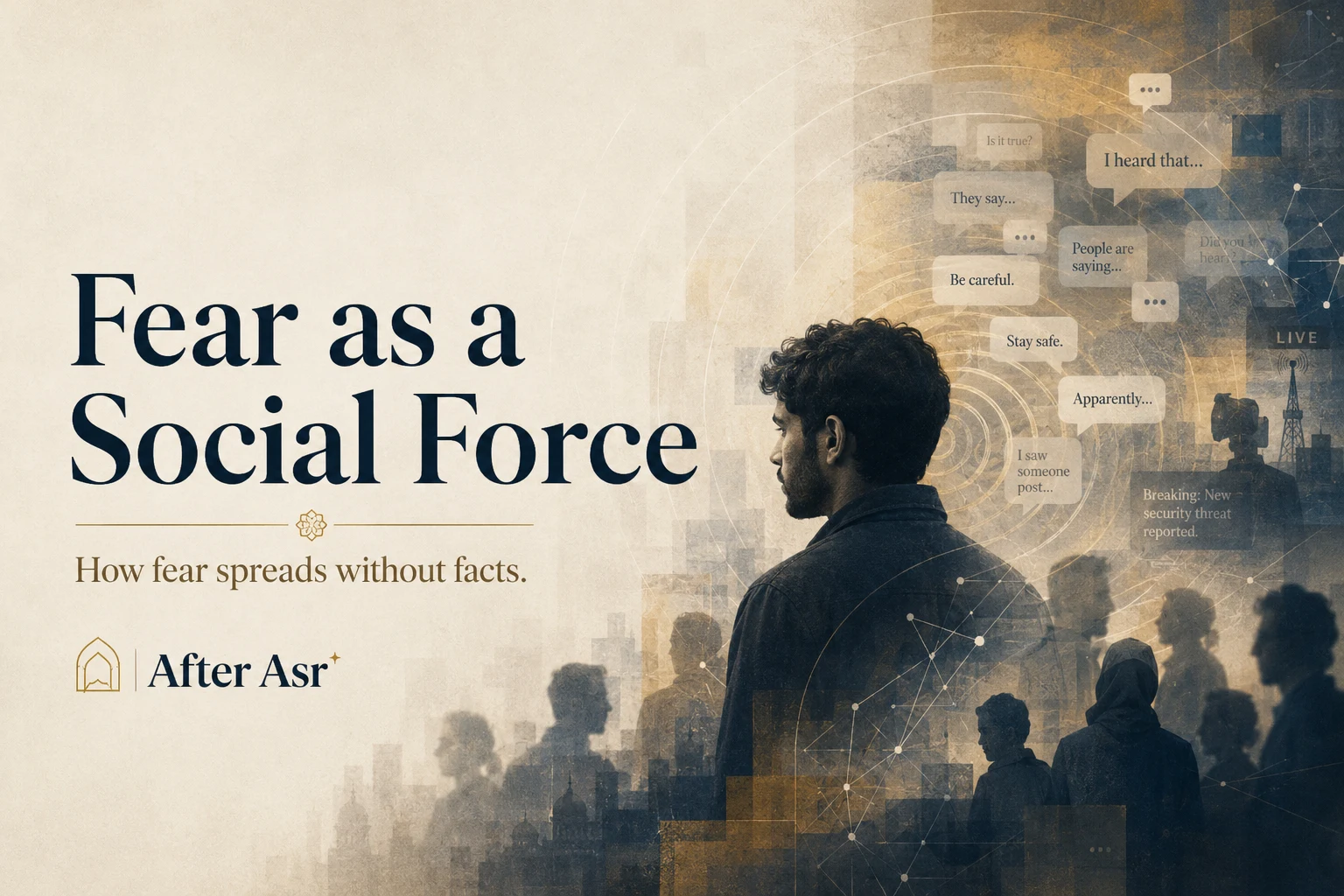
How fear spreads without facts.
Fear does not need to be true to become influential.
It only needs to feel possible.
A claim can be unverified, exaggerated, or plainly false, yet still shape public behavior if it touches an existing anxiety. People begin repeating it, institutions respond to it, media ecosystems amplify it, and before long the fear has created consequences of its own.
This is one of the most important forces behind Islamophobia. Anti-Muslim suspicion does not always begin with a direct encounter, a specific policy debate, or a serious examination of evidence. Often, it begins with atmosphere: a vague sense that Muslims are dangerous, that Islam is foreign, that ordinary religious visibility signals something threatening beneath the surface.
Once fear takes hold, facts are no longer the only thing shaping public judgment. In some cases, they are not even the strongest thing.
Fear Travels Faster Than Understanding
Understanding requires time. Fear does not.
To understand a community, a religious practice, a political conflict, or a social concern, people need context. They need history, proportion, and careful distinction. Fear offers something much simpler. It gives the mind a quick story: something is wrong, someone is to blame, and danger may be near.
That simplicity gives fear extraordinary speed.
Research on misinformation repeatedly shows that emotionally charged claims are more likely to attract attention and circulate, especially when they align with existing identities, suspicions, or social tensions. Repetition also matters. A statement heard often enough can begin to feel familiar, and familiarity can be mistaken for truth.
This helps explain why false or distorted narratives about Muslims can persist long after they have been challenged. The correction usually arrives later, asks more of the audience, and lacks the emotional punch of the original claim.
Fear plants itself quickly. Facts often arrive carrying paperwork.
The Power of the Vague Threat
A fear does not always need a clear object. In fact, vagueness can make it more adaptable.
A specific accusation can be disproven. A broad suspicion is harder to defeat.
If Muslims are portrayed not as neighbors, coworkers, students, or families, but as a shadowy cultural “problem,” then almost anything can be made to fit the narrative. A mosque becomes suspicious. A halal grocery store becomes a sign of demographic change. A school accommodation becomes evidence of social takeover. A political disagreement becomes proof of divided loyalty.
None of these conclusions requires evidence. They rely on suggestion.
The feared object remains slightly out of focus, which allows the fear to survive contradiction. When one claim collapses, another takes its place. The underlying message remains the same: be uneasy around Muslims.
This is why Islamophobia often works through implication rather than explicit declaration. It does not always say, “Muslims are dangerous.” It asks, “Are we allowed to ask what is really happening?” It does not always accuse. It insinuates.
And insinuation can be powerful precisely because it pretends not to have reached a conclusion.
When Possibility Is Treated as Proof
Fear changes the standard of evidence.
In ordinary reasoning, a serious accusation requires support. Under fear, the mere possibility of danger begins to feel like enough. The question shifts from “Is this true?” to “Can we afford to ignore it?”
That shift has enormous consequences.
A rumor about a Muslim person, school, mosque, refugee family, or public official may spread not because people have verified it, but because they decide that sharing it is safer than withholding it. The logic becomes preventative: what if it is true?
This pattern appears far beyond Islamophobia. Studies on rumor acceptance and misinformation suggest that anxiety and perceived threat can make people more likely to accept and transmit claims that match their emotional state. Fear does not merely respond to information. It can shape which information feels believable in the first place.
In anti-Muslim discourse, this means that Muslims are often judged by imagined risks rather than demonstrated conduct. A Muslim’s innocence may be treated as provisional. Suspicion becomes the starting point, and trust must be earned afterward.
That is not vigilance. It is prejudice organized as caution.
Repetition Creates Atmosphere
A single false claim may be dismissed. A repeated pattern of similar claims can become cultural background noise.
This is especially important in the formation of Islamophobia. One headline about “radicalization,” one viral clip stripped of context, one political speech warning of infiltration, one exaggerated story about religious law, one rumor about migrants or mosques, each may seem isolated. Together, however, they form a wider impression.
The impression may be stronger than any individual fact.
People begin to feel that they have “heard too much” to dismiss the concern, even if what they have heard was fragmented, misleading, or repeatedly recycled. This is part of the illusory truth effect: repetition increases perceived truth, including for claims that are false or poorly supported.
The result is not always open hatred. Sometimes it is lower-grade distrust. A hesitation around a Muslim name. A raised eyebrow at a public prayer space. A sense that Muslims are always near controversy, even when the controversy was manufactured around them.
Fear does not need everyone to become hostile. It only needs enough people to become uneasy.
Media Frames and the Making of Suspicion
Public fear is not created by media alone, but media can give it form.
What receives attention, how often it appears, which details are emphasized, and which events are treated as representative all matter. If Muslims are regularly encountered in public discourse through stories of terrorism, security, migration panic, cultural conflict, or extremism, then the category “Muslim” begins to accumulate an emotional charge.
This does not require fabricated reporting. Selection itself can distort. A fact may be accurate and still misleading when presented as part of a narrow and repetitive frame.
A violent Muslim is news. A Muslim quietly living an ordinary life usually is not. A controversial imam becomes a symbol. Millions of ordinary Muslims remain invisible. Over time, absence and emphasis work together.
Research on Islamophobic discourse has repeatedly identified the role of media framing in portraying Islam and Muslims through threat-centered narratives, especially in minority contexts where many non-Muslims have limited direct contact with Muslim communities.
When people lack firsthand familiarity, repeated public images can stand in for experience. The imagined Muslim becomes more influential than the real one.
Fear Is Socially Rewarded
Fear does not spread only because people are misinformed. It can also spread because expressing fear brings social rewards.
In some circles, suspicion toward Muslims signals seriousness, patriotism, cultural awareness, or a willingness to “say what others will not.” A person who raises an unfounded alarm may be praised for bravery rather than challenged for carelessness.
This reward structure matters.
If fear increases attention, attention brings status, and status encourages repetition, then public discourse begins to favor escalation. Claims become more dramatic. Language becomes more absolute. Nuance is treated as weakness. Anyone urging caution may be accused of naivete.
In such an environment, facts are not always ignored because people hate facts. They are ignored because facts interrupt the emotional and social function the fear is serving.
Fear creates belonging. It tells people who “we” are by warning them about “them.”
That is why prejudice so often presents itself as protection.
The Burden Placed on Muslims
When fear becomes a social force, Muslims are made to live inside its consequences.
They may be asked questions that others are not asked. They may be expected to explain world events they did not cause. They may find their religious practices treated as political statements. They may watch ordinary choices, such as wearing hijab, growing a beard, attending the mosque, or speaking Arabic, become loaded with meanings others attach to them.
The pressure is not always dramatic. Often, it is cumulative.
A look at airport security. A classroom joke. A hiring hesitation. A parent’s concern about a Muslim teacher. A viral post about a local mosque. A politician’s casual warning about “values.” None of these moments alone may define a life. Together, they create a social climate in which Muslims are not simply present, but interpreted.
This is one of the quieter harms of Islamophobia. It turns Muslim existence into a public question.
Fear Resists Correction
One of fear’s greatest strengths is that it can absorb contradiction.
If a frightening claim is disproven, some will say the truth is being hidden. If a Muslim public figure demonstrates integrity, some will call them an exception. If a community condemns violence, some will say the condemnation came too late or was not sincere enough.
The fear survives because it has become a lens, not merely a conclusion.
Once a group is interpreted through threat, neutral information may be read suspiciously, and reassuring information may be dismissed as strategic. The result is a closed loop. Fear demands proof, rejects proof, then cites the absence of acceptable proof as justification for remaining afraid.
This is why Islamophobia cannot be addressed only by presenting individual facts, though facts matter. It also requires challenging the frame through which those facts are received.
A society cannot reason clearly about Muslims while insisting on first imagining them as a danger.
The Difference Between Prudence and Panic
A healthy society does not abandon caution. Real threats exist. Violence exists. Extremist ideologies exist. Security concerns can be legitimate.
But prudence and panic are not the same.
Prudence is specific. It evaluates evidence. It distinguishes among individuals, movements, and communities. It accepts correction when facts change.
Panic is expansive. It generalizes. It suspects before it investigates. It treats proximity as proof and identity as warning.
Islamophobia often borrows the language of prudence while operating through panic. It says it is simply asking questions, while always asking the same questions about the same people. It says it is concerned about safety, while making Muslims less safe. It says it is defending social cohesion, while teaching society to mistrust some of its own members.
That contradiction must be named.
Building Resistance to Manufactured Fear
Fear will always have a place in public life. Human beings are vulnerable to alarming stories because survival matters. But a serious society cannot allow fear to become its primary method of judgment.
Resistance begins with discipline.
It means refusing to treat virality as verification. It means noticing when claims about Muslims rely on implication instead of evidence. It means asking whether a story is representative or merely sensational. It means resisting the pressure to share before understanding. It means refusing to let repetition stand in for proof.
It also means cultivating proximity. Fear thrives at a distance. It becomes harder to sustain when Muslims are not abstractions, but classmates, coworkers, neighbors, teachers, physicians, parents, and friends.
Facts matter. But so does encounter.
A person who knows Muslims in ordinary life is less likely to accept the idea that Muslims are best understood through alarm.
Conclusion
Fear is one of the most powerful forces in public life because it does not need to prove itself before it begins to work. It spreads through repetition, suggestion, social reward, and emotional urgency. By the time facts arrive, fear may already have shaped the mood of a community.
Islamophobia depends heavily on this process. It turns uncertainty into suspicion, suspicion into atmosphere, and atmosphere into unequal treatment. It teaches people to respond to Muslims not as individuals, but as possibilities of danger.
The challenge is not to pretend that fear can disappear. It is to prevent fear from becoming a substitute for truth.
A society governed by evidence may still disagree. A society governed by fear begins accusing before it understands.