
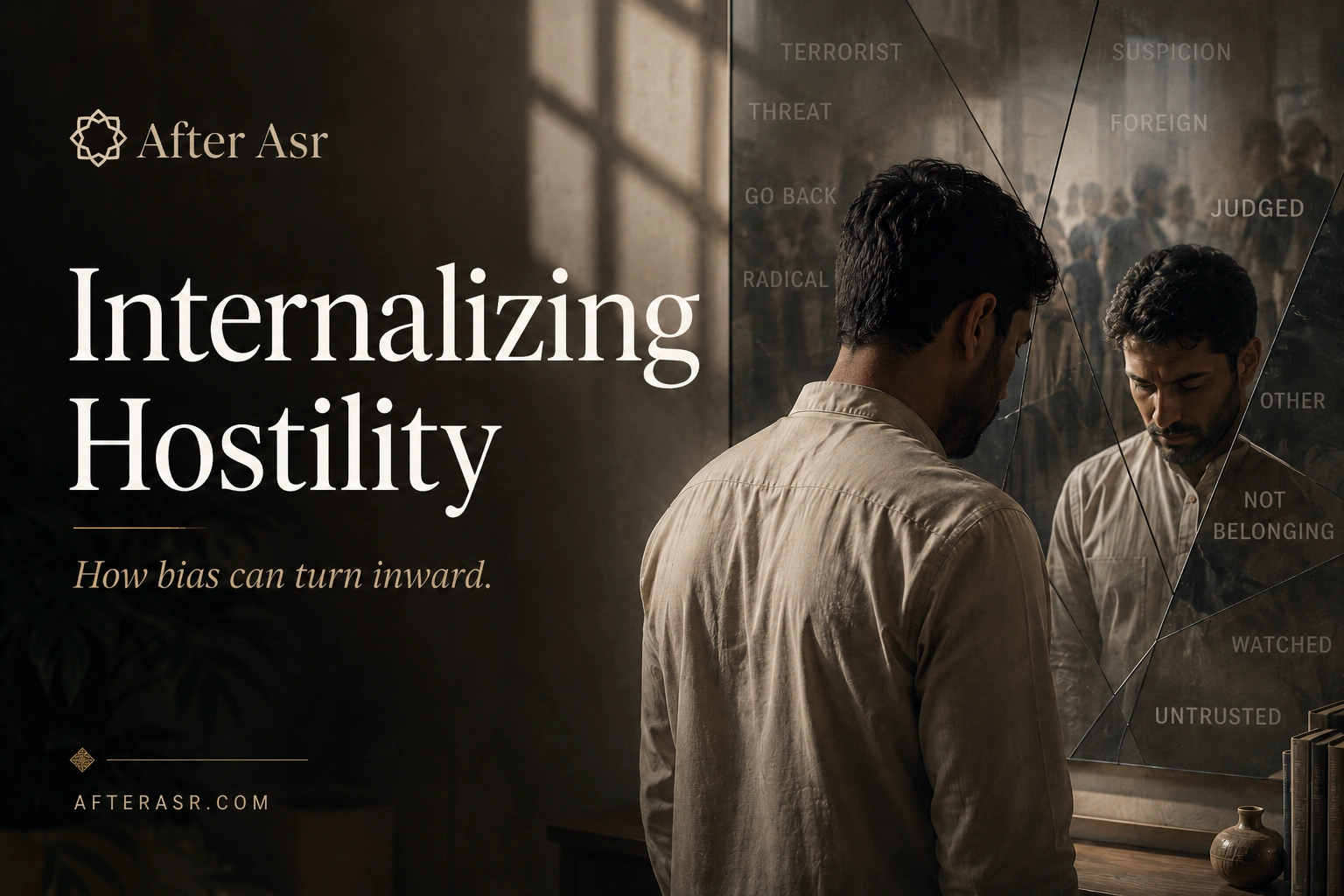
How bias can turn inward.
Hostility does not always remain outside the person it targets.
Sometimes, after enough repetition, it begins to echo inward.
A Muslim hears that Islam is backward, violent, oppressive, foreign, incompatible, or embarrassing. They hear it in headlines, jokes, classroom comments, political speeches, entertainment, online arguments, and the careful concern of people who insist they are only “asking questions.” At first, the hostility may feel obviously external. It belongs to other people.
But what happens when those messages are repeated for years?
What happens when a child grows up seeing their faith treated as a problem?
When a teenager feels they must apologize for being Muslim before anyone has accused them directly?
When an adult begins measuring themselves by how little discomfort their Muslimness creates for others?
Bias can be resisted. It often is. Many Muslims respond to Islamophobia with deeper conviction, stronger community bonds, and a clearer sense of dignity. But hostility can also leave another mark. It can produce shame, self-doubt, distancing, and the subtle adoption of assumptions that were first imposed from outside.
This is the quieter danger of internalized hostility.
It is prejudice beginning to speak in the target’s own voice.
When the Outside Voice Becomes Familiar
Internalized bias does not usually appear as a conscious decision to believe something hateful about oneself. It is more gradual than that.
A person may never say, “I have accepted Islamophobic ideas.” Instead, the effects appear in small adjustments:
- feeling embarrassed to be visibly Muslim
- worrying that a Muslim name sounds too foreign
- avoiding Islamic phrases in public
- treating religious practice as something to hide
- assuming that more observant Muslims are automatically harder to defend
- feeling pressure to prove, over and over, that one is not “that kind” of Muslim
The message begins outside: Muslimness is suspect.
The internalized version becomes: I must manage my Muslimness carefully.
A 2023 qualitative study of Muslims living in Spain examined how some participants internalized cultural and ideological myths that sustained the racism and Islamophobia directed at them. Based on eight discussion groups with 61 Muslim residents, the study found that domination can be reproduced partly when targeted people absorb and repeat the assumptions used against them.
This does not mean people who struggle with internalized hostility are to blame for it. Quite the opposite. Internalization is one of the effects of living in an environment where negative messages are persistent, socially rewarded, and difficult to escape.
Shame Is One of Prejudice’s Goals
Islamophobia does not always seek to make Muslims afraid. Sometimes, it seeks to make them ashamed.
Ashamed of association.
Ashamed of visibility.
Ashamed of public worship.
Ashamed of family traditions.
Ashamed of being linked to a faith they are constantly told must defend itself.
Shame is powerful because it turns identity into a private discomfort. A person may still call themselves Muslim, still believe, still belong, yet begin treating parts of themselves as socially inconvenient. They may apologize before speaking. They may preemptively criticize their own community to appear reasonable. They may distance themselves from ordinary religious signs so that others will not confuse them with a stereotype.
Scholar Noha Sadek has argued that Islamophobia can produce shame that, when internalized, encourages forms of disidentification from Muslim identity. That work is theoretical and psychoanalytic rather than a population-wide measurement, but it captures a dynamic echoed in broader research on identity strain under anti-Muslim hostility.
The emotional achievement of prejudice is not always open submission.
Sometimes, it is making people carry discomfort about themselves.
Distancing as a Survival Strategy
Not every act of distancing reflects internalized hostility. People make choices about dress, speech, affiliation, and public visibility for many reasons. Muslims are not obligated to perform identity in a single way, and caution under hostile conditions can be sensible.
But sometimes distancing emerges because a person has absorbed the lesson that being recognizably Muslim is socially costly.
They may think:
I do not want people to assume things about me.
I do not want to explain.
I do not want to be judged before I speak.
I do not want to be associated with what people already believe about Muslims.
These are understandable reactions. Yet over time, the line can blur between avoiding mistreatment and accepting the idea that the mistreatment is caused by Muslim visibility itself rather than by the prejudice surrounding it.
Research on Muslim minority identity has found that perceived Islamophobia and religious discrimination can shape how Muslims relate to both religious and national belonging. A 2012 study of Norwegian-Pakistani and German-Turkish Muslims found that experiences and perceptions of religious stigma were associated with national affiliation, partly through effects involving religious identity. A 2020 study in Britain likewise found that perceived Islamophobia was associated with stronger Muslim identity, while personal discrimination was associated with weaker British identity and greater depressive symptoms.
The response to hostility is not uniform. Some people cling more tightly to Muslim identity. Others feel estranged from the society around them. Still others begin feeling estranged from parts of themselves.
The Pressure to Be “Less Muslim”
Internalized hostility often grows in environments where acceptance appears conditional.
The implied rule is simple:
You may belong, but do not make us too aware of your difference.
Be Muslim privately.
Be spiritual, but not publicly demanding.
Observe your faith, but do not alter the room.
Carry your identity, but do not let it become inconvenient.
Over time, some Muslims may begin policing themselves according to this standard. They measure success by how comfortably others receive them. They treat “not seeming Muslim” as a compliment. They feel relieved when someone says, “I would never have guessed.”
That relief is revealing.
It means that recognizably Muslim presence has been framed as a liability, and passing outside that frame can feel like temporary freedom.
Yet the cost is high. Acceptance gained by hiding parts of oneself is fragile. It depends on continued concealment or accommodation. It teaches the person that belonging is earned through reduction.
When Prejudice Reappears Inside Community Judgment
Internalized Islamophobia does not affect only how Muslims see themselves. It can also shape how Muslims judge one another.
A visibly religious Muslim may be viewed as embarrassing or “making things harder.” A woman in hijab may be treated as attracting unnecessary attention. A man with a beard may be told he looks too intense. A young Muslim who speaks forcefully about discrimination may be dismissed as hurting the community’s image. An immigrant parent’s accent or clothing may be seen by more assimilated relatives as a source of social shame.
These judgments do not arise from nowhere. They often mirror outside hostility.
The hostile society says, “That version of Muslimness makes us uncomfortable.”
The internalized voice says, “That version of Muslimness makes us look bad.”
This does not mean all internal criticism within Muslim communities is illegitimate. Communities should be able to debate conduct, ethics, strategy, and public representation. But when criticism consistently moves in the direction of minimizing Muslim visibility to soothe outside prejudice, it deserves closer examination.
Prejudice has deepened its reach when it recruits the targeted community to help enforce its preferred image.
Children and Youth Are Especially Vulnerable
Young people are particularly vulnerable to internalizing hostility because identity is still forming while the messages arrive.
A teenager who repeatedly hears Islam discussed as a problem may begin wondering whether their own faith is a burden. A Muslim child whose classmates joke about terrorism may laugh along to avoid being isolated, even while absorbing the injury. A young person may become defensive, doubtful, or ashamed long before they have developed the confidence or knowledge to interpret what is happening.
A 2017 qualitative study of 30 American Muslim youth described how rising Islamophobia placed young Muslims in a defensive position, pushing them to justify their convictions while contending with doubts and insecurities produced by the surrounding climate. The study argued that one underestimated effect of Islamophobia is the “ingestion” of negative ideas about Islam by Muslims themselves, particularly younger Muslims.
A 2018 study of Islamic school children in the Netherlands also found that perceptions of religious discrimination were meaningfully connected to self-esteem and national identification, reinforcing the broader point that social hostility can shape how Muslim youth understand themselves and their place in society.
Children do not need to openly reject their faith for internalization to matter.
They may simply begin carrying it with less ease.
Internalized Hostility Can Sound Like “Realism”
One reason internalized bias is hard to identify is that it often presents itself as maturity.
“People are just uncomfortable with visible Islam.”
“You have to understand how we look to others.”
“Maybe Muslims should stop doing things that invite suspicion.”
“We should be less sensitive.”
“If we were more modern, this would not happen.”
Some of these statements may emerge from a desire to navigate real conditions pragmatically. But they can also slide into accepting the logic of prejudice as inevitable or deserved.
There is a difference between recognizing that bias exists and agreeing with its framing.
Recognizing bias says: This environment punishes Muslim visibility.
Internalizing bias says: Muslim visibility is the problem.
Recognizing bias says: People hold stereotypes about us.
Internalizing bias says: We should reshape ourselves around those stereotypes.
Recognizing bias says: We need strategies to stay safe.
Internalizing bias says: We need to become less troubling to those who mistrust us.
That distinction matters.
The Desire to Be Seen as an Exception
Internalized hostility can produce a powerful craving to be separated from the stigmatized group.
A Muslim may want to be regarded as:
- more educated than “other Muslims”
- more progressive than “traditional Muslims”
- more reasonable than “angry Muslims”
- more patriotic than “foreign Muslims”
- more moderate than “religious Muslims”
Again, none of these traits is inherently problematic. Education, reflection, civic commitment, and principled disagreement all matter. The problem begins when self-worth depends on being recognized as unlike the Muslim caricature circulating in public discourse.
The person begins living in relation to the stereotype, even when rejecting it.
Their identity is no longer shaped only by conviction, history, family, or faith. It is shaped by the desire to escape contamination from an image made by others.
In that sense, internalized hostility does not always say, “I dislike being Muslim.”
Sometimes it says, “Please do not mistake me for the Muslims you dislike.”
Bias Can Shape What Questions Feel Permitted
Internalized hostility may also influence intellectual and religious life.
A Muslim who has absorbed repeated claims that Islam is uniquely cruel, irrational, or backward may begin approaching their own tradition with anxiety rather than curiosity. Questions are not the problem. Faith traditions should be studied seriously, and doubt or inquiry should not be shamed. The issue is when the questioning mind has already been trained to suspect that whatever is unfamiliar or criticized must be indefensible.
Then a person may not be investigating Islam freely. They may be investigating it under pressure from hostility.
They are not simply asking, “What is true?”
They are also asking, “How can I avoid being ashamed?”
That is a heavy burden to place on spiritual development.
A person’s relationship with faith can become distorted when public hostility frames the terms of every internal conversation.
Internalization Is Not the Only Response
It is important to avoid presenting Muslims as passive recipients of prejudice. Internalization is real, but it is not destiny.
Many Muslims respond to Islamophobia by deepening religious commitment, seeking knowledge, building institutions, strengthening families, speaking publicly, engaging politically, and finding dignity in traditions others tried to discredit. Studies of Muslim identity under discrimination show complex responses, including stronger religious identification in some contexts rather than simple withdrawal.
This complexity matters.
Hostility can turn inward.
It can also provoke clarity.
It can fracture confidence.
It can also produce resilience.
It can create shame.
It can also lead people to reject shame entirely.
The task is not to assume one universal outcome, but to name the risk honestly.
Healing Begins by Naming the Source
One of the most important steps in resisting internalized hostility is recognizing that not every discomfort comes from within.
Feeling embarrassed by a Muslim name may not be a personal preference. It may reflect years of hearing certain names treated as suspicious. Feeling reluctant to pray publicly may not be mere shyness. It may reflect a culture that has made visible devotion feel risky. Feeling annoyed by “too religious” Muslims may not always be a thoughtful theological position. It may partly reflect the pressure to distance oneself from what public discourse has stigmatized.
This is not about overanalyzing every feeling. It is about asking where feelings were formed.
Once the source is named, the person regains some freedom. They can ask:
Do I actually believe this?
Or have I learned to anticipate someone else’s contempt?
Is this my conviction?
Or my adaptation?
Am I choosing, or merely avoiding shame?
Those questions do not produce instant healing. But they begin the work of separating the self from the hostile gaze.
Communities Need Spaces Without Performance
Internalized hostility weakens when Muslims have spaces where they do not need to audition for acceptability.
Spaces where Islamic language is ordinary.
Where visible faith does not require explanation.
Where children see Muslim confidence rather than Muslim defensiveness.
Where questions can be asked without shame, but hostility is not allowed to set the agenda.
Where religious diversity within the community is handled with care rather than turned into a hierarchy of who seems most respectable to outsiders.
Belonging heals what suspicion distorts.
A person constantly exposed to public doubt needs more than arguments. They need environments where their identity is not perpetually on trial.
The Role of Knowledge
Knowledge is another form of resistance.
People are less likely to internalize crude stereotypes when they have deeper access to their own history, theology, traditions, and communities. A Muslim who has learned Islam mainly through the lens of hostile public debate may encounter the faith as a series of allegations to answer. A Muslim who studies it through scholars, family, devotional practice, intellectual history, and lived tradition has a fuller framework from which to respond.
Knowledge does not remove every insecurity. But it makes prejudice less able to define the entire conversation.
The more Muslims know themselves beyond the categories imposed on them, the less likely those categories are to become their inner vocabulary.
Conclusion
Hostility does not always remain at the border of the self.
Sometimes it enters slowly. It appears as shame, distancing, overcorrection, self-policing, contempt for visible Muslimness, or the need to be accepted as an exception. It can shape young people, strain identity, and lead Muslims to judge themselves through assumptions they never chose.
This is not weakness. It is one of the injuries prejudice can cause.
But internalized hostility is not permanent. It can be examined. It can be named. It can be resisted through community, knowledge, honest reflection, and the recovery of dignity from beneath the weight of other people’s fear.
Islamophobia succeeds most deeply when Muslims begin managing themselves according to its expectations.
It begins to lose its hold when Muslims can ask, with clarity:
Which of these thoughts are mine, and which were taught to me by contempt?