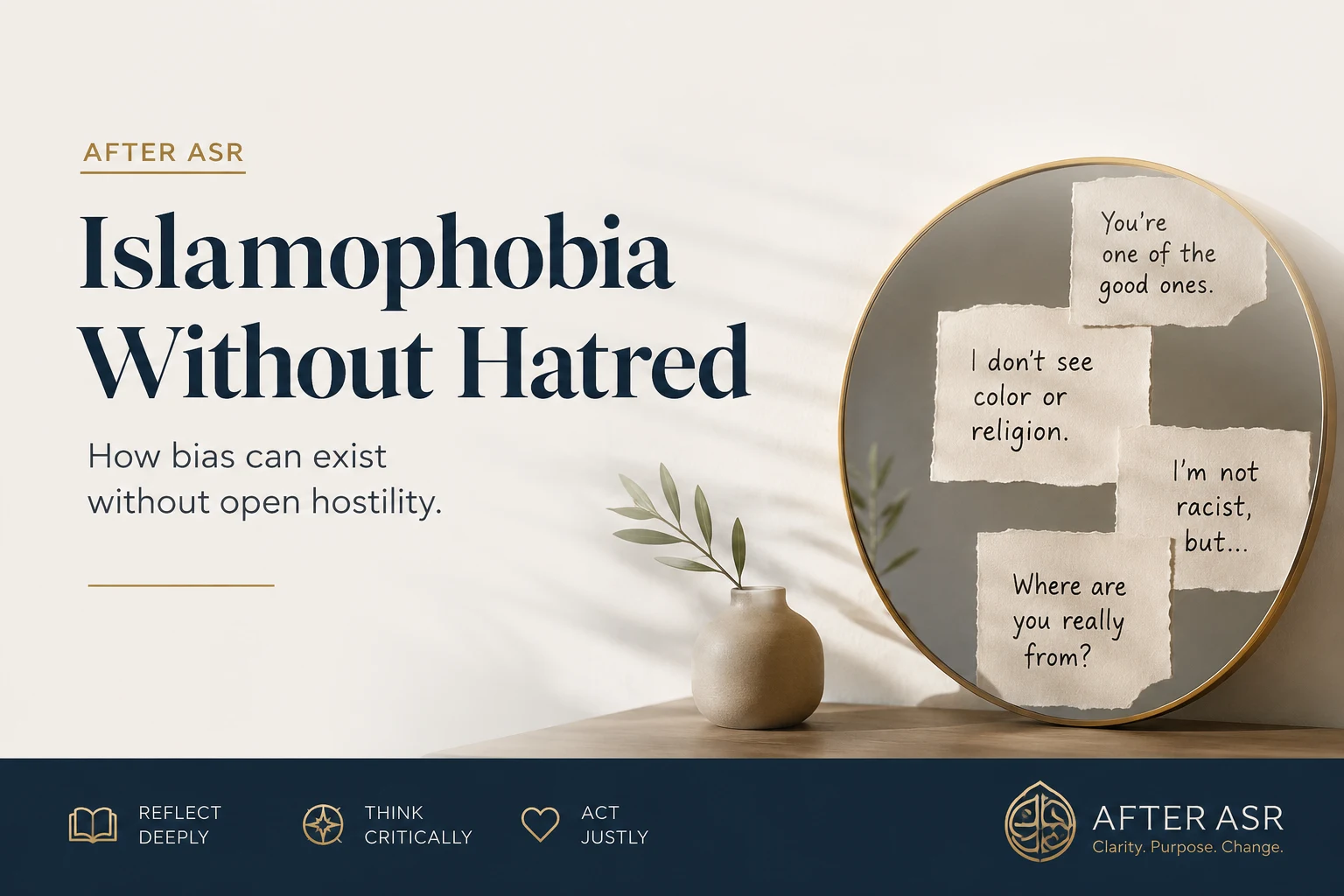
How bias can exist without open hostility.
Islamophobia does not always arrive shouting.
It does not always use slurs, circulate conspiracy theories, or openly declare that Muslims are unwelcome. Sometimes it speaks politely. Sometimes it appears as concern, caution, professionalism, neutrality, or common sense.
A hiring manager may insist they have nothing against Muslims, while quietly worrying that a hijab-wearing applicant will not “fit the brand.” A neighbor may be perfectly cordial, yet feel uneasy when a mosque is proposed nearby. A school administrator may praise diversity, then treat Muslim religious requests as inconvenient complications. A news consumer may reject obvious bigotry, while still assuming that a Muslim name in a headline signals something ominous.
No hatred is confessed. No hostility is proudly claimed.
And yet, bias is still doing its work.
The Mistake of Looking Only for Malice
Public conversations about prejudice often focus on the most visible forms: insults, vandalism, threats, exclusionary slogans, and openly discriminatory behavior. These deserve attention. They are real, harmful, and often easier to identify.
But they can also create a false standard.
If prejudice is imagined only as conscious hatred, then many people conclude that they cannot possibly participate in it. They do not despise Muslims. They have Muslim coworkers. They might donate after a mosque attack. They would never say something openly cruel.
Therefore, they assume, Islamophobia has nothing to do with them.
This is one of bias’s most effective hiding places.
Prejudice does not always require emotional hatred. It can exist through assumptions, reflexes, institutional habits, selective empathy, uneven standards, and the quiet distribution of trust and suspicion.
A person may sincerely reject hate while still perceiving Muslims through inherited stereotypes.
Suspicion Without Animus
Consider the difference between dislike and suspicion.
Dislike is often personal. Suspicion can be structural.
Someone may not dislike Muslims at all, yet still believe that Muslim political candidates deserve extra scrutiny, that Muslim charities require closer monitoring, that Muslim immigrants pose unusual cultural challenges, or that Muslim religious observance signals a deeper rigidity not assumed of others.
These beliefs may be expressed calmly. They may be framed as prudence rather than prejudice. They may even be defended as reluctant conclusions by people who think of themselves as fair-minded.
But when one group is repeatedly treated as more questionable, more culturally problematic, or more in need of proving itself, bias is present whether anger accompanies it or not.
Islamophobia without hatred often takes the form of default doubt.
Muslims are not openly condemned. They are simply trusted less.
The Polite Language of Exclusion
Bias that wants to remain respectable often avoids blunt language. It does not say, “We do not want Muslims here.” It says:
- “This may not be the right environment.”
- “We are concerned about community tensions.”
- “We need to think about public comfort.”
- “We support religious freedom, but there must be limits.”
- “It is not about Islam, it is about integration.”
Some of these statements can be legitimate in specific contexts. Language alone does not prove prejudice. But patterns matter. When such concerns appear disproportionately around Muslims, they begin to reveal something deeper.
A mosque project becomes a debate about parking, traffic, safety, neighborhood character, and property values in ways that similar developments may not. A Muslim employee’s prayer request becomes a question of operational burden, while other accommodations are handled more generously. A Muslim student’s religious expression becomes a disciplinary concern because it is interpreted through anxiety rather than normal institutional flexibility.
No one needs to say “Muslims are inferior” for Muslims to receive inferior treatment.
Bias Can Wear the Mask of Neutrality
Some of the most consequential forms of Islamophobia do not present themselves as anti-Muslim at all. They present themselves as neutral rules.
A workplace may ban “visible political or religious symbols” in the name of consistency, while the rule predictably affects hijab-wearing Muslim women more than nearly anyone else. A security policy may claim to be behavior-based, while employees and travelers with Muslim names, Arabic language materials, or visible religious markers experience its burdens more often. A school may prohibit certain forms of religious accommodation under a general policy that sounds evenly applied but lands unevenly in practice.
This is why outcomes matter alongside intentions.
A policy does not need to mention Muslims in order to disproportionately constrain Muslim life. An institution does not need to be animated by hatred in order to reproduce bias.
Neutrality can become a shield when no one asks who is carrying the cost.
“I Treat Everyone the Same” Is Not Always Fairness
One common defense against recognizing bias is the claim of equal treatment.
“I treat everyone the same.”
The phrase sounds principled. Sometimes it is. But in practice, treating everyone identically can become a way of ignoring meaningful differences in need, context, and burden.
A school that schedules a major examination during Eid and refuses adjustment may insist it is treating all students equally. An employer who resists reasonable prayer accommodations may say no one receives special treatment. A public institution that designs policy around majority norms may claim impartiality simply because it never paused to consider anyone else.
Equal treatment is not always equitable treatment.
When Muslim religious life is treated as a deviation from the norm rather than one part of a plural society, the result may be exclusion without hostility. The institution does not announce anti-Muslim feeling. It simply builds around assumptions that leave Muslims at the margins.
That is still consequential.
Familiarity Does Not Eliminate Bias
People sometimes cite personal relationships as proof that they cannot hold anti-Muslim bias.
“I have Muslim friends.”
“I work with Muslims.”
“My doctor is Muslim.”
These relationships may be sincere and meaningful. But they do not automatically erase broader assumptions. A person can be warm toward individual Muslims while maintaining suspicion about Muslims as a group. They can admire a colleague and still support policies that burden Muslim communities. They can welcome one Muslim who feels familiar and remain wary of Muslims who appear more visibly religious or politically outspoken.
Prejudice often survives by creating exceptions.
The friendly Muslim becomes “not like the others.” The competent Muslim is praised for being “moderate.” The Muslim who conforms to existing comfort is embraced, while the Muslim who makes visible demands on public life is seen as difficult.
Affection toward individuals does not necessarily correct the deeper frame through which a group is judged.
The Burden of Being Read Symbolically
One of the quieter effects of Islamophobia is that Muslims are often interpreted before they are encountered.
A beard is read politically. A hijab is read ideologically. Arabic is read suspiciously. A mosque is read as a statement. A Muslim public figure is read not only as an individual, but as a representative of Islam itself.
This symbolic burden is not always imposed with malice. Sometimes it comes from ignorance. Sometimes from overexposure to narrow media narratives. Sometimes from a genuine lack of familiarity with Muslim life.
But the effect remains.
Muslims are denied ordinariness. Their presence acquires additional meaning that they did not choose. They are made to carry questions, anxieties, and associations that others are not asked to bear.
Bias without hatred often sounds like curiosity but functions like scrutiny.
When Caution Becomes Unequal
Caution is not inherently prejudiced. Institutions need safety protocols. Communities can ask questions. Employers can make judgments. Governments can investigate threats.
The problem begins when caution settles disproportionately on one group and becomes self-justifying.
If Muslims are routinely viewed through the lens of possible extremism, even in contexts where no evidence warrants it, then caution has become bias. If a Muslim-led organization faces reputational suspicion that comparable organizations do not, then caution has become bias. If a Muslim student’s political views are interpreted as potentially radical in ways that similar views from others are not, then caution has become bias.
Islamophobia without hatred often insists that it is merely being careful.
But carefulness that consistently burdens the same people is not neutral. It is patterned.
Good Intentions Do Not Cancel Harm
Many people who participate in subtle Islamophobia would be genuinely upset to be accused of prejudice. They may see themselves as tolerant, thoughtful, even protective of minority rights. Their intentions may be decent.
Intentions matter. They help us understand people and invite correction rather than immediate condemnation.
But intentions do not erase effects.
A teacher who repeatedly misreads Muslim students through stereotypes can undermine them without wishing them harm. A journalist who frames every Muslim story through conflict may distort public perception without imagining themselves biased. A policymaker who overlooks how a regulation affects Muslim religious life can create exclusion without ever intending discrimination.
Harm does not vanish because it was unintended.
In fact, some of the most durable forms of prejudice persist precisely because those who sustain them believe their motives are innocent.
Why This Form of Islamophobia Is Harder to Confront
Open hostility is easier to identify. Subtle bias is easier to defend.
A slur can be condemned. A raised eyebrow is harder to litigate. A vandalized mosque is visible. A pattern of unnecessary suspicion is diffuse. A politician who says Muslims should be banned reveals themselves plainly. A committee that endlessly delays a mosque permit through “reasonable concerns” can claim due diligence.
This ambiguity creates a burden for those affected. Muslims may sense they are being treated differently, but struggle to prove it in the language institutions recognize. The bias is rarely announced. It appears in cumulative decisions, repeated hesitations, and standards that seem to tighten whenever Muslim life comes into view.
The absence of a clear villain does not mean the absence of a problem.
It often means the problem has become normal.
Recognizing Bias Before It Hardens
Islamophobia without hatred is not always fixed or malicious. That is precisely why it must be noticed early. People can examine their assumptions. Institutions can review their policies. Journalists can question recurring frames. Employers can notice where “fit” becomes a disguise for familiarity. Communities can ask whether their discomfort is evidence-based or inherited.
Several questions help:
Do Muslims have to prove harmlessness in situations where others are presumed ordinary?
Are Muslim practices treated as unusual burdens rather than manageable features of plural life?
Are concerns about Muslims framed more ominously than comparable concerns about others?
Do policies that appear neutral predictably fall harder on Muslims?
Are individual Muslims praised only when they reassure non-Muslims?
These questions do not require accusation as a first step. They require honesty.
Bias becomes more dangerous when it is allowed to remain unnamed because it does not look like hate.
Conclusion
Islamophobia does not depend on open hostility. It can operate through caution, etiquette, institutional habit, selective suspicion, and the quiet presumption that Muslim presence requires additional explanation.
This does not mean every awkward interaction is prejudice, or every difficult decision is discriminatory. It means that bias should not be defined so narrowly that only its most aggressive forms count.
A society can reject hatred and still harbor unequal assumptions. A person can mean well and still participate in a pattern that burdens Muslims. An institution can speak the language of neutrality while treating Muslim life as an exception to be managed.
Recognizing this is not an exercise in accusation. It is a step toward fairness.
Because the absence of open hatred is not the same as the presence of equal regard.
About the Author
Samira Nasser covers civic belonging, social perception, and the quieter ways prejudice shapes ordinary life, with a focus on Muslim communities in public institutions and culture.


